Showing posts with label general election. Show all posts

07 July 2024

YOU BETTER NOT LOOK DOWN [456]

Sir Keir Starmer's official Prime Ministerial portrait

“Whoso pulleth out this sword from this stone and anvil is the true born King of all Britain.”

The opening spoken passage of Rick Wakeman’s “Arthur” is just about the only part the BBC have not used to introduce their General Election coverage since 1979, but with each seat having been contested contested on the premise of “may the best person win”, a place could surely be found.

I followed this election through my fingers from the moment it began. The unforced errors of Rishi Sunak’s Conservative Party campaign ranged from calling it in the pouring rain, announcing the return of National Service, leaving the D-Day commemorations in France early, through to investigations into party members’ insider knowledge for betting on when the election would take place, and the disputed “£2,094” per household that having a Labour party in government would cost. Having a working state for the cost of a Sky TV subscription, something Sunak counted not having as a deprivation in his childhood, could be a good deal.

While Sir Ed Davey seemingly went on an extreme sports holiday to bring attention to the Liberal Democrats, and Nigel Farage decided we were worth his attention over Donald Trump, all Sir Keir Starmer had to do was remain statesmanlike, talk about returning politics to service, and following through on that once elected... 

Then the election became about keeping transgender women out of women’s spaces, with Starmer saying he thought they shouldn’t be allowed, and offering to meet J.K. Rowling to discuss her concerns, as the de facto leader of the “gender critical” movement, which abjectifies an entire group of people by asserting sex over gender at all costs. Starmer wants there to be a “reset moment” for trans people, removing the toxicity from the national conversation, but I would love to find out how he will do that.

Once again, I tried to watch the election results through the night, expecting the momentum prompted by the exit poll’s prediction of a Labour Party landslide to drive the TV coverage. I had seen enough polls predicting a “supermajority” of five hundred seats for Labour, but I was expecting a result like that seen in 1997, which was 418 Labour seats to the Conservatives’ 165 seats. The exit poll had 410 versus only 131, and while the thirteen forecast seats for the right-wing Reform UK were concerning, this was explained as being due to lack of sampling data, expected to be revised downwards. There was enough to talk about, but the first hour of coverage was dominated by a race to declare the first result. 

I mostly stayed with the BBC’s TV coverage, as ITV and Channel 4 had opted to include former politicians in their core teams – one verbal spar between Alistair Campbell and Nadine Dorries put me off Channel 4 for the night – and ITV had centred its coverage around one massive, visually uninteresting desk. After a full day’s work, and no longer able to keep my eyes open, I wound up retiring to bed at 12.45am, with only six results having been called. I woke up again at 4.40am to Rishi Sunak winning his seat for the Conservatives, but conceding the race – Labour’s Sir Keir Starmer had become Prime Minister, his party eventually winning 412 out of 650 seats, with a total of 33.7% of votes cast, on a 60% turnout.

What the public was voting for appeared not to be Labour, but Not-The-Tories, or Not-The-SNP in Scotland. Tactical or protest voting caused seats previously safe for one party to become more marginal this time around. People punished the Conservative government for leaving the country in a worse condition than when they assumed power in 2010. Meanwhile, some independent candidates won over parties due to specific issues like the war in Gaza. The First Past the Post system rewards the winner, but it means Labour enters Parliament with a shallow voter base.

The biggest protest vote was for Reform UK, the fourth party under which Nigel Farage has run for Parliament, which won five seats despite receiving 14.3% of votes, splitting the right-wing vote with the Conservate Party. If your party gets few seats because most of your candidates came second or third, then of course you could have done better if the rules were different. Changing to a proportional representation system would have benefitted the Liberal Party in 1974, the SDP in 1983, and Reform UK in 2024, but wanting to change the system because it would benefit you specifically is suspect, especially after a referendum in 2011 to change to an “alternate vote” system was, well, voted down.

It is imperative that, for whenever the next election take place, the Conservative Party regains its focus. British politics is usually fought from the centre ground, moving further left or right leaves people behind. Voting for Farage’s parties has been used most effectively as a blunt instrument in previous local, general and European elections, and while Farage talks of professionalising Reform UK, still currently a limited company over which he has the most voting shares, his stated aim of supplanting the Conservatives won’t happen if the Conservatives take his place first.

As for the new Prime Minister, all he needs to do is make our lives better while keeping the noise down. If he does, we might allow him to keep doing it.
24 October 2022

AND IT’S NO GAME [367]


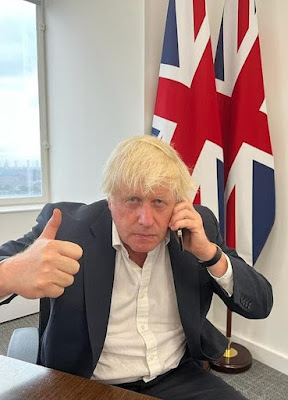
Official photo issued during Johnson campaign

The problem with writing about politics is that events often travel at break-neck speed, so I am not surprised at having eschewed politics as a subject for discussion at all. Give me postmodernism, pens and cars any day, along with any subject that remains evergreen, or slow-moving enough to pin down.

What rendered my previous article about the latest Conservative Party leadership election having been rendered out of date later the same day [link] was the announcement by one candidate that they were withdrawing from a race they never actually said they were standing in, like they had shown up to run the London Marathon with a hand-drawn number, withdrawing after realising whatever time they placed would never be counted.

The assumption made by Boris Johnson, returning from his holiday in the Dominican Republic to pick up from the point he had left in July, speaks of a man who hasn’t been in the country much at all in the intervening time. That he could ask the other two candidates, Rishi Sunak and Penny Mordaunt, to stand aside for him, is spectacularly arrogant – Sunak’s meeting with Johnson ended without agreement, while Mordaunt perhaps won some respect by asking Johnson to step aside for her. It also didn't help that the two photographs taken and issued on Twitter by supporter Lee Anderson MP, of Johnson calling MPs on the phone to secure their support, shows him looking like he is lacking sleep, visibly jet-lagged, or having been hit in the face by a football.

Then the statement he made on Sunday night – the first and last time during the weekend that someone did not speak for him – was delusional: “I have been attracted because I led our party into a massive election victory less than three years ago - and I believe I am therefore uniquely placed to avert a general election now... I believe I am well placed to deliver a Conservative victory in 2024 - and tonight I can confirm that I have cleared the very high hurdle of 102 nominations... and I could put my nomination in tomorrow... There is a very good chance that I would be successful in the election with Conservative Party members - and that I could indeed be back in Downing Street on Friday.”

Once he had placed himself on a pedestal, Johnson paints the portrait: “But in the course of the last days I have sadly come to the conclusion that this would simply not be the right thing to do. You can't govern effectively unless you have a united party in parliament. And though I have reached out to both Rishi [Sunak] and Penny [Mordaunt] - because I hoped that we could come together in the national interest - we have sadly not been able to work out a way of doing this. Therefore I am afraid the best thing is that I do not allow my nomination to go forward and commit my support to whoever succeeds. I believe I have much to offer but I am afraid that this is simply not the right time.”

The other official photo issued

What we have now is a way for Johnson to say, further down the line, “don’t say I didn’t warn you, I’m afraid”, while also still saying he is the only person that can unite the country, based on the General Election result of 2019, before so many other things happened. 

Marina Hyde, writing for “The Guardian”, had pointed out that Cincinnatus, the Roman emperor referenced by Johnson in his resignation speech who returned to his plough, and referenced because he came back and governed again, had only ruled for three more weeks before stepping down, once a plot to usurp power in Rome had been dealt with – his rule being a dictatorship is a fact that will just have to sit there.

Still, the situation means that the spectre of Boris Johnson hangs over the Conservative Party like a bad smell. Rishi Sunak was elected leader on Monday 24th October, after Penny Mordaunt withdrew her candidacy at the last minute, leaving Sunak as the last one standing, and as someone who had only sent out two messages on Twitter during the race, both in reference to Johnson dropping out.

Now that we have the fifth Prime Minister in the last six years, they have to pull their party together before they can hope to pull the country together, and whether the Conservative Party can do the first one, or is they are even willing by this point, is the next question. Popularity polls suggest that calling a General Election would currently be a death wish for the Conservative Party, but it has two years left before one has to be declared anyway. 

I resolve to myself that the General Election, whenever that may be, will be the next time I talk about politics.

07 November 2020

SPANK THE PANK WHO TRY TO DRIVE YOU NUTS [268]


Joe Biden has been elected President of the United States of America, and the world can breathe again. The extraordinary scenes of a country biding its time for five days, agonising as it awaits the outcome of an exercise in both democracy and due process, won’t be seen again for decades. The American people won’t allow their national character to be decided by ballot ever again, and has elected a President that has regard both for himself and the people. With Biden having won both the popular vote and the Electoral College, the victory is that bit sweeter, and that bit more legitimate.

This is a victory for all those made to feel unwelcome in their own country by their leader: the black people brutalised by their police, the immigrants demonised for their otherness, the LGBT people nearly legislated out of existence, and the women objectified and abused by the people that think they are there for the taking. Kamala Harris is, symbolically and in reality, a more qualified Vice President than the moralising ignorance of Mike Pence, let alone a President that flouted and ridiculed his own administration’s advice on coronavirus, only to get it himself.

The vote counters in Pennsylvania, Georgia, Arizona, North Carolina, Nevada and Alaska deserve applause for their days of hard work in the light of the largest turnout in over a century, and the increased absentee ballots due to the Covid-19 pandemic.

I once helped count the votes in a UK general election, for the Gosport constituency in 2005, which chose my Member of Parliament. I remember being told that you don’t have to answer the poll observers’ questions, as they stood over you, trying to tally who voted for their side, because your job is to make sure the count is done correctly – we recounted some batches of ballots if any inconsistency was found. Six hours later, and with over forty-three thousand votes counted, we could go home. If I’ve lost sleep just watching the US elections this time around, I couldn’t imagine having to wake up to go back to the convention centre to continue counting, but it just underscores how important the whole exercise of democracy is to be treated.

Joe Biden conducted himself the best following election day, guiding the tone for the country as it waited for the time when the result becomes final, and when he could legitimately claim to be the winner. I don’t know too much about Biden, apart from his serving as Barack Obama’s vice president, and for making occasional gaffes that reveal the regular guy under the politician exterior, but he proved himself as Vice President, and actually appears be human, which is enough. Living in the United Kingdom is no excuse for not following the US General Election results, especially when your country’s post-Brexit future may depend in part on what the winner is prepared to accept or offer, but I am assured that Joe Biden will consider what is best for everyone before making a deal with the UK, not only what is best for him personally.


Elsewhere Donald Trump, a man that makes gold look cheap, while looking and sounding like a drag queen version of his younger self, sequestered himself in the White House to feed from the conspiracy theories concocted about the count, attempting to convert them to fact by writing them out on Twitter, breaking their terms of service one more time. Perhaps his repeated claims of “fraud,” that Biden “stole” the election, votes being counted “illegally,” and the media deciding the election ahead of time, is all the nuance he can muster. With Twitter having decided to remove his “newsworthy individual” privileges the moment he stops being President, expect Trump's malicious and indiscriminate account to disappear very quickly, as he faces the world without Presidential immunity.

In November 2016 [link], I said that the holder of the office of President “cannot afford to be given the benefit of the doubt, especially when Trump has never appeared to need it before. He will be given the opportunity to govern in the way he sees fit, but he will be under constant scrutiny, for every single decision, for every public utterance, for the rest of his life.”

For Donald John Trump, that scrutiny will only intensify. What I had not expected is how half-arsed a leader he turned out to be. “Let’s Make America Great Again” was Ronald Reagan’s campaign slogan in 1980, and later used in speeches by Bill Clinton in 1992, so it doesn’t take much imagination for the real estate heir, taking advantage of Reaganomics and tax breaks, to copy the words, remove the inclusivity of “let’s,” and make it into a catch-all dog whistle. Trusting only his decisions, there is no history to learn, no precedent to observe, no dignity worth honouring.

Meanwhile, the politicians and White House staff that aided and abetted him have been a revolving door of “Dick Tracy” villains that either ended up in jail or wrote a memoir. Perhaps your experience of life is tainted when the only people that come close to you will eventually sell you out for profit, but when you define your life by the deals you make, you can’t reasonably expect fealty from anyone.

Posted to the telephone cabinet at the end of my street in 2018... in the UK...

What I am most wary about, despite Biden’s victory, is that over seventy million Americans still voted for Trump. This has already been indicated as meaning that neither Trump, or Trumpism, is going away, and that his political conduct over the previous four years has effectively been endorsed - his associates, acolytes, or even his family, may try to replicate the same disregard for America’s institutions and rules, with the expectation of a similar level of success. Talk of the United States being as divided as during the Civil War may subside, but it may leave a new Confederacy-style grievance in place, if Trump's die-hard followers try to turn "America First" and "Make America Great Again" into a new "lost cause." The next four years will be difficult, but Joe Biden already knew that.

Between now and 20th January 2021, Trump and his staff will most likely continue to obfuscate the election results, spread disinformation, and use all the tricks they can to pull off the win that exists in his head. But there is a word for that, a Middle English word derived from the Old French “tromper” (“deceive”), and meaning either attractive articles of little value or use, or something that is showy or worthless: “trumpery.”

The news cycle will not quiet down yet, but it’s nice to know it could. But for now, Joe Biden won, and a lot of people are saying the big stupid low-energy bully Donald Trump (never met him) is a loser, and a nasty, terrible person, the likes of which you’ve never seen before - everybody’s talking about it, that’s just what I had heard, a lot of people tell me. It’s very sad - he just took no responsibility at all.

...and in 2020.

15 December 2019

WE’RE ALL GONNA ROCK TO THE RULES THAT I MAKE [211]


It is unlike me not to engage with politics, or to even follow it, as my writing here attests, but when it came to the 2019 General Election, and the inevitability of a Conservative win in order to end the deadlock over Brexit, I switched off very quickly. I received my postal vote nearly three weeks before the day of the election, and put the completed vote through my town hall’s letterbox hours before the Conservative Party announced their manifesto. Once the exit poll was declared at 10pm on Thursday 12thDecember, declaring a Tory victory by 80-plus seats, I lasted fifteen more minutes before needing to watch something else – I missed the election-night tradition of looking into the counting taking place at the UK’s enormous variety of sports halls.

I consider myself politically to be slightly left of the centre, meaning I usually vote for a different party with each election, but never the right-wing Conservatives. Then again, my home town has had a Conservative MP since at least 1835 – only three different MPs have represented the area in the last seventy years, and the latest one, coming up on their tenth anniversary, just increased their majority. My dissenting vote made as much difference as it would by eating it, or setting it on fire. 

At that point in the election campaign, the Conservatives had already put out a misleading social media ad, making it look like Labour’s Sir Keir Starmer could not answer a question on “Good Morning Britain,” and Conservative Central HQ’s Twitter page was renamed “Fact Check UK” during a TV debate. These sleights of hand are what you are used to looking out for on social media anyway, and have been part of election campaigns since the invention of posters, let alone radio or television. As a film scholar, I was particularly offended by the Starmer ad being described by James Cleverly, the unfortunately-named Conservative Party chairman as having been “edited” instead of “doctored,” as if I wasn’t reading it properly – I hope he has accidentally stepped on a Lego brick since then.

Having afforded myself the relative luxury at looking at the election campaign after having voted, I personally do not believe that the Conservatives won due to the ongoing Brexit issue, or on public services, or in comparison to how bad the Labour or Liberal Democrat campaigns went: it was because the Conservatives were so pervasive in the discourse of the election, and that came from everyone, not just the media. They ran the clearest, if least detailed campaign: “Get Brexit Done,” then some other things. They had the least robotic leader – Boris Johnson looks like a child’s drawing of his brother Jo. They had the least overlap between themselves and the other parties, with all parties in competition with them.

However, I am perturbed by the talk following the election about how Boris Johnson will now govern as Prime Minister. Yes, he will not have to pander to the right-wing of his party, or towards the centrist MPs that lost the party whip during the last Parliament, and now their seats. Having won so many seats in the north of England, traditionally Labour territory, what effect will this now have on decision making? Shouldn’t we have had more of an idea of Johnson’s attempt during the campaign, where he was seen as having evaded questions, mainly by evading his being interviewed? Perhaps, we have heard little since because he is still working it out. The certainty over Brexit appears to be over – the UK is leaving the European Union or not, regardless over whether I think the question should have been asked or now, but what happens after that is another question, when there really shouldn’t be a question.

09 June 2017

YOU AND ME TOGETHER, YOUNG AND STRONG [59]


Well, that wasn’t meant to happen, apparently.
I had intended to write about the general election results, particularly about attempting to sit through the overnight coverage. For those non-football fans, with no cup finals or play-offs to pore over, the general election is my equivalent of the World Cup Final, or the Super Bowl, and the results programmes have developed to match that – the exit poll, battles in key marginals, the swingometer, and so on. Grace Wyndham Goldie, the BBC producer that created the first TV election results programme, in 1950, really was on to something, even if she had to fight engineers believing that broadcasting beyond midnight could damage the BBC’s electrical equipment.
So, um, yeah, my original idea was going to be something a bit light-hearted, talking about how we have a major TV event built around our democracy, mixed in with detail on how I tried to stay awake to watch it all… then the result of the exit poll came in, claiming a hung parliament, with the Conservatives as the largest party, but falling short of a majority of seats. Because the poll was wrong in 2015, predicting another hung parliament instead of a small Tory majority, the immediate reaction was to say that all options are still open, because it contradicted everything said in the campaign up to now.

From the moment the election was called by Theresa May, the belief was the Conservative Party would have an increased majority in the House of Commons – because the Labour Party, under Jeremy Corbyn, was always seen as divided between its party’s supporters and the leader’s supporters, the Conservatives may even cause a landslide. Many right-wing-leaning newspapers called the election a Tory win, which was to be expected, but because that included the “Daily Mail” and “The Sun,” this dictated the direction, and the noise, of the narrative.
The reason for calling the election has now also been called into question. Despite fixed-term parliaments having been introduced in 2010, it is the Prime Minister’s prerogative to call a general election whenever they like, but they should only do that if they are definitely sure they are going to win. The resulting vote in the Commons to have an election now could have resulted in an election not happening, but everyone else was sure they should have an election now, because they all had their own reasons – calling an election over Brexit alone, as Theresa May had done, was never a realistic possibility.
So, now what? Which party can form a government? What solidity of Brexit – hard or soft – will we get now? Could Jeremy Corbyn be the next Prime Minister? Could Boris Johnson be the next Prime Minister? Well, what we do know is this – turnout among 18-24 year-olds could be as high as 72%, up from 43% in 2015, and 38% in 2005, so whoever does wind up in government really will have to govern for everyone.