Showing posts with label bbc one. Show all posts

24 August 2025

ONE, ONE, ONE, ONE, ONE [508]


Aside from when, in 2011, host Matt Baker asked then Prime Minister David Cameron “how on Earth do you sleep at night?”, because he sincerely wanted to know, the defining moment of “The One Show” was in its Wednesday 27th September 2017 episode where Mel Brooks, of all people, started saying, “what a crazy show this is”, confounded by a show that, after all the attempts made on British television to replicate American chat shows, has proven to be the one show that worked.

“The One Show” began on BBC One in 2006 as a continuation of the old current affairs series “Nationwide”, but is more like an adult version of “Blue Peter”, covering various consumer items and colourful, interesting stories from around the UK, bridging the gap on weeknights between the regional news and the rest of the evening’s viewing. After a pilot run of shows in Birmingham, it moved to west London in 2007, then in 2014 to BBC Broadcasting House, just off Oxford Street, increasing its ability to attract big-name guests talking about their current projects, but not at the expense of the show’s existing mix of items, gaining it a reputation for varying degrees of randomness in its subjects, and the occasional handbrake turn in tone.

This makes sense for me. I watch “The One Show” every day, and I never usually watch other chat shows as a result. The usual go-round of promotions means you will see people talking about their projects in multiple places, and to that end, both “The One Show” and the weekly “The Graham Norton Show” usually bring out all their guests at once to increase engagement. Perhaps, with most high-profile people having their own podcast, they don’t need the likes of a Michael Parkinson, Terry Wogan or Johnny Carson to open them up for the public. If anything, being interviewed on “The One Show” means having to compete with the stories brought by the show itself.

Back to 2017, “The One Show” had gone from talking to Mel Brooks about his stage adaptation of “Young Frankenstein”, to picking up a story about someone named Patricia, who was trying to find a lost relative. Alongside Brooks was, of course, Russell Crowe, there to perform with his band as well as talk about his career; and Lesley Joseph and Ross Noble, who were starring in “Young Frankenstein”. Said Matt Baker, “we just turn the page and move on,” while co-host Alex Jones joking said, “right, now let’s focus Patricia now, alright?” Replied Brooks, “this is nuts, I want you to understand that.” The same episode included items about picking up rubbish from motorways, an award ceremony for vending machines, and finding manta rays off the Hebrides. 

Admittedly, this episode of “The One Show” was an hour in length, as it normally shoves this much material into half that time – the most recent broadcast, on Thursday 21st August 2025, had actors Brian Cox and James Norton in the studio, but also filmed and live pieces ahead of the Women’s Rugby World Cup, and the unveiling of the latest “Strictly Come Dancing” contestant.

However, “The One Show” has answered the question that eluded British television for years: how to have a nightly chat show, particularly in the form presented in the United States by the likes of Johnny Carson, Jay Leno, David Letterman and Stephen Colbert. There have been recent efforts, like ITV’s “The Nightly Show”, that only lasted for two months in 2017, and “V Graham Norton”, lasting for eighteen months on Channel 4 in 2002-03, before Norton moved to the BBC for a weekly show that is currently only broadcast for half the year. “The Jack Docherty Show”, which launched with Channel 5 in 1997, was the closest these shows came to matching the American formula, with house band, host monologue, sketches and other items before the chat, while coming from a theatre in London’s West End – however, it was cut from five to three episodes after a year. Even when Terry Wogan had his evening chat show on BBC One from 1985-92, it wasn't every night, Tuesdays and Thursdays being taken by "EastEnders" instead.

The only US chat show I see with any regularity, via YouTube, is “The Late Show with Stephen Colbert”, although I have also seen, when they have come up on TV, similar shows hosted by David Letterman, Jay Leno, Craig Ferguson and Conan O’Brien. In all cases, I will tune in for the monologue, then the sketch or further item afterwards – my favourite of these has been Letterman’s “Is This Anything?”, a collection of various circus and vaudeville acts all appearing at once, followed by the phrase, “wow, that was really something!” After that, I usually turn off – the only variation on the standard celebrity interview on any of these shows is the “Colbert Questionert” (pronounced “questionnaire”, to rhyme with “Colbert”), where everyone is asked the same questions to gain insight: window or aisle seat, first concert, apples or oranges, describing themselves in five words.

I guess what I want more are review shows – instead of celebrities talking about what new films, shows or albums are coming soon, I want someone to tell me what they are like. In the meantime, “The One Show” will provide enough time for an interview, before talking about gardening, or the price of electricity bills.

15 September 2024

DID I TELL YOU EVERYTHING IS FINE [466]


I came very late to Al Jarreau’s song “Mornin’”, a quite irrepressibly positive piece of smooth jazz with electric piano and strings, and a hybrid animated and live action video to match. It is very easy on the ear.

On my first listen, my first thought was, “this is a bit Pages from Ceefax, isn’t it?”, which is not as obscure a thought as it sounds. Certainly, David Foster’s original instrumental version of “Mornin’” fits that description completely.

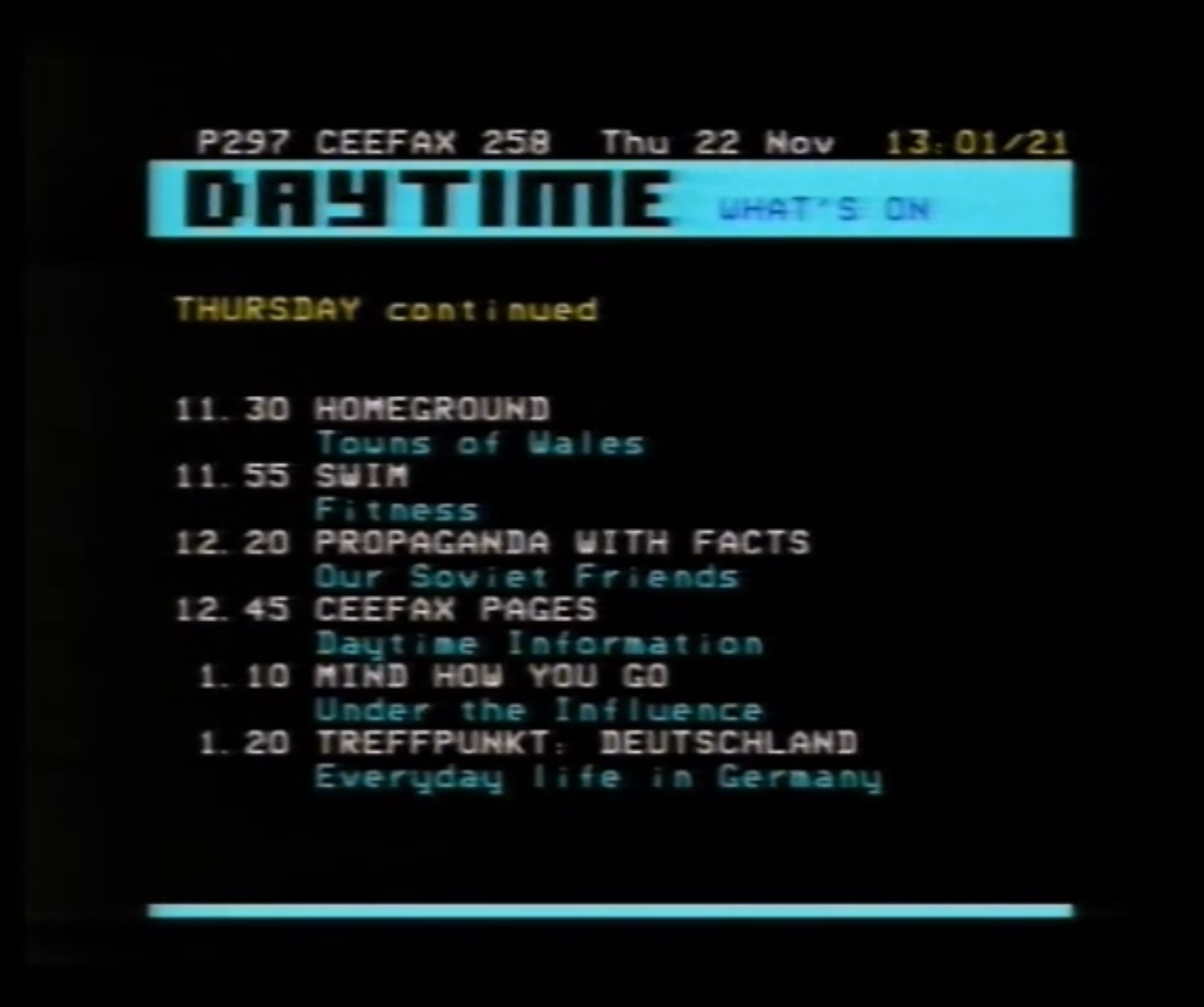
Ceefax, the BBC’s teletext service that began in 1974, was initially only seen by owners of sets capable of decoding that part of the TV signal. Meanwhile, with BBC One and Two only broadcasting a few daytime shows outside of the Open University, schools programmes and live events, a test card and music was played to fill the gaps. From 1980, a rotating series of news, weather and information named “Ceefax in Vision”, later “Pages from Ceefax”, began replacing the test card, while continuing to play music. This arrangement was still seen during the day on BBC television as late as 1990, later relegated to early morning and at the end of the day until the end of analogue TV transmissions closed Ceefax in 2012. 

Being of an age where I would have seen “Pages from Ceefax” during the day, I recognised that the music being played was not often heard elsewhere. Without exception, instrumental tracks were played, i.e. no singing, and they were often light or easy listening in nature, or bland an inoffensive at worst. Until 1988, there were still restrictions on the amount of recorded music being broadcasted in the UK, known as “needletime”, so this music would come from sources either exempt from these rules, like foreign recordings, or by licensing cheaper library and production music.


The “foreign recordings” element was often literal: VHS recordings of “Pages from Ceefax” posted to YouTube don’t often have the music picked up by their content ID system, although I found one 1995 example that used the 1981 album “Flashing” by the Japanese jazz pianist Himiko Kikuchi, or another from 1983 using the 1971 album “Sentimentálna trúbka” by the Slovak American trumpeter Laco Déczi.  However, British musicians and composers would also travel to Germany to record, with renowned library music names like Neil Richardson, Alan Moorhouse, Johnny Pearson and Keith Mansfield appearing under pseudonyms like “The Oscar Brandenburg Orchestra”.


Even at the end of Ceefax in 2012, the BBC were still using library music, this time more recent recordings licensed from Funtastik Music, which to me sounded more stereotypically like the “elevator music” under which the earlier tracks could be classified. Notably, the final song played was “B.A.R.T.”  a commercially-released song by Ruby, a rock band that featured Tom Fogerty of Creedence Clearwater Revival, and better known from being played between gaps in BBC schools programmes. This was more a nod to the end of laid-back presentation that could no longer take place in a time when TV channels need to continuously hold the viewer’s attention – no longer can BBC Two casually open up at 9.30am, warn viewers that coverage of the TUC Conference begins in two minutes, then play “Nifty Digits” by Richard Harvey, as they did on 9th September 1982, according to the YouTube channel that put up the recording.


But the earlier popularity of light music under big bands and jazz performers like Bert Kempfaert and Oscar Peterson, and the later existence of groups like The Test Card Circle point to the continued popularity of music of this type on its own terms, even down to CD reissues of production music albums made by labels like Bruton Music and KPM originally not meant for general sale. In this case, my brain has labelled it by where I heard that kind of music most, therefore as “Pages from Ceefax”.


14 August 2022

EXPRESS YOURSELF, YOU CAN’T BE WRONG [357]


“Sports Report” had read out the classified football results on BBC radio since 1948. “Classified” in this sense appears to be in a measured tone, in descending league order, with voice rising and descending with each club’s fortunes. This formula, replicated by “Final Score” on BBC One, and by Independent Radio News for commercial stations, is ingrained and ritualised across generations of fans, listeners and viewers as the culmination of Saturday football, still mostly played from 3pm, and as a sports equivalent of the Shipping Forecast, itself a methodical yet poetic rendering of information that has taken on an importance in British culture – marking the time of day, a moment of calm, a moment of order, a moment of nostalgia – beyond the information it imparts which, in changing times, is now more readily available in other ways. 

The 2022-23 football season on BBC Radio 5 Live marked the beginning of live commentaries on matches starting at 5.30pm, which resulted in cutting “Sports Report” in half, to half an hour, as previously announced on Monday 25th July. On Saturday 6th August, the first abbreviated edition of the season changed its approach to reading the results, preceding each league roundup with the results for that league, delivered in a faster, more informal tone – the focus on the Premier League meant no other league results would be heard for at least fifteen minutes. 

Because I am British, I have heard the football results read in the “classified” fashion countless times on television, while the results being read where displayed on screen. The one time I remember hearing it on “Sports Report” was not long after former BBC Radio 4 announcer Charlotte Green began reading them in 2013, although I remember her reading being interrupted by goals being reported by another presenter. Whenever I do want to find the football results, which is rare, I will find them online, where I read them in the “classified” way, because that is what you do.

Because I do not really follow sport, I misjudged the ability to manufacture outrage from changing the way in which football results are read out on the radio. On Monday 8th August, Henry Winter, chief football writer for “The Times”, said on Twitter that the classified results “has always been part of the Saturday match-day fabric for many fans. [The BBC’s] decision to scrap the service shows a lack of understanding of fans. It’s about continuity, the pyramid, information…” The story made Tuesday’s front page, an editorial inside describing the change as “an act of cultural vandalism... the BBC’s claim that it no longer has time in its schedules for results that are widely available on television and online, cannot be allowed to stand... There is a value in familiarity that cannot be easily measured. In a world of satellite communications, who really needs the shipping forecast? Yet the BBC would never dare touch it, just as it should have left the classified football results well alone. Or one must hope.”

On Wednesday, “The Times” reported that 86 per cent of readers responding to their own poll believed the classified results are vital to the BBC’s coverage, and former “Sports Report” host Mike Ingham said, “I don’t believe this was a malicious decision. Whoever made it is probably from the age of smartphones. But I believe they will have to reconsider; that they will realise this was an editorial mistake and reverse the decision. It was clearly not thought through.”

Later that day, the BBC issued a statement acknowledging complaints they had received: “We appreciate the strength of feeling towards the classified football results within Sports Report. It’s always difficult when a programme with a special history changes, but there are good reasons for the change... The classifieds were taking around five to seven minutes to read, which would have taken up around a third of the programme – constraining the range of sports we could cover.”

On Thursday, “The Times” reported this on their website as “BBC will not bring back classified results despite hundreds of complaints”, along with other stories putting pressure on the BBC: “Private paid work of BBC broadcasters is revealed” and “Paul O’Grady is latest star to join exodus from Radio 2”. However, their main story reverted to type for the newspaper in recent times: “Hard-left academics ‘plotted gender ID witch-hunt’ on colleagues”.

On Friday, the paper carried another editorial, saying “the BBC should take heed of the outcry over ending the classified check”, along with reporting said outcry from Age UK and the Royal National Institute of Blind People. By this point, I had stopped buying the paper even for research purposes, because subjecting yourself to relentless coverage over something that is, personally, a trivial matter, becomes draining over its continuing insistence of its own importance.

On Saturday 13th August, “Sports Report” proceeded in exactly the same manner as last Saturday. Competing commercial stations TalkSPORT and LBC News formalised their existing results coverage, the former swapping their previous informal tone for the “classified” version, and the latter moving the time of the results to 5.05pm, the time at which Independent Radio News provides them to other stations. The odd one out was also the elephant in the room: News UK, owner of both “The Times” and TalkSPORT, also operate Times Radio, a news and features station set up ostensibly to promote the newspaper, while also in direct competition with BBC Radios 4 and 5 Live and staffed with many former BBC presenters. They did not carry the classified football results on either Saturday, restricting their reporting to the usual sports bulletins.

My only possible answer to all this was to think of horror film sequels: “Exterminator 2, Death Wish 3. Hellraiser II, Friday the 13th Part V. Amityville Horror 2, Scream 2, Pools Panel: Home Win.”

03 April 2022

LET ME ENTERTAIN YOU [338]


BBC One launched a new ident package on Friday 1st April and, having covered the launch of the previous “Oneness” set in 2017, devised and filmed by the photographer Martin Parr [link], it only made sense for me to continue considering television idents and branding like it is public art. From the Channel 4 logo and the “2” used by BBC Two from 1991 to 2018, to the “ITV Creates” initiative employing artists to rebrand ITV channel every week since 2019, few get the chance to create in a space seen so often by so many people, even multiple times in the same evening.

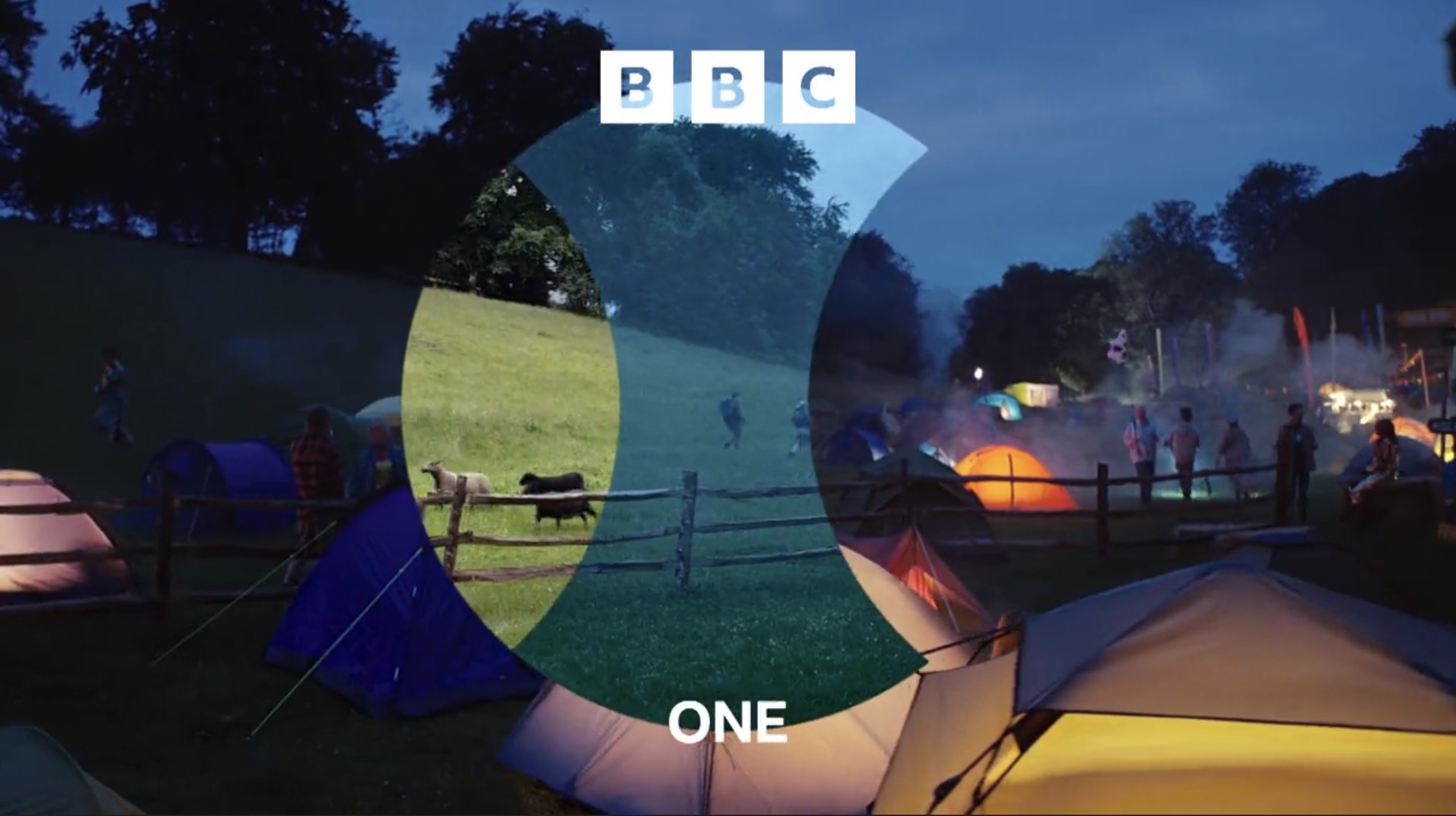
A production of BBC Creative and Man vs. Machine, a visual arts group that has created idents for More4, Film4 and 4seven, in addition to advertisements for KFC, Nike and Apple, the new BBC One idents pan the camera around spaces, seen through a lens to different times of day: a hall hosts children trampolining in one moment, but we see glimpses of a meeting, and preparations for a disco; a field hosts a festival at night, then ramblers, and later sheep herding; a street corner hosts a market stall, then a garage worker’s tea break, followed by a street sweeper; and a brickwork basement hosts skateboarding, with glimpses of a later photo shoot and a rave. 

These are great ideas by themselves, depicting spaces that bring people together, instead of Parr’s “Oneness” idents that just showed people appearing in a space, but each glimpse of a space also has a full ident that will show glimpses of the others within the lens, creating a moment of recognition in the viewer as the idents are repeated, while being a conceit that keeps the idents fresh as new ones are added into the mix.


The ”lens” idents were meant to have been introduced in October 2021, alongside the kinetic BBC blocks logo [link], which left the red circle motif placed between programme trailers as the only clue to their eventual form. BBC One’s idents have used the motif of a circle through the years to symbolise an all-encompassing inclusivity, most literally when a globe of the Earth was the channel’s ident for forty years to 2002, rendered through mechanical models, computer graphics, and as a hot air balloon. 


When your symbol has been that all-encompassing, “picture postcard” films of people in spaces doing things, such as the “Oneness” set, and ITV’s idents during before 2019, are merely holding a mirror to its audience. Fortunately, the focus is back on the channels themselves: BBC One, as Britain’s most popular channel, is reflecting how it is a space where people gather for its programmes, and the “ITV Creates” initiative is intended to emphasise the creative heart of the broadcasting business.


It will be interesting to see how much of an impact BBC One’s glimpses of life through a lens will be, for branding remains key: when BBC Two introduced its “2” logo in 1991, a symbol made into a blade, a rubber duck, a toy car, a garden display, a Dalek and so on, ratings for the channel improved. The programmes had not changed.


24 October 2021

YOU’RE STILL THE ONE [316]

Back in 2017, I wrote about BBC One replacing its channel idents with the “Oneness” series of group portraits, photographed by the artist Martin Parr [link]. I ended that article by saying: “…getting audiences to programmes do not rely on individual channels so much, unless you count the BBC iPlayer or Netflix as a ‘channel.’ For the BBC, Martin Parr’s new idents may be more important for the ’BBC’ on screen, rather than for the ‘One’.”

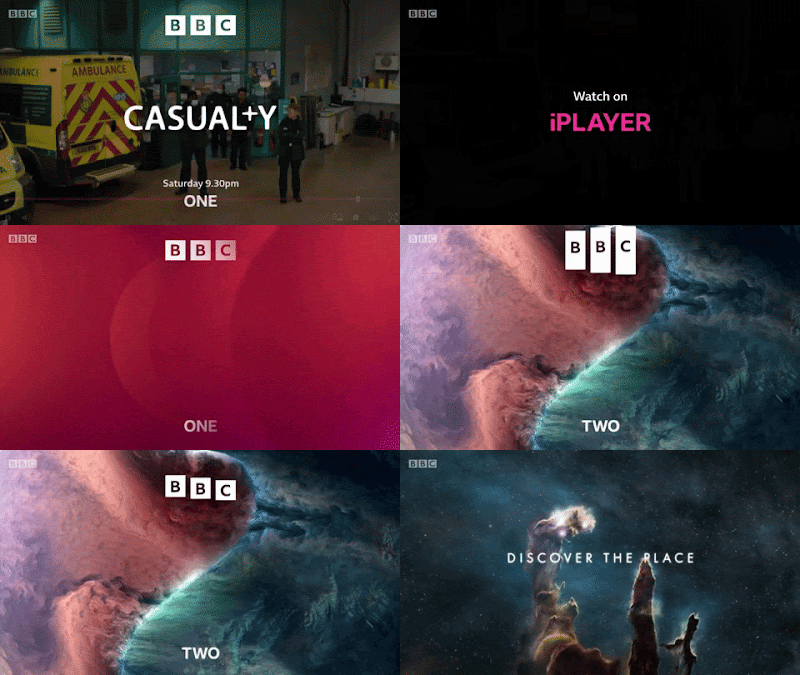
On Wednesday 20th October, the BBC unveiled new branding that placed their restyled logo at the top of screens, programme trailers and poster advertising, and their channel names in smaller letters at the bottom, underlining the inevitability of the move – all programme trailers end with “available on iPlayer,” placed prominently in the middle of the screen, just as “iPlayer” and “Sounds” replaced the “TV” and “Radio” categories on BBC Online. Long gone are the days of simple radio-like announcements over slides of upcoming shows. Moreover, the way the new logo is used highlights, at a fundamental level, the change in how we watch television over the last twenty-four years.

I have always changed my website’s logo and branding when it was needed, as proved by my 300th article showing five logos over five years [link], as I zeroed in on the most effective way of presenting myself and my work. Likewise, the BBC’s logo, a variation of three letters in three boxes since it was first introduced in 1958, has been modified as its uses have changed, from identifying a broadcaster to supporting the quality of British programmes sold worldwide, to being a mark of reputation to sell tie-in merchandise, to being a sigil for a British national identity portrayed through cultural soft power. 

As much as some people search for the opportunity to complain about taxpayers’ money being perceived to have been wasted on a logo change that is still superficially similar to the previous version, you have make changes when your current branding is found to have stopped working effectively. As stated by the BBC’s Chief Customer Officer, Kerris Bright [link], “Our research tells us that audiences think some of our services look old fashioned and out of date. They want a modern BBC that is easier to use and navigate to find the content they love and enjoy.” 

If people in its own country are saying that, then perhaps it was being said elsewhere. The latest BBC logo was introduced in April 2021 on an online streaming service aimed at North America, BBC Select, and on the Australian TV channel BBC Kids, six months before the UK saw it on screen. Because these are subscription services, their audiences are also, indirectly, paying for the new logo. Meanwhile, the latest Cadbury logo, using thinner lines and closer to the company founder’s original signature, was first seen on chocolate bars sold in Australia. 

A big feature of the BBC’s new branding, and one that has been introduced gradually for a couple of years, before reaching the logo, is the font. “Reith,” in its sans serif form, may not immediately be too different from the previous use of Gill Sans to the casual user, but the one-off cost of the BBC buying its own font, to use it as much as it wants, contrasts with the yearly fees to use Gill Sans, Helvetica, Futura and other fonts over the years. I could not find how much the BBC pays to use fonts, but I could also not find out how much Ikea saved in 2009 by switching their shops and catalogues from using Futura to Microsoft’s cheaper font Verdana.


The previous BBC logo was introduced in 1997. The logo that version replaced was deemed not to work when made smaller on screen – the lines under the blocks, and the spaces in the letter B, began to disappear. Its replacement was simplified, easier to reproduce and was more legible on screen.


What has changed since then is the screen. In 1997, people were still watching cathode-ray tube (CRT) televisions, beaming a raster pattern of electrons onto a fluorescent screen. LCD and LED televisions did become commonplace until 2006, when regular HD television broadcasts began in the UK. In 1997, the BBC still played their idents for their channels from laserdisc, with servers not being used until widescreen broadcasts began in 1998. They still only had two channels to worry about – the BBC News Channel began in November 1997, followed by BBC Choice in 1998. Aside from all this, watching television from a non-television screen only properly began when the BBC iPlayer download service began in 2005, only becoming a streaming platform in 2007, the same year Netflix began their own service – the flood of mobile, tablet and other connected devices began from there.


What made me realise this was using the BBC News app in beta mode. I knew about the new logo from the reports of BBC Select introducing it, finding that an upcoming update to the News app will use it. In using it, I found that the logo, placed at the top of my phone’s screen, placed its blocks further apart so they can animate more clearly: swiping down to refresh the page would stretch the blocks before reverting to their correct shape, and they would shrink to lines as I moved down the page, maintaining their presence as a constant reminder. 


I thought this animation was something cute at the time, because it is something you could do on your phone, but I didn’t think it would happen on television. With the blocks making the Channel 4 logo having been broken up and thrown about since it began in 1982, and with a new ident on ITV seemingly every week as part of an artist initiative, it is now time for the BBC to stop being defined by three static, immovable blocks. 


Now, they rarely ever sit: they move in, they fall into place, they move up, down, in and out. Perhaps this could have been done fifty years ago, but when BBC One and Two had idents that were live feeds of clockwork models, it wouldn’t have been practical. It certainly does not feel like the logo of a corporation that is approaching its hundredth anniversary in 2022, but that is entirely the point: this will be the last BBC logo made for a regular television screen, if not for a linear television channel. Next time: holograms, probably.


There is a lot to be said for the triviality of a broadcaster changing its logo, as I have proved, but because of the unique way it is funded, the BBC belongs to everyone, and it represents us all to the rest of the world. I want it to look its best.

25 April 2021

MAGIC MOMENTS [293]

Allow me to take a moment of your time to tell you that, once upon a time, a “moment” was an actual, measurable period of time, equivalent to one minute, thirty seconds. 

From the eighth to the thirteenth century, at a time when people still relied on sundials to tell the time, the writings of the Venerable Bede detailed how hours were broken into four points, named “puncta,” and each of those were made of ten “momenta,” from the Latin for “moving,” as in the word “momentum.” These divisions were made in order to complete various calculations, particularly in astronomy, but would not have been used by the wider public, whose main indicators of time remained sunrise, sunset, and church bells.


This usage fell out of favour when the advent of mechanical clocks in the thirteenth century standardised the length of an hour, no longer reliant on the sun. Counting up to sixty was present in ancient civilisations even before the Babylonians, but it was the Iranian scholar Al-Biruni, in around 1000 AD, who is credited with first describing how to divide hours into minutes, seconds, thirds and fourths. 


Ninety seconds is usually enough time to produce a summary of practically everything you need, particularly of the day’s events. Until recently, BBC One ran a ninety-second news bulletin at 8pm, making it the most-watched bulletin in the country, and even back in the 1970s, WPVI’s “Action News,” Deleware Valley’s leading news programme, capped news stories at ninety seconds both to cram in more stories, and to keep the pace up. I get where they’re coming from.

07 January 2017

IF YOU’RE NOT THE ONE [36]


The first act of 2017 appears to be replacing circling hippos with an aerobics class. After ten years, BBC One has replaced its channel idents, themed around “circles,” evocating the globe logos it used for many years, in favour of snapshots of groups of people, directed by photographer Martin Parr, themed around the idea of “oneness.”
So far, we have just four idents, out of a promised twenty-four – the aerobics class, a group of sea swimmers, and a slightly different version of each one. They are a bit sparse, with no music or sound apart from what is in the scene, and too mundane when compared with what they replaced. There are also too few idents available right now, risking outstaying their welcome by the time the next ones appear.
I thought that enthusiasm for TV idents was just an online pursuit, where you can go into as much detail as you want, but I am no longer sure. I really should know, as this happened before.
The first time I appeared on the radio, said in anticipation of a next time, was on Monday 29th March 2002, when I called Nicky Campbell’s morning show on BBC Radio 5 Live. Earlier that morning, BBC One switched its globe-shaped hot air balloon for “Rhythm and Movement” - groups of people dancing.
One of the idents, filmed at the Minack Theatre in Porthcurno, Cornwall, featured ten ballerinas performing a graceful dance, to the sounds of a string quartet that was led by a cello. This particular ident was described as being “too middle class,” and I called up to point out the sole point is to tell you what channel you are watching. It did sound a bit naïve at the time, but I was let onto Nicky Campbell’s show to say that – I think Nick Knowles was there too.
After making the point that, when I was born, BBC One’s single ident was a turning lime green globe on a blue background, I was thanked for my comments, and the show moved on. They did not discuss the ballet any further, my appearance having killed that conversation stone dead.
TV idents were borne of a time when you physically had to tune your TV to the correct channel, and even then, you were just as likely to have programmes introduced by someone appearing on screen to talk to you. BBC Two continues to show why logos and branding is important, as people are still enjoying watching their older “2” idents, made as early as 1991. Radio jingles fall into the same nostalgia, hoping you remember their frequency – all in the south of Hampshire sing with me now: “One-oh-three-point-two, Power-F-M!”
However, on digital TV, radio and online, where you can simply scan your receiver, and select your viewing from a list, idents are no longer needed – you are already where you need to be. You see more picture postcard-style idents, like those on ITV, and now BBC One, because they reflect their audience, and are easier, and cheaper, to produce.  In addition, getting audiences to programmes do not rely on individual channels so much, unless you count the BBC iPlayer or Netflix as a “channel.” For the BBC, Martin Parr’s new idents may be more important for the “BBC” on screen, rather than for the “One.”