Showing posts with label Bernie Taupin. Show all posts

01 June 2024

AND I WANT ALL YOU’VE GOT [451]


“The Fox” is an album released by Sir Elton John in 1981 that I have overlooked for some time – I own a CD copy of it, but didn’t pay too much attention to it because there are no identifiable “hits” from it that continue to receive airplay, or remain in concert setlists.

This is a shame, because it has completely captured my attention as of late. The three songs that were released as singles all managed to be different from each other: “Chloe” is a soulful song making good use of a Fender electric piano; “Nobody Wins”, originally a French-language song by Jean-Paul Dreau titled “J'Veux de la Tendresse”, is the most synthesised Elton John song I have heard, even down to a busy drum pattern programmed by Roger Linn, presumably on his own Linn LM-1 drum machine; and “Just Like Belgium” is a nostalgic, poppy track not unlike the later “Club at the End of the Street”, down to the blistering saxophone solo. 

These many changes in tone, including the more classical “Carla/Etude – Fanfare” sequence, arranged and co-composed by James Newton Howard, and the unrequited love ballad “Elton’s Song”, evoke earlier double-albums like “Goodbye Yellow Brick Road” and “Blue Moves”, make attempting to capture an artist’s entire range in only eleven songs and forty-six minutes an experience that requires maximum attention, with some breaks.

But what I discovered were two further songs that, while they remained album tracks, are exactly the sort of gospel-tinged barnstormers that have firmly lodged themselves in my mind from the moment I heard them: “Heels of the Wind” and “Breaking Down Barriers”. The latter of these is on its way to becoming one of my favourite Elton John songs, having a drive not unlike “The Bitch is Back” or “Bite Your Lip (Get Up and Dance!)”,and having the classic Elton John Band line-up of drummer Nigel Olsson and bassist Dee Murray, while still featuring John singing in his higher register, with falsetto as the song fades out. “Breaking Down Barriers” has lyrics by Gary Osborne, instead of John’s soul-mate collaborator Bernie Taupin, but they are perfect: “you have shown me a better way, and now I’m learning fast”,  and “I’m taking down barriers, and loving what I find”. 


“The Fox” was the first Elton John release under a US contract with Geffen Records – when John asked David Geffen about calling the album “The Fox”, he asked that a song be written for it with that title. This fact comes from a “telepress conference” for the album in 1981, which was presented as a daytime chat show presented by John himself, taking every opportunity to perform to the camera, while also keeping the show together as host, his “guests” being producers and marketing managers for Geffen Records. The tableau of desk, TV and stuffed fox that make the album cover were recreated for the occasion, the fox making its way to John’s desk. 

Intended for internal use and distributed on video tape to regional offices of Warner Bros. Records, distributors of the album, a copy of the conference has made its way to the repository of YouTube to give a valuable insight into how important this album was for the entire chain of command from artist to commercial staff.

What has also made its way to YouTube on 22nd May 2024 were the videos for every song on “The Fox”. Separate videos for “Nobody Wins” and “Elton’s Song” had been available for a while, but they formed part of a whole work titled “Visions”, released on VHS cassette, laserdisc and CED video disc in 1982. There is an apparently a wraparound element to the videos where someone is watching them, but the songs are presented on video individually. “Visions” was not re-released after 1982, so to see these videos essentially for the first time, and in high quality, is like filling in a gap in the history of music videos. You do see some elements, like backdrops, being re-used across the different videos, but they are all different from each other, and not simply a recording of a performance. They are directed by Russell Mulcahy, whose video for The Buggles’ “Video Killed the Radio Star” ushered in MTV, and continued directing for Elton John, and Duran Duran, through the decade. 

What I was most surprised about by “Visions” was, like the conference video, John’s performances to camera – in the comedic video for “Heels of the Wind”, I kept thinking I was watching Rick Moranis. However, you can’t help but compare these with John’s later avoidance from appearing in videos altogether.

23 July 2023

I WAS TEALBY ABBEY THEN [406]


Sir Elton John has been a constant and welcome presence in popular culture for over fifty years because he is seen as honest, genuine and emotionally complex as the songs he and Bernie Taupin have written since 1967, and we have responded in kind: “Your Song” is everybody’s song, his speaking about his sexuality helped change public attitudes, and he’s now been in the public eye longer wearing a wig than not, and we still don’t care.

Having not engaged in the sort of alternate persona building or avantgarde soundscapes that became expected with each new David Bowie album, an Elton John album has sweeping ballads, or barnstorming rock standards, with chords influenced by gospel, all coming from the minds of two people who found their Georgia located north of Wembley. 

This is why I’m still bemused by “Regimental Sgt. Zippo”, having only just become aware of its existence. The first Elton John album was a psychedelic rock album inspired more by The Beatles, Jimi Hendrix and Procul Harum than Little Richard or Jerry Lee Lewis, with heavy organ and harpsichord forming the album’s sound as much as piano. Recorded between November 1967 and May 1968, the album was ultimately shelved - some songs were released in a box set in 2018, with the full album not seeing the light of day until July 2021.

The title track is the sticking point. John started recording this album six months after the release of The Beatles’ “Sgt. Pepper’s Lonely Hearts Club Band”, and the same month as their single of “Hello, Goodbye” and “I Am the Walrus”. “Regimental Sgt. Zippo” is evocative of that period, when that heavier, psychedelic sound was prevailing in pop music, and can subsequently be folded into any playlist of music from that period, its being an Elton John album making it a novelty. To that end, I latched on to the heavier sound of “Nina” as making it the best song on the album, followed by the title track, with the more frivolous sound of “When I Was Tealby Abbey” being welcome. For an album that would have been released in 1968, there had to be songs titled “Angel Tree” and “A Dandelion Dies in the Wind”.

For me, the weak points were “Turn to Me” and “Sitting Doing Nothing”, sounding more like standard pop songs, the former sounding like it could have been written by anyone. The curiosity of “Sitting Doing Nothing” is its rarity as a song with Elton John lyrics, with music by producer Caleb Quaye - a nice little poem about being told you are lazy by people who wished they were as free as you are, the melody makes it sound simpler still.

At the time of the album’s recording, John and Taupin were staff songwriters for Dick James Music, cranking out songs on demand for clients - Taupin was given an hour for lyrics, and John just thirty minutes for the music. These songs feel like they were written under these conditions, meeting the moment rather than making it. With John having a parallel career at the time as a session musician, backing vocalist and anonymous performer of cover versions on cheap compilation albums, having your own album is the inevitable next step, but not with these songs. 

The first released Elton John album is “Empty Sky”, released in June 1969, and while I previously put its sound down to having been released that year – more progressive rock than psychedelic, more harpsichord than organ, and John and Taupin directed to write more for themselves – it now sounds like a bridge between “Regimental Sgt. Zippo”, which has the same band, and the first “proper” Elton John album, the self-titled 1970 release that includes “Your Song”, “Border Song” and “Take Me to the Pilot”. This third album, and most people’s first encounter with Elton John, properly displayed John’s and Taupin’s own voice as songwriters, which belied its origin as a sampler for those songs more than a proper album, and John’s confidence as a singer that saw him break the United States before the UK. That’s what you get for being yourself. 

09 June 2019

IT’S THE WAY THAT I MOVE, THE THINGS THAT I DO [179]


This article is rated “15,” or “R,” for infrequent strong language.
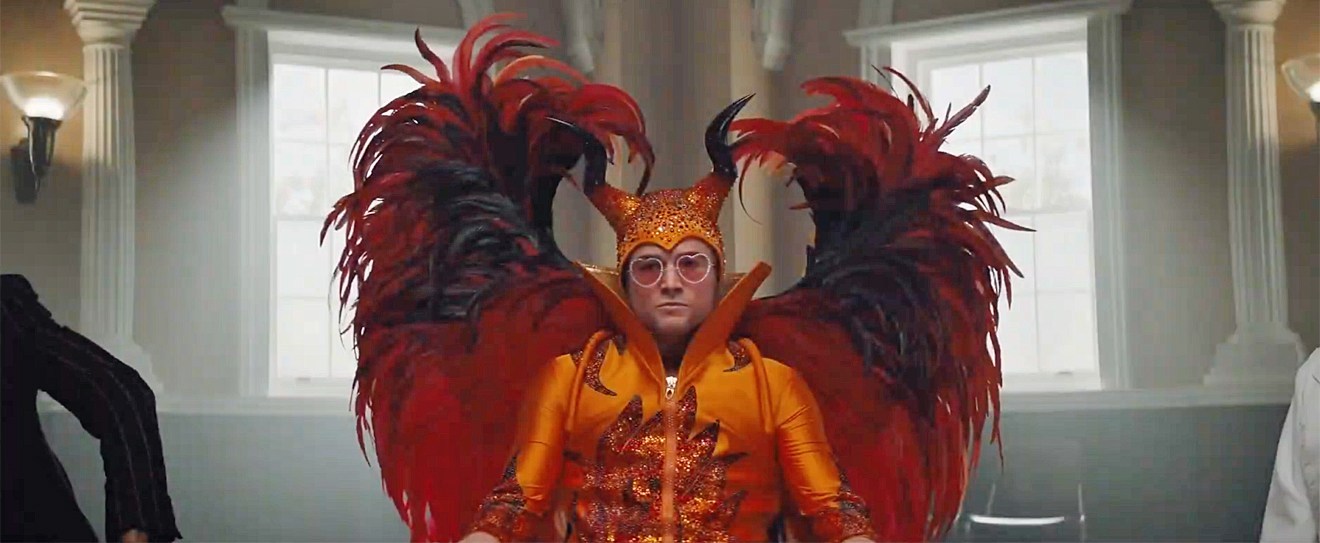
Sorry “Avengers” fans, “Rocketman” is the best film of 2019 so far. I did not expect Dexter Fletcher to channel the spirit of Ken Russell, director of musicals like “Tommy” and “Lisztomania,” into portraying the life of Elton John, when a straightforward biopic could have been enough. Moreover, Taron Egerton balances his portrayal of John amazingly, as both an introvert and extrovert, hero and villain of John’s own story, all while doing his own singing – you’ll believe a man can fly, while performing “Crocodile Rock.”
Elton John has lived a life of darkness and light, success and excess like few others have, or wanted, most remarkably emerging from it all, to enjoy and build on the legacy that his and Bernie Taupin’s songs have given us all. “Rocketman” could have whitewashed the sex and drugs from his life, but with its hero bankrolling the production of a “true fantasy,” as the poster says, John has taken responsibility for his past, his addictions and broken relationships, without trying to moralise on our behalf. His third-act break-up with himself, and his own rescue, is heroic, befitting a man who chose the middle name “Hercules.”
Writing for “The Observer,” Elton John explains the tone of “Rocketman” was established by videos produced by David LaChapelle for his Las Vegas show, “The Red Piano.” Most notably, a real-life half-hearted suicide bid, involving an oven in a kitchen with an open window, is reproduced by LaChapelle for “Someone Saved My Life Tonight,” a song based in that time of John’s life. When much of your biography is public knowledge anyway, there is little reason to shy away from it.

The standout line from the article was this: “Some studios wanted to tone down the sex and drugs so the film would get a PG-13 rating. But I haven’t led a PG-13 rated life.” The film bounced around many studios before arriving at Paramount, and the extra clout of Matthew Vaughan’s production company Marv, responsible for the “Kingsman” series, resulted in a film rated “R” in the United States, and “15” in the UK. But it left me with a big question: Elton John apparently led an “R-rated life,” but don’t we all?

Making films is a reductive process, from choosing what aspects of real life you wish to capture, to the compromises you have to make during production on what is physically, legally and affordably possible. Until 1968 in the United States, and 1985 in the UK, that work would then be subject to censorship, to fit what was morally allowed, until it became more appropriate to provide an advisory rating instead. Yes, the UK has issued ratings since 1912 – “U” for Universal, “A” for Adult, followed by “H” for Horror, later changed to “X” as a compulsory 16+ age limit (18+ from 1970) - but the British Board of Film Censors only properly switched to classifying films once the Video Recordings Act 1984 required them to provide advisory ratings for video tapes.
What has arisen from these classifications is rather odd – when the Motion Picture of Association of America (MPAA) marked its fiftieth anniversary in 2018, it was remarked that 17,202 of the 29,791 films it had rated to that point received an “R,” requiring anyone attending a screening aged under 17 to be accompanied by an adult – only 524 films received the top “X” rating, since renamed “NC-17.” Meanwhile, the number of films receiving a “PG-13” rating is nearly as many as received a “PG” (4,913 to 5,578), even though “PG-13” has only been available as a rating since 1984.

Like the later “12” rating in the UK from 1989, “PG-13” exists as a way of showing a little more of the true grit in life than is allowed under “PG” – brief and discreet sex and nudity, moderate violence that should not dwell on detail, or have emphasis on injury or blood, and strong language can be used in context, though usually only once in practice. Some people act like they have no fucks to give, but really mean that is all they say, but what if you had only one fuck to give? When would be the right moment to deploy it? Meanwhile, I once had a nosebleed that would be rated “R,” or “15,” because I did not have a tissue to catch it, and I had no option but to dwell on it, because I had to clear it up.

Looking at a pile of films in front of me, I can see only a few that required an “18” rating – “The Man Who Fell to Earth,” “They Live,” “Robocop,” and “Myra Breckinridge.” All these require violence (whether physical or sexual), blood, swearing and drug use in one form or another as part of their plots, but that use is appropriate – there is no gratuitous use of these to achieve a higher rating, and nothing that interrupts the plot to provide that kind of content. Perhaps the promotion of the “X” rating for films like “Fritz the Cat” in their advertising – “we’re not rated X for nothin’, baby!” – and the existence of the list of “Video Nasties,” horror films banned in the UK until around twenty years ago, has given the impression that a bar was set to jump over, when the numbers don’t prove that.

In the UK, films recently given an “18” include “Amin,” a French drama which includes a “brief explicit image;” “My Friend the Polish Girl,” which has a “brief strong injury detail;” and “Jonathan Agassi Saved My Life,” a documentary featuring “strong sex, sex references and drug misuse” – it is a documentary about a porn star. Meanwhile, “This One’s For the Ladies,” a documentary about male exotic dancers, appears to have become the first film rated “NC-17” by the MPAA in two years – it is being marketed as the “Uncensored” version, as an R-rated version is also available.

“Rocketman” receives a “restricted” rating because the film shows restraint – it would have been possible to make an 18-rated, or NC-17 version of it. We all show restraint in one form or another – no-one can proclaim they are “uncensored,” because we consider ourselves, and consider each other. This is why censorship, taking that consideration out of our hands, stings so much, such as the Russian release of “Rocketman,” which received five minutes of cuts for sex, drug use and homosexuality – the end text no longer mentions that the film’s producer is married to the film’s subject. Even after those cuts, it still received an “18+” rating, which would have been a “PG-13” or less here. No wonder the production felt hoodwinked by it.

07 December 2017

HAIR RING MOLASSIS ABOUNDING [85]


"Solar Prestige a Gammon” is a song from side A of Elton John’s 1974 album “Caribou.” The album was made under a contract that required John to release two albums per year – “Caribou” came only eight months after his masterpiece, “Goodbye Yellow Brick Road,” and was recorded in only nine days before embarking of a tour of Japan, leaving his producer, Gus Dudgeon, to finish the arrangements and mixing. Despite the rush, the album reached number one in the UK and US, and spawned two singles, “The Bitch is Back,” and “Don’t Let the Sun Go Down on Me.” Dudgeon’s own assessment was: “’Caribou’ is a piece of crap… The sound is the worst, the songs are nowhere, the lyrics weren’t that good, the singing wasn’t all there, the playing wasn’t that great, the production was just plain lousy” – seeing as Dudgeon was in charge of the production, I can only guess this was a case of the creative process not being what you wanted, even if the result was.


“Solar Prestige a Gammon” begins in the manner of a lament, but all is not as it seems: “Oh ma cameo molesting / Kee pa a poorer for tea…” The lyrics, by John’s songwriting partner Bernie Taupin, are sung in a cod-Italian fashion, but are comprised of seemingly random English words. “Cod” is the operative word: “turbert,” “salmon,” “hair ring,” “sardin,” “floundin,” and even “cod” are words used by Taupin, along with “molassis” and “gammon” for those made hungry by the references to fish. The chorus is a shift to a jauntier tome, the lament left behind, because life carries on: “Solar prestige a gammon / Kool kar kyrie kay salmon…” Que sera, sera…


Clearly, the lyrics in this song are supposed to be nonsense, but it is inspired nonsense. John has previously said the initial idea for “Solar Prestige a Gammon” came from the Long Medley on side B of The Beatles’ album “Abbey Road,” most notably John Lennon’s “Sun King”: “Mundo paparazzi mi amore cicce verdi parasol” - in turn, “Sun King” was inspired by Fleetwood Mac’s “Albatross.” The quote from John reads, “I thought it could be great to write a song with English words that didn’t mean a thing, but that sounded fantastic when put together.” It has also been said that the deliberate avoidance of meaning was due to people having read things in Taupin’s previous lyrics that may not have been intentional, like “Madman Across the Water” being about Richard Nixon, religious references in “Border Song” and “Take Me to the Pilot,” and “Grey Seal” being about nothing in particular.
Everything I thought I did hear in “Solar Prestige a Gammon” is an example of the pareidolia I have examined previously [link] – just like you look for faces in inanimate objects, you hear for patterns in music and speech, which have created the system of scales and chords found in Western music, and where the joke surrounding rock bands like Status Quo is there are only three chords, and you know when they are going to appear. Does this mean that any attempt that writing something that is deliberately nonsense is doomed to be made sense of by the next person to come into contact with it? Possibly, so long as there was a reason to do it.