Showing posts with label chrome. Show all posts

13 February 2022

BREAK IT TO ME GENTLY NOW [331]


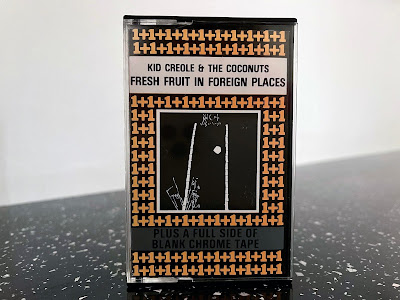
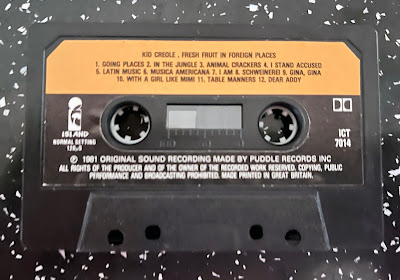
A while ago, I bought a cassette tape in a second-hand shop. It wasn’t for the album on side A, which was “Fresh Fruit in Foreign Places” by Kid Creole & The Coconuts – their most played songs, “Annie I’m Not Your Daddy” and “Stool Pigeon”, are on their following album “Tropical Gangsters” - but more about why side B of the tape was deliberately left blank.

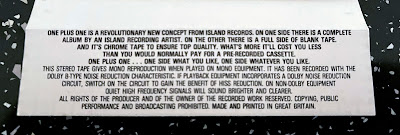
In 1981, Island Records began a series of album releases on cassette titled “1+1”. The inlay card on my album describes it as a “revolutionary new concept… On one side there is a complete album by an Island recording artist. On the other there is a full side of blank tape. And it’s chrome tape to ensure top quality. What’s more it’ll cost you less than you would normally pay for a pre-recorded cassette. One plus one… one side what you like, one side whatever you like.” After a year, the “1+1” pattern on the packaging was minimised to a single logo at the bottom of the front cover of the cassette, which otherwise matched the regular release of the album, and would instead feature the title album in full on each side, giving you the option to record over one side. This series was discontinued in 1983, but continued in the United States by Mango Records, Island’s ska and reggae label.

This would have been particularly attractive at the time to people who made copies of their vinyl albums for home use, or on their recently-acquired Sony Walkman, as the forty-minute duration of the average LP meant two of them could fit onto a C90 cassette. The attraction of buying an album on higher-quality tape stock, and adding another of your own to take advantage of the same tape, will have made “1+1” a sensible option at the record store. 

However, with the marketing blurb mentioning that its cost would be lower than usually expected, I originally thought “1+1” was a novel way of packaging album re-releases. But 1981 was the year “Fresh Fruit in Foreign Places” was first released, and the “1+1” version was simultaneously released alongside the standard cassette format which, in being able to use both sides of the tape, used half the amount of tape. Meanwhile, chrome tape didn’t cost much more to buy than standard ferric tape, but its use as a selling point is more interesting today.


In 2017, I wrote that many of the advances in cassette technology, from types of tape used to Dolby noise reduction, are no longer available to new adopters of the format [link]. Buy a new blank cassette, and it will only be standard ferric tape, otherwise known as IEC Type I, which was established once new formulations of tape were created by manufacturers like BASF, that turned Philips’s original Compact Cassette from a medium for dictation into a higher fidelity format suitable for music. However, Type II chrome, Type III “ferro-chrome” and Type IV “metal” tapes, using different compounds to increase dynamic range and fidelity, haven’t been made for some time, although you now have the option of paying premium prices for the “new old stock” that remains...


...provided your cassette recorder can make use of the different tape formats. With the “Tanishin” China-manufactured cassette mechanism being effectively the last remaining cassette mechanism still being manufactured, and the only new cassette recorder I can find that still currently manufactured to record to chrome tapes, while also accounting for the maximum output levels, bias levels and time constants of different tape types, turns out to be the professional-grade Tascam 202MKVII and its TEAC-branded consumer version, costing from £400 to £600. In short, making serious use of cassettes as a recording medium in the way it used to be requires you to invest in old equipment that can take advantage of the advantages chrome tape could offer, and probably old tapes as well.


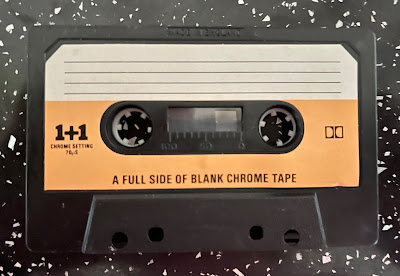
Side B of my copy of “Fresh Fruit in Foreign Places” is still blank after forty years and, unless someone buys me the Tascam unit, that is how it will have to stay.


17 November 2017

HIT IT, PAUSE IT, RECORD AND PLAY [82]


Modern-day ingenuity means that popular forms of old technology can have their useful lives extended far longer than ever intended. For example, I have a 1983 BBC Micro computer, sadly no longer working, which could connect to my TV via a SCART lead, and could save BASIC programs to an SD card.
Likewise, improvements in sound recording and playback mean we can play new vinyl records that sound as good as CDs, through heavier records, cutting the groove at a slower speed, and direct-drive turntables. Even CDs sound better through 24-bit mastering not available when they were introduced, meaning my 2015 copy of David Bowie’s album “Never Let Me Down” sounds louder, more dynamic and clearer than my 1987 copy, which I only bought because Bowie hated his song “Too Dizzy” enough to delete it from all future reissues.

However, with retailers now offering more cassette players and blank tapes for sale than seen in the last ten or fifteen years, including various devices to copy cassettes to MP3 format, I must point out the new players and tapes will sound WORSE than what you threw away, or gave away, all those years ago, because the improvements made to cassettes when they were popular are no longer made.

When Philips introduced the Compact Cassette in 1962, the virtue of its compactness – the earlier RCA tape cartridge, as well as Sony’s later Elcaset, were the size of a VHS cassette – was outweighed by its lack of actual sound fidelity. Running at a quarter of a speed of then-conventional reel-to-reel tape, and on tape about half as wide, the iron oxide-coated “ferric” tape rendered only enough to use in dictation, and little else. The introduction, in 1972, of tape using a chromium dioxide coating, known as “chrome” or “Type II,” began the slow replacement of pre-recorded 8-track cartridges with tapes that could would be wound backwards as well as forwards, while 1979’s “Type IV” or “metal” tapes, using iron or chromium instead of their oxides, meant you could start approaching CD quality – “Type III” was a combination of the first two types by Sony, which did not last beyond the mid-1970s.

Meanwhile, the ubiquitous hiss of tapes could be reduced if your recorder incorporated Dolby Noise Reduction, with Dolby B being the first consumer standard introduced in 1968, followed by Dolby C in 1980, and Dolby S in 1989, just as CD sales began impacting cassettes. Unlike the industry standard Dolby A and SR, Dolby B and C were directed at the higher and lower frequencies at which the hiss would be heard, but Dolby S improved the whole dynamic range.

For anyone in the market for a new cassette player, I can now tell you that just about EVERYTHING I have just told you will be unavailable. Unless you can find someone selling unopened old stock, you will only find the base level Type I tapes available, for only these are still made. Even worse, Dolby stopped licensing their noise reduction systems a number of years ago, concentrating their efforts on digital and home cinema systems instead. Even worse, because modern hi-fi systems are not concerned with including cassette players, you can expect the overall quality of the players themselves to be less than before, although making sure the playback heads are clean and aligned always help. Playing back a Dolby-encoded tape will still work, but you just won’t get the benefit.
If you are prepared for the expense of matching the cassette experience you remember having, you may well have to buy your old system back from eBay – you may find me there, trying to buy a replacement BBC Micro.