Showing posts with label Grey Gardens. Show all posts

03 June 2023

TEA FOR TWO, AND TWO FOR TEA [399]


I thought I knew what let myself in for by watching “The Beales of Grey Gardens.”
 

The film is a sequel to “Grey Gardens,” Albert & David Maysles’ 1975 documentary that followed “Big Edie” and “Little Edie” Bouvier Beale, cousins to Jackie Kennedy, living in poverty within a crumbling mansion in East Hampton, New York. The faded grandeur of the house, and the defiant beauty of the characters, has bewitched audiences ever since. 

For me, it came across as a cross between Bean Wheatley’s film of J.G. Ballard’s novel “High Rise”, with a tower block and its residents decaying into chaos while indifferent to the outside world, and “Steptoe and Son,” with the child bound to the parent and the house, but yearning to leave. Little Edie did eventually leave, and moved around a lot since, but only after her mother’s death, and after she could guarantee that any buyer of Grey Gardens would not demolish it. When the 2002 Academy Awards had its memorial montage of film industry people that died over the year, Little Edie was included, such was the cultural impact “Grey Gardens” has made.


“The Beales of Grey Gardens” was released in 2006, utilising more of the conversation that would not have been given time to breathe in the original film. The Maysles were proponents of “Direct Cinema,” which aimed to show life as it really is, achieved through developments in lighter and more portable cameras and sound equipment, and through using it to present the objective truth, without outside opinion or narration. However, in both this film and the original, the Maysles are a passive audience for both Big Edie and Little Edie - if the characters are inviting you into their lives, it makes it hard to stay detached for too long.

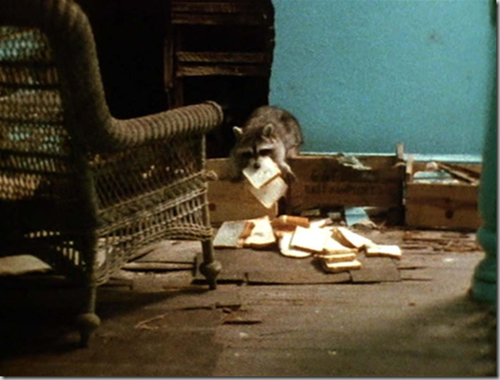
One sequence that I could not believe was left out of the original film is where you see the Maysles become active participants. They turn up for filming as usual, and Little Edie yells that the house is on fire. Sure enough, on the landing upstairs, a fire has broken out in a corner, an inevitability of tinder-dry wooden houses in that part of the US. Bowls of wood, and a blanket that was a gift from Jackie Kennedy, is used to put out the fire. Later, we see the hole caused by the fire has grown, from the wall into the floor, and a raccoon has made home in it. The answer? Lay down some bread for it, and allow the wildlife to continue taking over the house.

Anything I try to write here will not do justice to what you see in the films themselves, or to the people whose lives were followed. All I know is, the Beales live the way they wanted, Grey Gardens itself was restored, having been bought in 1979 for $220,000 and sold in 2017 for $15 million, by married “Washington Post” journalists Sally Quinn and Ben Bradlee, the latter portrayed by Tom Hanks in Steven Spielberg’s film “The Post”. The hole was replaced by a door.


12 March 2023

THEN FIRE, MAKE YOUR BODY COLD [387]


I had wanted to buy a copy of Carl Theodor Dreyer’s “The Passion of Joan of Arc” for a while. I now have the Eureka Entertainment "Masters of Cinema" series edition, making it part of an excellently-produced series that includes the definitive versions of silent films like "Metropolis," "Nosferatu," and "The Cabinet of Dr. Cagliari," along with later films like "Nashville" and "Grey Gardens" - although, if you are a serious film collector and scholar, you will be already aware of this.


My reason for buying this film is, like "Citizen Kane," it is considered one of the greatest films of all time. Both films also suffered the fate of the original camera negative being destroyed in fires. However, with the reputation of "Citizen Kane" only being firmly established after the critic Pauline Kael wrote about it in the 1970s, "The Passion of Joan of Arc" was seriously studied from the start, even if everyone was watching the wrong version of it.


As befits a religious-themed, pre-"Life of Brian" film, and one not made by a French person, "Joan of Arc" was subjected to cuts mandated by French film censors and the Archbishop of Paris. The fire happened after that, and in a time when copies of films were easily discarded after use, and when those copies were routinely made from the original negative, the original film was as good as lost.


What do you do from here? Carl Dreyer was able to stitch together a second version of the film, using alternate takes, and other shots not originally used.


That version was also destroyed by a fire in 1929. "Safety film" was not introduced until the 1940s, meaning an entire art form had to rely on nitrate film stock, combustible when stored or even moved wrongly.


Until 1951, the only widely-available version of the film was a cut-down version with a commentary from an American radio personality. The rediscovery of a print of the second version consigned the bastardisation to the bin, but this version had a Baroque-style film score and subtitles added by the person who found it. All the while, the director had to look on and object to what happened to what was left of his work.


This is where it gets weird, if it didn't feel so already. In 1981, a copy of the original version was discovered, in its original wrapping from the Danish film censor, in a janitor's cupboard in a mental hospital in Oslo - in 1928, the director of the hospital asked for a copy, as they had written about French history. The Norwegian Film Institute was contacted to see if they wanted it. They took it, then stored it for three years without watching it. When they finally did, it was found to be perfect.


This sort of miraculous discovery is not new - two episodes of "Dad's Army" were rescued from a skip, some Patrick Troughton "Doctor Who" episodes were recently found in Nigeria, and the now complete version of "Metropolis" used elements found in Argentina and New Zealand. The simple thing is never to throw anything away, as you may not be the one who realises how much it is worth.