Showing posts with label Ford. Show all posts

13 October 2024

YOU SAW THE WHOLE OF THE MOON [470]


[Update: A big thank you to the digital artist Dave Jeffery [https://www.kecskebak.hu/], whose work in creating and recreating channel idents has been used on screen by the BBC and Big Centre TV, for contacting me via Mastodon to confirm that Meridian’s logo was designed by Ian Carley, the company’s head of design. The original article is below.]

The half-sun, half-moon face used as a logo by Meridian Broadcasting has remained lodged in my mind long after it disappeared from TV screens, but I have never considered why it was used to represent independent television in the south and south-east of England – my hunch is that it doesn’t matter at all.

Back when ITV was the name of a network of regional TV channels, mostly named for the area on which they were broadcast – Thames, Tyne Tees, Anglia, Scottish, London Weekend Television and so on – Meridian replaced TVS (Television South), providing programmes in its area of the UK from 1993. It is still broadcasting, but in the procession of takeovers and mergers of ITV companies that began when Meridian bought Anglia in 1994, Meridian’s distinctive logo and name were usurped by a national “ITV” identity from 2002, the name living on as “ITV News Meridian”, the name of their regional bulletins.

This does not explain the choosing of its symbol, from a designer whose name I could not find, here picked out in high-contrast red, yellow and purple, initially in idents on a halved yellow and blue background. The sun-moon face is centuries old, borne of opposing forces, of duality, and of accepting this as a nature of being, from good and bad, to life and death, and femininity and masculinity. It was seen as decoration on old naval navigational tools, like compasses and sextants, fitting in with the brief of serving an area of the UK steeped in maritime and naval tradition like Portsmouth, Southampton, Cowes and Chatham, but means precisely nothing if you are also broadcasting inland to the likes of Salisbury, Reading and Oxford.

The name “Meridian” is more confusing than expected: it comes from the Latin “meridionalis”, meaning “of the south”, but it makes me think of London, and the Greenwich Meridian - this use came from the Latin “meridies”, for “midday”. When the consortium that owned Meridian bid, in 1991, to represent the ITV network in the south and south-east of England, they also bid for the London area, most likely using the same name and logo. Perhaps the intention was, just “Granada” came to symbolise Manchester and the north-west of England as much as that region of Spain, Meridian will do the same for the south, once it appears often enough. This expectation did not happen so much for Carlton, like Granada a pre-existing company with a pre-existing name, which eventually won the London licence.

The website TVArk has a quote from a J Dallas, creative director at Meridian, talking in 1999 about the replacement of their original bombastic and orchestral idents with something a lot calmer and more purple: “The idea was they thought the Company had become established and the computer graphics for the original ident looked old fashioned. The problem with the logo is it looks stuck on to something whatever you do with it.” Meanwhile, the wonderful book “Branding for Television With Knobs On” by Martin Lambie-Nairn, designer of the Channel 4 logo, noted that Meridian executives took offense at being told their production and marketing wasn’t connected by a unifying strategy and brief, its “marketing tree” being disparate twigs growing from the ground, unable to take advantage of the fact the TV channel itself, branding and all, is as much a product as the programmes by themselves.

The Meridian logo appeared everywhere: before every programme, at the end of programmes made or commissioned by them, in flashes before each advertisement break began, and in a bizarre tie-in with Southern Ford Dealers, where you could buy the Ford Fiesta Meridian special edition car – I really saw a TV broadcaster’s logo plastered on cars that private citizens chose to buy with their own money.

Meridian’s legacy was in children’s programmes like “Wizadora”, “ZZZap!” and “It’s a Mystery”, alongside dramas “The Ruth Rendell Mysteries” and “Hornblower”, and the documentary series “Monkey Business”. However, its logo was used so prominently between 1993 and 2002 that its legacy is what remains for me - it is visually striking, but it only represents itself, not what Meridian was, or continues to be.
01 April 2023

TOO MANY ROADS BYPASS MY WAY [390]


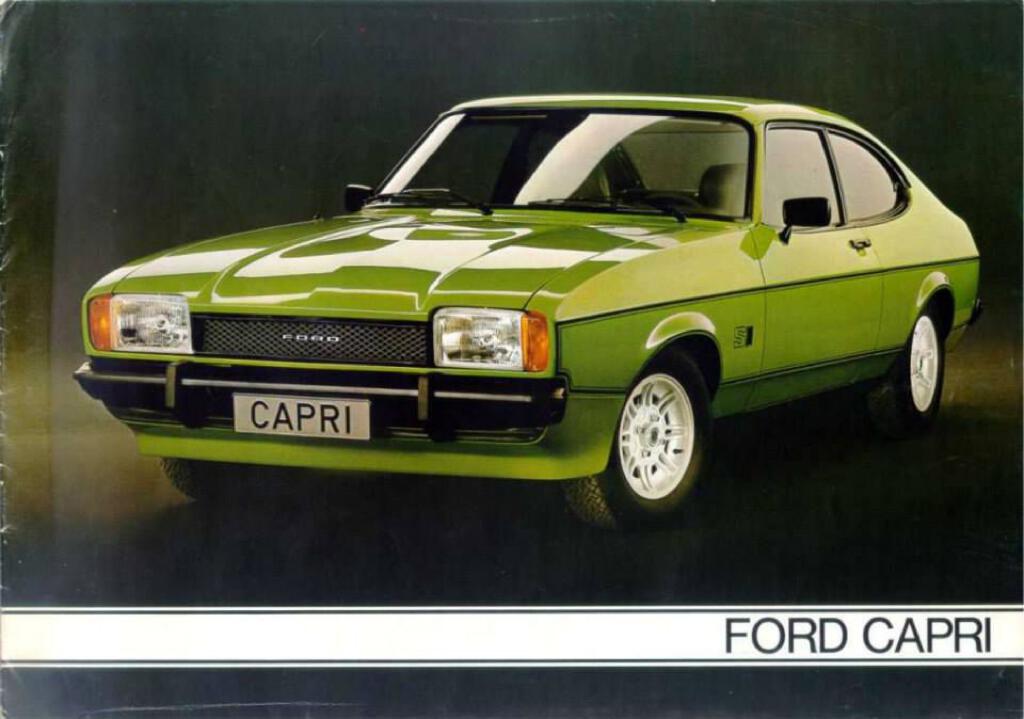
The Ford Capri is a coupé car made by Ford of Europe from 1968 to 1986.

The Ford Capri is a convertible sports car made by Ford of Australia from 1989 to 1994.

The Ford Capri is the possible name of an upcoming sports utility vehicle from Ford of Europe, continuing the replacement of their original car range that included the Focus and the Fiesta [which I talked about here] with a more radical range of electric vans and trucks that includes another new SUV, the Ford Explorer.

However, this will not be the same Ford Explorer as sold in the United States. Ford didn’t really sell Jeep-like cars in the UK until 1993 with the Maverick, but that isn’t the same Maverick as the compact car sold in the US during the 1970s, which was replaced by the Ford Granada... which was supposed to be the same Ford Granada that popped up in Europe at the same time, but too many changes needed to be made to fit American standards and tastes. Lower-specification Granadas were sold in the UK as the Consul, reusing the name of the car it was meant to replace, as Ford was being sued over their use of the name by the TV company and motorway service station group also named Granada, an action which ultimately proved unsuccessful – Granada’s TV channel would later show Granadas being driven recklessly on “The Sweeney” and “The Professionals”. Traditionally the largest car in Ford’s range, the Consul had a coupé variant from 1961 to 1964, known as the Consul Capri...

Just as there initially was animosity over the radically different Ford Sierra replacing the popular Ford Cortina [link], there has been a ground swell in the UK media over the return of the name “Capri” – the Cortina-based European coupé was both an aspiration and rite of passage for British drivers of a certain age, especially those who pretended their entry-level 1.3 litre car was just like the top-line 2.8 or 3 litre V6 model. Since 1986, the Capri niche has been filled by Ford with the Probe, Cougar and Puma, the latter also a small coupé reinvented as a SUV, before being finally plugged by simply selling the Mustang in Europe, having been the Capri’s original inspiration. Nearly four thousand Capris remain on British roads, according to howmanyleft.co.uk – I would say that everyone that wanted a Capri like that has one, while others bought the Audis, BMWs and “hot hatches” that took the Capri’s place in the car market.

Ford can name any car it wants “Capri” – it first used the name on a series of Lincoln cars in the 1950s, and the Australian Capri was sold as the Mercury Capri in the US, just as the European Capri had been in the 1970s. Holding the rights to use names matters in the car industry – Ford of Europe wanted to call their Mustang emulator the “Colt”, but were stopped by Mitsubishi, hence using a name they already owned.

15 October 2022

AROUND THE WORLD, AROUND THE WORLD [365]


The Ford Escort was the biggest-selling car of the 1980s, a statement that applies both the United Kingdom and the United States.


Whether that statement applies to one car is another question. Created as a “world car” between Ford’s American and European divisions, ostensibly to share both expertise and production costs, the Escort on sale in North American showrooms from 1980 shared little more than its engine with its European counterpart, and its design is different enough to call the effort of sharing its development into question.


I had not heard of there being a separate Ford Escort until a couple of weeks ago, but looking at pictures of it brings a sort of an “Uncanny Valley” effect – the European version was so prevalent on British roads, seeing something that purports to be the same thing, while looking almost like it, but not quite, produces an unwarranted feeling of unease.


Reading the 1982 brochure for the North American Escort reveals the difference in approach with Ford of Europe: placing emphasis on its “world car” status, and on having outsold every imported car in the US in 1981, Ford introduced the Escort to replace both the Pinto, a “subcompact” coupé-looking car with a poor safety record, and the Fiesta, Ford’s first attempt at a “world car” that was too small for the United States (and which I have talked about here: link). Both the targets and the stakes were set high, but this situation was only found in North America, and its half of the plan must have inevitably diverged to meet them.


The European Version

Meanwhile, the focus of the European Escort was squarely on aerodynamics, fuel economy and simplicity of design, having launched in the UK with the slogan “Simple is Efficient”. Unlike Ford of America, which attached a globe logo to every Escort sold there in its first year, Ford of Europe make no mention of having developed the car with anyone else. The European Escort’s straight line design was by Uwe Bahlsen and Patrick Le Quément, following it with the futuristic, for the time, Ford Sierra (also discussed previously: link).


The North American Escort could serve to indicate the main differences between American and European cars in general. It has the same wheelbase as the European model, but is nine inches longer, two inches wider, and one inch shorter in height, with a more sloped nose, and chrome trimmings on even the base L model. Only a 1.6 litre engine was offered initially in America, the largest of the engines offered in Europe, and the interior was entirely redesigned, with black, fawn and blue colour combinations joined by an all-interior blood-like colour known as “Medium Red”. The “Squire Option” of faux wood panelling was available on the estate car.


Contributing to the design changes to the North American Escort may have been differing safety standards. Many European manufacturers in the 1970s seen their sleek designs essentially ruined through the process of “federalisation” to meet US safety regulations, often through the addition of thick black shock-absorbing bumpers to protect the headlights and engine in a 5 mph collission – Ford would do this with the Capri coupé when it was sold as the Mercury Capri in the US. This led British Leyland to redesign the MGB and MG Midget to suit, but because the US was their main market, it had to be done.


The Escort would become more of a “world car” through the 1980s, adding production at Brazil, Argentina and Venezuela to the factories in the UK, West Germany, Spain and the United States. However, the Escort produced in South America was the European version – the North American version was only sold in North America, and was only made there too. When Ford of America updated their Escort in 1990, it opted to rebrand the Ford Laser, a car sold mostly in Asia and Australasia, and based on the Mazda 323. Meanwhile, successive updates of the European Escort continued until the Focus began replacing it 1998, the Escort name disappearing in 2002... until it reappeared in 2015, on a redesigned Focus saloon car sold in China and the Middle East. Perhaps the name travels further than the car.


"Medium Red"


21 August 2022

PEOPLE SAY I’M THE LIFE OF THE PARTY [358]


A visual shorthand for the 1970s, the 8-track tape cartridge appeared to peacefully co-exist with the competing Compact Cassette format for its entire time on sale, from 1964 to 1990, even if its popularity dwindled through the 1980s. I have only limited experience with the format, through an 8-track car player my father owned, but they only felt at the time like a “big cassette”. What allowed the 8-track to stick around for so long?

Both formats appeared around the same time. Philips unveiled the Compact Cassette in Europe in 1963, and in the United States in 1964, the same year the first demonstration 8-track players appeared from the Lear Jet Corporation, which spearheaded its development as an in-flight entertainment device. The first in-car units were offered as optional extras by Ford in 1965, alongside the first pre-recorded cartridges from RCA. Home-based hi-fi players and recorders for both formats would both appear before the end of the decade.

Like almost all tape formats, cartridges existed to make reel-to-reel tape easier to handle. The Compact Cassette miniaturised the reels and tape, to 0.15 inches wide and played at 1.875 inches per second, but the first pre-recorded demonstration cassette would not appear until 1967, the Compact Cassette’s initial poor recording quality only useful for dictation purposes. Instead, an 8-track cartridge used the same quarter-inch tape used in reel-to-reel players, playing at 3.75 inches per second, twice that of the Compact Cassette, but half the maximum speed of a reel-to-reel player, making 8-track almost an “audiophile” format by comparison. However, in splitting the tape into four programmes, each made up of two tracks, the 8-track increased both tape hiss and the possibility of “crosstalk” between the tracks and a misaligned playback head.

At four inches wide, each cartridge can play for up to eighty minutes, housing enough tape for four programmes of up to twenty minutes in a single-reel “endless loop” design, like the earlier 4-track Stereo-Pak and Fidelipak “broadcast cart” cartridges used for playing radio jingles, leading from the middle, and windingback around itself. The join in tape was bridged by a silver foil splice which, once it moved past a sensor, moved the playback head to the next programme automatically. The pinch roller usually found in the player mechanism was moved to inside the cartridge, allowing it to automatically engage and play upon being entered into the player, particularly useful when travelling.

With this form to play with, the albums that resulted on 8-track were, to me at least, not the greatest aesthetically. In terms of packaging, the hard plastic cartridge eliminated the need for the case required for a Compact Cassette, but the album cover and other information would be provided as a sticker that would deteriorate with age, along with the silver foil and foam pads inside the cartridge.

The biggest problem, however, is the inflexibilities of arranging an album onto an 8-track cartridge. With a C-90 cassette providing up to 45 minutes per side, you could fit the equivalent of an entire vinyl record on each side of a Compact Cassette, as Pink Floyd did with their double album “The Wall” in 1979. The maximum 8-track programme length of twenty minutes should accommodate one side of a record, but to minimise the amount of tape used, the maximum programme length will be the total length of the album, divided by 4. 

The worst example of this I could find was David Bowie’s 1976 album “Station to Station”, a six-song, 38-minute album, meaning 9.5 minutes per programme is available... but the title track is over ten minutes long by itself, taking up the entire first programme and the beginning of the second. “Word On a Wing”, song 3 of 6 on every other issue, is now song 2 on the 8-track, followed by “Wild is the Wind”, usually the album closer, itself broken up between programmes, perhaps to take advantage of a quiet moment in the song. This means that the final three rockier songs, “Stay”, “TVC15” and “Golden Years” (usually tracks 5, 4 and 2), can play without interruption. Make your album fit, or forget about it.

Meanwhile, the average length of each side of “The Wall” vinyl album was twenty minutes, fitting relatively easy onto the four programmes of an 8-track without making any changes to the songs’ length or running order, except that “Hey You”, the first song on side 3 of the vinyl version, begins at the end of one programme, and starts the next one. It is not possible to lengthen one programme to make the rest of the song fit, as you will have a gap at the end of the other three programmes, disrupting the flow of the album in a different way.

While 1978 was the peak year for 8-track sales in the United States, sales of pre-recorded albums by mail order clubs continued there until 1988, while the electronics retailer Radio Shack sold its Realistic-branded players and blank cartridges until 1990. Meanwhile, the more portable and cheaper Compact Cassette had caught up through constant improvements in tape and playback quality that did not happen with 8-track, although Dolby B noise reduction was licensed for both formats. But by then, the Compact Disc had allowed for seventy-four minutes of high-quality music, later eighty minutes to be played back on one side, without interruption.

28 March 2021

WE HAVE FIESTA AND FERIA [288]


Two weeks ago, I bought a book I remember checking out, on multiple occasions, from the library of my secondary school. “Let’s Call It Fiesta,” written by Edouard Seidler and subtitled “the auto-biography of Ford’s Project Bobcat,” was published when the Ford Fiesta first went on sale in 1976. I had been transfixed by the vast array of conceptual designs and models made by various parts of the company, as Ford grappled with producing their first “world car” since the Model T, although I didn’t try to draw them myself either back then, or now. The book chronicles how both an oil crisis, and competition from small cars like the Renault 5 and Fiat 127, created the smallest Ford so far.

Last week, Ford announced that their factory in Valencia, Spain, built to manufacture the Fiesta, will begin making engines for their electric car range. This marks the end of the road for the Ford Mondeo after twenty-eight years, and the end of their producing and selling large family and executive cars in Europe, breaking a link that extended back through to the Consul, Granada, Cortina and Sierra - the nearest car left in their range will be the Mustang Mach E, the electric crossover vehicle as forward-thinking as the Sierra was (which I have talked about previously). When the Mondeo is withdrawn from sale, Ford of Europe will only have two vehicles that are not sports utility vehicles, crossover cars, or vans: the Focus, a smaller family car that replaced the Escort in 2000, and is currently the size of the original Cortina; and the Fiesta, which is now the size of the original Escort, and twenty inches longer than the original version of itself.


There hasn’t really been a time since the 1980s began where Britain’s best-selling car wasn’t either the Ford Fiesta or the Ford Escort. At different times, they have been the standard, middle-of-the-road car: a front-wheel drive hatchback, about fourteen feet long, and big enough to carry a family of four, or five at a push, along with luggage or a pet. Since 2014, the Fiesta has been the best-selling car in UK history, overtaking the 4.1 million sold by the Escort from 1968 until its replacement by the Focus. Indeed, the longevity of the Fiesta may be down to Ford never having changed the name.


However, as evidenced by the numerous designs in the book I now own, the Fiesta has continued to sell because of the space it leaves for the personality of its owners. The original 1976 car was designed by Ghia, to this day a Ford-owned Italian firm of coachbuilders and concept car designers, whose name was once used by Ford as their byword for luxury. There was nothing brash, imposing or excessive about the original Fiesta design, but the curve created by the side windows is a subtle, more European touch. The ubiquity of the Fiesta makes it a part of most driver’s journeys, from having learned to drive or taken their test in one, to it perhaps being the first car of their own. For years, the Fiesta has been the default “British” car.


The fragmenting car market is now weakening the Fiesta’s hold – as off-road and crossover vehicles continue gaining popularity in Europe, even Ford could sell you Fiesta-sized versions of each in the EcoSport and Puma. Crucially, with the Fiesta having increased in size over the years, and with the Ford Ka city car now withdrawn due to lack of interest, Ford no longer makes a car to compete with the current Fiat 500, or the upcoming new electric version of the Renault 5, both of which were precisely the reason Ford made the Fiesta in the first place. It is easier than ever to find the car you want - I guess the Ford Fiesta will continue until we don’t need it anymore.

30 April 2018

I’VE BEEN HIGHER THAN THE HIGH SIERRA [107]


What is in a name? If that name is “Cortina,” enough to make a documentary: in 1982, the BBC broadcast “The Private Life of the Ford Cortina,” not as an episode of “Top Gear,” but as part of the arts series “Arena.” Named after an Italian ski resort, the car was portrayed as having woven itself into the fabric of British life over the previous twenty years, becoming the archetypal British family car and company car, its ascending trim levels equating itself with social status. In styling terms, it was the closest you could get to an American car without importing one.
However, the “Arena” documentary followed an announcement by Ford that Cortina production would end in 1982, to be replaced by a new model based on a futuristic, aerodynamic concept unveiled the previous year. The comedian and writer Alexei Sayle, appearing as a Cockney punter through the programme, lamented the demise of his favourite car like a death in the family, before turning on its successor:
“They’re gonna call it the Sierra, the bloody Sierra. And what does that mean, eh, Sierra? What’s that about, eh? It don’t speak volumes to me, an English person, Sierra. It’s not like Cortina, you know what I mean? They’re doing away our car for some poxy hatchback. Oh I think it’s - I think it’s disgraceful. I’m angry.”


That “poxy hatchback,” named after the Spanish word for a mountain range, was the future of car design, requiring only tweaks over the following eleven years while the rest of the industry redrew its cars from scratch. Although the Sierra remained rear-wheel drive just as front-wheel drive became more common, this helped it to be adapted into high-performance sports models, like the XR4i (also sold in the US as the Merkur XR4Ti), the XR4x4, and the fabled Sierra RS Cosworth – South Africa also had the XR8, with a five-litre V8 engine. My grandfather had a more regular Sierra, and it was as comfortable and dependable as a Ford is should be, with the familiar blue oval badge coming with its own set of expectations.
However, in 1982, the Sierra’s design was proving to be ahead of its time, making it more difficult to form a personal connection in the way others did with a Cortina, unless you owned one of the sportier models. The Sierra proved to be very popular in Germany, where it replaced the lower-selling Taunus, and for the last six years to 1982, the Cortina was a rebadged Taunus. But with the goodwill generated by the “Cortina” name carrying forward in the UK, it was likened to a jelly mould and a spaceship, and the lack of a Sierra saloon option until 1987 meant buyers scared off by the then unconventional design were forced to look at the smaller Ford Orion, or at competitors like the Vauxhall Cavalier – while the Cortina was the UK’s biggest-selling car in each year of the 1970s, the Sierra usually found itself second to the Cavalier or the Ford Escort.

Right now, the name “Mondeo” has been used by Ford longer than “Sierra” and “Cortina” ever were, and if their recent decision to phase out regular cars in the US and Canada, apart from the Mustang and a version of the Focus, in favour of more sports utility vehicles and similar crossover cars, the whole notion of a standard “family car” may already be over. However, the nostalgia over the name “Cortina” can still be found in the UK, and in real numbers – according to howmanyleft.co.uk, 3,520 Cortinas remain registered on British roads, against only 2,642 Sierras. Perhaps, the Sierra is still too close to the cars we have today for nostalgia to kick in and save those that are left.

23 November 2017

NO THOUGHT FOR ME REMAINS HERE [83]


Waiting in the queue in TK Maxx to buy a purse, I looked at the various gifts and confectionery stacked before the checkout. On a shelf, at my eye level, was a die-cast model of a car – not one for playing with, as it had been screwed to a plinth. It looked like a Smart car, but with the grille of another company attached to it. I did not know a model was made of a car that appeared to have disappeared as soon as it, well, appeared – perhaps it was part of the marketing. Therefore, my initial thought upon seeing it was not, “oh, that’s interesting,” but, “they really made that?”
There actually was a method to the madness that was the Aston Martin Cygnet. When Aston Martin announced, in October 2010, that a concept car exhibited earlier in the year would enter production, they intended to provide a luxury version of the “city car,” like the Smart Fortwo, or the Ford Ka. Indeed, it was feasible that many owners of their sports cars may want a Cygnet as their weekday vehicle, so they can enjoy the same level of luxury as in their DB9 – the press release stated, “luxury is not constrained by scale,” and, “it is a car without compromise, just like every other Aston Martin.” That said, for a four-seater car slightly shorter (117.5 inches) than the original Mini, the only real boot space was achieved by removing the rear seats. However, for a city car as luxuriously upholstered as a DB9, and painted with the same paint, £30,000 could have been a bargain.

This is where the Cygnet starts to fall down. It’s main reason for existing were European Union guidelines concerning the carbon dioxide produced by a car company’s range of vehicles. Even though the emissions of their diesel models proved less than desired, the Volkswagen Group can balance out the CO2 produced by their Bentley and Bugatti models with their smaller models from VW, Seat and Skoda. Meanwhile Aston Martin, not owned by a larger group, needed to introduce a car to cancel out the effects of their Vantages and Vanquishes although, producing 110 grams of CO2 per kilometre, the Cygnet only reduced the company’s average from 304 to 290 g/km.

Even worse, the biggest problem for the Cygnet was that it was simply a tarted-up Toyota iQ, which had been introduced in 2009. “Badge engineering” is a common practice in the car industry – a previous family car of ours, the VW Sharan MPV-minivan, was also sold as the Ford Galaxy and the Seat Alhambra, while the latest-model Toyota Aygo, which replaced the iQ in 2014, is also known as the Citroën C1 and the Peugeot 108. What Aston Martin did in customising the iQ into the Cygnet went beyond changing the badges, but the 150 hours they spent on each car – a regular Aston Martin took 200 hours to build from scratch – only extended to how the car looked, and its interior. Just like iQ drivers, every Cygnet was stuck with a 1.3 litre engine, capable of 97 bhp, producing a 0-60 mph time of 11.5 seconds, and a top speed of 106 mph – I can only guess Aston Martin hoped prospective buyers would look past those figures.

The Cygnet lasted only two years in production, from 2011 to 2013, with the media and public simply unable to look past the Aston Martin badge and grille without seeing the Toyota iQ behind it. I have only ever seen one in the window of Aston Martin’s dealership in London’s Park Lane, and have never seen one driven on the road. Aston Martin hoped for four thousand sales per year: in the end, around four hundred were ordered upon its release, with only 150 in the UK, and that was it – you are more likely to see a DB5 or DB6 on the road. For all I know, they probably sold more of those die-cast models. In June 2017, Aston Martin announced an all-electric version of its four-door Rapide S luxury saloon, the RapidE, will enter production in 2019 – that’s a bit more like it.