Showing posts with label Weird Al Yankovic. Show all posts

01 September 2024

AND I DON’T THINK I’LL BE COMING BACK AGAIN [464]

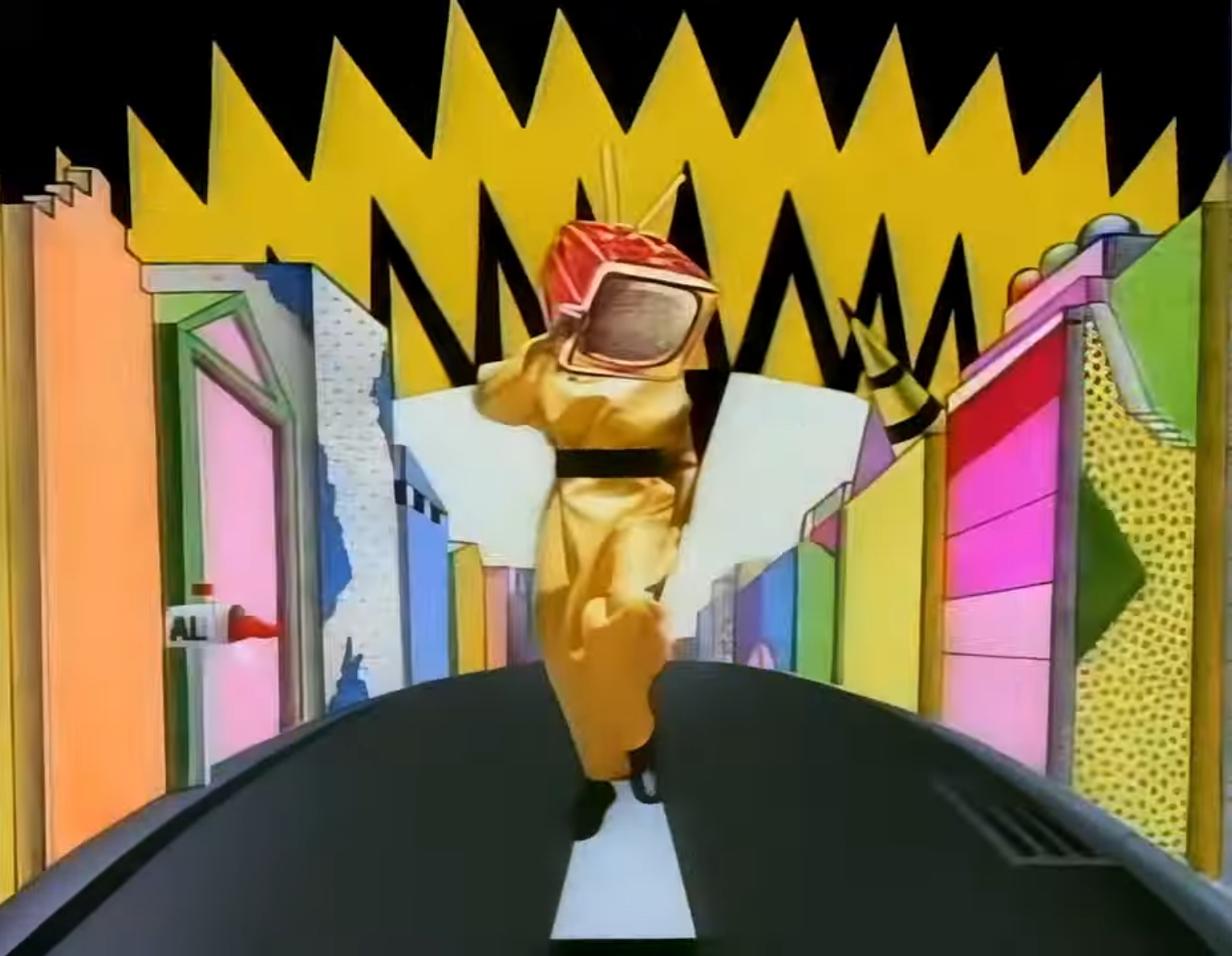
Detail from "Dare to Be Stupid"

On Tuesday 27th August 2024, the following message was sent out across social media by the brilliant parody singer and songwriter “Weird Al” Yankovic: “About a year ago, my old record label replaced all my old music videos with upscaled HD/4K versions. Some folks really liked it, and some folks really didn't. Well, I hate for anybody to be disappointed, so now BOTH versions are available on YouTube - take your pick!”

I wasn’t aware that the original versions of some songs had been removed from view. I love the videos for “Living with a Hernia”, Weird Al’s take on James Brown’s “Living in America”, and the note-perfect Devo pastiche “Dare to Be Stupid”, as much as the songs themselves, and the artistry in matching the spirit of their targets both audibly and visually means they have to be taken together. 

MTV came along at the perfect time for Weird Al, and just as changes in consuming music means he now puts out songs as and when they are ready, rather than waiting to compile an album’s worth of material, it is natural that YouTube would present the perfect opportunity to lay out your life’s work as accessibly as possible.

However, I made the mistake of looking at the upscaled videos on my phone first – the pictures seemed a little sharper, and the colours more vibrant, which led me to think that they have gone to the original source, whether that be film, or a tape format like U-Matic or Betacam, and made a new scan. 

"I Lost on Jeopardy" - what happened to the categories?

This is clearly not what has happened, seen most clearly on the video for “I Lost on Jeopardy”. The film was originally uploaded in 2009, and while the picture quality is listed as “480p”, the picture itself is soft, like it came from a standard format VHS cassette, which can only achieve half this resolution. The upscaling, listed as 1080p HD format, appears to have been made from this version, using an A.I. upscaling program: outlines are suddenly sharp, and surfaces smoothed out, with text suddenly coming into focus the nearer the camera gets, particularly detrimental with the video’s need to show you a standard “Jeopardy” question board.


A.I. has been used in film preservation for years, helping in the more menial correction tasks like picture stabilisation, and removing scratches and dust that weren’t already caught by photochemical and other cleaning processes. Even then, this requires close examination of what has been done – I remember watching an explanation of the restoration of Fritz Lang’s 1927 film “Metropolis”, showing that the interpolation performed between individual frames that removed scratches and excessive film grain also removed the bottom of someone’s leg, which had to be manually corrected.


It is important to note that, like some people may refuse to watch a film or television programme because it is in black and white instead of colour, it is feasible that rejecting a work because it is not in “standard definition” is possible, which may have prompted the original A.I. transfer of Weird Al’s videos. The ephemeral nature of music videos may mean that master tapes are harder to find, but the care and attention could have been used to ensure the highest-possible quality of these videos simply costs more money than running them through an A.I. scanner program. Perhaps running a previous DVD of Weird Al’s work through an upscaling Blu-ray player, interpolating the picture to HD quality as it goes, would have produced a better effect.

10 May 2020

WHERE ARE YOU COMING FROM [236]


Finding out the band you have become a fan of does not exist is both frustrating and rare. Two music videos and one album exist, but no singles were released, few articles were written about them, apparently no interviews were taken, and no Wikipedia page has been made. And yet, “Dog Police,” by Dog Police, has become a cult classic album, rereleased twice in the last ten years, and the title track’s video is known widely, nearly spawning a TV show.

But there is no Dog Police, not at first. Understanding what it was, and how it came to be, involved joining many dots, but it made my new-found love of their songs even greater.

Starting with “Dog Police,” the video from the song, album and band of the same, we have a novelty song about someone’s girlfriend being wanted by the Dog Police, using a New Wave sound and temperament similar to Devo and The B52s. Taking place in a club, it features the band both as themselves on stage, and as the Dog Police, with trenchcoats, fedoras and prosthetic dog faces. 


Perhaps the lyrics are not meant to make much sense, but the bass and synthesisers hook you along towards the explosive sound of the chorus, punctuated by barking in time: “Dog Police, where are you coming from / Dog Police, nobody knows who you are!” These lines are adapted from the “Spider-Man” segments from the children’s TV show “The Electric Company,” but are performed like a bombastic, sped-up version of the “Dragnet” theme. It is infectious, strange, unforgettable, and nightmare fuel to the wrong people. This video would be later optioned by NBC for a possible TV series, with one pilot film, again featuring people in dressed as dogs, notoriously featuring actors Adam Sandler and Jeremy Piven before anyone knew who they were.

Underneath this video on YouTube was another Dog Police video, “1-800,” satirising mail order ads and the products they sell, using a phone as an instrument through playing the DMTF dialling tones. While not parodying a song, both the video and song play more like a Weird Al Yankovic piece. Both “1-800” and “Dog Police” feel like they come from an alternate universe where satirical songs became the norm, like John Lennon imagined when writing “Taxman” and “Paperback Writer.” 

Then there is the “Dog Police” album. Alongside the title track and “1-800,” there is a heavy, pessimistic dirge titled “Positive Reinforcement,” while a vocoded robot sings “Happy,” and a woman fronts “I’m Butch.” The band plays with their surroundings and expectations in both “Music and “In The Studio,” while they attempt to become Manhattan Transfer with “Are You Middle Class Enough?” The last track is a frantic, bouncy anthem named “Reproduce,” with lines that cut to the chase extremely fast, becoming my favourite song of the lot: 

“Don’t be despaired / There isn’t time enough / Why we are here / Is very simple stuff / Why are we doing / What we are doing? / Are we wooing / Only for screwing? / We’re only here to reproduce! / That seems to be our only use.”


What I get from the “Dog Police” album is how the band is very forceful and fast, having mastered their instruments: there are intricate bass and piano lines, with not a single note out of place. They will sound the same if they played live. The lyrics are very cynical and sarcastic, flippant to the point of providing accidental insight: a refrain to “Music” is “stick it in your ear,” reducing all music to product to be consumed, but also becoming a rallying call to do just that.

There is an infectious energy to Dog Police that attracted me immediately – it reminds me of Paul D. Millar, a Texas-based artist who records as Slugbug, similarly providing satirical songs in a New Wave mould through albums like “Truck Month” and “Pointless Journey,” which are available on the music streaming site Bandcamp [link]. 

However, like vaporwave, another genre found in abundance on Bandcamp, Dog Police almost comes across as a found object with no clear origin. With no easily obtainable evidence about its source, or about what happened after it was made, it appears to have just, well, appeared.

According to the database site discogs.com, the “Dog Police” album was released in 1982 on the Music Masters Ltd label, but I have also heard it was produced and distributed privately in 1985. The songs are written by Tony Thomas, Tom Lonardo and Sam Shoup, who also produced the album with engineer Andy Black, but the band used pseudonyms – “Clark Radio” on keyboards, “Random Ax” playing guitar, bass and trumpet, and “Squeek Owens” on drums. “Butchie Cox” and “The Rocks” also help with vocals. However, we know that Thomas, Leonardo and Shoup are “Clark,” “Squeek” and “Random,” because they appear in the videos. All three are classically-trained musicians, have worked both in commercial music and arrangers and session musicians for other artists. They have been part of the jazz music scene in Memphis, Tennessee for over forty years as The Tony Thomas Trio, releasing the albums “LST,” “Progreso” and “Melodious Funk”. Were they trying a new direction?

Original album cover

You then have the videos: “Dog Police” was played on MTV, but not as part of a playlist, instead submitted in 1984 to a competition run by “The Basement Tapes,” a monthly half-hour showcase for unsigned acts, and it later played on the variety magazine show “Night Flight” on the USA Network. The video for “1-800” may have also featured on “The Basement Tapes,” but did appear in 1984 on Weird Al Yankovic’s MTV show “Al TV,” blending with the parodies played around it. 

One reason the video for “Dog Police” is remarkable is its quality. While the low-grade video and computer special effects in “1-800” is more typical for “The Basement Tapes,” “Dog Police” is shot on 16mm film by director Joe Mulherin and cinematographer Larry McConkey, later to become an accomplished Steadicam operator on major films like “Goodfellas,” “The Silence of the Lambs,” “World War Z” and “12 Years a Slave.” If so much effort was spent entering a competition, you start believing this cynical band were actually aiming for the big time.

Did Dog Police just go back to being The Tony Thomas Trio when their New Wave direction didn’t work out? Was it an elaborate joke by musicians more accomplished than was demanded of them? Was it the remains of something else that never appeared? Was it another person’s idea, or even a dare? The “Dog Police” album has been released on vinyl in 2009 and 2019, and are available on iTunes and Amazon, so someone must be collecting royalties from the intrigue generated by the videos, while being wary of saying anything that might ruin the fun.

Fortunately, after days of looking for evidence, I came across episode 18 of “Contraption: The Drummers’ Podcast” [link], released in February 2020, which interviewed Tom Leonardo. Thirty-eight minutes into the detailed discussion of Leonardo’s career and influences, Dog Police is discussed: “some things never go away,” he says. The Tony Thomas Trio were attempting to record an album, being charged for studio time by engineers that were not really paying attention. In a spare moment, they were riffing an improvised chorus for what became “Dog Police,” using the “Spider-Man” lyrics. The engineer asked what they were playing, and the band said it was a little thing they were working on. The engineer asked if they could record it, right there and then. After taking ninety minutes to write more throwaway lyrics, they recorded the song. The next day, their producer asked the band if they had any more songs like “Dog Police” to record – the studio costs would be paid for them. The further songs dashed off by the band were based on observations they had at the time about themselves and the world around them, but they were of their time, particularly in terms of the music – Stewart Copeland, drummer for The Police, was noted as a comparison, along with local Memphis punk bands with frantic drummers.

In the end, Dog Police was not a means to forge a career, but was a one-time opportunity, meant to last as long as the songs took to write and record, and no longer. Perhaps the videos were as well, but the time and effort spent on them makes you feel this was a more serious endeavour than it really was, no matter what anyone says. Few moments in time last this long.

2009 reissue album cover