

The famous "South Park" disclaimer
Would saying “this article is based on a true story” make you more likely to read it?
Is this because you are assured of reading something true to life, inspired by real events, or because it will shed light on a wider truth? Or did I use it as a marketing tool, knowing it would work?
The truth is that I wrote “this article is based on a true story” on a Post-It note with no idea of what I meant by writing it, or of what I would do with it. This sums up my feelings about this phrase: by itself, it means nothing, but it is used to ascribe worth to other things.
Two examples of stories “based on a true story”, when they are not, are Joel & Ethan Coen’s 1996 film “Fargo”, which infamously begins with a message saying it is a true story, but in reality is a fictional story based around a real murder; and “Saturday Night Fever”, a film based on a “New York” magazine article of which its writer, Nik Cohn, revealed twenty years later was a fictional story, but inspired by people he met. “Based on a true story” perhaps sounds more “official” than “inspired by true events”, because that could feasibly be used to describe the inspiration for any and all stories.
An article on MTV’s website from 2005 quotes Joel Cohen from a “Time Out” magazine interview, which I have been unable to find online, saying “if an audience believes that something's based on a real event, it gives you permission to do things they might otherwise not accept.” The MTV article, by Karl Heitmueller, talks about the veracity of “The Amityville Horror” series of films, real-life atrocities being the reliable sponge base for many horror film cakes.
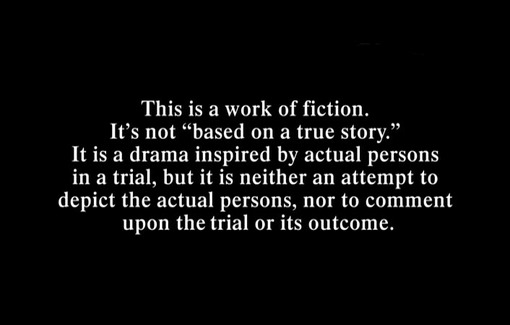
Disclaimer for the HBO film "Phil Spector" (2013)
For me, verisimilitude has more importance. The average Batman comic book story could be completely fantastical, from the villains to the technology deployed and the way Gotham City is portrayed, but there are elements of truth or realism that make the more outlandish elements plausible. I think this is why, in terms of the fictional stories I read or watch, I can get along with “Blade Runner” more than “Lord of the Rings” – the former, especially through its city setting, has a more immediately familiar verisimilitude to me from real life, while the rich world-building of the latter, well, builds its own plausibility, rewarding the audience’s attention.
I don’t find myself watching a straight drama very often – that is, one not tinged by a genre, like science fiction. One was “Howzat! Kerry Packer’s War”, a 2012 Australian two-part mini-series about the commercial professional cricket tournament set up for a media mogul’s television network. The two characters that drew me the most into the story were TV executive Gavin Warner, who bore the pressure of making this outlandish idea work, and Packer’s personal assistant Rose, both reflecting and deflecting her employer’s monstrous personality.
At the end of the second episode, I saw the cast explicitly listed them as “fictional character[s]”. At the time, I felt a little like I had wasted my time in watching scenes that did not happen, but I recognised this artistic license was needed for the story to work as a drama – a talking heads-style documentary, or even a docudrama, could give you the facts efficiently, but making an emotional connection requires a different approach. I did like the fact that the credits were honest - the creation of a fictional assassin in the 1932 MGM film "Rasputin and the Empress", and the defamation trial that followed, prompted the adoption of the famous disclaimer “The events and characters depicted in this photoplay are fictitious. Any similarity to actual persons, living or dead, is purely coincidental.”
In 2023, “Based on a True Story” was used to name a TV comedy series about an estate agent with a “true crime”-themed podcast, also named “Based on a True Story”. The success of this series may determine future (over-)usage of the phrase.


