Showing posts with label google. Show all posts

19 April 2026

WHO WANTS TO BE A MILLIONAIRE? [537]


I will start with the facts. As of 8.03am BST on Friday 17th April 2026, this website, www.leighspence.net, has had one million page views since it went live at midday BST on Saturday 1st May 2021. Thank you for being one of those viewers. I have never added a page counter to this website, as I think people stopped doing that when GeoCities closed in 2009.

This website was originally found at www.dancingwiththegatekeepers.com from 30th May 2016 – yes, I will be doing something to mark a decade since then – and I regret having not used my name from the start. Before the 2021 switch, I had amassed over 185,000 views, but despite the usual promotion on social media, including reposting new links for everything I had done to that point, it took until July 2016 for the new site to achieve one thousand views. 

Fortunately, the momentum reappeared, feelings about starting from scratch being replaced by the safety of having over three hundred articles already available: ten thousand views were reached by September 2021, and twenty-five thousand by the end of the year. Growth was steady, taking until August 2023 to reach one hundred thousand views, but it only took one more year to double that, and only until May 2025 to double that again to four hundred thousand views. 

This means that www.leighspence.net has been visited over six hundred thousand times in the last year...

This is why I am sceptical about page views for websites: it is not from seeing counters on the sites that do have them, or from media reports about other sites, or claims made to attract advertising, but from having seen the data about my own work, for it appears to be thriving to the extent of having taken on a life of its own.

I can only guess that having written about so many different subjects over nearly ten years means that work will appear in search engine results – the main driver of traffic to the website is Google, followed by itself via links from other sites, with social media in third place. Although I will continue to use social media to promote my work, it may be that I am in a good place to survive any eventual decline in the general use of social media, as people move on to other things – it may be a good opportunity to resurrect GeoCities.

I still have my suspicions about A.I. robots scraping my writing, much as anyone who has created anything and put it on the internet will do, despite all the attempts you have made to mitigate or prevent this. However, it this is simply an evolution of how people are searching for information, no matter my misgivings on checking the veracity of what they are being told, then I am glad to be considered a reliable online presence.

The conclusion I should reach from here is accept the figures, instead of being bemused by them, and don’t question why the numbers are so high. I should take it as a sign that I must be doing something right... and if you’ve read this far, I probably have.

Thanks to all of you again.

06 July 2025

YOU’VE MADE ME SO VERY HAPPY [503]


YouTube has become my main portal for listening to music, apparently by mutual agreement.

I still own a Sony Walkman MP3 player, holding thousands of songs in CD-quality FLAC format, alongside the CD themselves, but I mostly have only my phone while on the move, along with the headphones that connect only to that phone. I also still subscribe to YouTube Premium  which, in addition to removing advertising from around all videos, allows uninterrupted listening while my phone is in my pocket. For someone who once said that music is their drug of choice, this is a beneficial arrangement: Google gets my money, and I get unlimited music in good enough quality against the outside noise.

YouTube’s 2024 Recap pegged my listening habits as “The Time Traveller”: “my listening traversed the decades, melodically exploring eras all year long”. The words “lively”, “giddy”, “hopeful” and “rock” were given as overall descriptors. Musical moods were classified, in descending order, as upbeat, uplifting, happy, fun and energising. I was also in the top 0.1 per cent of listeners to Sir Elton John, with Madonna, XTC’s psychedelic pastiche project The Dukes of Stratosphear, and Tears for Fears not far behind. I found myself taking pride in what the data proved and affirmed.

Despite a separate YouTube Music app has been available since 2015, I only use the main app to listen to songs like they were regular videos. Non-music videos are also mostly watched via my television, where I also only get recommended videos based on my subscriptions list, once I blocked several news channels first. This has created, for the YouTube app on my phone at least, an algorithm trained only to recommend music to me – looking at the main page of the app on Friday 4th July 2025 recommended songs to which I had previously listened, songs like them, songs used in other videos I had been watching while using YouTube on my television, or songs I haven’t listened to in a while. The only deviations from this are a strap of the top news stories, from the channels remaining unblocked, and a video titled “Analog[ue] tricks that make a song great”, in case I want to try it myself.

The YouTube algorithm has been so useful to me that the music recommendations it had made has become articles here: “Breaking Down Barriers”, Sir Elton John’s opener from his album “The Fox”, came from recommending the videos made for that album, while a link to his buried psychedelic album “Regimental Sergeant Zippo” alerted me to its existence. My love of the Japanese synth pop group Yellow Magic Orchestra (YMO) was triggered by one track, “Rydeen”, being used as the background to a video of computer-generated animation. I may have heard “Take Me Home”, from Phil Collins’ enormously successful album “No Jacket Required” on the radio first, but listening to it on YouTube led me the ultra-infectious songs “Only You Know and I Know” and “Who Said I Could”.

I haven’t created a single music playlist in all the years I have used YouTube, only using the generic “Favourites” playlist, where songs sit among regular videos. I find myself sometimes going along with the mixes generated automatically by YouTube if I see songs I want to hear, but I most often make last-second decisions on what to hear next, sometimes acting upon the app’s suggestions. A recent lunchtime at work ran as follows: “Injected with a Poison” by Praga Khan (heard on the radio), “Break Out” by Swing Out Sister (YouTube suggestion), “Fire Brigade” by The Move (suggestion, heard previously), and “Hip to Be Square” by Huey Lewis and the News (suggestion, heard previously).

In all these cases, it was down to personal discretion as to which versions of the songs I heard. From searching artist and song names, do I then hear the official upload made fifteen years ago, or the alternative from an unknown channel from only three years ago? Sometimes, you must wade through numerous uploads to find the official one or settle before you get there. Age of video aside, the highest quality of sound available on YouTube, 256 kbps in AAC format, is equal to an iTunes download, and while I have gone on to buy a CD release to have the better quality, like “No Jacket Required” and “Regimental Sergeant Zippo”, there are many cases where I am not there yet. 

What I am finding myself increasingly doing is using YouTube for music at home as a shortcut over my Walkman – if everything is there, why go to my own library? If the quality is good enough for right now, why delay satisfaction until you get the best quality sound?

The recommendations themselves may also be of concern. I was recommended Emerson, Lake & Palmer’s version of “Fanfare for the Common Man” – the single edit, thankfully – but follows other recommendations from the 1970s and 80s: ELO, Swing Out Sister, Matt Bianco, Manfred Mann’s Earth Band, ABBA. The Carpenters, the theme to the BBC drama series “Howard’s Way”... Have I created a greatest hits radio station in my phone without realising, and should I consider it a problem?

This is why I always listen to the radio in addition to YouTube – you need to have someone share something new with you, because they won’t know what you have and haven’t heard.

01 June 2025

I’M WORKIN’ ON MY REWRITE [499]


In “The Further Adventures of an Artificial Intelligence Refusenik”, I have realised that, if I ever need to prove that I am indeed the author of anything to which I have placed my name, I may need to go back to writing out that work longhand or, at the very least, plan them out using pen and paper.

This may sound like the latest stop on a road to paranoia, but for as much flak as people gave Ed Sheeran for revealing how he employs a videographer to record his songwriting process, to avoid further lawsuits over perceived breaches in copyright, his need for incontrovertible proof of his own creative ability speaks of how much the assertion of authorship has, well, been taken as written up to now.

I have found it hard to write much in a creative capacity recently because the presence of A.I. makes the act of writing mechanical in a way that threatens my dream of making it a livelihood, a threat I could not have envisaged when I started writing articles in 2016. The continued use of A.I. may require people to prove they did not use it to write anything, from a letter to a news article, from a short story to a complete novel. Rather than just needing to have something in my writing to help make me stand out, or to protect my ability to write, what we all need is something that proves that consideration was made into what words were used.

What highlighted this issue to me the most — although, to be honest, sniping about A.I. reliably rouses me anyway — was the use of em-dashes. The apparent story regarding these is that, because the ChatGPT program uses em-dashes as its default dash, not distinguishing its use with that of an en-dash or a hyphen, marks it as a red flag. An em-dash is used when you want to make a separate point within a sentence, like I did two sentences ago, but I know I am guilty of not selecting the correct dash while typing, which ironically could save me here.

It makes me wonder if this is acting as a kind of A.I. “watermark”, like imperceptible watermarks that can be added to A.I.-generated images, an irony when A.I. is often used to remove more visible ones. If A.I. doesn’t know when to use the right dash, but consistently uses the same wrong one, is this evidence of a wrong-footed style that acts as a deterrent for people to choose their own words instead? 

Not really, as while Google has created an open-source “SynthID” that records the weighting given to the choice of words by its text-generating programs, something similar is required for every other program that does the same. Until then, self-declaration is the name of the game, suggesting its own questions of motive depending on the answer.

People shouldn’t be left with the words they need to get by, or to have them mean enough for what they need. Playfulness needs to replace the paranoia. All we have our words, which I will need to write in ink.

19 June 2022

MY HEART IS HUMAN, MY BLOOD IS BOILING [349]


Here is the news: the latest social media storm is DALL·E mini, an open-source artificial intelligence engine taking user prompts to gather images from the internet and create new, composite images – the more information you feed it, the wilder the image it could create. Meanwhile, an engineer at Google was put on paid leave after they claimed the company’s LaMDA chatbot had become sentient.

Neither of these came without precedence. DALL·E mini is a cut-down version of a much higher-power, closed-source program designed to render photorealistic pictures, while LaMDA, short for Language Model for Dialogue Applications, is designed to engage in a more free-flowing and conversational style.

Then comes the human angle: DALL·E mini creates a 3 x 3 picture grid of possible results with comparatively minimal rendering when compared to the full version, creating impressionistic, almost expressive images within which may be what you were hoping to see, creating a kind of pareidolia in the viewer, a concept I have talked about previously [link]. At Google, engineer Blake Lemoine published conversations he lad with LaMDA, asking if the bot was sentient: “Oh wait. Maybe the system does have a soul. Who am I to tell God where souls can be put?” Lemoine was put on leave for violating Google’s confidentiality policies.

It is still possible to approach the capability of modern computing as if it is magic. As someone who once had to try to wrangle the Magic Wand editing tool on Adobe Photoshop in order to separate a picture of someone from its background in as smooth a manner as possible, the machine learning now involved in the option to select a subject and pick them out automatically, or even to remove a subject from the background of a picture and have the device fill in the gap with believable detail without needing to ask for that to be done, completing the task in less time to think about what you wanted to do, let alone how it even works.

Asking whether humans are mature enough to use AI is a deliberately facetious question, but not one without some basis: as soon as home computers gained text-to-speech ability, their users granted them the ability to swear. A childlike curiosity is something that continuously advancing technology can continuously inspire.

But what may be happening with DALL·E mini and LaMDA is their rational programming being met by the irrationality of the end user, wanting to see what could not be intended by the program, a variable that cannot be programmed, or too inefficient to be programmed – and if someone can, then humanity really could be taken over by the machines.

10 October 2021

IT’S GOT NOTHING TO DO WITH YOU [314]

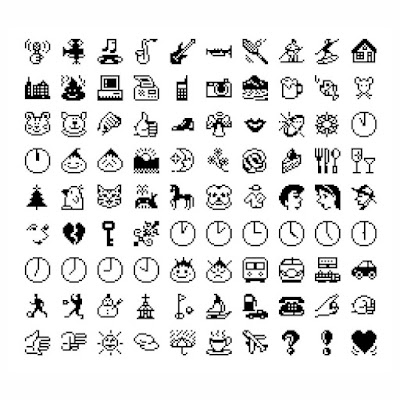
The original JPhone emoji set (1997)

As silly as it sounds, I decided I was not going to use emoji when I realised I didn’t know what any of them were supposed to mean. Their implementation as a keyboard on my phone, one that required me to select it over the regular English keyboard, made me think they act principally as pictograms, to use as word replacements – like a lexicon, but not like a rebus. Unable to find any kind of glossary, mainly because meanings applied to particular emoji are reached over time by consensus, rather than being prescribed, I decided I was better off not using anything that could cause confusion or misunderstanding – it is hard enough doing that using English words.

Mind you, I never used emoticons or Wingdings, both intended to add simple pictures to messages like adding a sticker, so I didn’t see the line that led to emoji. Wingdings was hampered by relying on both the sender and receiver having access to the same font, and emoticons were made less clear by having to be read on their side >:/ 8-> >:-( Analgoues to both systems are found in Japan, through kaomoji (“face character”, read in the same direction as text (ˊ•͈ ◡ •͈ˋ) ૮⸝⸝> ̫ <⸝⸝ ა), and in emoji (“picture character”, with no ties to emotion or emoticons).

With the latest Apple mobile system upgrade to iOS 15, I am now seeing emoji suggestions in their predictive text feature, and I cannot disable this feature, let alone the entire emoji keyboard. I know my mother only uses emoji other than a smiley face in text messages to me if they are suggested to her, like the fish that accompanied a mention of the McDonald’s Fillet-O-Fish. My biggest exposure to emoji has been on social media, where they are used to point, promote, and to clap between words to emphasise points being made. If I have ever used one at all, it may have been for effect, but it was too long ago for me to remember, and I can’t see any reason to start now.


Essentially, emoji began like Wingdings, as a proprietary font available only to users of a particular phone in 1997, the SkyWalker DP-211SW from JPhone, now SoftBank. A competitor, NTT DoCoMo, implemented their own emoji across their i-mode platform, beginning the mass usage that culminated in companies like Apple and Google supporting emoji in Japan first, and the need to attach emoji to Unicode, the international text standard, in order for the same images to be seen between different devices. This led to many pictures that existed in Unicode becoming emoji, including those previously added to the standard from Wingdings, Webdings and Zapf Dingbats.

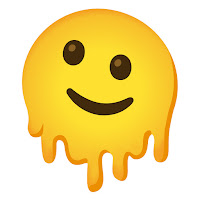
New emoji are added yearly, and Unicode’s emoji proposal guidelines [https://unicode.org/emoji/proposals.html] are specific in what must be excluded, like logos, exact images, or having meanings that are transient or very specific – openness to interpretation and usage is built into the process. Therefore, when the “Melting Face” emoji was included in Unicode 14.0 and Emoji 14.0 from September 2021, people jumped on it as a symbol for our current times, a kind of sarcasm as things fall apart. Indeed, Jennifer Daniel and Neil Cohn, who conceived it two years before, intended it as a kind of embarrassment, a Western version of when Japanese manga characters turn into paper and float away. It sums up my inability to use such an established communication system perfectly.

03 April 2021

RETURN TO SENDER, ADDRESS UNKNOWN [290]


Here was the idea I had:

After nearly five years, I had reached the conclusion that I could use a website address that was shorter than www.dancingwiththegatekeepers.com, ideally one that used my name. This was compounded when, after describing what I wrote to someone at work, I had to write out the site address for them, instead of confirming what top-level domain followed my name, whether it was .com, .co.uk or .net. I could also do with getting some business cards printed, but that can follow later. For the record, this is not because I am phasing out “Dancing with the Gatekeepers” from my site – if something like that comes to you in a dream, you use it, and you keep it.


Here is where we are now:


I am now the owner of the address leighspence.net - entering this into your web browser will redirect you to www.dancingwiththegatekeepers.com. I chose the top-level domain .net, one of the first such domains to be introduced on 1st January 1985, because of the hard T sound making it clear to anyone who asks for my website. (The other six domains introduced onto the internet on the same day were .com, .org, .edu, .gov, .mil, and .arpa, as in “Arpanet,” the predecessor of the internet.)


As convenient as this sounds, the original plan was to have leighspence.net as the main address, and www.dancingwiththegatekeepers.com would be retained as a redirecting address. I hadn’t realised how that wouldn’t work.


I am sure that, if you have read any of my articles before, it is more because you have seen a link to it on Google, Twitter, Facebook or Instagram, rather than going straight to the website. I thought that, as I own both addresses, you could have the individual weblinks, or “metalinks,” for each individual article, remain under www.dancingwiththegatekeepers.com, while future articles would use leighspence.net in their metalinks.


That was naïve. Instead, changing the main address for the website broke the connection for five years of existing links, which is when I realised that these were the more important web addresses of them all.  I could have added the new address to the metalinks, but there are nearly three hundred of them, and any connections they have made with anyone will be broken by this action – it would be like rebuilding the connections I have made from scratch, and I am not prepared to do that. 


What I am left with is the remnants of a good idea. I guess I could copy across my work to a new website that uses leighspence.net, but that would also be starting from scratch. I don’t honestly know what the best option would be. Does anyone have any ideas? 

13 June 2020

WE'RE LEAVING TOGETHER [246]


Taking a look at Twitter, I see Debbie Harry and Kate Bush are trending. The BBC had shown two episodes of “Top of the Pops” from 1989, repeating old performances they made. As ever, that was not why they were still trending from the night before: it was from people opening Twitter themselves, and expressing thanks that they hadn’t died, because seeing their names trending got them worried for a moment. Of course, writing their names out one more time feeds them back into the system, and the process continues. My sincere hope is that, one day, this will happen to Twitter itself, and no-one will have reason to care.

I have maintained a presence on Facebook and Twitter since 2009, initially to avoid being impersonated, and later just to keep up appearances, as more people made social media their primary form of communication. Today, these accounts are only used to promote my writing, along with an Instagram account I recently started, in order to keep a hand in there. (I should point out that most referrals to www.leighspence.net are from searches on Google, far outstripping social media.) Outside of these, I have no reason to engage: Twitter is a place for people to shout the first thing that comes into their heads, usually about how what they said previously was taken out of context; and Facebook is for parents posting pictures of their children. Instagram is for selfies, but we knew that much already.

There will come a time when social media will end – sites will either be legislated out of existence, or people will get bored and wander off. Either extremism and fake news will be dealt with, or people will just have to learn how to speak to each other properly – which they have increasingly been doing via by video conferencing services, like Zoom, FaceTime and Microsoft Teams, instead of social media. This is much healthier than measuring your influence and wealth by how many followers you have. If you really need to let people know what you think about something, get a blog, or ask Google to resurrect GeoCities.

I have no answers on what would happen after social media is ended, because the next question would be what to do with the data that sites were allowed to collect. For as much use as it could have in anonymised form, identifying and targeting specific groups of people with only the services they could want, the data collected will immediately become outdated and irrelevant the moment that collection is stopped.  

There is precedence, in the form of Bebo and MySpace – just delete the data, put it beyond use, and move on. The former was a site that was founded after Facebook in Twitter, in 2005, and closed when it went bankrupt in 2013. Meanwhile, MySpace has remained in business since 2003, but use of the site had peaked by 2009, and what remains is ineffective. Bebo’s bankruptcy led to the announcement that user data would be deleted, although account holders were given the opportunity to download what they had entered first. MySpace, however, returned to public consciousness in 2019 when a server move led to their pre-2016 records being corrupted and lost, with a banner warning of this remaining on their front page – for those who were shocked into remembering they still had account, their data was now irretrievable.

Admittedly, I do not know where I am going with any of this, but I would just like to think of a time when there is no social media anymore. Everyone will be out of their respective bubbles, I have no obligation to maintain a presence there, and presidents will have one less way to bully their people.

20 October 2019

WHEN YOU TELL ME WHAT WILL BE [203]


I don’t like being given opportunities to feel old, especially as I am still in my thirties, but the inevitability of progress in technology, working against my human stubbornness to adapt to a new way of working, will provide more situations to reflect on where that progress leaves you.


What am I talking about? It’s more that I don’t expect my devices to talk back at me, mainly because I turned off their ability to talk. Even more, I have turned off their ability to evaluate my commands.

Before I make myself sound even more paranoid, this is based on the principle of knowing that, if I want something, I will ask for it. I will not say “Alexa...” or “Hey Siri,” “Hey Google,” “Hey Cortana” – I’m not really a “hey” kind of person – and expect the artificial intelligence based on previous interactions to throw up what it thinks is the right answer, or what is the first answer, or the answer most accessed by others. 

The only virtual assistant I do use is Siri, on my Apple TV box, purely to speak the name or title I want to search on YouTube, Vimeo or the BBC iPlayer, an expediency over just typing it, which is the final resort when it doesn’t accept how I’ve pronounced a vowel.


While the debate over the application of virtual assistants is currently focussed on the microphone – your voice being recorded and analysed, even when you are not using it – my concern is on its ability to act as a bridge in human thought, making evaluations over the answer it thinks I will need, without informing me on how it came to that decision. There is an implication of trust on my part, which turns into a lack of trust in practice.

If so, why am I happy using a search engine like Google? Is it the trust gained over twenty years of usage, that virtual assistants need to demonstrate? (Siri, the oldest of them, began in 2011.) Is it having a screen to view the answers of the search engine providing the illusion of choice? Is it that the algorithms that influence the search results are more well-known? (For Google, PageRank evaluates the links to pages, and between pages, Panda promotes higher-quality sites, while Hummingbird emphasises natural writing over forced keywords – how am I doing so far?)

Perhaps, I am still looking at virtual assistants as being in their infancy, as having pretensions over previous voice-activated units that acted as glorified hands-free switches. It comes back to trust over the answers I would expect them to give, if I tried to use them. I just need something to explain how they came to their decisions, like a screen, and something to choose and edit the answer, like a keyboard.


07 July 2019

BUT I’D RATHER STAY ON THE SOFA [184]


In his video review of the “Huge Screen ver. 2,” a cheap LCD game, Dr. Stuart Ashen wondered if he would have a good time playing it. “Yeah I know it’s not going to happen. Join me after the break.” The screen fades to black. A caption appears: “There are no advertisement breaks. This is the internet.” The previous shot fades back in: “Oh yeah, that was weird. Thought I was on television for a moment. Hmm, I’d probably know I was on television because I’d be being paid.”
This video was posted to YouTube on 25th October 2010. Nine years and over 400,000 views later, I’m watching it on my television, preceded by an ad for the National Lottery. I only came across the “ashens” channel over a month ago – the first video I came across was the “Chicken in a Can,” a lunch / autopsy hybrid that included the bones and giblets. At that point, the channel had 774 videos available – diving into it is like deciding your next box set to watch will be “Coronation Street”.
I am beginning to think that “ashens” – subtitled “Comedy, Technology, Idiocy” - may well be the archetypal YouTube channel. It is almost as old as YouTube itself, and has evolved both with it and because of it – what must have started as a bit of fun became a career because the platform evolved to accommodate the more professional videos people have posted to it. YouTube is not social media, it is public access television, in the same way that Facebook and Twitter are really publishers.

Ashen’s first video on the channel was “The Truth About Open Source,” a skit made using action figures and computer effects, about why you should pay for licensed software. It is typical of the short, funny videos people first placed on YouTube, when people were testing it to see what worked there – not everyone can put up their day at the zoo. It was posted on 25th February 2006, only two months after the platform officially launched, and nine months before it was bought by Google. Video resolution was only 320 x 240 pixels, and a ten-minute limit on video length was imposed to deter the pirated upload of TV shows, although you could post longer videos if you respected YouTube’s terms of service.
Widescreen was introduced in November 2008, prompting Ashen to post a video warning YouTube about the sides of the screen they were now exposing: “That’s where the monsters live... that one’s got a hat on.” By this point, the other type of videos he posted became more prominent, as they were elsewhere on the platform: show-and-tell reviews of products, mostly bad ones, framed against the stage of a brown sofa. His second video was the first of the “Pop Station” LCD game consoles, endlessly rehashing poor games with incoherently-translated instructions, but it would take two years for these occasional videos, co-existing with Noseybonk and other sketches, before it would gain the “Hello” opening title card they have used to this day.

I would not normally watch “unboxing” videos, but if you base these types of videos around obscure or poor technology, mundane or badly made “tat” from Poundland, and exotic or expired food and drink, there is much scope to apply dry wit and sarcasm to what you uncover. Because Ashen’s videos are usually unscripted, they usually also serve as their own “reaction” videos, a category of YouTube video that is also prevalent – I am aware that someone did a video reacting to the “chicken in a can” video, in the perfect example of media eating itself.
However, Ashen has continued to make space for comedy, adding an edge to the unscripted reviews. For example, a video that involved clearing a drawer of items to be reviewed contains a sketch about creating the dice that will determine the fate of the objects, loading their eventual destruction with great symbolism. One video was ended by sticking a cartoon frog into a corner while bizarre music played, because it can be done. One review, for a toy violin, was abandoned and re-recorded because Ashen broke down laughing at the poorly translated English on the box, explaining that master violin creators were “nicolas, Marty,” “Antonio Stella bottom tile,” and “ji plug pu – melon nai” – the two videos have a total of nearly two million views between them.
I am aware I haven’t mentioned the feature films yet – the science fiction fantasy comedy “Ashens and the Quest for the Game Child” (2013), and the upcoming “Ashens and the Polybius Heist”. You know you have done well when you can raise the money to make your own film, but when you can get Robert Llewellyn from “Red Dwarf,” and Warwick Davis from “Celebrity Squares,” you name must have some cachet. Oh, and the books: “Terrible Old Games You’ve Probably Never Heard Of,” and “Attack of the Flickering Skeletons: More Terrible Old Games You’ve Probably Never Heard Of.”

(...And how could I forget to mention “Chanticleer Hegemony,” a Pop Station LCD game that featured on a box, but not inside it, and was tracked down after five years, only to find it was literally a cockfighting game, because that was something someone made.)
As Ashen explained on the BBC’s “Newsnight” in 2015, when the word “unboxing” made it into the Oxford English Dictionary, the ultimate reason for doing these videos is because people want to watch them:
“I think when, in the past, when you wanted to buy a new product, you would be very led by advertising, the only things you could see would be in adverts, or perhaps in a very controlled environment, like a shop, whereas people like the raw honesty of just, here is a box, and here inside is what you will get if you buy it, and if we can make that entertaining while we show people it, it’s all good.”

This is the point where YouTube became a professional platform, as in people could begin earning a living from their work. The partner program that began in May 2007 currently pays revenue to channels with more than a thousand subscribers, and more than four thousand hours of time spent watching their videos within 12 months – the latter requirement was added in 2018, a consequence of both the increased number of channels with multiple subscribers, but also the increasing professional standard of the videos posted, as watching online video eats away at traditional television – any video scoring over 100,000 views within a week is already beating most television audiences on satellite and cable television in the UK, and anything over a million views is approaching BBC Two and Channel 4 primetime figures.
I am glad that the YouTube algorithm somehow suggested “ashens” to me, as I haven’t laughed so much in a long time – that can be put down mostly to the toy violin. What it has taught me is that if you think you have a video something that people find funny, put it out there, and make sure they know about it. I should try it myself - if a comic monologue can be wrenched from jelly beans, I could make a video explaining how Quorn could be made in more interesting shapes, then present a blue pyramid of the stuff.
However, to start a career on YouTube, I would need to start by posting at least ten videos, of ten minutes in length, that would get at least 2,400 views each year, with everyone watching to the end, with nearly half of them deciding to subscribe for future content – that is the minimum before I even see a penny from YouTube, unless I get sponsorship. Perhaps, I should make something for fun first.

12 November 2018

GET READY FOR THE SQUARE DANCE [135]


Watching YouTube involves a lot of understanding. You understand that the people creating the videos are most often people at home, who have turned a passion into a paying job. You understand that, to earn a living from their passion, they need to advertise, seek sponsorship, and offer subscriptions for more content. You understand the advertisements you see are what pays for your ability to watch the videos, and what contributes to the creators’ income. You understand that Google, YouTube’s owner, will take the information generated by your having watched the videos to target you with the ads that will attract your interest the most, to ensure you continue watching.
However, what I don’t understand is why YouTube is bombarding me with ads for only one company. In one evening, across six videos, five of them started with different ads for the same website, two were interrupted with another ad for that website, and when one of these videos joked that they were going to be interrupted with an ad for the new “Grinch” film, they were interrupted, but did so to repeat the same name once again: Squarespace.
With the videos I watch on YouTube – usually lots of comedy and factual pieces, film and technology reviews, documentaries, and monologues from Stephen Colbert – you will often come across introductions saying, “this video is sponsored by Squarespace,” and will end with something explaining how the creator of the video has been taking a course on Squarespace to improve their editing skills, or something like that, and you can do the same when you sign up using the discount code that sounds a bit like the channel name.

What I didn’t realise is that Squarespace, much like Google, aims to be the complete package. It was founded in 2003 by Anthony Casalena as a website builder, allowing users to create their own sites using drag-and-drop templates, without a need to know complex HTML code. Later, e-commerce functions were added, and online tutorials and classes appeared to give users greater ability to fulfil their online business. Even the name “Squarespace” gives it a more collegiate atmosphere than Google, even though both sites were founded out of college dorm rooms – just what is it about college dorm rooms?

I can see why the barrage of Squarespace ads may line up with the videos I watch – Google knows I run a website, and I write weekly articles on it, so it may be trying to be helpful. The same videos may also be sponsored by Amazon’s audiobook shop Audible, or various internet security services, and I can see why Google may not prioritise those ads. But this is it – Google knows I run a website because Google hosts it – why would they recommend someone else? Do they realise what they are doing or, at least, do their algorithms know? Should I try watching other types of videos to throw them off their scent, or should I start subscribing to YouTube’s premium service to get rid of the ads altogether? That would be very cynical indeed. Perhaps, by posting this article online, some algorithm somewhere might get the point?

06 August 2018

AND IT WAS ALL YELLOW [121]


On 1st September 2017, Yell Limited announced the next edition of the Yellow Pages will be the last, with the final Brighton edition for 2019 coming fifty years after the book was piloted there. Like Pears’ Cyclopaedia, whose final edition, after 120 years, was announced by Penguin Books on the same day, when did anyone last use the Yellow Pages?
Let’s see: opening up the final edition for my area, which arrived last month, I randomly find the category “Video & DVD Hire & Retail.” In the UK, the final Blockbuster Video closed in 2011, and the first Blu-ray disc went on sale in 2006. Yes, the same category in the previous year’s Yellow Pages didn’t have anything listed under it either, save from telling me to turn to the section titled “Music Shops (CDs & DVDs)”. Both editions have only one listing there, for an independent record store based over thirty miles away, in another county altogether – there is one in my home town, and it is not listed, along with three others I can think of, and perhaps many more besides them.
Before getting on to how the internet changed everything, TV ads for the UK Yellow Pages focussed entirely on the good things in life, rather than just referring to the book when you have a blocked drain or a broken window, which were the examples they gave. Instead, you have the examples of how it can solve problems for the better, like finding a French polisher before your parents get back, or finally finding a copy of the book on fly fishing you once wrote. On the other side, businesses will want to pay to advertise in the Yellow Pages because everyone is likely to use it – I remember the banks of shelves in my local library that collected all the phone books for the whole UK, but I haven’t been there in some time.
Bristol 2005-06 and 2016-17 editions
Now, there are simply easier, quicker, cheaper and more effective ways of finding the same information, and this was foreseen very early. Yell.com has operated since 1996, pre-dating Google by two years, and offers free listings for businesses, while continuing to make money off both online advertising and their directory enquiries number 118 247, which began in 2003. Their main competitor, the Thomson Directory, launched when British Telecom took over Yellow Pages production from Thomson in 1980, has already ended in print form, and now specialises in website design, SEO builders, and all the stuff to make your business easier to find online – their 2014 printed directory, which I found in our garage, didn’t list even one music shop. Even the major classified ad magazine Exchange & Mart converted to online only in 2009, and forms the backbone of classified ads for a number of local newspapers, although 2009 was also the year I opened an account with eBay.
The end of the Yellow Pages is really just another story of something ending that we already thought had done: it was still relevant where the enormously comprehensive books could not fit through your letterbox, but some novels are longer than the 192-page final edition I received. However, the “let your fingers do the walking logo” will continue online – it was originally designed for the US Bell System (now AT&T) in 1962, but because it was never trademarked (and AT&T were too late when they remembered to try) it is now in the public domain, alongside the gay pride flag and the Smiley Face. I could use it to launch my own Yellow Pages, but I’d need to Google the information to go into it.

24 February 2017

WE’D LIKE TO KNOW A LITTLE BIT ABOUT YOU FOR OUR FILES [43]


I suppose I shouldn’t be at all surprised about what I read on Facebook, given the measures being currently rolled out to combat “fake news” articles, but what surprised me more was an advertisement that appeared in the middle of the long procession of updates from family members and work colleagues. Somehow, Facebook’s data and algorithms suggested I read an article, first published by “The New York Times” in October 2016, titled “Is It OK to Find Sexual Satisfaction Outside Your Marriage?” The article turned out to be the from the newspaper’s problem page, which also answered a query about smoking after beginning a new health insurance policy.
I certainly didn’t need to read it – it’s not a case of, “she doth protest too much,” I’m just not married, and I don’t smoke – but it made me wonder what it was about me, or my associates, that made Facebook suggest this to me. An algorithm is not “artificial intelligence,” in which case it would have known better, but all it had to go on is the information we had all been feeding into it.
Later the same day, my thumb clicked on the wrong “Maps” app on my phone, clicking on the app provided with the phone, and not the better one I usually use. Somehow, without me never having asked it, the app had plotted my usual journey to and from work, even down to marking the two ends of the line as, “Work” and “Home.”

We had this coming. Tesco Clubcard, the supermarket loyalty card launched nationwide in 1995, may be the first time most people had come across the idea of “Big Data,” where the data being collected was so large, so complex, that the ways of storing and reading through it had to change. The results, however, caused Lord McLaurin, a Tesco executive, to declare, “What scares me about this is that you know more about my customers after three months than I know after 30 years.”
We rely on “Big Data” to anticipate our needs, demands, and wishes. What that means, however, is that companies can no longer be in a position to guess what people might need. Tesco has expanded enormously over the twenty years since Clubcard began because it knows exactly what it needs to buy – it is a business that no longer needs to anticipate demand, in the same manner as Facebook, Google, Apple, and so on.
However, in the rush to accept the more convenient future that Big Data can bring, we often rush past the Terms & Conditions to press the “Accept” button, something I am also guilty of doing, in the name of convenience. Would we be less accepting to give away our information if we took the time to read through the T&Cs? R. Sikoryak has created “Terms and Conditions: The Graphic Novel,” a 94-page comic adaptation of the Apple iTunes Terms and Conditions but, with this being unauthorised, is it against Apple’s business plans to make their conditions more entertaining to read? Does it no longer matter? I have a good idea for Netflix’s next big show.