Showing posts with label bruce springsteen. Show all posts

17 August 2025

DON’T BE AFRAID, 'CAUSE THERE’S STILL TIME [507]


In the 2024 film “I Saw the TV Glow”, a trailer for “The Pink Opaque”, the Young Adult Network drama enrapturing the isolated teenagers Maddy and Owen, includes the line, “It can’t hurt you if you don’t think about them”. This hits home toward the end of the film as Owen, eight years older, having resisted the call to escape his passive small-town life, tells himself, “It’s not real if I don’t think about it.”

I heard the second line when I first watched the film, but I only caught the first line on my second viewing. Owen tells himself to dismiss Maddy’s plan to take Owen back to the world of “The Pink Opaque”, to reassume his real identity as a character inside the show itself, having been banished to the “Midnight Realm” of our world by the “Big Bad” Mr Melancholy in the show’s final episode. Hearing the first line clarified to me the peril of staying blinkered to what needs to be confronted.

Films are not made to be watched like TV programmes, screen vastly reduced in size, sound compressed and funnelled down to small speakers, viewing spaces not acoustically optimised. I expected to get the most out of “I Saw the TV Glow” with a second viewing, but I had not expected to need it. So, harking back to my film studies degree, I was in a quiet room by myself, with pen, paper and (this time) a PDF copy of the script on standby, fully prepared to rock footage back and forth to ensure I hear each line correctly. It wasn’t that anyone mumbled their lines, even if the lead characters are teenagers, but I clearly didn’t have the volume up high enough on that first viewing.

I wanted to see “I Saw the TV Glow” for some time – no physical Blu-ray release has happened in the UK, so after a year I resorted to streaming the film, and I was not disappointed. The film’s allegory for the discovery of transgender identity, which I now know is also called the “egg crack” moment, preceded it, its writer/director Jane Schoenbrun reportedly having begun writing the script at the outset of their own transition process. 

The “white draft” of the script, dated 31st May 2022, had a lot more jumping between different periods of time, which I took as evidence of the cracks appearing in the characters’ reality appeared, but the finished film proceeds more linearly to concentrate on Maddy and Owen’s relationship with the “Buffy the Vampire Slayer”-like show “The Pink Opaque”, a title I am guessing is deliberately, well, opaque, only because I don’t know why Cocteau Twins used it as the title of their 1986 compilation album.

Aside from self-inflicted sound issues, I had some frustration “I Saw the TV Glow” on its first viewing. For instance, there is a point where shots of “our world”, presented by the film’s regular widescreen aspect ratio and pin-sharp picture, overlaps with the squarer VHS-quality picture of “The Pink Opaque”, realities passing between resolutions. The second viewing confirmed this already elsewhere as the shots of the show’s character of Isabel are shown are repeated in both forms, and in parallel with Owen in “our world”, which I should really be calling the “Midnight Realm”. Later, as Maddy – or Tara, as she is called in “The Pink Opaque” – has an almighty long speech about what happened to her, how she crossed dimensions, and how she came back to get Owen. The script had Owen watching her monologue as intently as he watched the show, physically breaking up the long passages, but none of these reverse shots made their way into the finished film, making it look easier for Owen to dismiss the story later as a long ramble.

However, what I appreciated on the second viewing were when the parallels were drawn between Maddy and Owen, and Isabel and Tara. The pilot of “The Pink Opaque” had Isabel not knowing what was happening to her as her telepathic powers became apparent, later serving her in defeating foes with Tara, who lived in a different county – in the “Midnight Realm”, Owen can’t say more than a few words to Maddy, but they communicate via cassettes of the show, left in a neutral location to pick up. 

Elements from “The Pink Opaque” also appear in the “Midnight Realm” – an ice cream van, the ghost tattoo from Isabel and Tara’s necks – to reinforce the magic link between the worlds. I never had a show I loved enough to substitute for real life – I loved “The Simpsons” at their age, but not that intently – but with Tara being Maddy’s favourite character, and with her saying the show feels more real than real life, you are primed as an audience for when reality eventually flips...

...which is why Owen, as a character, is confounding. As a trans woman, I initially didn’t have the words for what I was beginning to realise about me, but I got them in the end, and acted upon them. Owen, however, doesn’t appear to make the connection when it is presented to him. As a teenager, he doesn’t know if he likes girls or boys, but he does like TV shows, going so far as saying, “When I think about that stuff, it feels like someone took a shovel and dug out all my insides. And I know there’s nothing in there, but I’m too nervous to open up and check” – even when he does, he closes himself back up. 

This passivity makes Owen a character without agency, consistently immobilised from saving the day, or himself – when Maddy tells him of his initial plan to leave town, he tells another friend’s mother that he “needs to be grounded”: “You can’t let me leave here with her. I don’t want to leave home.” Through the film, we see an adult Owen in front of a fire, alone in a forest at night – in the end, he puts out the fire.

This makes one scene particularly jarring upon watching it a second time, and after reading the script. Upon seeing the final episode of “The Pink Opaque”, Owen puts his head through his TV screen. His father pulls him out, Owen yelling, “this is not my home! You’re not my father!” He vomits something, obscured by the scratchy neon effect added to it – it is not just the “glow” of the TV, it is meant to be soil, from having been buried alive. You are left to assume this horrific moment was repressed by Owen, or repressed for him.

What starts as psychological horror film becomes a tragedy. The chalk drawings are topped with the message, “There is still time”. I have heard this sentiment, in the same context as “I Saw the TV Glow”, in two songs, Supertramp’s “Take the Long Way Home” and Lisa Lougheed’s “Run With Us” – hell, throw in Bruce Springsteen’s “Dancing in the Dark” as well. The film does not explicitly say its story acts as a transgender metaphor, although its pink and blue colour palettes acts as a guide, but when a piece of art connects with you, you will see what you need to see, eventually.
02 June 2019

BUT I’M NOT LETTING YOU OUT OF MY SIGHT [178]


Never underestimate the toughness of a Compact Disc. I’m not talking about the episode of “Tomorrow’s World” where one still plays after Kieran Prendiville smeared jam on it, because that never happened – a report on the BBC’s “Breakfast Time” showed someone doing that with honey, while Prendiville was presumably safe at home in bed.
What I am talking about is owning a CD playing as perfectly as when it was pressed in 1987, a testament to the error-correction technology built into CD players as long as forty years ago, and the record company printing instructions on how to care for it inside the cover.  
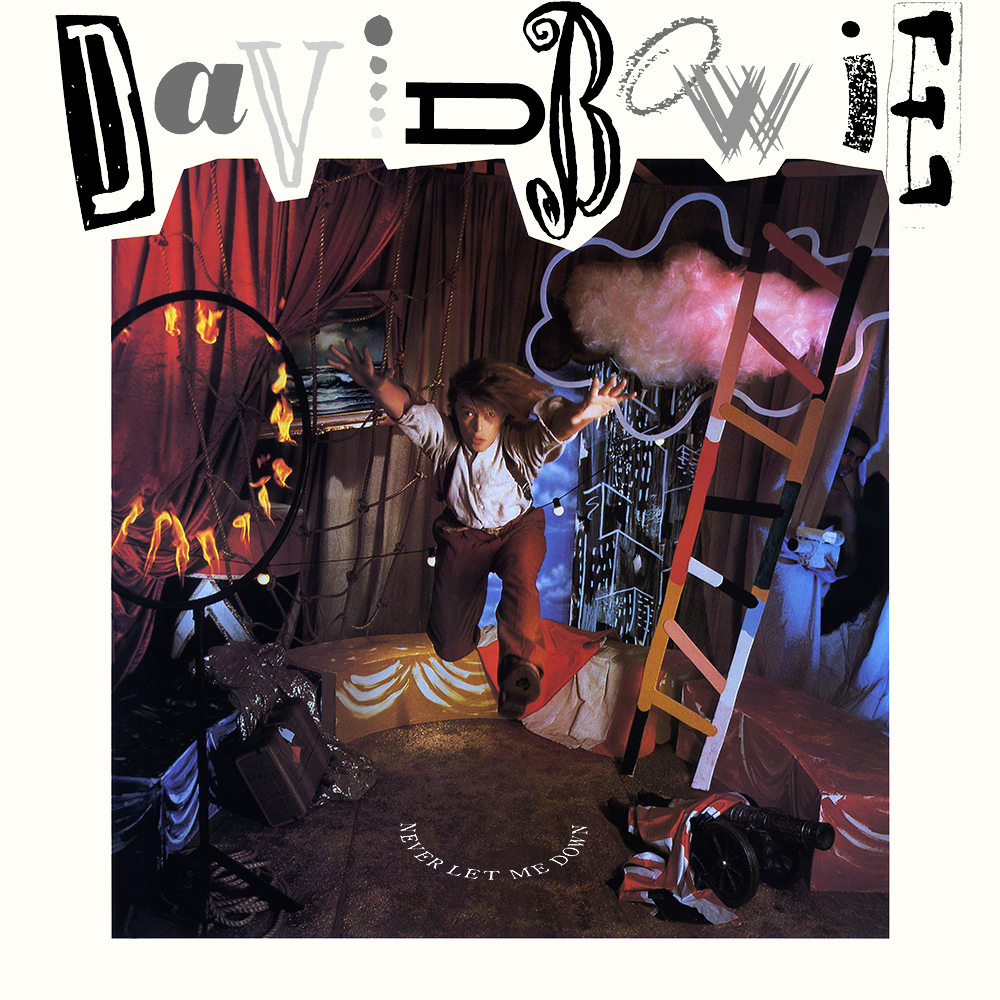
Why do I have a CD as old as this? It is because David Bowie disliked a song on one of his albums so much, it was deleted from all future releases of it, even after his death. Its only other release was a rare promo record in the US, before the record label decided not to release it as a single. 
The song is named “Too Dizzy,” and I quite like it.
When David Bowie released "Never Let Me Down” in 1987, it became one of his biggest-selling albums. Having scored a phenomenal hit with the “Let’s Dance” album, resulting in a scramble for bigger stadiums than usual to play the Serious Moonlight tour, “Never Let Me Down” needed to play to a much wider, much broader audience than would have taken in Major Tom, Ziggy Stardust, and the Thin White Duke.


However, “Never Let Me Down” became one of David Bowie’s least regarded albums, particularly by Bowie himself, who described playing to the broader crowd in the 1980s as his "art-school Phil Collins" period: if the audience should be at a Phil Collins gig, then what was he doing? Like “Let’s Dance,” and 1984’s “Tonight” album, “Never Let Me Down” is less the work of “David Bowie,” which remained a stage name throughout his life, but more the fit, healthy and perfect David Jones, about to get his teeth fixed.

"Never Let Me Down" is the most commercial album David Bowie ever released, in that its polished, smoother sound could have come from other 1980s artists. Its synthesised sound dates the songs, and is reminiscent of Bruce Springsteen's "Born in the USA" album – “Beat of Your Drum” sounds close to “Glory Days.” Lyrics are concerned about social problems - "Day-In Day-Out" talks about poverty, while "Time Will Crawl" deals with ecology and nuclear paranoia after the Chernobyl disaster. Oh, and the actor Mickey Rourke does a rap on one song too - on a David Bowie album...
If anything, "Too Dizzy" is a welcome breeze, following the statement on Margaret Thatcher that was “87 & Cry.” A very upbeat song about 1950s teenage jealousy, and apparently a throwaway song written to see how Bowie worked with instrumentalist Erdal Kizilcay, “Too Dizzy” could either be seen as a breather from the socially aware songs on the album, or a distraction from them – that Bowie was surprised he left it on the album suggests the latter.

With a sound that demands to be played on big speakers as loud as possible, ”Never Let Me Down” feels good on the surface, and is worth a listen in the mood for a hard slap of Eighties, but it doesn’t feel like a David Bowie album. Bowie had always intended to re-record the album at some point, and the group that did so in 2018, for the “Loving the Alien” box set, had been chosen by Bowie before his death. The new version of the album sounds more stripped back and folk-like, more strings and brass in place of synthesisers, which mostly benefitted “Zeroes,” a song about the music of the late 1960s – you can hear the Mellotron now. However, Erdal Kizilcay has been left out of the album entirely, including “Too Dizzy,” and was considering a lawsuit if his arrangements were used without credit or compensation.
Would “Too Dizzy” have fitted among the re-recorded version of “Never Let Me Down”? It has a very peppy sound, with lots of saxophone, so making any change to that would be reductive, even if it would make it fit more with the rest of the album. Perhaps the song could be released as a separate song, but to prevent its release in any form just seems strange.
For me, there does come a point where, if you have put something out into the world, then change your mind on how you think about it, you can't then decide it didn't happen, especially when it really isn't that bad. No wonder Bowie finished the 1980s by submerging his ego in the hard rock of Tin Machine for a while.
I still love David Bowie and his songs, but rock gods are not infallible.

21 May 2018

AND WHO WOULD HAVE THOUGHT, IT FIGURES [110]


Nine months after promising myself that I would upgrade my iPod nano to a Sony Walkman [link], I have done exactly that, when the iPod stopped working for a few days. I have now launched headlong into the devotional task of loading my CD collection of twenty-plus years onto it – the first purchase, from Virgin Megastore in Portsmouth, was of “Jagged Little Pill,” by Alanis Morrissette, and “Now 35.”
Apparently, my NW-A45 Walkman can play “HD Audio,” which Sony defines as anything above CD quality. I had not looked into this before buying it, as my main intention was to find something that can accept a 200 Gb micro SD card – Sony says it can take a card with ten times that capacity, but none has been made yet. However, if this Walkman is expected to beat CD quality, then I can leave MP3 behind: in 2015, Ryan Maguire reconstructed a version of Suzanne Vega’s atmospheric song “Tom’s Diner,” used in the 1990s as a control when testing the “lossy” codec that compresses sounds into MP3 format, that only plays the sounds that were, in effect, discarded – enough sound is left behind for you to still identify the song as “Tom’s Diner.”
After some research, I now have the definitive advice for converting your CDs, which I will be using on my entire collection: only use FLAC (Free Lossless Audio Codec) format, setting it to 44.1 kHz 16-bit if you have the option, because this matches the settings of the CD.


The “lossless” element of FLAC, a format that has been around since 2001, means all the available information on your CD is being retained. Because of this, you do not set a bitrate of kilobits per second like you would with MP3, because that rate will change with the song. Using the first CD I converted, “Hot Potatoes: The Best of Devo,” there is a difference based on the type of song: “Devo Corporate Anthem,” a simple fanfare, reaches a maximum of 655 kbps, while “Through Being Cool,” a more involved, complicated, recording has a maximum of 871 kbps. A few Bee Gees tracks I have break the 1,000 kbps barrier, louder and richer than the Devo recordings, which proves what you can still get from a CD if it has been mastered correctly.
Put in as simple a manner as I can, CDs use a 44.1 kHz sample rate because it is twice the 20Hz to 20 kHz range of the human ear – it also matched the highest usable rate for recording digital audio on video tape - while the 16-bit pulse-code modulation used to digitise the sound, the latest development of a technology initiated to reduce the noise in long-distance phone calls, means the amount of detail picked out by the technology is more than “enough,” with a grove that won’t wear out like vinyl will.
What this does mean is that, if you have a CD that is “24-bit remastered,” this is talking about the digital master used to make the CD, which will still be 16-bit, even if more detail is available to sample. As an example, I have a 24-bit remastered copy of David Bowie’s album “Never Let Me Down,” but I also have the original 1987 release, because Bowie hated the song “Too Dizzy” enough to leave it off all subsequent reissues. The song “Beat of Your Drum,” with a chorus sounding like Bruce Springsteen’s “Glory Days,” is 34.3 Mb in size when taking a FLAC copy from the 1987 album, but the 24-bit mastered version raises this to 36.6 Mb – the difference is there, but you need a very quiet room to start with.

But with Sony highlighting the enhanced “experience” of HD Audio, the extra resonance adding to the recording, I feel like I have already achieved that, for now, by leaving MP3 behind, regaining the lost layer of sound from my, in some cases, decades-old CDs.

11 March 2017

AND I WON’T MENTION MY TEN THOUSAND HOURS IN TRAINING [45]


I own an alto saxophone, having written about the allure of them previously [www.leighspence.net/2016/07/you-better-play-that-sax.html], but I cannot yet play it. One day, I hope to play it like an artist uses a paintbrush, but I am aware of how much practice it will take to get there…  mainly because a number has now been put on it.

The number ten thousand, to me, is a number that is “just about right,” a big enough number to be counted as a “big number.” If you were going on a TV game show, a jackpot of nine thousand pounds sounds like a big enough number, but TEN thousand... We do many things thousands of times in our lives, but if you can look someone in the face at the end of the day, and say you walked TEN THOUSAND STEPS that day, it sounds like an achievement.

Likewise, if you can play the saxophone like Clarence Clemons or David Sanborn, it is because you spent as many as ten thousand hours practising: breaking that time down into a nine-to-five, five-day work week, minus an hour per day for lunch and breaks, and six weeks’ holiday a year, ten thousand hours becomes SIX YEARS, and a couple of months – if I start now, I may be up to the E Street Band’s standard once I hit forty years old, provided Bruce Springsteen doesn’t retire by then.


Ten thousand sounds an easy number to pick, but these two uses of it have reasoning behind them: ahead of the 1964 Tokyo Summer Olympics, a Japanese company made a pedometer named “manpo-kei” – “10,000-step meter”- which they later backed up with research that advised walking this number each day helps maintain a healthy weight. This target has since been taken up by the World Health Organisation, and the NHS considers a walker of seven to ten thousand steps per day to be “moderately active”, having walked twice the national average to get into that range.


However, practising for ten thousand hours is more difficult to prove, and even harder to justify. The figure was popularised by Malcolm Gladwell, in his 2008 book “Outliers,” which looked at why some people are able to achieve more than others. However, people took his writing to mean this number is a cut-off point, where you become an “expert” upon reaching it. The original 1993 research paper, snappily titled, ”The Role of Deliberate Practice in the Acquisition of Expert  Performance,” talked of this figure being an average – some people just get the hang of things more quickly than others. Its writer, the professor Anders Ericsson, later contended that Gladwell didn’t mention the practice had to be “deliberate” – the name of that essay, “The Danger of Delegating Education to Journalists,” makes it sound like the rigour needed to do a proper job is something you cannot teach, even if you could try to learn.

What should I do? Practice makes perfect, but practice means pushing yourself – keep walking that bit further than the last time, and learn your major and minor scales on your saxophone. Ten thousand is a target, but once you reach it, set a new one.