Showing posts with label museum of modern art. Show all posts

30 November 2025

DON’T GO FOR SECOND BEST [520]


David Fincher’s video for Madonna’s song “Express Yourself” (1989) ends with an epigraph: “Without the Heart, there can be no understanding between the hand and the mind." Inspired by the futuristic, utopian and dystopian of imagery Fritz Lang’s science-fiction magnum opus “Metropolis” (1927) – perhaps even down to Madonna’s monocle, although Lang never wore his on a chain – a similar epigram is displayed in capitals at the beginning, middle and end of that film: “THE MEDIATOR BETWEEN THE HEAD AND THE HANDS MUST BE THE HEART!”

The plot of “Metropolis” has become secondary to the visuals, not surviving the film’s being scattered to the wind following its premiere in Berlin. Its plot, a modified retelling of the Tower of Babel story, lost sub-plots and characters when it was re-ordered for Paramount’s US release by Channing Pollock, a playwright and sometime writer of the Ziegfeld Follies. Half an hour shorter than the original 153-minute length, this wider release was also seen across Germany, cut shorter still by Nazi Party censorship in the 1930s – this 93-minute version, archived by New York’s Museum of Modern Art, was pirated for low-quality public domain releases that blew out both greyscales and actors’ faces.

But the imagery shone through. Influenced by the Manhattan skyline, Art Deco and Modernism, the city of Metropolis can be found in “Blade Runner”, “Akira”, Superman and Batman comics, and Osamu Tezuka’s manga also titled “Metropolis”, itself later a film. The “Maschinenmensch” robot, designed by Walter Schulze-Mittendorf, is deliberately more human-looking for reasons explained later, and the underground workers’ city is stark in its comparative lack of detail, simple edifices below a concrete sky, the real sky only visible through grates.

The story is simple. Joh Fredersen, architect of the city of Metropolis, installed at the top of the New Tower of Babel, sees the underground workers that toil to keep the lights on above ground as “off where they belong”. His son Freder, entranced by the appearance of Maria, who came from the depths to show the underground children their “brothers and sisters” in the restricted Eternal Gardens, descends to witness the horror of the M-Machine, the “Moloch” devouring its workers, and works to bring hope. Maria, preaching from the catacombs, retells the allegory of the Tower of Babel, altered from its use as an allegory for why different languages and cultures exist: “But the hands that built the Tower of Babel knew nothing of the dream of which the head that had conceived it had been fantasising… The hymns of praise of one man had become the curses of others… The same language was spoken, but these men did not understand one another.” Freder knows he is the mediator from the start, and will link the hands of his father with the workers’ foreman at the film’s end.

The robot is the most startling image of “Metropolis”, and its reason for looking so close to human was lost among the cuts, along with scenes of the “Thin Man” enforcer trailing Freder, and scenes of the man who swapped places with Freder being tempted to join the hedonistic nightlife he previously could only imagine. The scientist that built the robot, Rotwang, is not the archetypal wild-haired, one-handed mad scientist that James Whale’s “Frankenstein” cemented, for his work to bring the robot to life was to resurrect the memory of a lost love, named Hel, who would eventually marry Joh Fredersen, dying after giving birth to Freder. Joh’s demand to turn the robot into a clone of Maria, to sew discord among the workers, is used by Rotwang as an opportunity to avenge Hel’s death by killing Freder, and to take the real Maria as a substitute. Just as Joh told Rotwang, “Let the dead lie, Rotwang… She’s dead for you as she is for me,” Rotwang’s reply is, “For me, she isn’t dead, for me she lives! Do you think the loss of a hand is too high a price for recreating Hel?”

I have previously mentioned watching four versions of “Metropolis” over the years. One was a 139-minute version on VHS, rented from a library, that undercranked the film to the extent I had to watch it on Fast Forward – that all silent films were made at sixteen frames per second is a misnomer. Giorgio Moroder’s pop music-laden version was comparatively quick, barely over eighty minutes, achieved mostly by replacing intertitles with subtitles, but the reincorporation of Gottfried Huppertz’s original hand-written score from the premiere, the original titles from German censor cards discovered in a film archive in Sweden, and many scenes from multiple sources, most importantly the rediscovery of a near-complete copy of the film in Buenos Aires in 2008, has allowed me to watch the film as near as possible to what was originally intended at its premiere.In terms of what I think about "Metropolis", I appreciate the visuals more now the full story is back in place.

11 June 2023

UNDER THE RED SKY [400]

New York City, Wednesday 7th June 2023, 18:17 ET

Between Monday 5th and Friday 9th June, I took my first holiday outside of the United Kingdom, to New York City with my parents, since beginning this website in May 2016. This wasn’t intentional, but more because my last couple of holidays have been guided by museum exhibitions, resulting in my trip to Tate Liverpool in 2019 to see art by Keith Haring, and travelling to Milton Keynes in 2021 to see furniture by the Memphis collective. To this end, expect an American flavor, instead of flavour, to some upcoming subjects.


The main takeaway from this week in New York, however, is that I experienced its worst air quality in sixty years, and walking for miles in it will sting your eyes.


I did not watch the news on the morning of Tuesday 6th June, having chosen Looney Tunes cartoons instead, but I was told the main news was the ongoing effect of wildfires in Canada. They began in March, but by June had affected eleven million acres of forest, around fifteen times more than expected for this time of year, displacing 120,000 people in the progress. Two thirds of the over four hundred wildfires were categorised as “out of control”, and their smoke was being carried south towards the north-eastern United States.


New York City, Wednesday 7th June 2023, 18:12 ET

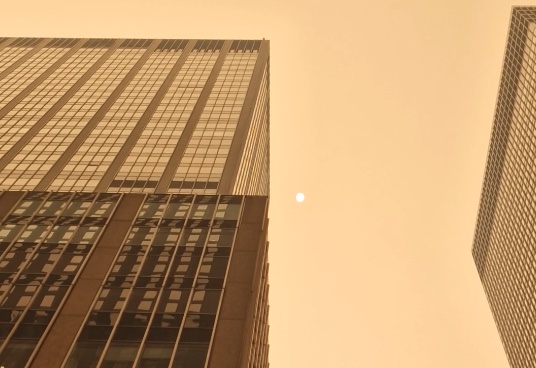
Fortunately, our plans that day took us to the Hudson River side of Manhattan and away from the skyscrapers – I am mindful enough of the tall buildings in London holding in exhaust fumes, so New York City was a perfect incubator for all the incoming particulates. All we experienced was a bit of rain, and the grey haze in the sky turning a bit yellow – otherwise, we were fine.


The air quality index used in the United States since 1968 usually puts New York into the yellow “moderate” category, with a value between 101 and 150, indicating a risk to people sensitive to air pollution, but otherwise acceptable. Overnight, and through Wednesday 7th June, this index reached 484 at 5pm local time – the maroon “hazardous” category begins at 301, described as “health warning of emergency conditions: everyone is more likely to be affected”. The highest level ever recorded on this index, New York City was briefly the most polluted city on Earth, the sky having turned orange.


On the ground, those who already wore masks from the COVID-19 pandemic continued to war them as normal, and everyone else did not. Fire stations began handing out N95 and KN95-standard masks, again left over from the pandemic, but this did not start until Thursday 8th June – by then, Mayor Eric Adams had appeared behind various lecterns telling people to curb their activity, to stay indoors, and that they could skip exercising their dog. 


New York City, Wednesday 7th June 2023, 18:17 ET

Meanwhile, my parents and me carried on as normal: the sky had become a sandy colour once we entered the Museum of Modern Art, becoming orange while we were inside. We took refuge in the toy shop FAO Schwarz, in the Rockefeller Center, and later at the Hard Rock Café on Broadway. We only heard from Mayor Adams in the early evening, having walked around more shops. We had reduced our activity, but this meant walking for eight miles instead of twelve. Despite wearing glasses, my eyes had begun to sting, but not enough for them to tear up. 


We took as many pictures of the sky as everyone else, both locals and tourists, and we had to be outside to do it. We were there for an experience, and this was the only one not planned. On Thursday 8th June, the sky was clearer, turning to blue through the day, as the wind blew the smoke further east, and we kept ourselves around the outside of Manhattan once again. Now back home, we have no side effects from the smog, but we were lucky, as we could leave. On Sunday 11th June, the air quality index registered at 109.


It is not a case that I believe in climate change, for we have experienced the effects of it. This may have been an extreme event, but it is one more likely to take place. Not modifying our behaviour all that much was unwise, but this will have been an event where the advice will now be anticipated for next time. That this event will be described as a one-off, or rare, belies the effect that, around the world, they are happening more often. If you thought you could do something to mitigate the damage caused, you would do it. If you thought you had a way to prevent it, you would do it. I only sound like I am babbling because I feel the need that someone really should be doing something.

13 August 2018

AND OTHER FRIENDS OF MINE, TAKE YOUR TIME [122]


I would love to visit New York again. While my only trip so far, in 2011, confirmed I would rather not live there – London is a beehive, but New York is a wasp’s nest – saying I visited the Statue of Liberty, Times Square, Central Park Zoo and FAO Schwartz (before it closed) is not bad at all.

We also had two art galleries in our sights: the Metropolitan Museum of Art, and the Museum of Modern Art. However, the only photographs I have of the Metropolitan Museum of Art were all taken from their roof garden, and the three I have from MoMA were for reference purposes: a portrait transmitted by RCA Photoradiogram in 1926, a print of Sir Isambard Kingdom Brunel by those chains (from the SS Great Eastern), and Edward Hopper’s painting “House by the Railroad,” which inspired the Bates House in Alfred Hitchcock’s “Psycho.”

The clearest picture of all from MoMA is one stuck in my mind, and like “House by the Railroad,” the painting was given anonymously: it was Salvador Dali’s 1931 painting “The Persistence of Memory,” presented to them in 1934. Apparently inspired by a Camembert melting in the sun, many examples of Dali’s surrealist imagery are present: melting watch faces representing the passage of time, ants representing death, a creature of some indiscernible type, a foreboding foreground shadow, the Catalan landscape, and so on. This artwork has been reproduced endlessly, and working melting clocks are now just something you can buy.
Regardless of the content of the picture, the memory that has persisted of “The Persistence of Memory” is just how SMALL it is: it is only 24 centimetres (9.5 inches) tall, and 33 cm (13 in) wide, making it a bit bigger than both A4 and Legal paper sizes. The oils are painted very finely, and having seen only photographs of the picture previously, I imagined the brush strokes would have been much larger. Dali must have had his eyes tested regularly.

I usually do not take pictures in art galleries – if I want to refer back to what I saw, I will buy a guidebook, or find the picture later online. However, what I will have taken from the visit is a sense of proportion, and a sense of colour: because so many pictures have been taken of it, “The Persistence of Memory” is available online in many different levels of quality, brightness and contrast, and even shape, depending on how the picture has been cropped. One of them must be right, because I cannot take an average of them.
I am not in favour of banning photography in art galleries, although you should consider flash photography and copyright before you walk in, but if you walk around a gallery with a camera permanently in front of you, taking snapshots of that time you saw an object, and it looked like “this” when you “saw” it, remember you were already there: you don’t need to look at the work later, you can look at it now. Just like a film is made to be shown in a cinema, art galleries provide the right conditions to contemplate ALL of an artwork, including its size.
There is only one legitimate copy of “The Persistence of Memory,” and it is a picture I did not realise existed until last week: Dali’s own “The Disintegration of the Persistence of Memory” (1954), and on display at the Salvador Dalí Museum in St. Petersburg, Florida. In this interpretation, the shadow has receded, and the landscape has been blown apart into straight-cut bricks, revealing a further surface underneath, and the unidentified creature has mutated. The painting is thought to mark the loss of Dali’s interest in surrealism, just at the point where other forms of art at the time, particularly Pop Art, become more about what is presented on the surface. As it happens, it is also about the same size as the first painting.

03 September 2016

I'LL BE YOUR MIRROR [16]


I cannot comprehend how the Pop Art-ist Andy Warhol ate the same lunch for twenty years – like Albert Einstein, or Alfred Hitchcock, who always wore the same clothes, I can only guess a standard lunch of condensed soup (usually tomato) and Coca-Cola means you save precious seconds that can be spent thinking how to produce the perfect screen print of Marilyn Monroe, or of an electric chair, or something.
Having just eaten this lunch before writing – I had cream of mushroom – I feel that fewer than three hundred calories does not feel like enough to sustain you until dinner, and the soup really needs to be eaten with something. It might fill a hole in your stomach, but not much more.
However, this was not why Warhol, whose career as a commercial illustrator for newspaper and magazine advertisements led him into fine art, chose to make his name by painting the cans and bottles that he saw every day. With a chance to submit works to a gallery, and a need for to distinguish his work from more polished artists, like the comic book-style canvasses of Roy Lichtenstein, or British artists like Peter Blake (he of the “Sergeant Pepper” album cover), a friend suggested Warhol should paint a subject already familiar to people.
The final work, literally named “Campbell’s Soup Cans” (1962), consisting of thirty-two paintings of every flavour available at the time, including Manhattan clam chowder, caused a sensation, mostly from people not sure what to make of it, or outrage over seemingly too much effort used to paint a picture of such an easily available, manufactured object.

Pop Art is based around taking images from popular culture, often changing their context and meaning as a result. The more ironic the use of a banal or kitschy item, the more success the artist may have - the reason a five-year-old can’t do it is because they wouldn’t know why they should. It was a journey not many people had taken, or would want to take, but in our era of unmade beds and sharks in formaldehyde, gallery audiences nowadays are much more receptive. 

While I see the elevation of mass production into fine art, what I also see how we can rightly take mass production for granted. Without various factories, processes and conveyor belts, consider how much effort it would take to produce a can of condensed soup, and a bottle of cola, from cooking the soup and mixing the drink, through to forming a metal can, blowing a glass bottle, and illustrating the labels.

In the book “The Philosophy of Andy Warhol,” whether he wrote it or not, Warhol, an immigrant from what is now Slovakia, stated what made the United States great was how it “started the tradition where the richest consumers buy essentially the same things as the poorest… the more equal something is, the more equal it is.” Whether you spent tens of millions of dollars on his paintings of soup tins and Coke bottles or, in my case, £1.68, the meaning of what you see is the same. Democracy, especially in art, means no special treatment for anyone, and levelling the playing field, however that is done, means someone had to take a big step first.

Originally intended to be sold off as individual canvasses, the gallery owner bought all of “Campbell’s Soup Cans,” and they are now kept together by the Museum of Modern Art in New York. For Andy Warhol, having had his first successful art show, he could concentrate on pictures of what he enjoyed the most – soup, Coca-Cola, money and celebrity.