Showing posts with label Island Records. Show all posts

13 February 2022

BREAK IT TO ME GENTLY NOW [331]


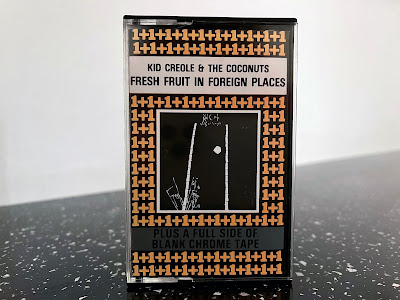
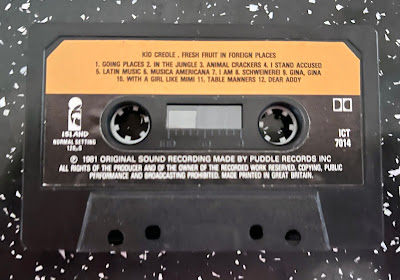
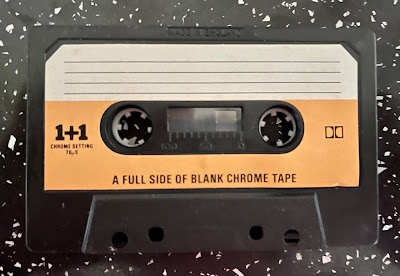
A while ago, I bought a cassette tape in a second-hand shop. It wasn’t for the album on side A, which was “Fresh Fruit in Foreign Places” by Kid Creole & The Coconuts – their most played songs, “Annie I’m Not Your Daddy” and “Stool Pigeon”, are on their following album “Tropical Gangsters” - but more about why side B of the tape was deliberately left blank.

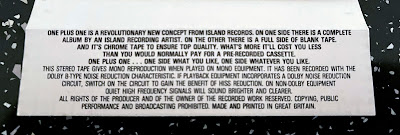
In 1981, Island Records began a series of album releases on cassette titled “1+1”. The inlay card on my album describes it as a “revolutionary new concept… On one side there is a complete album by an Island recording artist. On the other there is a full side of blank tape. And it’s chrome tape to ensure top quality. What’s more it’ll cost you less than you would normally pay for a pre-recorded cassette. One plus one… one side what you like, one side whatever you like.” After a year, the “1+1” pattern on the packaging was minimised to a single logo at the bottom of the front cover of the cassette, which otherwise matched the regular release of the album, and would instead feature the title album in full on each side, giving you the option to record over one side. This series was discontinued in 1983, but continued in the United States by Mango Records, Island’s ska and reggae label.

This would have been particularly attractive at the time to people who made copies of their vinyl albums for home use, or on their recently-acquired Sony Walkman, as the forty-minute duration of the average LP meant two of them could fit onto a C90 cassette. The attraction of buying an album on higher-quality tape stock, and adding another of your own to take advantage of the same tape, will have made “1+1” a sensible option at the record store. 

However, with the marketing blurb mentioning that its cost would be lower than usually expected, I originally thought “1+1” was a novel way of packaging album re-releases. But 1981 was the year “Fresh Fruit in Foreign Places” was first released, and the “1+1” version was simultaneously released alongside the standard cassette format which, in being able to use both sides of the tape, used half the amount of tape. Meanwhile, chrome tape didn’t cost much more to buy than standard ferric tape, but its use as a selling point is more interesting today.


In 2017, I wrote that many of the advances in cassette technology, from types of tape used to Dolby noise reduction, are no longer available to new adopters of the format [link]. Buy a new blank cassette, and it will only be standard ferric tape, otherwise known as IEC Type I, which was established once new formulations of tape were created by manufacturers like BASF, that turned Philips’s original Compact Cassette from a medium for dictation into a higher fidelity format suitable for music. However, Type II chrome, Type III “ferro-chrome” and Type IV “metal” tapes, using different compounds to increase dynamic range and fidelity, haven’t been made for some time, although you now have the option of paying premium prices for the “new old stock” that remains...


...provided your cassette recorder can make use of the different tape formats. With the “Tanishin” China-manufactured cassette mechanism being effectively the last remaining cassette mechanism still being manufactured, and the only new cassette recorder I can find that still currently manufactured to record to chrome tapes, while also accounting for the maximum output levels, bias levels and time constants of different tape types, turns out to be the professional-grade Tascam 202MKVII and its TEAC-branded consumer version, costing from £400 to £600. In short, making serious use of cassettes as a recording medium in the way it used to be requires you to invest in old equipment that can take advantage of the advantages chrome tape could offer, and probably old tapes as well.


Side B of my copy of “Fresh Fruit in Foreign Places” is still blank after forty years and, unless someone buys me the Tascam unit, that is how it will have to stay.



15 March 2020

SPARKS WILL FLY WHEN THE WHISTLE BLOWS [226]


Looking through a second-hand shop, I bought a copy of Grace Jones’s 1985 album “Slave to the Rhythm” – the title track is a brilliant, lushly orchestrated song, and Jean-Paul Goude’s cut-and-paste cover, comically elongating Jones’s hair and mouth, is iconic. I was already aware that the album reworks the same song in different ways, but looking up further details later revealed something that left me feeling dissatisfied – the CD copy I bought was an abridged version, nine minutes shorter than the original release.

I thought it would be easy, these days, to find the album on Spotify, or iTunes, or Amazon, to stream or download, but it was nowhere (at least, in the UK) – the title track is on Spotify, but as part of a 1980s best-of compilation, and not listed alongside Grace Jones’s other albums. Therefore, if I wanted to hear the album as originally intended, I would have to buy the vinyl LP, or track down the original US release on CD, from 1987. I saw one copy listed on Amazon as “dispatched from USA,” but did not state version it was – fortunately, it was the right one.

“Slave to the Rhythm” was a concept album produced by Trevor Horn, assisted by Stephen Lipson, and the song was written by them alongside Bruce Woolley and Simon Barlow... yet it couldn’t be more about its singer if it tried, and is credited as such: “Breath, Blood and Voice: Grace Jones.” Knowing this project was originally announced as Horn’s next collaboration with the band Frankie Goes to Hollywood, before being recorded by Jones while taking a break from her new film career, doesn’t sound right – I thought Jones had written it.

The two versions of the album I have are as follows: the 1987 CD release by Island Records, (catalogue number 422-842 612-2), and the UK reissue as part of the “Island Masters” series, from 1989-90 (IMCD 65). Both albums have eight tracks, with the nine-minute reduction coming from cutting sections out of almost all the songs. This is done by mostly excising the spoken-word content of the album: fitting the album’s subtitle, “A Biography,” Grace Jones is interviewed by music journalists Paul Morley, formerly of the “NME,” and Capital Radio’s Paul Cooke. Morley asks the more searching questions, and Cooke says to Jones, “I’m sure a lot of people expect you to be very intimidating, but I think you’re great fun” – an enduring image from British television is Grace Jones slapping the TV interviewer Russell Harty for turning his back on her to talk to someone else.


The songs themselves were produced at the rate of once a week, cutting up Jones’s performance into different ways. The lyrics are brief and pointed - “Work all day / As men who know / Wheels must turn / To keep the flow” – almost designed to be cut and pasted in any order. The track closest to the single release known as “Slave to the Rhythm” is actually titled “Ladies and Gentlemen: Grace Jones” on the album, and has the most complete performance of the lyrics. A rockier version, “Jones the Rhythm,” also released as a single, cuts the first verse, but features a spoken introduction by the actor Ian McShane, taken from Jean-Paul Goude’s biography “Jungle Fever” – McShane also reads from this on the track “The Frog and the Princess,” talking about using Jones as “the ideal vehicle for my work” – Jones does not feature on this track herself. In contrast, “Operattack” is only Jones’s voice, sampled and contorted through all the “work to the rhythm / dance to the rhythm” sections, punctuated by a wail of “SLAVE!”   

The tracks were produced at the rate of one a week, and the cost of studio time, and use of an orchestra, was pushed to $385,000 – that may be the equivalent of $926,000 in 2020, but many rappers’ videos have larger budgets. I do not know if the album came as a result of deciding to release all versions as one collection, instead of having to choose one for a single, or if the interviews and spoken sections were used to create a theme. What I do know is that Grace Jones, both as a performer and a personality, could carry a more conceptually challenging work like this, and make it a commercial success too, without having the pressure of breaking the mould with every album, which was expected of David Bowie.

In short, the “Island Masters” removes most of the spoken sections, some of them being printed as liner notes, alongside the album credits – Paul Morley and Paul Cooke are no longer credited for their contribution, as they are no longer heard, and Ian McShane’s sections are cut back. One track, “The Crossing (Ooh The Action...),” is turned into an instrumental by the cuts. Perhaps this is to make the reissue more successful commercially, by making it sound more like a regular album. There does exist an album titled, “Highlights from Jeff Wayne’s Musical Version of War of the Worlds,” which makes the original sound like it was similar in scale to Wagner’s Ring cycle, but hacking away much of Richard Burton’s narration makes the “Highlights” version weaker. Every word on “Slave to the Rhythm” is about Grace Jones, even if it not her saying them.

If it is not clear enough that I consider the original version of “Slave to the Rhythm” to be the full, proper, correct version, it is the most avoidable aspect of the “Island Masters” reissue – the spelling errors. The final track is given the title “Ladies and Gentleman: Grace Jones”, and Stephen Lipson is credited as Steven Lipson, while the Synclavier, an early sampling synthesiser used throughout the album, is confused with fish eggs: “The synclaviar was used extensively during the compilation of this biography: acknowledgement to New England Digital.” The Synclavier would later be overrun by computers like the Commodore Amiga 1000 and the Atari ST, but that’s beside the point.