Showing posts with label Game Boy. Show all posts

22 December 2024

I WANNA KNOW THE NAME OF THE GAME [480]


Having owned a Game Boy for five years now I appreciate the reliable source of enjoyment and distraction it has been, and I want to keep that experience as long as I can without making any compromises.

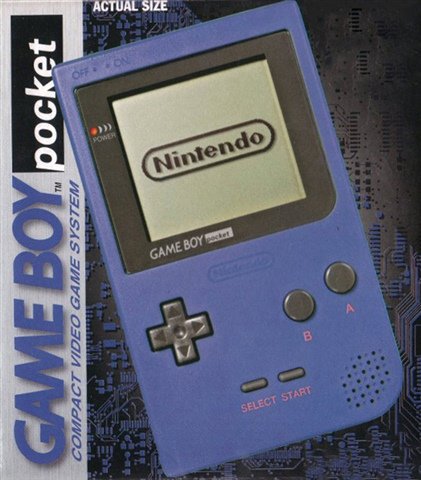
My current console is a blue Nintendo Game Boy Pocket, made in around 1997-98. I love its robust build and frugal use of AAA batteries, but I am aware of its biggest limitation, an LCD display with no backlight that also slowly fades with age – playing the Breakout-like game “Alleyway”, I’ve often realised I can’t see where the bouncing ball is going, even when playing in a brightly lit room.

I cannot expect the console to keep working forever, so I decided to take advantage of the growing market in Game Boy clones, arising from the love of the machine, its game library, and the fact that Nintendo built it with largely off-the-shelf components – the Z80-derived processor found in the original Game Boy, Pocket, Light and Color is also found among 1980s computers like the Sega Master System, Sinclair ZX Spectrum and the Amstrad CPC range.

My first option was to buy another Nintendo console, but not their latest Switch – I already own the games I play, so I don’t need to buy them again from the Nintendo eShop. I bought a Game Boy Advance in 2021, which also plays the original cartridges, but its screen is also not backlit – the later folding Advance SP has both front- and blacklit versions, and accordingly sell at a premium, just like the Japan-only Game Boy Light. Admittedly, I had not done my research, but the Advance was later sold for more than I bought it for, a mark of increasing interest and appetite for these consoles.

My next consideration was a refurbished console. An enormous demand has grown for after-market Game Boy screens – backlit, of course, but only able to approximating screen resolutions – console shells and components. I have no aptitude for this kind of modification and assembly, especially more delicate tasks like connecting a new screen to the motherboard, but the ability to order one, encased in exactly the colour of case and buttons you wish, was very appealing. It is an ideal choice to extend the life of existing Game Boy hardware, if you can look past the age of the motherboards – the last Game Boy Colour was sold in 2003, and the last Advance SP in 2010 – but the rework usually with its own warranty.

I then decided to at all-new hardware. A company named Funny Playing makes the “FPGBC”, a Game Boy Color clone using a field-programmable gate array (FPGA) chip to replicate exactly the original machine’s processors, largely guaranteeing compatibility with cartridges and peripherals. Like refurbishing an existing console, you can buy the FPGBC motherboard, pre-assembled with screen attached, and build your own case around it, or have one built for you. Aside from its using a rechargeable battery, this is the closest available console to the original Game Boy, the perfect choice if you simply want to play games using all-new hardware.

The only reason I didn’t go for the FPGBC myself was seeing the price tick up when I looked at assembly options for the case and button colours I wanted, followed by the cost and time of delivery, because it pushed my expected cost towards the Analogue Pocket, a console produced in limited numbers since 2021 that, while assuming a mostly similar shape and button layout to a Game Boy, uses its FPGA chip to replicate the Sega Game Gear, Atari Lynx, PC Engine and Neo Geo Pocket, although the extra cost of cartridge adaptors made this less desirable. Furthermore, its continued use of a plastic case and similar rechargeable battery like the FPGBC, while costing up to twice as much as one, soured me a bit, high-resolution screen or not – their shipping costs from the US to the UK didn’t help either.

My final option was announced in June 2024. The ModRetro Chromatic comes from Palmer Luckey, a former virtual reality headset designer who got into modifying Game Boys as a teenager, and now owns a company named Anduril, making armed drones – this fact might be a deal-breaker, but the Chromatic, advertised as a strictly limited “1st Edition”, is already sold out as of the time of publication, so it has already become moot. 

The console is built like a smartphone: a bespoke display matching the resolution and colour temperature of the Game Boy Color, rather than appropriating a screen made elsewhere, and encased by sapphire glass; durable clicky PBT plastic buttons, and a painted magnesium-aluminium alloy case seemingly doubling as its warranty, in the hope of making it indestructible. It is completely overbuilt for its purpose, and more expensive than a FPGBC that could do the same job just as well, and while you can connect a USB-C cable to capture or relay the video from the screen, do you really need that?

I pre-ordered the Chromatic four months after it was announced: I surmised that if Luckey wanted to make money from it, it wouldn’t have been made the way it had been, or would cost more than the $199 asking price – I expect future editions will be cost-reduced, and more in line with the FPGBC. 

However, the 1st Edition might be the best Game Boy not made by Nintendo themselves. I bought it in “bubblegum” (pink, with purple A and B buttons), and feels incredibly solid and well put together, although heavier than I was expecting – with cartridge and AA batteries installed, the Chromatic weights 270 grams, versus 160 for a similarly prepared Game Boy Pocket. The crisp, legible and colourful screen is a revelation – the backlight is so powerful that I have it at one level above “off”, so I expect it, and the console, to last a very long time, although my main concern is avoiding any chipping of the paintwork.

In short, buy the FPGBC to enter the world of Game Boy gaming to avoid using old hardware, and if you want a Game Boy Advance, buy a refurbished console if you can, or an Analogue Pocket. If you don’t want to compromise, learn to compromise.
08 March 2020

WE CAN’T REWIND, WE’VE GONE TOO FAR [225]


Having owned a Nintendo Game Boy for around a year now, my favourite game has been one I bought a few months ago. “Alleyway,” a clone of the arcade game “Breakout,” was part of the console’s launch line-up in 1989, and was designed by the console’s creator, Gunpei Yakoi. Having since played “Super Breakout” for the Game Boy Advance, I can appreciate the variations made on the original game, rearranging the blocks, adding bonus levels, and increasing the angles at which you can hit the ball.


When I have mentioned this to someone, either in passing at work or elsewhere, the terms “retro” or “old school” will be included amongst the reminiscing about when they owned a Game Boy, or from when they were a child. Having never been interested at the time, nothing about my playing “Alleyway” now has any level of nostalgia or irony to it. For my small collection of game cartridges, including “Tetris,” “Space Invaders” and “Game & Watch Gallery” – my small collection favours straightforward games that take little time – I am playing them in the best possible manner, on the proper hardware, with the proper controls. I am merely being sensible, as far as I know.


Can something be considered “retro” if I am still using it now? The word “retro,” describing something imitative of the recent past, led me to think it was related to going backwards, as in the word “retrograde,” instead of simply looking back, as in “retrospective” – in fact, I was right the first time, if you count things that imitate obsolete objects, like Nintendo’s NES Classic Mini. For something to be “retro,” it should appear to have been replaced, or overcome, by new ways of working, or thinking, but it is not affected by the longing for something lost that characterises nostalgia, because there has to be some level of irony for returning back to the object. No exaggeration of the obsolete object’s importance should have to be made, but there must some knowing reason for bringing it up.

If I was deliberately using a Game Boy to make some statement about how much better playing one is over using your phone, the Game Boy would be rendered as retro. I guess it could still be a retro item by my having chosen it over all the options available to me, having never owned a game console before, but having made my choice, I didn’t think anything more of it – I just put my money down.

The same reasoning appears to be behind the Evercade, a new portable games console launching in May 2020. It is similar in form to the Game Boy Advance, and uses cartridges that hold multiple games, but they add more modern innovations like an LED screen, and HDMI connection to your TV. However, they know their target audience: the cartridges will feature collections of games from Atari, Namco and Interplay, and their promotional Twitter handle is @evercaderetro, but it is hard to be cynical with another way to play “old school” arcade games.

19 May 2019

YOU LITTLE WONDER, LITTLE WONDER YOU [174]


Some time ago, I downloaded Tetris for my mobile phone, but I rarely play it. The compromises necessary to make the game work with touch-screen technology made it, for me, less playable: the choice is to swipe your “tetrominos” down the screen, or choose where you want it to fall. I want to be able to properly guide them down, and rotate them around – I need buttons, one for each thumb.
I took the obvious path: I now own a cheap Nintendo Game Boy, and a cartridge of the game that was, until Pokémon happened, its killer app – and it didn’t need a character, be they a plumber hedgehog or Pikachu. I need not mention how Tetris works, as everyone must have played it by now – thirty-five million copies of the original Game Boy game, introduced with the console in 1989, were sold, not counting further versions of it, both for the Game Boy and other systems. The game’s inventor, Sergei Pajitnov, has said the Game Boy version is his favourite, and I can see why, having not put it down since I picked it up: the controls are very responsive, I like trying to squeeze a tetromino into a tight spot, created when you are not getting the ones you want, and you have to put them somewhere. I also like the option of a “B-Game,” where you play until you have completed twenty-five lines, instead of continuing until the batteries in your Game Boy run out.
The squarewave music generated by the Game Boy is iconic - remixes of the Tetris “A-Type” music, by “Doctor Spin,” and the “Super Mario Land” theme reached the UK Singles Chart in 1992, and can be found on “Now That’s What I Call Music! 23”. However, why did I have a pang of nostalgia when I heard the sound made when I completed a line of tetrominos? If I ever played the game before, it would be too long ago for me to have remembered it, and it would have been on someone else’s system – I have never owned one before. I couldn’t find it in the remix. “Doctor Spin” turns out to be a pseudonym for record producer Nigel Wright, and some guy named Andrew Lloyd Webber – no, I don’t know what to do with that information either.

The Game Boy and Game & Watch range

I had originally considered buying a cheap Tetris LCD game, but now I have a Game Boy, I can cast my net wider, although the type of game I like are quick affairs like “Space Invaders” and “Lemmings.” Indeed, the Game Boy was conceived, by Nintendo’s Gunpei Yokoi, as an upgrade to their existing “Game & Watch” LCD games. Yakoi had already set his toy maker employer down the electronic path when he developed a Love Tester game in 1969, a resistance meter that needed two people to work, and worked better when they kissed. Yakoi developed the Game & Watch series after seeing a commuter on a train, messing about with their calculator – the Game Boy is essentially a customisable Game & Watch, with an LCD screen that can create more intricate shapes, like Super Mario or Robocop.
A word on the Game Boy I bought. Mine is a blue Game Boy Pocket, from 1996, palm-sized instead of hand-sized, and half the weight of the original, especially once the batteries are installed – only two AAA batteries, instead of four AAs. The LCD screen is grey, instead of that pea-soup green that the original is famous for, but the playing time allowed by the batteries is down to ten hours – in other words, the level we are now used to having. I didn’t feel like I would need the extra capability that the Game Boy Color, Advance, or Advance SP have, but what I now know is, even if I was to buy one of the last Advance SPs, made in 2005, it will still play my original Tetris game from 1989, with no adaptor required.The first Nintendo DS can play Game Boy Advance cartridges, yet its design is influenced by the Game & Watch. I don't know if the Nintendo Switch has a Love Tester function.