Showing posts with label Myra Breckinridge. Show all posts

10 April 2022

I’VE GOT TO FIND IT, GET ME BEHIND IT [339]


Like “Myra Breckinridge”, a film I have written about three times without its charms ever growing on me [link] [link] [link], “Beyond the Valley of the Dolls” is an X-rated film released in June 1970 by 20th Century Studios, when it was still named 20th Century-Fox. 

Both films satirise the new Hollywood evolving from the implosion of both the Classical Hollywood era of cinema, and the 1960s in general, both films making good use of their rating, plunging into subject matter, nudity, language and violence brought in from the fringes of the film industry, when mainstream studios need to make money. The films are also closely linked due to their often being paired as a double bill both in cinemas and in subsequent discussions, having been released within a week of each other.

It has been remiss of me not to take “Beyond the Valley of the Dolls” into account when considering “Myra Breckinridge”, especially when its reputation has made it much easier to find: my DVD of “Myra Breckinridge” was a lucky eBay purchase of an out-of-print release from 2005, while “Beyond the Valley of the Dolls” was a prestige Blu-ray release from Arrow Films, a UK release including extras used by The Criterion Collection.

Watching the film was by turn bewildering, overwhelming and exhausting, perhaps on purpose, as a kind of drug trip. You either remain on edge for every moment for fear of missing something, or you just need to have the film wash over you. All the time, there is a sense of dread hanging over the hedonism throughout, beginning, as the film does, with a shooting inspired by, and reminiscent of, the killing of Sharon Tate, star of the original “Valley of the Dolls”, perhaps the only time a film’s climax is shown in the opening credits.

“Beyond the Valley of the Dolls” is successful in its having been made by a confident filmmaker, with rapid editing, and humorous music by Stu Phillips, holding the film together. This is a marked contrast with “Myra Breckinridge”, its use of clips from Classical Hollywood films having turned from a motif to a sticking plaster during the production. Sex and nudity are also used much more freely and naturally, although this is because the maker of “Beyond the Valley of the Dolls” was well-versed in their use in cinema.

The film was co-written, produced and directed for 20th Century-Fox by Russ Meyer, the usually independent maker of small-budgeted sexploitation films like “Supervixens” and “Faster, Pussycat! Kill! Kill!” Marketed on Meyer’s name, it stars a cast of unknowns, although Charles Napier, Harrison Page and Pam Grier, an extra in a party scene, went on to have long careers. 

The other writer was the film critic Roger Ebert, a frequent collaborator with Meyer who turned out to be best placed to satirise Hollywood. With Meyer having originally been hired to direct a straightforward sequel to 1967’s “Valley of the Dolls”, Ebert and Meyer took only its framework of three women coming to Hollywood to find fame and fortune, but only finding sex, drugs and violence, and stretching it as far “Beyond” it as possible. 

As Ebert wrote for “Film Comment” magazine in 1980, the film was as intended to feel as much of a fictionalised exposé or real people as the original, but without having personally encountered such types, becoming “…an essay on our generic expectations. It’s an anthology of stock situations, characters, clichés and stereotypes, set to music and manipulated to work as exposition and satire at the same time; it’s cause and effect, a wind-up machine to operate emotions.” At the same time, the story was made up as Ebert and Meyer went along, to use existing studio sets, “which makes subsequent analysis a little tricky”, like making Ronnie “Z-Man” Barzell, a music originally based on Phil Spector, into a woman in drag by the end, without any indication of this earlier in the film.

“Beyond the Valley of the Dolls” was very much a Russ Meyer film with a larger budget, featuring much sex and nudity in line with his films’ recurring use of these to satirise and subvert the conservative attitudes of older generations to them. Having said that, Meyer shot X-rated and R-rated versions of scenes, expecting to need to meet the R rating usually required by a major studio... except that 1970 was the year that the Academy Award for Best Picture was won by an X-rated film, “Midnight Cowboy”. Having received an X rating, which could have been reduced to an R with only a few cuts, Meyer wanted to add in more X-rated versions of scenes to take advantage of having the rating, but the rushing of 20th Century-Fox to release the film prevented this. Meanwhile, “Myra Breckinridge” received an X for both sex and sex changes, but it was resubmitted in 1978 and changed to R with a few cuts – “Beyond the Valley of the Dolls” remains both uncut, and rated X, now NC-17.

What came to mind when watching “Beyond the Valley of the Dolls” is how it appears to be about the “degenerates” that are in the background of “Myra Breckinridge” – the people that came in from outside to usurp Classical Hollywood, sweeping it away, and making new types of films more relevant for their time, like “Midnight Cowboy”, “Easy Rider” and “Bonnie & Clyde”. Both “Myra Breckinridge” and “Beyond the Valley of the Dolls” are films of their times, but the latter is more successful in reflecting its time, because the former hates it.

27 October 2019

MAMA I’M SURE HARD TO HANDLE [204]


This is Part 3 of an apparent series about the 1970 film “Myra Breckinridge” – find part 1 here [link], and part 2 here [link]. In short, I think “Myra Breckinridge” is the worst film ever made because I needed it to be the best ever made, and it wasn’t – a statement I made so snappily in my notes, I didn’t realise I hadn’t used it in my first two thousand words on the subject. 

Having given myself time to recover, I can return to my study of “Myra Breckinridge” to discuss what happened next. To further understand my enemy, I have invested in my own copies of the sources of information that have most influenced the opinions made about the film, and one that even Gore Vidal’s original novel couldn’t do without. My intention is ultimately to refer to them when I eventually write the definitive book on “Myra Breckinridge” – I have already pointed out the rarity of a transgender film buff writing about a film whose protagonist is also a transgender film buff – but, in the meantime, I will share with you what they are, and what they say.

The best narrative account of the making of “Myra Breckinridge” is contained in the essay “Swinging Into Disaster,” by Steven Daly, published in the April 2001 issue of “Vanity Fair” magazine, and collected into the book “Vanity Fair’s Tales of Hollywood,” published by Penguin in 2008. There are interviews with the film’s writer and director, Michael Sarne, producers Richard Zanuck and David Brown, and with the film’s star, Raquel Welch – Gore Vidal responded in writing, Farah Fawcett declined to be involved, and others are reflected through narrative and anecdotes. The essay does a great job of centring its story on Sarne, his becoming director, and his influence in creating a notoriously chaotic production, people being fired left and right, and scripts rewritten every day. The decision to use archive pieces of Laurel & Hardy and Shirley Temple came during the editing process after the film was completed, not when it was being written. The ultimate outcome is that no-one came away from the film unscathed, either by it becoming a blot in John Huston’s filmography, or Raquel Welch not being properly recognised as a comic actress until four years later, in Richard Lester’s “The Three Musketeers.” Sarne clearly had scores to settle, as later proved in his DVD commentary in 2004, in contrast to Welch’s bemusement on her own.

The film critic Rex Reed, playing the pre-transition Myron Breckinridge in a white suit, like an episode of “Randall and Hopkirk (Deceased)” is often quoted in saying that, of “Myra Breckinridge,” “on this movie, everybody’s asking, ‘Who do you have to screw to get out of it?’” This comes from “Myra Goes Hollywood,” an essay for the August 1970 issue of “Playboy” magazine. Yes, I really did buy a copy of “Playboy” for the articles and, for the time, it reads like “The New Yorker” with soft-core pornography leavened into the mix. The advertisements are for alcohol, tobacco, and British Leyland – their page 3 pin-up is the MGB GT. The purpose of the article is for Reed to provide a more authoritative contemporary account of the chaotic production than the leaks could have suggested, played out as mostly juicy gossip, but the most telling part is how Reed details his agreeing to play  Myron, based on having script approval for his role – his not interested in playing a gay man who has a sex change, his eventual role as “a sort of carnal Jiminy Cricket to Raquel’s erotic Pinocchio” ultimately resulted from working around his demands. Reed does not state why he even agreed to be in the film, apart from making some reference to how critics should take the opportunity to learn the technical side of making a film.

The writing of the film critic Parker Tyler looms large in Myra Breckinridge’s mind, as she waxes lyrical about Hollywood dealing in myths, and in exclaiming that, “during the decade between 1935 and 1945, no unimportant film was made in the United States.” Parker’s 1947 book “Magic and Myth of the Movies,” a seminal work that applies psychoanalysis to then-recent films like “Mildred Pierce,” “Double Indemnity” and “The Seventh Veil,” at a time when films were only just doing that themselves, for example in Alfred Hitchcock’s “Spellbound” (1945). However, the glow of the screen does better for Parker than the real life it reflects upon, and Myra also basks in that glow, as the new Hollywood of the 60s produces less effectual role models. 


Tyler initially complained that “Myra Breckinridge,” both the novel and film, defamed him and his work, but the attention led “Magic and Myth of the Movies” to be republished in 1971. My copy of the British reissue, with Rita Hayworth on the front cover, also features a new foreword by Tyler, where he deals with the ambiguous nature of the tribute the story gives him, as his ideas are even dropped by Myra upon the novel’s end.

Finally, the February 1971 issue of the British journal “Films and Filming” has an article by Michael Sarne, returning to the magazine for which he used to write reviews, titled “For Love of Myra.” Sarne plays the production as an affair between himself and the character of Myra. Photographic evidence was provided, also on the cover of the magazine, to prove Sarne did try to find a male actor to play both Myra and Myron, before opting for the baggage of Rex Reed. Sarne labelling his affair as “the ultimate love-hate relationship, the Lord Byron and Caroline Lamb of the ‘sixties, perhaps all that remains of our affair will be the things they say about us.” For certain, that is all Sarne has, as Myra returned in Gore Vidal’s sequel novel “Myron.”  

09 June 2019

IT’S THE WAY THAT I MOVE, THE THINGS THAT I DO [179]


This article is rated “15,” or “R,” for infrequent strong language.
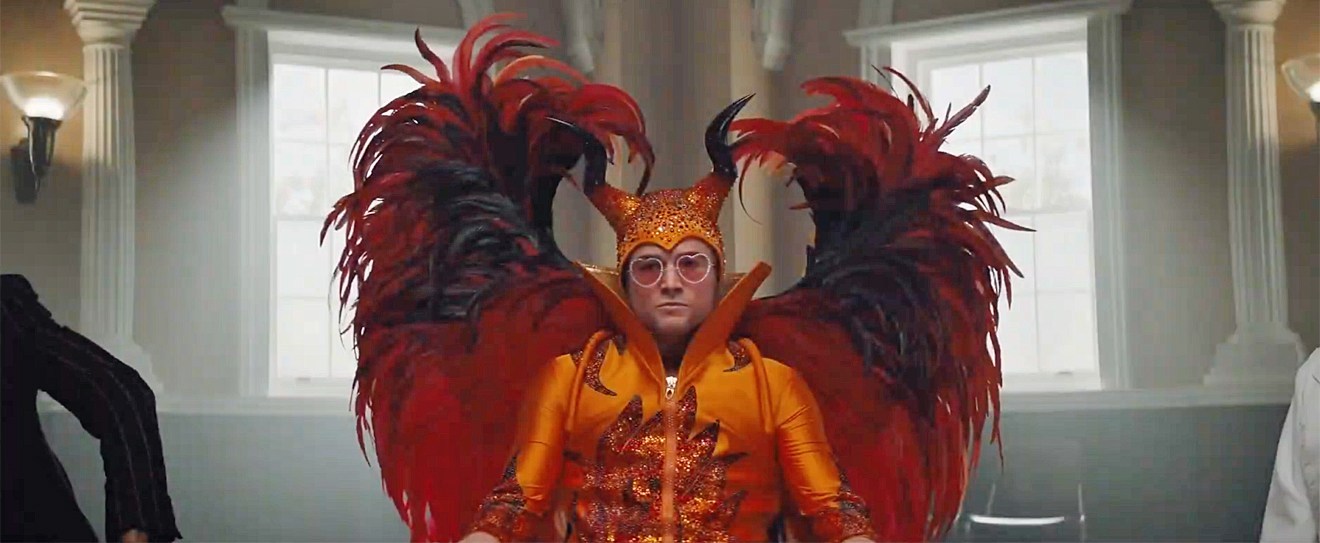
Sorry “Avengers” fans, “Rocketman” is the best film of 2019 so far. I did not expect Dexter Fletcher to channel the spirit of Ken Russell, director of musicals like “Tommy” and “Lisztomania,” into portraying the life of Elton John, when a straightforward biopic could have been enough. Moreover, Taron Egerton balances his portrayal of John amazingly, as both an introvert and extrovert, hero and villain of John’s own story, all while doing his own singing – you’ll believe a man can fly, while performing “Crocodile Rock.”
Elton John has lived a life of darkness and light, success and excess like few others have, or wanted, most remarkably emerging from it all, to enjoy and build on the legacy that his and Bernie Taupin’s songs have given us all. “Rocketman” could have whitewashed the sex and drugs from his life, but with its hero bankrolling the production of a “true fantasy,” as the poster says, John has taken responsibility for his past, his addictions and broken relationships, without trying to moralise on our behalf. His third-act break-up with himself, and his own rescue, is heroic, befitting a man who chose the middle name “Hercules.”
Writing for “The Observer,” Elton John explains the tone of “Rocketman” was established by videos produced by David LaChapelle for his Las Vegas show, “The Red Piano.” Most notably, a real-life half-hearted suicide bid, involving an oven in a kitchen with an open window, is reproduced by LaChapelle for “Someone Saved My Life Tonight,” a song based in that time of John’s life. When much of your biography is public knowledge anyway, there is little reason to shy away from it.

The standout line from the article was this: “Some studios wanted to tone down the sex and drugs so the film would get a PG-13 rating. But I haven’t led a PG-13 rated life.” The film bounced around many studios before arriving at Paramount, and the extra clout of Matthew Vaughan’s production company Marv, responsible for the “Kingsman” series, resulted in a film rated “R” in the United States, and “15” in the UK. But it left me with a big question: Elton John apparently led an “R-rated life,” but don’t we all?

Making films is a reductive process, from choosing what aspects of real life you wish to capture, to the compromises you have to make during production on what is physically, legally and affordably possible. Until 1968 in the United States, and 1985 in the UK, that work would then be subject to censorship, to fit what was morally allowed, until it became more appropriate to provide an advisory rating instead. Yes, the UK has issued ratings since 1912 – “U” for Universal, “A” for Adult, followed by “H” for Horror, later changed to “X” as a compulsory 16+ age limit (18+ from 1970) - but the British Board of Film Censors only properly switched to classifying films once the Video Recordings Act 1984 required them to provide advisory ratings for video tapes.
What has arisen from these classifications is rather odd – when the Motion Picture of Association of America (MPAA) marked its fiftieth anniversary in 2018, it was remarked that 17,202 of the 29,791 films it had rated to that point received an “R,” requiring anyone attending a screening aged under 17 to be accompanied by an adult – only 524 films received the top “X” rating, since renamed “NC-17.” Meanwhile, the number of films receiving a “PG-13” rating is nearly as many as received a “PG” (4,913 to 5,578), even though “PG-13” has only been available as a rating since 1984.

Like the later “12” rating in the UK from 1989, “PG-13” exists as a way of showing a little more of the true grit in life than is allowed under “PG” – brief and discreet sex and nudity, moderate violence that should not dwell on detail, or have emphasis on injury or blood, and strong language can be used in context, though usually only once in practice. Some people act like they have no fucks to give, but really mean that is all they say, but what if you had only one fuck to give? When would be the right moment to deploy it? Meanwhile, I once had a nosebleed that would be rated “R,” or “15,” because I did not have a tissue to catch it, and I had no option but to dwell on it, because I had to clear it up.

Looking at a pile of films in front of me, I can see only a few that required an “18” rating – “The Man Who Fell to Earth,” “They Live,” “Robocop,” and “Myra Breckinridge.” All these require violence (whether physical or sexual), blood, swearing and drug use in one form or another as part of their plots, but that use is appropriate – there is no gratuitous use of these to achieve a higher rating, and nothing that interrupts the plot to provide that kind of content. Perhaps the promotion of the “X” rating for films like “Fritz the Cat” in their advertising – “we’re not rated X for nothin’, baby!” – and the existence of the list of “Video Nasties,” horror films banned in the UK until around twenty years ago, has given the impression that a bar was set to jump over, when the numbers don’t prove that.

In the UK, films recently given an “18” include “Amin,” a French drama which includes a “brief explicit image;” “My Friend the Polish Girl,” which has a “brief strong injury detail;” and “Jonathan Agassi Saved My Life,” a documentary featuring “strong sex, sex references and drug misuse” – it is a documentary about a porn star. Meanwhile, “This One’s For the Ladies,” a documentary about male exotic dancers, appears to have become the first film rated “NC-17” by the MPAA in two years – it is being marketed as the “Uncensored” version, as an R-rated version is also available.

“Rocketman” receives a “restricted” rating because the film shows restraint – it would have been possible to make an 18-rated, or NC-17 version of it. We all show restraint in one form or another – no-one can proclaim they are “uncensored,” because we consider ourselves, and consider each other. This is why censorship, taking that consideration out of our hands, stings so much, such as the Russian release of “Rocketman,” which received five minutes of cuts for sex, drug use and homosexuality – the end text no longer mentions that the film’s producer is married to the film’s subject. Even after those cuts, it still received an “18+” rating, which would have been a “PG-13” or less here. No wonder the production felt hoodwinked by it.

10 February 2019

I WOULDN’T TELL YOU WHERE TO GO [150]


Last time, I vowed to enter Hollywood to sort out the film “Myra Breckinridge,” which I described as the worst film ever made.
I will admit I don’t take my cache as a film critic, of any description, that seriously – I am not Mark Kermode trying to rehabilitate “The Exorcist” here – but there are two ways to create something good from the wreckage of “Myra Breckinridge”: mount a new adaptation of Gore Vidal’s novel, or go back in time and change the original film.
As interesting as it could be, a new adaptation, in my opinion, will not work: the novel is a satire of a particular moment in Hollywood at the end of the 1960s, its Classical period now over, and the people in charge having been overturned. You could set a remake in its original time period, but you would have to drill the historical context into the audience before expecting them to laugh.
You could try to set it in the present day, with Myra exclaiming about “star quality” in an era where everyone is an open book, and how the franchise-driven Hollywood should return to when it made films like “Easy Rider” and “Beyond the Valley of the Dolls”. Moreover, a plot that uses rape as a corrective will not fly these days, and a man becoming a woman so they can conquer the sexes won’t make it through the rewrites – you may as well write a different story altogether.
So yes, going back in time to correct the original “Myra Breckinridge” may be the more feasible option here, in an attempt to correct the decisions that made the film turn out the way it did. The simplest choice is to eliminate the two people that caused the most rancour on set: director and co-writer Michael Sarne, and star Mae West.
Sarne’s treatment of the story, constant rewrites during the shoot, and his encouragement of bickering between the cast, produced the film we have. The original director was to have been Bud Yorkin, best known as a producer of TV sitcoms like “All in the Family” and “Sanford and Son,” and later of the two “Blade Runner” films, and was replaced with Sarne, originally hired only to re-write the script, but after having directed the “swinging London” film “Joanna,” because it was thought Yorkin would have been too conservative in his direction – his later career would prove otherwise. Not having Sarne write the script would give previous drafts by David Giler, and Gore Vidal, another chance. Thinking about it, if Yorkin turned out not to be available anymore, George Cukor, another name once attached to the film, would have been the perfect director – rather than splice in pieces of Classical Hollywood films to enhance your own film, just get the director of “The Philadelphia Story,” the original “A Star is Born,” and “My Fair Lady” to direct the whole thing.
Why have no Mae West? Her contract to appear in the film was unnecessarily restrictive, requiring her to have two full-scale musical numbers in a film where she plays a talent agent, and having refusal on not only the costumes she wore, but also those of Raquel Welch, the actor playing the lead. One of Welch’s costumes was confiscated by Welch because it was black and white, reasoning only she could wear monochrome clothes. Welch, who later said she couldn’t work out if West herself was a man or not, was having none of it, and stole it back. One costume Welch wore appears as white on camera, but had to be died very light blue, in order to placate West – they both appear in the same scene, but Welch is speaking to a body double.
The most major change I would make would appear on screen. Both Raquel Welch and John Huston wanted to appear in “Myra Breckinridge,” and this shows in their performances, but Welch actively lobbied for her role, even before having read the script – there might have not even been a script to read at that point. She did so in the belief that she would be playing both Myra and Myron, her original male self. However, the male role was given to the film critic Rex Reed, who was promised his character was presented through the conceit of a dream, and would have approval over his sections of the script, therefore changing how the story will be told.
When “Myra Breckinridge” bombed both in reviews and at the box office, sales of the novel dwindled very quickly. Ironically, the film critic Parker Tyler, whose work was appropriated by Myra, including the memorable assertion that no insignificant film was made in Hollywood between 1935 and 1945, saw his work come back into print as a result. Gore Vidal resorted to his own sequel, “Myron,” published in 1975, where Myra enters a film that Myron was watching on television, in a plot likened by the poet Thom Gunn, and used by Vidal in the collected edition of both books I have, as an “Alice Through the Looking Glass” to the original novel’s “Alice in Wonderland.” This time, Myra and Myron talk of themselves as different people, each one a parasite for the other. I’m not a fan of this, but I haven’t properly read it yet either.
I fear I may have Myra Breckinridge on my back for a while, continuing to make sense of her, but I need to write about something else. Both the novel and its sequel are set out in a diary format, using a three-hundred-page ledger, as Myra’s psychiatrist advises her to keep a journal of her thoughts - in the sequel, this becomes how one person knows what the other is doing. Meanwhile, I began 2019 with a ledger of similar size, and I must be expecting something sizeable to happen to me, as I have only reached page 18 so far.
Read the books if you can, and only watch the film for Raquel Welch and John Huston.

03 February 2019

COME OUTSIDE (SHOVE IT) [149]


Once upon a time, I thought this was a good idea.
This is the first of a two-part exploration of why the 1970 film “Myra Breckinridge” is the worst film ever made. This first part explains why I think this is the case, and what it has done to me, while the second part will explain what I am going to do about it.
It has taken me nearly ten days to even begin writing about why I think this film is so bad, and it is because I had absolutely no idea where to start, and I needed to have my own reason for thinking so. As someone with a degree in film studies, six years of writing about film online, and a film collection that would have rivalled a Blockbuster Video store, if I’m having trouble trying to write about how bad a film is, it must be pretty bad.
The simplest thing to do is describe the plot. Myra Breckinridge is a film buff who arrives in Hollywood to overturn the degeneracy and method acting that has replaced the production of the films she so loves. In fact, she states her purpose as “the destruction of the last vestigial traces of the traditional man, in order to realign the sexes, decrease the population, with the intent of increasing human happiness, and preparing humanity for its next stage” – I should also say this film is a satire. Myra’s plan is to destroy her late husband Myron’s uncle, the former Western actor Buck Loner, who runs a method acting school on land to which Myron had a claim. She also aims to emasculate one of the students, Rusty, whose idea of how a man should act is to exercise and “ball chicks,” and to launch fellow student Mary Ann into her own career, despite only attending the school to see Rusty, marry him and start a family...

Oh, and Myra is Myron, having had a sex change two years earlier. In carrying out her plan, she will have complete mastery over both sexes, because that’s how that works. Myron also appears in scenes with Myra, making Myra appear less as her own character, “whom no man will ever possess,” and more as a woman-shaped golem carrying out a male fantasy. Myron is played by real-life film critic Rex Reed, who writes to this day for “The New York Observer,” and Myron will eventually be masturbated by Myra, before eventually killing her when she outlives her use. I’m sure that some people took their impression of transgender people from this film, and it does not help that the director, on the DVD commentary, states he thinks transgender people are pathetic are deluded.  

Apart from the plot, “Myra Breckinridge” has a reputation for its incompetent production. The director and co-writer Michael Sarne, an actor and singer best known for the novelty song “Come Outside,” used stock footage of films from Classical Hollywood icons like Marilyn Monroe, Peter Lorre and Laurel & Hardy to act as a Greek chorus around the footage, commenting on the more modern action. However, in the hands of a director that spent days photographing a table of food, and who would leave the actors and crew waiting while he thought to himself, the stock footage would later be used to glue the plot together, leaving the unintended consequence of Laurel & Hardy being the funniest actors in the film, even when trying not to look at Rusty getting raped by Myra... yes, that happens too.

The only two redeeming features in “Myra Breckinridge” is the acting from Raquel Welch, playing Myra, and John Huston, the director of “The Maltese Falcon,” “Key Largo” and “The African Queen,” playing Buck Loner, who is referred to throughout as “Uncle Buck.” Both actors believe in their roles, and are making the most of their time. Many character and genre actors of the classical Hollywood period are also featured. However, Mae West, in her first role after twenty-seven years, playing the predatory talent agent and singer Leticia Van Allen, is camp as hell, when she needed to be louche – the tone of the whole film could be described that way.

Every film buff knows the drill: for every “Citizen Kane,” there is a “Manos: The Hands of Fate,” and for every “Vertigo,” there is a “Birdemic: Shock and Terror.” The canon of bad movie making has been explored deeply, especially online, a morbid fascination at the results of bad decision making, misplaced intentions, and pure incompetence. Every so often, a film will rise up that has the right mix of all the wrong things, and “Myra Breckinridge” has been celebrated as a disaster ever since a review in “Time” magazine began with: “’Myra Breckinridge’ is about as funny as a child molester. It is an insult to the intelligence, an affront to sensibility and an abomination to the eye.”

The prevailing opinion about “Myra Breckinridge” has generally followed the “Time” review, even without seeing it. A DVD was released in 2005, but is now out of print – my copy was bought on eBay some time ago, and despite my owning it, I originally based my decision on the film being the worst ever made on what I already knew about it. To make sure I knew what I was talking about, I watched it in preparation for this article, and had a sleepless night.

Not many films will ever be made about a transgender film critic, and for someone like me, an actual transgender film critic, I am horrified by the portrayal of Myra Breckinridge in her own film as a front for a man with very vivid fantasies – the original book, by Gore Vidal, was not like that, although she reverts back to Myron by the end of the story. The “it was all a dream” ending only makes it worse.
This film turned from something that could be dismissed, into something I must address. Therefore, I must meet this film at its own game – I must meet Myra at her own game. Time to enter Hollywood, and sort this out myself.
(continued next time)