Showing posts with label Gosport. Show all posts

19 December 2021

WHEN THE TRAIN IS MOVIN’ ON, I GOT TO KEEP ON MOVIN’ [324]

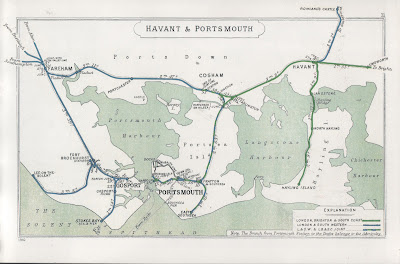
Map showing the Fareham-Gosport line, 1910


Here are the facts: my home town of Gosport, Hampshire, has an estimated population of eighty-five thousand people. It is a dormitory town, so most of its inhabitants work outside of it, making the main A32 Fareham Road and the B3334 Rowner Road gridlocked at least twice a day. The last passenger train left Gosport on 8thJune 1953, a whole decade before the Beeching cuts that severely reduced the UK’s rail network, but the first motorway in the UK, the Preston bypass, now forming part of the M6, opened on 5th December 1958. Rowner and Bridgemary, two major areas of Gosport, were built into suburbs in the 1960s without any further major roads being built in and out of the town. 

The train line continued to be used for freight until 1969, and while the southern half continued to be used to move naval ordnance until 1991, the rest was converted to a cycle track. Eventually, public transport returned to the northern half in 2012, the tracks replaced by a busway removing one type of vehicle from gridlock – an extension to this busway opened in December 2021, using up part of the converted cycle track, reducing the length of the average bus journey by two minutes. Gosport Train Station was redeveloped into housing in 2010, having been left derelict for fifty years.

The reason any of this has been on my mind is because, having rolled around local history in my mind for so long, the fact there was a gap between the end of passenger trains in Gosport and the opening of the first motorway meant that no-one would have thought to plan for when reliance on roads would continue to increase: the nearby M27 motorway between Southampton and Portsmouth did not begin to be constructed until 1972. 

It doesn’t necessarily mean I think a motorway needs to be cleaved into the town to reduce the time taken to get in and out, because the upheaval caused by attempting something like that now would carry its own cost over that of the concrete, tarmac and labour. While there is a bypass nearing completion in nearby Stubbington, where the land is available to build one, it serves to highlight the reliance on cars in Gosport, as I have mentioned previously on how a number of industries have left the town in the last thirty years [link].

I am not certain if trains should be reintroduced to Gosport, especially now that buses have taken over the track, but this is only because I am not sure trains were the answer to begin with. Gosport Train Station was opened in 1841, outside the town walls when they were still there, because it was less of a security risk to build there than in the home of the Royal Navy at Portsmouth Harbour, a situation which had changed by 1876. Branch lines to Stokes Bay and Lee-on-the-Solent had died out by 1914 and 1930 respectively – the former is now also a cycle track, while Lee-on-the-Solent station has been used an amusement arcade for so long that any indication of its previous use is almost accidental. If it wasn’t used so much for naval ordnance, the track probably would have closed to passengers before World War II.

13 January 2019

IF YOU’RE BLUE AND YOU DON’T KNOW WHERE TO GO TO [145]


My home town of Gosport, Hampshire has been in demand recently as a filming location: its 17th Century Village attraction was used for a recent episode of “Doctor Who;” some of the science fiction horror film “It Lives,” also known as “Twenty Twenty-Four,” was filmed at the Royal Naval Submarine Museum, while the Cold War submarine HMS Alliance, based at the museum, was used in “Transformers: The Last Knight.” Reports included pictures people took of themselves with Jodie Whittaker, Sir Antony Hopkins, Mark Wahlberg, and Bumblebee...
What was not picked up in this reporting is how Gosport has no cinema. 11th April 2019 will mark twenty years since its last cinema, the Ritz, showed its final film, “LA Confidential.” Rescue attempts came and went, and the Ritz was demolished in August 2001. I began my degree in Film Studies the following month. How can someone like me, steeped in the history of film, come from a town with no cinema. 
The Ritz had only ten years to make its mark on me. The first film I remember seeing was seen there, and it was “Who Framed Roger Rabbit?” in 1988. Five years later, I joined people queuing around the block to see “Jurassic Park”, and its sequel four years later. I saw “Titanic” there with my mother’s mother, who once worked there, and had an ice cream during the intermission that had, thankfully, been preserved by the cinema – we rejoined at the scene where the ship hit the iceberg. The final film I saw there, in 1997, was “Starship Troopers,” which made very good use of the sound system, as “Independence Day” and “Batman & Robin” had previously done.

With every single visit, overtures of film soundtrack music played as you found your seat, up to when the curtain opened – the Ritz promised you a special experience every time you visited, even if your film was to be prefaced with the same animated fairground advert for Cadbury’s Chrunchie bar every time, which they just about did. The Ritz also once accidentally ran the title of their matinee and evening performances together above the front door, creating “The Fox and the Hound Die Hard With a Vengeance.”

This period of time charted the evolution of blockbuster films into “tentpole” productions, as studios banked more money, and their success, on fewer key films. The first multiplex cinema opened in the UK in 1985, supplanting the single screen picture palace found in town centres. However, the Ritz, which seated around 1,200 people in its stalls and balcony, promoted itself as the biggest single screen on the South Coast, approaching the 48-foot screen found at the Odeon Leicester Square. The cinema could have been converted into two screens, across the balcony, and a dividing wall could have made it four, but by the time that sort of thing was considered, you could already get that experience out of town.

This is all right me saying this now, but I was still only fourteen years old when I saw “Starship Troopers” – the films were big, the sound was loud, and to this day, I have never sat before a bigger screen. It is difficult for that sort of experience to not have an effect on you, and for it to be so accessible – within half an hour’s walk from my house – I have been spoiled for every cinema experience I’ve had since, with every single visit to every single multiplex having been judged against it. I may have to move closer to Leicester Square.

However, my experience at the Ritz is tempered by how it became more and more run down over time. If it was ever renovated, it was before 1982, and the red carpets were sticky. The toilets were one level below the public toilets found outside, and if a seat in the auditorium was broken, it was removed, and never replaced. Some of the remaining seats felt like the foam had to be bolstered with cardboard, because they were. Eventually, the balcony closed. For this decline to happen, there had to be a chance of replacing the cinema altogether, and indeed there was.

For me, the only cinema in Gosport has been the Ritz, but when it opened on 11th March 1935 - with a showing of the MGM film “What Every Woman Knows” (based on the play by J.M. Barrie – yes, that one) - it was competing with three other cinemas: the Gosport Theatre in the High Street, the Olympia Picture House in Stoke Road, and the Criterion Cinema in Forton Road. All of these were opened between 1910 and 1912, when films only reached one or two reels in length, but were now shown in places with more comfortable seats than the old nickelodeons. Both the Gosport Theatre and the Olympia closed in 1938, but another new cinema, the Forum, opened just across from the Olympia in the following year. So, when the Ritz was bombed on 10th January 1941, there was no great clamour to reopen it straight away, as audiences went elsewhere.


When the Ritz reopened in 1958, trading its original restaurant for a Cinemascope screen (but kept the bar open), the success of television, which reached the South of England in 1954, ultimately closed the Forum, making way for a car showroom and petrol station, before being demolished to make way for a supermarket. The Criterion also closed in 1968, but remains open to this day as a bingo hall. Even when it stood alone, the Ritz closed for a time between 1982 and 1985, around the point when home video caused cinema audiences in the UK to reach an all-time low, and was sold to Gosport Borough Council, which later leased it to new operators. Applications were made to the council in 1991 and 1998 to replace the building with a new five-screen multiplex – the last of these was approved, but never built. When the Ritz was demolished, the application to build there was made by another supermarket, with a Job Centre built next door.

Today, the only cinema of any sort in Gosport is “The Ritz Cinema @ St Vincent,” a volunteer-run effort based out of a sixth-form college, running fortnightly screenings of recent films. The last attempt to open a permanent cinema was a rejected 2004-05 plan to convert a slaughterhouse in a former Royal Navy yard – yes, I did type that. The Ritz cinema is an experience not really done anymore, but here is the thing with that: from the all-time low of 1984, the number of admissions to UK cinemas in 2018 are around twenty per cent more than in 1999, reaching levels not seen since the early 1970s. People want to have an experience, and it may be time for someone to build a big, red, opulent picture palace once again, and if I ever win the lottery, I know just where I’ll build mine.

17 February 2017

FERGUS-ON SINGS THE BLUES [42]


Once upon a time, televisions were made in our home town. We owned a few of them, but the most memorable, were two black-and-white portable televisions which, like the others, were made by Ferguson, a major employer in Gosport, Hampshire, and a division of the enormous Thorn-EMI corporation. The cathode ray tube in one TV gave up one day, but the other hung on for a very long time: when the on-off-volume switch fell off, it was replaced by the end of a used chapstick, jammed into the hole to serve for nearly a full decade. Colour television arrived in my bedroom when both progress, and a Christmas present, replaced the Ferguson with a portable Matsui TV.
It turns out that this coming Monday, 20th February, is the twenty-fifth anniversary of the closing of the Ferguson factory, which has since become a business park. The US conglomerate Cyanamid, once owners of brands as disparate as Old Spice and Formica, had a pharmaceutical plant down the road, but it has since moved out, the factory knocked down. The remaining mass employer in Gosport, apart from the Royal Navy, is the Finnish company Huhtamaki, makers of food and drink packaging, and formerly known as the great-sounding Sweetheart International, whose base is big enough for them to sponsor the flowers on nearby roundabouts.


It is too easy to get sentimental about these things, especially the jobs that are lost – I have only worked in my home town for five months out of the last twelve years. However, the reason the last TV was replaced was the same reason the factory closed: competition. In 1987, Thorn-EMI sold Ferguson to Thomson, the French company that already shared production and designs with them, but they themselves pulled out of a market where Ferguson no longer fit.
Back when people rented TVs, because they were often too expensive to buy, Thorn-EMI not only made the TVs, you rented and bought from them too – their Radio Rentals, DER and Rumbelows rental businesses have since become Bright House. Thorn-EMI also made some of the programmes you saw, owning half of Thames Television, and all of EMI Records. Only Sony has gone as far as this since, owning Columbia Pictures and record labels, but they don’t keep their customers tied in to the same extent, as TVs have since become cheap enough to buy, and to throw away – no jamming in any chapsticks there.
If people are looking at bringing back industry the way we used to have it, so long as you are able to innovate and adapt as well as any other part of the world, and you know that the conditions are different from the way they were, then it is certainly possible. Whether it means anyone will buy up Gosport’s KFC drive-thru, knock it down, and build the Cyanamid factory on top of it, is another question all together… one that has the answer, “probably not,” unless plans for the future are being made over a bucket of chicken.