Showing posts with label david bowie. Show all posts

21 September 2025

IT’S NOT TO LATE TO WHIP IT [511]

"New Traditionalists" alternative album cover

Having only discovered the genius of David Bowie after he died, and becoming enamoured with Kate Bush out of embarrassment for not having any of her albums [https://www.leighspence.net/2024/01/do-you-wanna-know-how-it-feels-432.html], I have, at the very least, understood DEVO, the “de-evolutionary” New Wave band and multimedia project, while it is still possible to see them live. As their catalogue of videos are restored and re-released to their YouTube channel, their work remains as vital and relevant as ever.

I first encountered DEVO many years ago, having had the name “Mark Mothersbaugh” drummed into my head as a child through his opening theme for the cartoon series “Rugrats”, also writing the incidental music alongside his brother Bob. I was pleasantly surprised by the big hits, formed of spiky synthesisers and guitars, driving rhythms and direct lyrics: “Whip It”, “Jocko Homo”, their idiosyncratic cover of the Rolling Stones’ “(I Can’t Get No) Satisfaction”, and “Through Bring Cool”, a song so soaked with smart-ass attitude over being misunderstood – “eliminate the ninnies and the twits” and “time to show those evil spuds what’s what” – that I will never let go of it.

If I only had DEVO’s songs, that would be enough. “Concept albums” are such a ubiquity that I hadn’t considered how much further DEVO took the notion of a “concept”. Indeed, co-founder and co-lead singer Gerard Casale described “de-evolution” as a “technique”, a philosophy informing the group’s outlook and work. 

Casale and friend Bob Lewis had already formed the initial idea that mankind was regressing, instead of continuing to evolve, through increasing dysfunction in society and herd mentality, when Mark Mothersbaugh brought to them a Christian anti-evolutionary tract titled “Jocko Homo: The Heaven-Bound King of the Zoo”, written by a Dr B.H. Shadduck in 1924. Having attempted to read it, I saw it was trying to say that the meeting of liberalism, rationalism and Darwinism had attempted to pass off skeletons as evidence of progress:

“Old bones only prove that brute races and families have passed and will pass. Rudimentary organs prove that equipment not used, be it a wing or a soul, becomes atrophied. THAT IS NOT EVOLUTION, it is the opposite. It is going the wrong way. Show us a species that is coming or an organ that is in the making. Show us how to grow wings where there are none.” [Capitals and italics are as per the original edition.]

The tract later states that “The scholar who believes the ‘fact’ of evolution, doubts the infallibility of the Bible. I know of no exception.” The DEVO song “Jocko Homo” provides its own answer: “All together now, God made man, but he used the monkey to do it / Apes in the plan and we're here to prove it / I can walk like an ape, talk like an ape, I can do what monkey do / God made man, but a monkey supplied the glue.”

The “Devolutionaries” that make up DEVO – its classic 1976-84 line-up is Gerald Casale (vocals/bass/keyboards) and Mark Mothersbaugh (vocals/keyboards), their brothers Bob Mothersbaugh (“Bob 1”, lead guitar) and Bob Casale (“Bob 2”, rhythm guitar and keyboards), and Alan Myers (drums) – present as identically-dressed agents of change, shedding light how humanity is devolving, while technology and cybernetic systems rapidly advance, encouraging people to recognise their plight, and recalibrate and reorganise as a result. 

I may have made this sound heavy-going for a very fun, surrealist and Dada-influenced band, but “Whip It” is a string of motivational statements about dealing with problems, its video only making the “whip” more literal. A further element is potatoes, referencing people and fans of the band as “spuds”, equating with a lowly vegetable often underestimated, as in the line from the song “I’m A Potato”: “I'm a spudman, I got eyes all around”.

While DEVO did not form in answer to it, the shootings by the Ohio National Guard of thirteen unarmed anti-war protestors at Kent State University in Ohio on 4th May 1970, killing four, loom large over the pre-history of the group – Gerald Casale was at the protest, one of his friends being killed there, while Mark and Bob Mothersbaugh were attending another campus at the university that day. Despite their proximity, there is no DEVO song specifically about the incident – this was left to distant observers like Crosby, Stills, Nash & Young, John Denver, Bruce Springsteen, the Steve Miller Band, The Isley Brothers, Genesis and so on – but it underlined the serious intent of highlighting “de-evolution”.

As early adopters of music videos, conceiving and producing them themselves, DEVO completed a short film in 1976 titled “In the Beginning Was the End: The Truth About De-Evolution”, building a narrative around performances that include characters General Boy and son Booji Boy. The film includes a “De-Evolutionary Oath”, adopting and repurposing a number of “Trick Rules” the “Jocko Homo” tract had “identified” as excuses for evolution theory, reappropriated as calls to action. For the sake of completion, these are: wear gaudy colours or avoid display; lay a million eggs or give birth to one; the fittest shall survive yet the unfit may live; be like your ancestors or be different we must repeat!

My favourite DEVO album is “New Traditionalists”, released in 1981 – it had to be, with “Through Being Cool”, a riposte to the band becoming “cool” after the release of “Whip It”, and employing a darker, more synthesised sound, albeit one caused by the master tape shedding oxide. “Beautiful World” may qualify as one of the best DEVO songs of all, a simple hymn to how great the world is... “for you, for you, for you”. The accompanying video creates a utopian montage of American cultural life, becoming darker and more menacing before the punchline of “It’s not for me” is reached.

I also love how they masqueraded as a corporation, press releases and all, for their most recent album, 2010’s “Something for Everybody”. I now know the famous red ziggurat “energy dome” hats were influenced by the work of scientist Wilhelm Reich, and that I would need to insert a hard hat liner not just for comfort, but to allow the hat to collect energy properly. I find it hilarious that they created the fake Christian pop band Dove, in order so they could appear as their own opening act, one that couldn’t be better than they were. I’m still not sure about the deliberately anaemic cover versions of their own songs in the “EZ Listening Muzak” tapes, originally created to stop live venues playing other bands’ songs before their concerts, but I think they are growing on me – the “EZ” version of “Come Back Jonee” sounds like I may have heard it in an episode of “Rugrats”.

This hasn’t been a case of me recounting lore or building a story. I have been genuinely fascinated by discovering DEVO’s vast body of work, and wanted to share my findings. At the same time, I hope it is as clear as possible that art and politics are not separate, and all art is political as a result – even if the group were just reflecting their current time, that engagement also confirms their intentions in creating that work, and in their continuing to perform it. This notion forms the basis of the art critic John Berger’s book “Permanent Red”, published in 1960:

“But why should an artist’s way of looking at the world have any meaning for us? Why does it give us pleasure? Because, I believe, it increases our awareness of our own potentiality. Not of course our awareness of our potentiality of artists ourselves. But a way of looking at the world implies a certain relationship with the world, and every relationship implies action.”

And so, I love DEVO, and I love how their work energises me. 

06 October 2024

BOYS ALWAYS WORK IT OUT [469]


“Oblique Strategies” is a set of cards, introduced in 1975 by artists Brian Eno and Peter Schmidt, designed to promote lateral thinking when breaking creative blocks. I knew about them from Eno’s collaboration with David Bowie, sparking and informing decisions made on Bowie’s albums “Heroes” (1977) and “Lodger” (1979).

My sister Layla Spence, writer and artist of the online comic “Ill Fame”, owns a pack of these cards, saying she has used them when a second opinion might be needed, and thought I could use them in my writing. 

You don’t reach the four hundred and sixty-ninth article in a series without having deployed some lateral thinking along the way, but I didn’t know if I should use the cards to spur an idea, or to apply them to something I had already prepared. Upon cutting the cards, the first one read “What wouldn’t you do?”, so my answer was to be led by the cards this time around, forcing me to be creative about my creativity.

“What mistakes did you make last time?” I think my last article about Toys “R” Us opening concessions in branches of WHSmith was a little overblown. Visiting a local branch that stated it was “now open” amounted to a further statue of Geoffrey the Giraffe, and shelves of toys to one side. No space for traditional WHSmith product lines stationery was really lost – if anything, it looked tidier than usual. I always visit that branch when I am in town, and I was facing the prospect of losing some of the reason I go there – as it turned out, I needn’t have worried.

“Do nothing for as long as possible.” Your baseline may vary - living authentically as yourself is politically charged in the sight of the wrong people. Meanwhile, I don’t write to intervene - I don’t need the hassle. I observe, I write, I continue looking. “Nothing” is subjective.

“Abandon normal instruments.” I will switch to making videos someday.

“Who should be doing this job? How would they do it?” There is no vacancy here, but if you can honour your obligation to explore your intrigue every week, while trying to articulate that in an approachable way while never having a set formula for how that will be done each time, then you may be in with a chance... to do it for yourself on your own site.

“Trust in the you of now.” Don’t give yourself enough time to decipher or question your methods. Ritual leads the way. Deadline is style. You are in there somewhere.

“Don’t break the silence.” I drew this card just after watching a YouTube video about a Nintendo GameBoy clone that I want to buy, which I watched to give myself a rest for a moment – I am purposefully thinking of buying myself a worthwhile distraction that forces concentration. I listen to the music or have a TV on in the background all the time. I only do “silence” when I am asleep, and even then, my TV must remain on as I fall asleep. I can be “still”, but not “silent”.

“Do we need holes?” What did you have in mind?

“Abandon normal instruments.” I just drew the card that inspired David Bowie’s song “Boys Keep Swinging”. The plan was already to emulate a garage band by having Bowie’s band playing each other’s instruments – the simple drums are by guitarist Carlos Alomar – and the card seems to imply they were on the right track. Also, “abandon normal instruments” for a song about gender identity? [Yes, I was thinking so hard I didn’t realise I drew the same card twice.]

“Distorting time.” This may have been my plan all along – whatever that is, I’ll never tell, because I don’t actually know.

21 January 2024

DO YOU WANNA KNOW HOW IT FEELS? [432]


My musical listening journey has created a list of artists and bands for whom I don’t have a physical copy of any of their music, an omission to remedy someday: Pink Floyd, Led Zeppelin, Nina Simone, Joni Mitchell, the Spice Girls and so on. Some works demand better than the lossy compressions of MP3 or streaming.

Kate Bush is a different matter. Upon realising I had none of her albums, I felt embarrassed by this admission - how can I have all of David Bowie’s studio albums, but nothing by Kate Bush? I practically ran to the nearest HMV to stock up: “Hounds of Love”, “The Red Shoes”, “Never For Ever”, “The Kick Inside” and “The Sensual World”, one each of what the store had in stock. 

My CD collection felt complete in that moment, and seemingly remains so until I decide I really need something by Pink Floyd, for Kate Bush always feels like a special occasion, whenever I hear a song by her, and no matter how often I hear those songs. 

From the ethereal nature of early hits like “Wuthering Heights”, “Them Heavy People” and “Wow”, to the spiky characters of “The Dreaming” album, and the triumph of both sides of “Hounds of Love”, Kate Bush’s output became better as more creative freedom was afforded to her, and her increasingly experimental albums, made in her own time, at home through technological advances and portability, like the Fairlight CMI album first used on “Babushka”, have allowed this experimentation and freedom to become mainstream.

My favourite Kate Bush album is 1985’s “Hounds of Love”, and my favourite song of her songs is “Running Up that Hill (A Deal with God)”, from the commercial-led side A of that album – the perceived failure of 1982’s “The Dreaming”, which still reached number 3 in the charts despite singles not charting, led to a compromise that put more avant-garde material onto side B, while also becoming Bush’s first album recorded entirely at home, in her own time, at her own pace.

“Running Up That Hill” reached number 1 in the UK singles chart for three weeks in June 2022, having been used as a plot device in the Netflix TV drama “Stranger Things”. Having a song that talks about exchanging sexes to achieve a greater understanding to have come back from 1985 to become more relevant and celebrated than ever intended, is perhaps one of the best things that could have happened in pop music, and it was entirely deserved – it was like us, as the audience, had caught up with the song at last.

Kate Bush’s last album of new material was 2011’s “50 Words for Snow”, a chamber-pop-jazz-ambient album based around a single theme, with no track shorter than seven minutes in length. There is a natural expectation for any future release, but I currently like to think that she thought long enough to make music her way, having achieved a position where she can make music entirely for herself, any clash this makes with the image of a publicly accessible rock star is her audience’s problem alone.  

14 January 2024

STUMBLE YOU MIGHT FALL [431]

The BT Tower, seen from St Paul's Cathedral

Leaving home for work as usual, I opened the BBC Sounds app on my phone to play BBC Radio 6 Music. Chris Hawkins has a brilliant weekly feature about people’s names heard unintentionally during songs, and as the time for it approached, the app would not load. Sometimes it takes a while, but realising this was taking longer than usual, I opened my web browser to stream the station via the BBC’s website. This also failed to load, along with any other website I tried.

Arriving at my bus stop, unable to check why my phone had no internet signal, I hoped the bus company’s app will let me catch the bus. Restarting my phone did not re-establish any connection. Fortunately, I was able to carry on my journey, as whatever codes needed for the app to work today must have downloaded previously.

Unaccustomed to travelling in silence, and with my MP3 player at home, I was resigned to listening to music saved to my phone before the near-unlimited choice of a music streaming app made purchases rare. I compromised with the Muzak Corporation’s “Stimulus Progression 5” background music album, various songs by the Bonzo Dog Doo-Dah Band, and the reworked version of David Bowie’s 1987 “Never Let Me Down” album released in 2018, an interesting exercise that could still have been left alone. Listening to the sublime original “Rawlinson End” piece by Vivian Stanshall, I thought of looking up more information about it, then had to sit there realising I could not – I couldn’t leave my bus to work to stop at a library.

Finally logging into my work computer confirmed that Vodafone, my mobile network, had an outage of their 4G and 5G internet networks, but not phone calls and text messages – Vodafone introduced text messages to the world, so maintaining its use must be a point of pride. I thought the internet came back just before starting work at 9am, but this was after going to an area of the building with poor reception (the staff toilets) caused my phone to search out the still operating 3G network instead. This network will be phased out by Vodafone during 2024 to bolster 4G and 5G reception, a good idea in the circumstances, but GPRS (General Packet Radio Services), introduced in 2001 and still used for calls and messages, will remain.

Cybernetics is a subject I plan to discuss in greater detail in coming weeks, but nothing serves to focus your mind on the science of control systems, communications and technology than being temporarily kicked out of such a control system. As much as I would like to think I could live without the internet, I have surely arrived at the point where any period of disconnection will cause frustration. Its initial usefulness became a welcome extension of myself, and it may be time to properly make sense of that.

Everything was back to my new normal by 11am, and I listened to Chris Hawkins’ radio feature during lunchtime.

04 December 2022

I NEVER DID ANYTHING OUT OF THE BLUE [373]

I previously said “Station to Station” (1975) was my favourite David Bowie album [link], but the album I have the T-shirt for is “Scary Monsters... and Super Creeps” (1980), which closed the “classic” Bowie period of the 1970s, before he reinvented himself as “himself” for “Let’s Dance” in 1983.

“Scary Monsters” begins and ends with two versions of the same song, “It’s No Game”, the first sung as a wail against an oncoming onslaught, the second much calmer, as if having accepted a new status quo. Initially feeling like a set-up for an album with an anti-fascist theme, most clearly in the lyrics to “Fashion”, “It’s No Game” launches you into what becomes almost a definitive Bowie statement on recurrent themes of alienation, madness and misunderstanding, before taking on a new confidence with the next album.

What I had not expected was for “It’s No Game” to have dated from the start of Bowie’s “classic” era. A new box set, “Divine Symmetry”, was released in November 2022 to act as a complement to 1971’s “Hunky Dory” album, showing the process that led to “Life on Mars”, “Oh You Pretty Things” and “Changes”, while including songs that remained as demos or were only performed live. One of these, “Tired of My Life”, starts as a folk-like song more reminiscent of Bowie’s previous album “The Man Who Sold the World”, but you start recognising the chord progression, and then the middle section: “Pull the curtains on yesterday and it seems so much later / Put a bullet in my brain and I'll make all the papers.” 

The verses around it may have changed, and the remaining lines polished further, but hearing “It’s No Game” in “Tired of My Life” is inescapable, just as listening to “King of the City” will lead you to start singing “Ashes to Ashes” along with it. I shouldn’t have expected something like this to have been done – if you bought the remised reissue of the Beatles album known as “The White Album” that came with an extra CD of demo songs, you will know that John Lennon’s “Child of Nature” had its lyrics rewritten to become “Jealous Guy” – but there is something about hearing David Bowie essentially recycling old material years after writing, and not just when plans don’t work out, such as a musical version of “Nineteen Eighty-Four” being repurposed into 1974’s “Diamond Dogs” album. 

Even if these recordings were known, or even released previously, grouping them together to display an artist’s creative process confirms the adage about how much of it is perspiration over inspiration. Add in “Scream Like a Baby”, reusing the music composed by Bowie for “I Am a Laser”, a 1973 song he wrote for backing group The Astronettes, and Bowie’s covering of Tom Verlaine’s “Kingdom Come”, and half of the ten tracks for “Scary Monsters” existed before the album’s production began, which departed from Bowie’s usual process by having backing tracks recorded before lyrics were written, instead of pre-written demos or Brian Eno-led improvisation.

This exposure to Bowie’s musical processes will continue, but it will come at the expense of the mystique that the works were intended to create. With the selling of the publishing rights to his back catalogue for $250 million to Warner Chappell Music in January 2022, everything will eventually come out. We remain curious, but we cannot put our fingers in our ears, we will eventually know Bowie inside out.

09 October 2022

BECAUSE YOU'RE MINE, I WALK THE LINE [364]


Most of what I write will start as half-thoughts recorded on a scrap of paper, or even a couple of words scrawled on my right hand. This is borne from a belief, made many years ago, that I had forgotten more good ideas than I had written down, so therefore all ideas must be caught, with a paper and pen – the finished work can then be typed up later.


To that end, when I write – when I am actually in the headspace of writing – I use a felt-tip pen, specifically the Paper Mate Flair, introduced in 1966. Their current advertising makes big mention of fun and expression, selling in a range of bold and expressive colours of ink that won’t smear or bleed through the page. I don’t really doodle or draw, or write bullet journals, so the appeal is purely functional: I avoid the mess I always end in when using a fountain pen, and I avoid the extra force required to write with a ballpoint pen. Instead, it is just me, and essentially a very stiff brush soaked in ink, and I love how that looks on the page.

There is no accounting for how people wind up with what they need to work. Pinned up at my workspace is a copy of David Bowie’s handwritten lyrics to “Fashion”, because it showed the process where he attempted to rewrite the end of the line “we are the goon squad and we’re coming to town, beep beep”, proving that sometimes the first idea you have is the best one. Like other Bowie lyrics I have seen, these were written with a felt-tip pen, red on this occasion, on squared paper. I did wonder if he also used the Flair pen, and the recent biopic “Moonage Daydream” confirmed it for me in a photograph of Bowie writing, the distinctive Flair shape blown up to fifteen feet long on a cinema screen. It was a happy coincidence for me.

With felt-tip pens most often found in packs for children, and adults, to colour between the lines, I forgot that felt-tip pens became popular enough for Parker, maker of higher-end fountain pens, made a felt-tip version of their Big Red pen in 1970, itself a copy of the Duofold pen that dated back to the 1930s, and oddly marketed as “a glorious handful of solid pleasure”, so faithful to the old design that you have to unscrew the lid, rather than just take it off. Withdrawn in 1981, Parker never made another felt-tip pen, keeping to ballpoint and fountain pens, but like Paper Mate, they are part of Newell Brands, formerly the delightfully-named Newell Rubbermaid, so there is still time to share some ideas around.


21 August 2022

PEOPLE SAY I’M THE LIFE OF THE PARTY [358]


A visual shorthand for the 1970s, the 8-track tape cartridge appeared to peacefully co-exist with the competing Compact Cassette format for its entire time on sale, from 1964 to 1990, even if its popularity dwindled through the 1980s. I have only limited experience with the format, through an 8-track car player my father owned, but they only felt at the time like a “big cassette”. What allowed the 8-track to stick around for so long?

Both formats appeared around the same time. Philips unveiled the Compact Cassette in Europe in 1963, and in the United States in 1964, the same year the first demonstration 8-track players appeared from the Lear Jet Corporation, which spearheaded its development as an in-flight entertainment device. The first in-car units were offered as optional extras by Ford in 1965, alongside the first pre-recorded cartridges from RCA. Home-based hi-fi players and recorders for both formats would both appear before the end of the decade.

Like almost all tape formats, cartridges existed to make reel-to-reel tape easier to handle. The Compact Cassette miniaturised the reels and tape, to 0.15 inches wide and played at 1.875 inches per second, but the first pre-recorded demonstration cassette would not appear until 1967, the Compact Cassette’s initial poor recording quality only useful for dictation purposes. Instead, an 8-track cartridge used the same quarter-inch tape used in reel-to-reel players, playing at 3.75 inches per second, twice that of the Compact Cassette, but half the maximum speed of a reel-to-reel player, making 8-track almost an “audiophile” format by comparison. However, in splitting the tape into four programmes, each made up of two tracks, the 8-track increased both tape hiss and the possibility of “crosstalk” between the tracks and a misaligned playback head.

At four inches wide, each cartridge can play for up to eighty minutes, housing enough tape for four programmes of up to twenty minutes in a single-reel “endless loop” design, like the earlier 4-track Stereo-Pak and Fidelipak “broadcast cart” cartridges used for playing radio jingles, leading from the middle, and windingback around itself. The join in tape was bridged by a silver foil splice which, once it moved past a sensor, moved the playback head to the next programme automatically. The pinch roller usually found in the player mechanism was moved to inside the cartridge, allowing it to automatically engage and play upon being entered into the player, particularly useful when travelling.

With this form to play with, the albums that resulted on 8-track were, to me at least, not the greatest aesthetically. In terms of packaging, the hard plastic cartridge eliminated the need for the case required for a Compact Cassette, but the album cover and other information would be provided as a sticker that would deteriorate with age, along with the silver foil and foam pads inside the cartridge.

The biggest problem, however, is the inflexibilities of arranging an album onto an 8-track cartridge. With a C-90 cassette providing up to 45 minutes per side, you could fit the equivalent of an entire vinyl record on each side of a Compact Cassette, as Pink Floyd did with their double album “The Wall” in 1979. The maximum 8-track programme length of twenty minutes should accommodate one side of a record, but to minimise the amount of tape used, the maximum programme length will be the total length of the album, divided by 4. 

The worst example of this I could find was David Bowie’s 1976 album “Station to Station”, a six-song, 38-minute album, meaning 9.5 minutes per programme is available... but the title track is over ten minutes long by itself, taking up the entire first programme and the beginning of the second. “Word On a Wing”, song 3 of 6 on every other issue, is now song 2 on the 8-track, followed by “Wild is the Wind”, usually the album closer, itself broken up between programmes, perhaps to take advantage of a quiet moment in the song. This means that the final three rockier songs, “Stay”, “TVC15” and “Golden Years” (usually tracks 5, 4 and 2), can play without interruption. Make your album fit, or forget about it.

Meanwhile, the average length of each side of “The Wall” vinyl album was twenty minutes, fitting relatively easy onto the four programmes of an 8-track without making any changes to the songs’ length or running order, except that “Hey You”, the first song on side 3 of the vinyl version, begins at the end of one programme, and starts the next one. It is not possible to lengthen one programme to make the rest of the song fit, as you will have a gap at the end of the other three programmes, disrupting the flow of the album in a different way.

While 1978 was the peak year for 8-track sales in the United States, sales of pre-recorded albums by mail order clubs continued there until 1988, while the electronics retailer Radio Shack sold its Realistic-branded players and blank cartridges until 1990. Meanwhile, the more portable and cheaper Compact Cassette had caught up through constant improvements in tape and playback quality that did not happen with 8-track, although Dolby B noise reduction was licensed for both formats. But by then, the Compact Disc had allowed for seventy-four minutes of high-quality music, later eighty minutes to be played back on one side, without interruption.

16 July 2022

THEY CALLED HIM ERNIE [353]

ERNIE 2 (1972-88)

No-one could mistake the following for financial advice, but I decided long ago that, if I ever won the lottery, I would buy Premium Bonds. (Always speak to your financial advisor.)

I also found myself saying this when talking about the “Bowie Bonds” issued by David Bowie to raise the money to buy his back catalogue [link]. Like the bonds issued by businesses and governments, these were issued for a limited period of time to raise funds, after which the investor would receive their money back with interest. Premium bonds, however, are an evolution of the “lottery bonds” occasionally issued for government projects dating back to the 18th Century, whereby the interest, currently running at one percent per annum, is issued as a monthly prize draw for prizes ranging from £25 to £1 million.

Operated by National Savings & Investments, Premium Bonds effectively act as a restricted, government-approved form of gambling, competing on its launch in 1956 with the similarly staid Football Pools, betting on the outcome of the coming week’s matches without visiting a betting shop. The National Lottery, launched in 1994, has bigger prizes and a higher profile, but like the Pools, your stake pays for the prize, operating costs, tax and charity donations. Premium Bonds allow you to retain your “stake” of up to a maximum of £50,000, each pound becoming an entry to the monthly interest draw, and withdraw any or all of your funds at any time, but the lack of guaranteed returns makes it less desirable than a regular savings account, unless you are just looking for somewhere to place your money. 

But the other side of the initial appeal of Premium Bonds upon their launch was its insanely futuristic use of a computer, and the anthropomorphising of said computer. ERNIE, an acronym (and possibly a backronym) for “Electronic Random Number Indicator Equipment”, entered its fifth iteration in December 2019, having moved from using the signal noise generated by neon tubes, through the thermal noise in transistors, through to quantum computing - a concept I am still getting my head around, because it involves the computer holding the binary values "0" and "1" simultaneously - to generate winning codes that are verifiably random, instead of using an algorithm to generate codes that can be interpreted as “random”. Like the naming of National Lottery draw machines, “ERNIE” is a human name given to the effort to prove the transparency of the process, and what can be more random than the human ability to be irrational?

With my original statement implying I would not invest in Premium Bonds until I won the lottery, is there a reason for not applying now? I think I was unconsciously making a joke about moving from the high-stakes lottery to the comparative sensibility of Premium Bonds, before deciding it sounded like it may be a good idea. However, I think looking at how many things in my home town were paid for using money raised from the National Lottery has swayed towards waiting until the point when a lottery win provides the money to invest.

29 May 2021

FIVE YEARS, STUCK ON MY EYES [300]

First logo (May-December 2016)

Hello there. There is a question you often hear in interviews where the answer is always going to be “no.” “Did you think that when you started Leigh Spence is Dancing with the Gatekeepers on 30
th May 2016, that you would still be doing it five years later?” “Yes, yes I did, I always knew that I could write articles about various aspects of popular culture, philosophy and the news, then deliver them weekly for that that entire time without a break. That outcome was baked in from the start.”

Of course, I never planned it, but I’m glad it happened. I began this site to keep my mind working, learn more about different subjects, and build confidence in putting my name out there. I was inspired by the Three Minute Thesis competition, begun by the University of Queensland, which challenges PhD students to present their research in only three minutes, to an audience with no specialty in their subject. Trying to explain a complex subject in an engaging manner is a brilliant way to develop your communication skills, so I deliberately put myself in a position to make myself do this over and over again, refining my approach and style as I go. I originally set myself a five-hundred-word limit, which would take about three minutes to read, and if anyone else happened to read what I wrote, then that was good – and if they found it entertaining, better still.


I certainly did not expect to arrive here, at my three hundredth article, having reached over 196,000 views so far, with another sixteen thousand for the “Gatekeepers” videos posted to YouTube. I can only assume that my plan must be working, especially as that word limit was abandoned a long time ago! To anyone that has read or watched my work over the last five years, thank you for your time.


The question is, what have I learned in that time? What lessons from five years of nostalgia culture crisis will I take into the next five, provided I get that far?


Second logo (January 2017 to May 2017)


1. STAY CURIOUS

I am happy I have never restricted my choice of subjects. I may like to find out new things, especially about how ideas, machines and personalities are constructed, but there is a difference between a hobby, and your natural state of being. I cannot imagine a version of me that is simply contented with things being as they are – I would want to know why that was the case.


Therefore, my top ten most read and viewed works here, combining views on my website and YouTube, is as varied a list as I could have hoped for, and I am happy with what has appeared. Some weeks may feel like I’m throwing spaghetti against a wall to find a subject, but it is amazing to see what sticks.


1. Why BBC Radio had no news to broadcast on Good Friday 1930 (#88 I’m Just Second Hand News, written version posted 29/12/2017, video 24/02/2020)


2. My January 2020 walk around the doomed Elephant & Castle Shopping Centre (#217 An Elephant Never Forgets, video posted 15/01/2020)


3. The shipwrecked ocean liner SS American Star, formerly America and Australis (#76 Just a Dream and the Wind to Carry Me, written version posted 06/10/2017, video 26/12/2019)


4. Looking around The Bridge Shopping Centre, Portsmouth in 2019 (I’m Giving Up on Trying to Sell You Things That You Ain’t Buying, video posted 13/10/2019) 


5. How “CheapShow” is the “Goon Show” of podcasts (#234 Welcome to the Cheap Seats, posted 03/05/2020)


6. A list of interesting facts about Jeremy Beadle, who built a library onto his house (#26 Watch Out, Beadle’s About, posted 11/11/2016)


7. The HP-12C financial calculator, which no-one has stopped buying since 1981 (#200, I Am Adding and Subtracting, I’m Controlling and Composing, video posted 29/09/2019)


8. the battle to grow blue roses (#78 I’ll Pick a Rose for My Rose, written article posted 20/10/2017, video 25/05/2020)


9. The ornate pleasure dome that is The Trafford Centre, Manchester (#192, Plastic Palace People Sing Silent Songs, written version posted 11/08/2019, video 22/03/2020)


10. The ridiculous Sports Direct Giant Calculator (#208 Everyone Seems to Know the Score, video posted 24/11/2019)


Is there anything I wish was on the list? Not really, as writing about a particular subject never means I am then done with it. However, if you read what I am calling “The Myra Breckinridge Trilogy” - #149 Come Outside (Shove It) (03/02/2019), #150 I Wouldn’t Tell You Where to Go (10/02/2019), #204 Mama I’m Sure Hard to Handle (27/10/2019) – suggests I am not done with that film yet.


Third logo (May 2017 to April 2018)

2. ALL THEY HAVE ARE WORDS

In hindsight, I find it funny that I started this series by picking apart why The Beatles are called “The Beatles,” but it set the tone I wanted. The intention was to point out that, while the true inspiration came from Buddy Holly and the Crickets, and the name of Marlon Brando’s motorcycle gang in the 1953 film “The Wild One,” the “official” origin is instead a man coming to John Lennon in a dream, riding a flaming pie, declaring the name of his band will be “The Beatles” with an “a.” It turned out that Yoko Ono pushed for this version, a flippant answer once given by Lennon to a journalist, to be the origin of the band’s name as given in “The Beatles Anthology,” with Sir Paul McCartney admitting, “There are still a lot of things we have to fudge because of compromise. If we don't all agree on a story, somebody has to give in.”


Well, I dreamt that I had recorded an album titled “Leigh Spence is Dancing with the Gatekeepers,” and one song on this album will feature me repeatedly singing “all we have are words” – I’m guessing I was incandescent, either in the dream or earlier that day, about being told what to think, by someone who claimed they had all the answers. I will write that song eventually, but after having to reject any comparison I could have made with The Beatles’ flaming pie, I concluded that “Gatekeepers,” as a series, will “be more about me trying to make sense of an issue, why I think the way I do, or why I am expected to think something, rather than coming to a decision. Ultimately, I want this to be a fun exploration of the stories we tell ourselves.” Keeping this in mind would, hopefully, prevent me from being seen as a “gatekeeper” myself.


So, the angle and tone for my writing was set by The Beatles. It was at this point I decided to use song lyrics as titles for my work, as a kind of primitive search engine optimisation, although that first title came from David Bowie’s “Word on a Wing”: “Ready to Shape the Scheme of Things.”


I did talk again about The Beatles, except to explore how multi-track recording meant John Lennon didn’t have to play his harmonica anymore.


Fourth logo (April 2018 to May 2021)


3. ALL THEY HAVE ARE WORDS


When I began “Gatekeepers,” Barack Obama was still President of the United States, David Cameron was still Prime Minister, the Brexit vote was a few weeks away, and Donald Trump was an also-ran… and then, 51.9% of 72.2% of the British electorate voted to leave the European Union. I don’t give the figures like that to question the legitimacy of the vote, more to point out that the single issue that has dominated British politics, and social life, ever since, was decided in a process where over a quarter of people who were entitled to have their say said nothing at all. I personally believe voting in elections and referendums should be mandatory, so the winner knows they have to answer to their entire electorate.


I consider my political position to be slightly left of the middle – many would consider me to the “right” of them, and many more would consider me to be the “left” of them. As a result, I have never found talking about the “Right” and the “Left” to be overly helpful. The last five years pushed politics and people to extremes of opinion and thought, whether that be Labour and Conservative, or Democrat and Republican, and I am left in the middle thinking, “what happened?” 


I never feel I need to talk about my own politics, but I feel I have become more informed about what mine is. I just wished that politics could become the background to general life again, instead of carrying the tune.


4. ALL THEY HAVE ARE WORDS

I began 2021 by writing several articles about how postmodernism, a branch of arts and philosophy deeply rooted in the 1980s and 1990s, still influences public discourse today. Most notably, the route normally taken is to think that, just because Jacques Derrida deconstructed texts to look at meaning and motive, reality itself must therefore be relative, and you can do and say anything you want. Even worse, deciding you can say what you want, because you know it ultimately doesn’t matter, is dangerous. 


No wonder I spent four out of the last five years excoriating Donald Trump. Originally just someone who needed people to explain what he is trying to say, the alternate reality Trump’s words created became so dangerous to the security of his own country that he had to be banned from Twitter. Now a relic of his own era, Trump had to start a website to continue issuing his own statements – anyone can do that (I said, living in a country where a right-wing newspaper columnist became Prime Minister). 


Imagine putting ideology over life. Imagine being so strident with your language that it killed people.


Fifth logo (from May 2021)
 

5. ALL I HAVE IS WORDS


Words can only take you so far. That is why I started making videos as well. 


When making a trailer for my YouTube channel I ended it by saying, as a joke, “That’s Leigh Spence is Dancing with the Gatekeepers, the longest name in culture.” The truth is, if I knew this would turn into an ongoing project, I would have chosen a shorter name, no matter how evocative “Dancing with the Gatekeepers” is – I once had to tell someone, “It’s not an affirmation, it’s a website.”


Therefore, I am changing things a bit. The new name for this series is “Leigh Spence,” subtitled “dancing with the gatekeepers since 2016” – there will still be “nostalgia culture crisis” in the mix, but that can be taken as read by. The new address for all my work will be www.leighspence.net.


I also have a degree in film studies, but YouTube opened the year after I graduated - I wish I had been in on the ground floor of that in 2005, but streaming video never mixed well with dial-up internet. Now that I can fit a video camera approaching TV broadcast quality into my pocket, allowing me to use it like I would a pen, there is simply no excuse to take the leap I need… said someone who made a video questioning if videos need pictures, and presented my thoughts on Ikea plastic plants in 2.39:1 Cinemascope.


From now, video will be my focus. I will still post my scripts to read, but they will have been made as videos first. Separate written articles will still appear on occasion.


What has cemented this decision is that top ten list. Three of the “articles” were made as videos first, and my walk around the Elephant & Castle Shopping Centre, a fifteen-minute video with no voiceover, constructed entirely through editing pictures and captions, is exactly what I should pursue more. That this video is also the second most-viewed “article” of the series makes that decision extremely easy.


For this reason, I may not post something new every week – you tend not to be in pre- or post-production on a written article. I also need to work around a full-time job until something causes that to change, like a lottery win. However, more time will produce, I hope, even better work.


In short, I owe the confidence I have to the work I have done, and I am the person I am due to that confidence.


After five years, and three hundred articles… I think I’ll give myself the week off.

16 August 2020

IN OTHER WORDS, HOLD MY HAND [255]


If a film is made of my life, it will begin like this:

It is 1987, I am four years old, and have just started school. A teacher notices how I am writing, and takes my pencil, putting it through a triangular block that will help me to write better. I was left-handed, and I am expected to take the pencil back in my right hand.

Cut to today, and I write freely and fluidly, with my left hand, like I always have done, because why would you change something that doesn’t need changing?


I hadn’t realised that every 13th August since 1992 has been observed as International Left Handers Day, because left-handedness has largely ceased to be a prejudicial difference in people, when other differences should also have done by now. Whenever left-handedness comes up, even my reaction is just an “oh yeah.” I am aware of the Latin word for “left” being “sinistralis,” causing its own set of problems through history, and how a the perceived cultural issue of using the “wrong” hand has given way to greater understanding of genetic differences in people, leaving general grumbles when you wish a left-handed can opener was as available as a right-handed one.

Before now, the last time I even gave a thought to the hand a person wrote with was at least three years ago. I had printed a photograph of David Bowie’s handwritten lyrics to “Fashion” – he had tried to replace his use of the “Taxman”-like “beep beep” in the chorus, only to write it back in when his first thought proved to be the best one – when I realised his writing sloped slightly to the left. I searched for confirmation of Bowie’s left-handedness online, only to realise all the saxophones, guitars and keyboards he played in his career were right-handed... just as all mine have been.


I am writing this after having placed an order for a keyboard, a Novation Mininova. I already know my left hand will be relegated to playing bass if I play a piece that anyone else has written, but at the same time, whenever I have played a guitar, my left hand is better placed for fingering and chords, with my right hand left holding the plectrum. At the same time, I like how all game consoles have their directional controls on the left side, a hangover when arcade machines did this to make games harder for (most) people to play. However, I only have right-handed scissors because they are all I have ever been given to use, my computer mouse has only ever been on the right side, and if I want tinned tomatoes... and for that matter, I remember another teacher at school, in the canteen at lunch, getting me to hold my knife in the left hand, seeing as I was left-handed. I always hold it in the right hand.

I don’t necessarily think I am ambidextrous because I can use right-handed implements – it is more that I have learned to adapt when implements that would be more suited for me are harder to find, more expensive, or non-existent. Sure, I have a left-handed ruler, where the increments are marked the other way, but that was after thirty years of practice using a “regular,” “standard” ruler. Even the “special” ruler cost more than a right-handed one. (Checking the website of guitar maker Fender, their left-handed guitars laudably cost the same as their right-handed versions, but they are specialist instruments with low production runs, more easily manufactured to an individual’s specifications.)

This may be a topic I will need to explore another time, as I had started this thinking my left-handedness is a quirk, and I have ended it thinking, “they’ve decided to stop going on about it, but the only left-handed things you can have easily are scissors and guitars,” whoever “they” happen to be. I have never been given reason to feel disadvantaged by being left-handed, but what difference would it have made if it had always been catered for? I will have to come back to this.

06 June 2020

TOUCH MY BUMPER, HEY, LET’S MAKE A DEAL [244]


Between 1984 and 1989, Billy Ocean could do no wrong, topping the charts in both the UK and US with punchy electric rock songs: “Caribbean Queen,” “Loverboy,” “When The going Gets Tough, The Tough Get Going,” and the outlier ballad “Suddenly”.  Audiences in the UK saw the beginnings of this force through “Love Really Hurts Without You” and “Red Light Spells Danger,” but Ocean’s voice has a rich tone that he can project effectively, like asking Lionel Richie to go hard or go home.

What made Ocean’s 1980s songs particularly memorable were the videos, in particular how “When the Going Gets Tough...” features Kathleen Turner, Michael Douglas and Danny DeVito on “backing vocals,” the song having been used by their film “Romancing the Stone.” The video made for “Loverboy,” a fantasy filmed at Durdle Door in Dorset that evokes Jim Henson productions like “The Dark Crystal” or “Labyrinth,” make you want to see the whole film, until you realise that this was one Ocean song that was not used for a soundtrack.

The reason the video for Ocean’s 1988 song, “Get Outta My Dreams, Get Into My Car” – also used in a film soundtrack, for the Corey Haim and Corey Feldman vehicle “License to Drive” - sticks in my mind even more than that of “Loverboy” is that it is so entirely of its time, from the synthesisers used in the song, to the choice of colours used in the video, and the animation – the video had to have been made in 1987, and at no other time. It is possible to make fun of the choices made in its production now, and call it the most Eighties thing to have ever Eighties-ed, but it was made in the Eighties.


Sometimes it is easiest to say what you see. The video is set at night, and all the artificial light is switched to pastel shades as Ocean drives his Porsche through a car wash, which cycles through becoming a Jeep, a Volvo 740 and a Renault 5. After passing through, the car fills with animated water, and a fish swims by, singing the backing vocals. Rolling down the window to let the water out, an animated duck speeds past, wearing green and pink clothes, and carrying a boom box. The car wash workers dance around the car – there is a 1950s style to the set, and to the costumes, evoking nostalgia for the childhoods of the people making the video. With his date, Ocean stops at a petrol station, where the old-style petrol pumps sprout eyes and lips, again to sing backing vocals. People are literally dancing in the street, and Ocean appears to be chasing the duck from earlier. They arrive at a drive-in cinema, and Ocean watches himself appear on the stage as the song key’s changes, dancing alongside the duck, that had been playing along to Vernon Jeffrey Smith’s saxophone solo.

Music videos only need to grab your eye as it gives you the song, so making sense is a secondary concern. The animation is a surprise: with a release date of January 1988, “Get Outta My Dreams...” came five months before “Who Framed Roger Rabbit?”, although stacking animation alongside live-action is used here for pure visual effect, and for no reason of narrative. The pastel colours and 1950s American setting are playing off the sunny, bouncy energy generated by the song, and presage the choices made now when evoking the 1980s itself.

The video was directed by Terence Bulley, who was cinematographer for David Mallet’s video of David Bowie & Mick Jagger’s “Dancing in the Street” – yes, that video – alongside other projects for Queen, Culture Club, Cliff Richard, The Cure, the Style Council, and many others, seemingly responsible for developing a more filmic look for music videos that helped them be taken more seriously. Bulley is also director of aerial photography for “Eddie the Eagle” and “Star Wars Episode VIII: The Last Jedi,” but he still made Billy Ocean dance with an animated duck.

01 March 2020

IF YOUR MEMORY SERVES YOU WELL [224]


As previously discussed, I like to prefer my own copies of songs and albums instead of streaming them. To that end, my Sony Walkman – I also insist on having my own dedicated music player, instead of just using my phone – is required to hold my CD collection, which was founded in 1996 with Alanis Morrissette’s album “Jagged Little Pill.” Right now, my Walkman holds six THOUSAND, six hundred and ninety-nine individual tracks, with some CDs left to transfer. 

There are duplicates in that total number: I have two copies of Madonna’s “Express Yourself,” two of Devo’s “Working in a Coal Mine,” and three of “Love Potion No. 9” by The Clovers. This is due to a small indulgence I make every so often: buying those cheap CD compilations you find in supermarkets, with titles like “100 Hits: The Best 80s Groove Album,” or “Now 100 Hits – Forgotten 90s.” These collections are usually made up of four or five discs, come in a cardboard sleeve, list no more than track names, artists, song writer credits and copyright information, and will be sold for no more than seven pounds, usually averaging at £5.

This is not simply a case of bulking out my CD collection. For one thing, outside from specialist shows and online streaming, “classic hits” or “gold” radio stations are moving away from older songs – the famous New York station WCBS-FM no longer plays songs from earlier than 1970, and has started playing tracks from the 2000s. There is also a nice feeling to find that a song you considered downloading, like “Good Stuff” by the B52s, turns out to be a song you owned after all.

I mostly prefer buying CDs over downloads due to cost. I may only spend 99p, or 79p, on a single track when a CD is very difficult to get or, in the case of Graham Gouldman’s soundtrack to the film “Animalympics,” it was only ever available on vinyl. However, so long as I can find about six or seven tracks on a compilation that I would consider downloading, I will buy the CD – I will eventually listen to the other seventy to ninety songs anyway, or discover a new favourite among the ones I didn’t realise I already had.

To illustrate, my most recent purchase of this kind was “The Hits Album: The 60s Album,” a four-disc, eighty-song collection from Sony and Universal. Seven songs will put me ahead of iTunes, although the CD quality, greater than MP3 and AAC, has already done that:

“Space Oddity (Deram Version)” – David Bowie: made for a promotional film Bowie made while at his first record label, but not seen or heard until 1984, this feels like a demo of the version everyone knows, recorded four months later, that sounds far more layered, and more confident. It is a moment in time, one that would have dismissed Bowie as a novelty act if it was heard at the time.

“This Wheel’s On Fire” – Julie Driscoll, Brian Auger & The Trinity: also known as the theme tune of “Absolutely Fabulous,” for which Driscoll sang with Jennifer Saunders’ husband, Adrian Edmondson.

“Tainted Love" – Gloria Jones: Soft Cell and Marilyn Manson still have nothing on the original, faster version.

“You Don’t Own Me” – Lesley Gore: a song whose message of emancipation survived its being used in ads by Armani and House of Fraser.

“The Name Game” – Shirley Ellis: Leigh, Leigh, bo-lee, bo-na-na, fanna fo fee, fee fi mo-me. Leigh!

“The More I See You” – Chris Montez: searching the lyrics brought up the Michael Bublé version first. Not everything needs the big band treatment.

“Cinderella Rockefella” – Esther & Abi Ofarum: why not?


02 June 2019

BUT I’M NOT LETTING YOU OUT OF MY SIGHT [178]


Never underestimate the toughness of a Compact Disc. I’m not talking about the episode of “Tomorrow’s World” where one still plays after Kieran Prendiville smeared jam on it, because that never happened – a report on the BBC’s “Breakfast Time” showed someone doing that with honey, while Prendiville was presumably safe at home in bed.
What I am talking about is owning a CD playing as perfectly as when it was pressed in 1987, a testament to the error-correction technology built into CD players as long as forty years ago, and the record company printing instructions on how to care for it inside the cover.  
Why do I have a CD as old as this? It is because David Bowie disliked a song on one of his albums so much, it was deleted from all future releases of it, even after his death. Its only other release was a rare promo record in the US, before the record label decided not to release it as a single. 
The song is named “Too Dizzy,” and I quite like it.
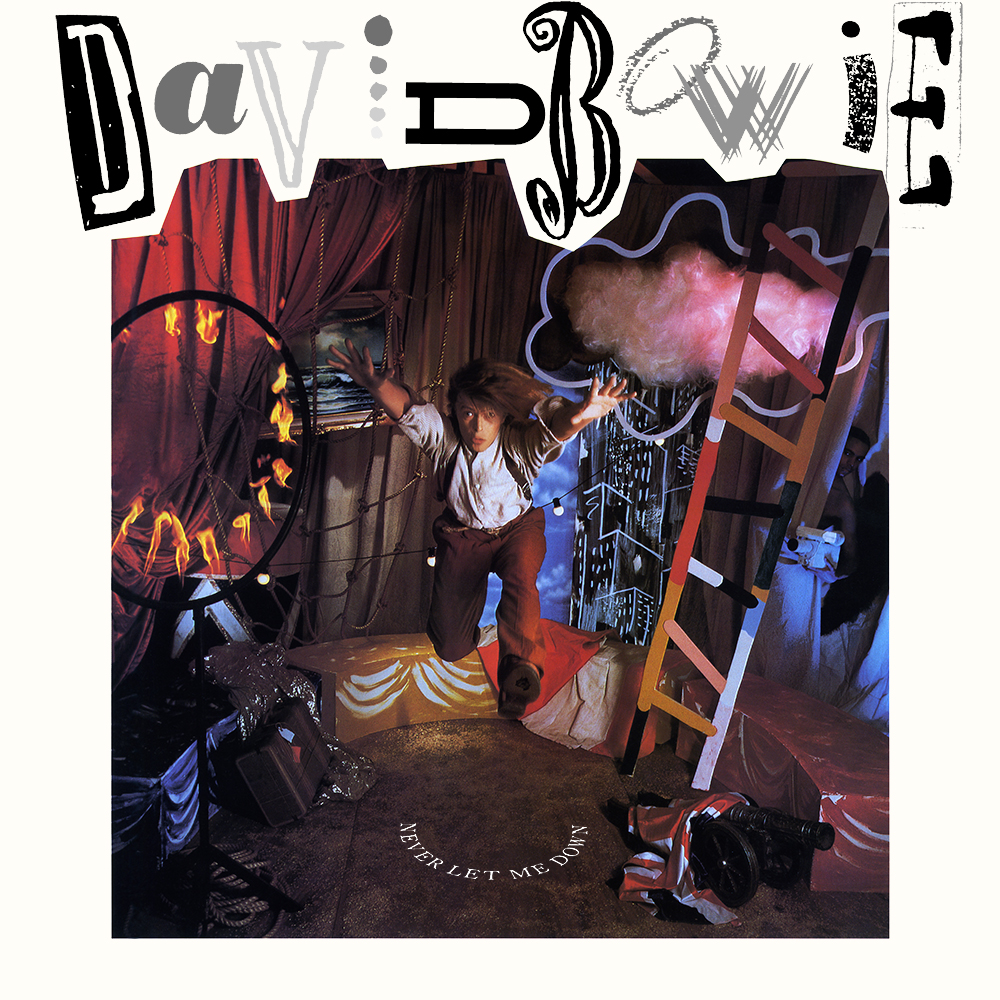
When David Bowie released "Never Let Me Down” in 1987, it became one of his biggest-selling albums. Having scored a phenomenal hit with the “Let’s Dance” album, resulting in a scramble for bigger stadiums than usual to play the Serious Moonlight tour, “Never Let Me Down” needed to play to a much wider, much broader audience than would have taken in Major Tom, Ziggy Stardust, and the Thin White Duke.


However, “Never Let Me Down” became one of David Bowie’s least regarded albums, particularly by Bowie himself, who described playing to the broader crowd in the 1980s as his "art-school Phil Collins" period: if the audience should be at a Phil Collins gig, then what was he doing? Like “Let’s Dance,” and 1984’s “Tonight” album, “Never Let Me Down” is less the work of “David Bowie,” which remained a stage name throughout his life, but more the fit, healthy and perfect David Jones, about to get his teeth fixed.

"Never Let Me Down" is the most commercial album David Bowie ever released, in that its polished, smoother sound could have come from other 1980s artists. Its synthesised sound dates the songs, and is reminiscent of Bruce Springsteen's "Born in the USA" album – “Beat of Your Drum” sounds close to “Glory Days.” Lyrics are concerned about social problems - "Day-In Day-Out" talks about poverty, while "Time Will Crawl" deals with ecology and nuclear paranoia after the Chernobyl disaster. Oh, and the actor Mickey Rourke does a rap on one song too - on a David Bowie album...
If anything, "Too Dizzy" is a welcome breeze, following the statement on Margaret Thatcher that was “87 & Cry.” A very upbeat song about 1950s teenage jealousy, and apparently a throwaway song written to see how Bowie worked with instrumentalist Erdal Kizilcay, “Too Dizzy” could either be seen as a breather from the socially aware songs on the album, or a distraction from them – that Bowie was surprised he left it on the album suggests the latter.

With a sound that demands to be played on big speakers as loud as possible, ”Never Let Me Down” feels good on the surface, and is worth a listen in the mood for a hard slap of Eighties, but it doesn’t feel like a David Bowie album. Bowie had always intended to re-record the album at some point, and the group that did so in 2018, for the “Loving the Alien” box set, had been chosen by Bowie before his death. The new version of the album sounds more stripped back and folk-like, more strings and brass in place of synthesisers, which mostly benefitted “Zeroes,” a song about the music of the late 1960s – you can hear the Mellotron now. However, Erdal Kizilcay has been left out of the album entirely, including “Too Dizzy,” and was considering a lawsuit if his arrangements were used without credit or compensation.
Would “Too Dizzy” have fitted among the re-recorded version of “Never Let Me Down”? It has a very peppy sound, with lots of saxophone, so making any change to that would be reductive, even if it would make it fit more with the rest of the album. Perhaps the song could be released as a separate song, but to prevent its release in any form just seems strange.
For me, there does come a point where, if you have put something out into the world, then change your mind on how you think about it, you can't then decide it didn't happen, especially when it really isn't that bad. No wonder Bowie finished the 1980s by submerging his ego in the hard rock of Tin Machine for a while.
I still love David Bowie and his songs, but rock gods are not infallible.