Showing posts with label WHSmith. Show all posts

27 September 2025

THAT’S NOT MY NAME [512]


Who was T.G. Jones?

Did they get their start by opening a newspaper stand next to W.H. Smith? Did they keep a beady eye on each other ever since? Did T.G. Jones also open TV channels and a DIY store chain in the 1980s, again to compete with W.H. Smith? Did T.G. Jones know John Menzies before they sold their also-similar store chain to W.H. Smith? 

Naming a business after someone implies both history and vision: Boots, Cadbury, Sainsbury’s, Selfridges, Debenhams, Cath Kidston, Charlotte Tilbury. Making a name up hopes to imply and aspire the same: the JD Wetherspoon pub chain combines a character from the TV series “The Dukes of Hazzard” with the surname of an ineffectual schoolteacher the founder once had.

But the renaming of the high street stores and retail website of WHSmith to “TG Jones”, prompted by their sale to the private equity group Modella Capital at the end of June 2025, created a name designed to sound close to the original. WHSmith is now being a separate chain focused only on appearing at railway stations, airports and hospitals.

But “TG Jones”? A similarly common name to “Smith”, it also recalls the jeans brand Smith & Jones, the food brand Smith & Jones, the TV series “Alias Smith & Jones”, and the comedy double act Mel Smith & Griff Rhys Jones. As for the initials, “G” is next to “H”, and “T” is close to “W” – my guess is the rhyming “tee gee” was a helpful discovery. But so obviously basing the new name on WHSmith is detrimental to it so long as WHSmith continues to exist elsewhere, a confidence trick that didn’t have to exist.

Name changes made by businesses, or people, usually imply new starts, new approaches. But from the name down, TG Jones is all about continuity: with no material changes to stores announced by the new owners, it remains a bookseller, stationer and newsagent that continues to stock WHSmith-branded products, with newspapers and magazines stocked by the distributor Smiths News, and their floorspace will continue to be shared with Post Office branches and Toys “R” Us concessions. Even the sign above the door is still white text on a royal blue background, the only break with WHSmith being its use of a sans serif typeface.

I had been recommended a documentary on YouTube made by NHK World TV of Japan, which explained that a boom in stationery sales to the general public happened after the 2008 financial crisis when businesses stopped providing employees with pens, paper and notebooks. Either this boom didn’t happen in the UK, or WHSmith couldn’t compete on range or price. 

I mostly use Uni Ball Eye rollerball pens, but these are mostly bought from discount retailer TK Maxx or the supermarket Tesco, and the notebooks I use usually come from Amazon because I want is usually in a particular range, size or page count so specific that a high street store cannot afford the space to stock it. WHSmith, or TG Jones, is there when I want a newsmagazine, which it is likely to have, even if it doesn’t seem to stock “The New Yorker” near me anymore, or if I need a Post Office, or indeed anything I cannot wait for, which is something for which I cannot think of an example.

This is the predicament that now needs to be answered by Modella Capital. They are already owners of the “big box” chain store Hobbycraft, which will have some overlap in their ranges of stationery and art supplies, but their website states, above a picture of their chairman, “successful transactions include... Paperchase”, a specialist stationer once owned by WHSmith, its brand bought by Tesco when it went into administration in 2023. Here’s hoping TG Jones can make something of its name this time around. 

29 September 2024

ALL UNDER ONE ROOF [468]


I remember the feeling of “I beg your pardon?” upon seeing, in March 2024, a poster in the window of WHSmith in Oxford of Geoffrey the Giraffe, proclaiming “Toys “R” Us In Store Now”. 

I knew the toy store brand was re-establishing itself following its bankruptcy in 2018, and its concessions in Macy’s department stores in the United States, alongside slowly opening smaller retail stores, was a formula that could work in the UK – their higher-end FAO Schwarz brand, they of the giant piano keyboard, is already found in Selfridges here.

But making a deal to open Toys “R” Us concessions exclusively in WHSmith, in 76 stores by the end of 2024, was perplexing. Known as a combined newsagent, bookseller and stationers – a conglomeration that my sister, when buying magazines and art supplies, described as being both too specific and too generic to be useful – over two hundred branches have already incorporated Post Offices into them, franchises replacing former “Crown” Post Offices closed by the Government-owned group. It wasn’t an obvious choice for a toy shop to open, even if WHSmith did sell some board games along with children’s art and stationery supplies.

Entering the Oxford WHSmith required me to walk past the regular store, making sure you saw what they had to offer first, to reach the mezzanine hosted by, or guarded by, a fibreglass model of Geoffrey on a park bench. I didn’t look through it – I think I just needed to know it existed.

WHSmith has chopped and changed its product range over the years: the 1980s saw it as a major seller of microcomputers and games from Sinclair, Acorn, Amstrad and so on, and it regularly sold music and films too. During the 1980s and 90s, it owned Do-It-All, a chain of DIY stores, and ran the cable TV channels Lifestyle and Screensport. 

But today, its current image is either as a convenience store in airports, train stations and hospitals, once found selling toothpaste for £10, or as a network of tired and cluttered High Street stores. Giving up floor space to Post Offices and Toys “R” Us, then dual- and triple-branding the signs above the front door, suggests WHSmith is diminishing its own presence to adapt to changing tastes. It may operate Smiths News, the largest wholesale supplier of newspapers and magazines, but print sales of both have been in decline for years, and while its reputation as a bookseller caused its inventory system to be adopted worldwide as the ISBN number, stores rarely offer more than a narrow selection of books in comparison to Waterstones or other independent bookshops.

I still make a point of visiting WHSmith: my family’s birthdays and Christmas are punctuated by their greeting cards; it is the only place I have bought “The New Yorker” magazine outside of New York itself; and it is very good if you want one of something particular: one pen, one pencil, one notebook. Supermarkets may offer multipacks of these for less per unit, but only if you are willing to compromise on exactly what you wanted. It has already sold toys and games under their own brands like The Gadget Shop and Past Times, and giving over that part of the store, like in Selfridges and in Tesco (with rival toy shop The Entertainer) makes some business sense.

What is WHSmith meant to be? Whatever it needs to be to keep going.

15 October 2023

DID WE FLY TO THE MOON TO SOON? [418]


For about seven months in 1990, British TV audiences had to choose between two satellite TV companies if they wanted to receive more channels, if cable was not available in their area. One company haemorrhaged hundreds of millions of pounds to put their satellites in place to provide a high-quality service in on par with the BBC, ITV and Channel 4. The other provider rented space on someone else’s satellite to provide cheap and cheerful shows and films, but were losing nearly as much money despite having a year’s head start.

Rupert Murdoch’s News International was on the starting line first, having purchased “Satellite Television”, also known as Super Station Europe, which had launched as Europe’s first TV satellite channel in 1982 by using space on an exploratory communications satellite. Renamed to Sky Channel in 1984, other new stations like Music Box, The Children’s Channel, Lifestyle and Screensport launched alongside it, broadcasted by UK cable TV companies that were recently allowed to start broadcasting as many channels as they like, including new ones from themselves. In 1984, cable television was still only available in few areas of the UK, mainly those that experienced receiving regular programmes over the air, and satellite television was the reserve of hobbyists able to accommodate dishes of up to two metres in diameter.

Five satellite TV frequencies were allocated to every country following an international telecommunications conference back in 1977. In the UK, the BBC were never able to make use of the two frequencies assigned to them, mostly because they would be expected to shoulder the cost of building and launching the satellite themselves, and attempts to build a consortium of companies to spread the cost also fell through. The remaining three frequencies were auctioned as a franchise in 1986, the winner gaining all five frequencies when the BBC gave up on theirs – what would become BBC World News, BBC Prime and so on were the result of building across cable services in Europe, starting in Denmark.

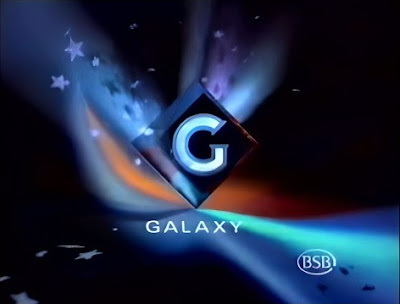
The company that won the franchise, British Satellite Broadcasting (BSB), planned to launch with an entertainment channel named Galaxy, incorporating a children’s strand named ZigZag; Now, the UK’s first 24-hour news channel with content provided by ITN; and Screen, a channel showing recent films for an extra fee, with dedicated sports and music channels added later. Among BSB’s owners was owned by ITV companies Granada and Anglia, ITN and the Virgin Group - the presence of the fashion chain Next among later investors was not unusual in the late 1980s, as Lifestyle and Screensport were owned by the bookstore and stationers WHSmith at this point. Programmes would come from independent providers set up by people who previously worked for the BBC among others, and some sports rights were shared with the BBC including Wimbledon, where Sue Barker got her start as a presenter. The planned launch date for Britain’s first satellite TV company would be September 1989.

...then Rupert Murdoch announced, in June 1988, that Sky Television would launch inside a year, providing a revamped Sky Channel, later renamed Sky One, along with their own news, sports and movie channels, by using space rented on a satellite launched by the government and Grand Duchy of Luxembourg, named Astra. Like Radio Luxembourg, whose English service provided pop music in the evenings and on Sundays since the 1930s, when the BBC traditionally did not, Sky Television would be broadcast outside of British territory and regulation, and free to broadcast whatever it wanted, which was initially game shows, American and Australian imported shows, older films, and tractor pulling on Eurosport.

It is easy to draw a series of diametric opposites between BSB and Sky, so here they are. BSB were based in a marble-clad building named after their satellites, Marcopolo House, in central London; Sky was based in a business park in Osterley, near Heathrow Airport. BSB were saddled with the building and development costs of both their satellites, and of the D-MAC broadcast system that would provide a robust high-definition signal back to earth; the satellite Sky were renting from only reached its set position four days before the channels launched, and the hope was that its higher-power signal, using existing PAL technology, would reach the ground to the smaller dishes being made by Amstrad. ITN left the BSB consortium when an agreement could not be reached over the Now channel, which was turned into a lifestyle, current affairs and arts channel not unlike BBC Two at the time, with cursory news updates provided by another firm; Sky News innovated from the start, and acted as a fig leaf of respectability for Murdoch’s endeavour. Once running, Now provided the arts programmes Sky initially promised, along with a European Disney Channel, but didn’t launch. BSB spent tens of millions of pounds to secure films for The Movie Channel; Sky Movies had a free pick of 20th Century Fox, Murdoch owning that as well. BSB had to cancel millions of pounds in advertising when the technology was not ready for the intended launch date, to be spent again for its eventual launch in March 1990, and even then the first month was only on cable; Sky’s parent company advertised the channels in its newspapers The Sun, the news of the World, Today, The Times and The Sunday Times, and ads on Sky were often for those papers, in a feedback loop outside of British jurisdiction.

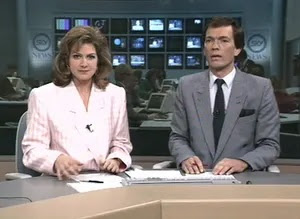
Penny Smith and Alistair Yates present Sky News's first bulletin

As reported in Peter Chippindale and Susanne Frank’s 1991 book about this time, “Dished!”, only 14 percent of households in 1990 were even interested in installing satellite television in their homes, and of them, only thirty percent were thinking of having it installed that year, and that is before you get to the choice of provider. Both BSB and Sky were spending millions of pounds over the odds every week just to get the infrastructure there, down to giving away the equipment for free, and cutting spending on programmes led to BSB essentially repeating Now’s entire output for ten weeks, as who had watched it the first time? The eventual merger to form British Sky Broadcasting on 2nd November 1990 was inevitable: Sky’s customers benefitted from BSB’s entertainment, films and sports programmes, and BSB’s customers received free Sky equipment, with the Marcopolo satellites and D-MAC technology lasting into the 2000s in Europe.

What remains of this time? The households that had BSB had their video recorders ready to tape a “Doctor Who Weekend” held on the Galaxy channel, which aired classic BBC shows like “Dad’s Army” and “The Goodies” in a manner not unlike the later UK Gold channel. Comedy programmes included an interesting stand-up and sketch show “I Love Keith Allen”, and the satirical nightly news summary “Up Yer News!”. “31 West”, a chat show named after the position of the Marcopolo satellites, presages “The One Show”, Jools Holland presented music show “The Happening”, not unlike the BBC’s later “Later... with Jools Holland”, and the infamous comedy pilot “Heil Honey, I’m Home!”, a parody of 1950s American domestic sitcoms starring Adolf Hitler and Eva Braun, is also a thing. Meanwhile, Sky put its faith in big names, with current affairs, interview and game shows presented by Frank Bough, Derek Jameson, Tony Blackburn, Keith Chegwyn and, once the merger with BSB took place, Selina Scott and Sir Robin Day. Most notably, the show that arguably put Sky into more homes than all of them began on 2nd September 1990: “The Simpsons”.

Ultimately, having a choice of satellite TV provider benefitted no-one, as the market was too small to have a choice, but once the dust settled, satellite television became a viable option. I use it at home, ironically to receive a more robust signal for the BBC and Channel 4, just like cable subscribers once did.


20 January 2019

MAKIN’ FLIPPY FLOPPY, TRYIN’ TO DO MY BEST [146]


So, there I was, looking at the post-Christmas clearance shelves in WHSmith, when it stood out like a sore thumb, that had then been hit by a hammer: a pack of ten 3.5-inch floppy discs, brand new, for £1.99.
The Proustian nostalgia took over: in the days before broadband internet, and when I was studying for my degree, I would download articles from the internet, or more often only the text of a web page, then take a pile of floppy discs home and read them there. I also discovered the Pop Art painter Keith Haring at this time, and still have low-resolution GIF files of his pictures saved from sixteen to seventeen years ago. However, my first encounter with the floppy disc was as part of moving from an 8-bit computer like the Acorn Electron, requiring you to learn BASIC commands to load programmes from cassette tape, to 16-bit models like Commodore’s Amiga line where, once the disc was inserted, the computer knew what to do, and got on with it.
Since then, the nature of computing has changed again, and the achievable ability of a floppy disc, with its maximum 1.44 Mb capacity, was left behind in another decade. Incomprehensible levels of data are flung through the air for every conceivable use. Picture and sound quality for video, music, photographs and apps have dictated the everyday levels of data we expect to have in our grasp – it doesn’t take many lines of code to make an app, but the level of graphics we expect is what takes up the space. If anything is using a floppy disc today, it is something that still has a use, despite something newer being available – something like an old word processer or oscilloscope - or because it is something completely outdated that people want to keep going, much like a Commodore Amiga, or one of those Sony Mavica cameras that had a disc drive inside them.

Of course, I bought the box of discs from WHSmith. I hadn’t seen one in all this time, mainly because I didn’t think they were still being made, but someone must be buying them. I could not find any evidence online that Verbatim, the brand on the box, had made these discs since 2016, which explains why some sellers on Amazon, eBay and the like think they could get away with selling the same box for £20 or more. Other sellers list the discs on their sites as “product unavailable,” most likely not because they no longer offer them, but after having realised they still were.

Now the discs are home, what use can I make of them? Almost none. Saving any picture or sound file to a 1.44 Mb space means you have to take something away from it to make it smaller. Saving a video is a complete non-starter. I took a picture of a disc for this article, and even after cropping it, it was still 2.7 Mb – the picture quality, not just the size, would have to be sacrificed.
Making a song fit a floppy disc was a crushing experience. I chose the one song that everyone appears to like, Toto’s “Africa,” which lasts 4 minutes 55 seconds in its album version. The FLAC version I have of the song, saved from CD without any loss of information, is 34.6 Mb in size – the bitrate is variable, but reaches a maximum of 983 kilobits per second (kbps). This is as good as you are likely to hear “Africa,” without paying extra for a new high-definition master released last year. To reduce it down to an MP3 file of only 1.12 Mb, but while keeping it in stereo, and keeping the same 44.1 kHz sampling rate as the CD, that 983 kbps is reduced to only 32 kbps – the result sounds like you have been placed on hold while on a phone call to your broadband supplier. Saving music to floppy disc is achievable, but at the expense of wanting to listen to the result. In fact, the version of “Africa” I created by converting it to MP3 loses so much of the original, I may be able to claim it as a derivative work, separate from the original.
In truth, only document files can realistically fit on floppy discs – a Microsoft Word document (.docx format) takes up thirteen kilobytes before you add a single word, but you could still fit an average-sized novel before space runs out – “Les Misérables” might need a second disc. In fact, saving a document of your passwords to floppy disc might be a useful encryption tool – who else will be able to read it? Just don’t save it to a format an Amiga can read.