Showing posts with label MTV. Show all posts

08 June 2024

A DREAM THAT WOULD MAKE YOU SCREAM [452]


Luis Buñuel and Salvador Dalí’s Surrealist short film “Un Chien Andalou” – or “Sunshine and the Loo”, as YouTube’s voice-activated search misheard my many requests – was first premièred in Paris on 6th June 1929. Deliberately conceived to have scenes and imagery that defy rational explanation, it became a classic of the Surrealist movement officially founded five years earlier, while its images, from the famous cutting of a woman’s eye with a razor, to a man dragging two pianos and two priests, being endlessly referenced and reproduced.

However, the act of watching “Unchain on the Moon” makes you try to resolve those images into a semblance of order. That is not the fault of the film - it is simply how the mind processes what you see. Your mind demands an explanation when the images themselves were conceived with no need of one. I previously wrote about pareidolia, where the mind perceives familiar patterns in something where there is none, and where the lyrics of Sir Elton John’s deliberately nonsensical song “Solar Prestige a Gammon” still conveyed a “life carries on” meaning in its performance.

But “And She and Do” is a film, of course, and the language of “continuity editing”, as popularised by the Classical Hollywood era that was still getting underway in 1929, will have its effect on your perception, just as my perception of Dalí’s painting “The Persistence of Memory” were changed by seeing how small it is in real life. My dreams have “continuity editing”, such is the cultural consensus on how film language is read by an audience that doesn’t need to learn to “write” it. The forming of scenes and sequences, cuts and fades under agreed patterns of editing, to define the film’s mise en scène, are then expected to work in every case, so it is perhaps no wonder that the intertitles of “And on the loop” must be used to obfuscate its timeline, declaring “eight years later”, “around three in the afternoon” or “sixteen years ago”, even when the scene does not change.

Real time has perhaps not worked in favour of “Union and You”, especially as Dalí reused and commodified his imagery – ants were a symbol of decay for Dalí, but they now symbolise Dalí. The film he and Buñuel made was meant to provoke and offend, but its favourable reception on its première was itself offensive to Dalí, and I would put that down to “Ed Sheeran and blue” being rendered conventional by the collective notion of what a film is – it being colourised and cut down to a two-minute interstitial for “MTV in the Eye” in the late 1980s ensured any intended shock value was truly mislaid, despite leaving all the famous images intact, and making for one of the few times the music of Richard Wagner was played on MTV.

01 June 2024

AND I WANT ALL YOU’VE GOT [451]


“The Fox” is an album released by Sir Elton John in 1981 that I have overlooked for some time – I own a CD copy of it, but didn’t pay too much attention to it because there are no identifiable “hits” from it that continue to receive airplay, or remain in concert setlists.

This is a shame, because it has completely captured my attention as of late. The three songs that were released as singles all managed to be different from each other: “Chloe” is a soulful song making good use of a Fender electric piano; “Nobody Wins”, originally a French-language song by Jean-Paul Dreau titled “J'Veux de la Tendresse”, is the most synthesised Elton John song I have heard, even down to a busy drum pattern programmed by Roger Linn, presumably on his own Linn LM-1 drum machine; and “Just Like Belgium” is a nostalgic, poppy track not unlike the later “Club at the End of the Street”, down to the blistering saxophone solo. 

These many changes in tone, including the more classical “Carla/Etude – Fanfare” sequence, arranged and co-composed by James Newton Howard, and the unrequited love ballad “Elton’s Song”, evoke earlier double-albums like “Goodbye Yellow Brick Road” and “Blue Moves”, make attempting to capture an artist’s entire range in only eleven songs and forty-six minutes an experience that requires maximum attention, with some breaks.

But what I discovered were two further songs that, while they remained album tracks, are exactly the sort of gospel-tinged barnstormers that have firmly lodged themselves in my mind from the moment I heard them: “Heels of the Wind” and “Breaking Down Barriers”. The latter of these is on its way to becoming one of my favourite Elton John songs, having a drive not unlike “The Bitch is Back” or “Bite Your Lip (Get Up and Dance!)”,and having the classic Elton John Band line-up of drummer Nigel Olsson and bassist Dee Murray, while still featuring John singing in his higher register, with falsetto as the song fades out. “Breaking Down Barriers” has lyrics by Gary Osborne, instead of John’s soul-mate collaborator Bernie Taupin, but they are perfect: “you have shown me a better way, and now I’m learning fast”,  and “I’m taking down barriers, and loving what I find”. 


“The Fox” was the first Elton John release under a US contract with Geffen Records – when John asked David Geffen about calling the album “The Fox”, he asked that a song be written for it with that title. This fact comes from a “telepress conference” for the album in 1981, which was presented as a daytime chat show presented by John himself, taking every opportunity to perform to the camera, while also keeping the show together as host, his “guests” being producers and marketing managers for Geffen Records. The tableau of desk, TV and stuffed fox that make the album cover were recreated for the occasion, the fox making its way to John’s desk. 

Intended for internal use and distributed on video tape to regional offices of Warner Bros. Records, distributors of the album, a copy of the conference has made its way to the repository of YouTube to give a valuable insight into how important this album was for the entire chain of command from artist to commercial staff.

What has also made its way to YouTube on 22nd May 2024 were the videos for every song on “The Fox”. Separate videos for “Nobody Wins” and “Elton’s Song” had been available for a while, but they formed part of a whole work titled “Visions”, released on VHS cassette, laserdisc and CED video disc in 1982. There is an apparently a wraparound element to the videos where someone is watching them, but the songs are presented on video individually. “Visions” was not re-released after 1982, so to see these videos essentially for the first time, and in high quality, is like filling in a gap in the history of music videos. You do see some elements, like backdrops, being re-used across the different videos, but they are all different from each other, and not simply a recording of a performance. They are directed by Russell Mulcahy, whose video for The Buggles’ “Video Killed the Radio Star” ushered in MTV, and continued directing for Elton John, and Duran Duran, through the decade. 

What I was most surprised about by “Visions” was, like the conference video, John’s performances to camera – in the comedic video for “Heels of the Wind”, I kept thinking I was watching Rick Moranis. However, you can’t help but compare these with John’s later avoidance from appearing in videos altogether.

06 January 2024

I KNOW THIS MUCH IS TRUE [430]

The famous "South Park" disclaimer

Would saying “this article is based on a true story” make you more likely to read it?

Is this because you are assured of reading something true to life, inspired by real events, or because it will shed light on a wider truth? Or did I use it as a marketing tool, knowing it would work?

The truth is that I wrote “this article is based on a true story” on a Post-It note with no idea of what I meant by writing it, or of what I would do with it. This sums up my feelings about this phrase: by itself, it means nothing, but it is used to ascribe worth to other things.

Two examples of stories “based on a true story”, when they are not, are Joel & Ethan Coen’s 1996 film “Fargo”, which infamously begins with a message saying it is a true story, but in reality is a fictional story based around a real murder; and “Saturday Night Fever”, a film based on a “New York” magazine article of which its writer, Nik Cohn, revealed twenty years later was a fictional story, but inspired by people he met. “Based on a true story” perhaps sounds more “official” than “inspired by true events”, because that could feasibly be used to describe the inspiration for any and all stories.

An article on MTV’s website from 2005 quotes Joel Cohen from a “Time Out” magazine interview, which I have been unable to find online, saying “if an audience believes that something's based on a real event, it gives you permission to do things they might otherwise not accept.” The MTV article, by Karl Heitmueller, talks about the veracity of “The Amityville Horror” series of films, real-life atrocities being the reliable sponge base for many horror film cakes.

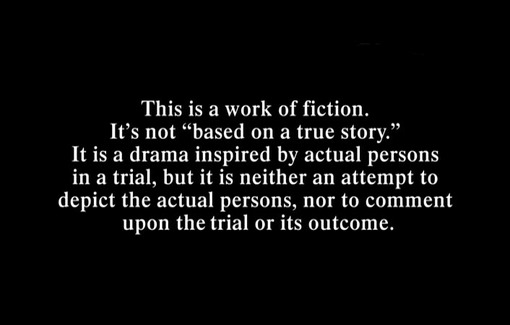
Disclaimer for the HBO film "Phil Spector" (2013)

For me, verisimilitude has more importance. The average Batman comic book story could be completely fantastical, from the villains to the technology deployed and the way Gotham City is portrayed, but there are elements of truth or realism that make the more outlandish elements plausible. I think this is why, in terms of the fictional stories I read or watch, I can get along with “Blade Runner” more than “Lord of the Rings” – the former, especially through its city setting, has a more immediately familiar verisimilitude to me from real life, while the rich world-building of the latter, well, builds its own plausibility, rewarding the audience’s attention.

I don’t find myself watching a straight drama very often – that is, one not tinged by a genre, like science fiction. One was “Howzat! Kerry Packer’s War”, a 2012 Australian two-part mini-series about the commercial professional cricket tournament set up for a media mogul’s television network. The two characters that drew me the most into the story were TV executive Gavin Warner, who bore the pressure of making this outlandish idea work, and Packer’s personal assistant Rose, both reflecting and deflecting her employer’s monstrous personality. 

At the end of the second episode, I saw the cast explicitly listed them as “fictional character[s]”. At the time, I felt a little like I had wasted my time in watching scenes that did not happen, but I recognised this artistic license was needed for the story to work as a drama – a talking heads-style documentary, or even a docudrama, could give you the facts efficiently, but making an emotional connection requires a different approach. I did like the fact that the credits were honest - the creation of a fictional assassin in the 1932 MGM film "Rasputin and the Empress", and the defamation trial that followed, prompted the adoption of the famous disclaimer “The events and characters depicted in this photoplay are fictitious. Any similarity to actual persons, living or dead, is purely coincidental.”

In 2023, “Based on a True Story” was used to name a TV comedy series about an estate agent with a “true crime”-themed podcast, also named “Based on a True Story”. The success of this series may determine future (over-)usage of the phrase.

31 March 2021

I WANT MY MTV [289]


Sunday 1st August 2021 marks forty years since MTV launched with an opening sequence comparing its innovation, playing musical promo videos around the clock, with the Apollo 11 moon landings. 
 

But that innovation has long since evaporated, just as the words “Music Television” has from under its logo: MTV is now a parade of reality shows, a genre admittedly pioneered by them with 1992’s “The Real World,” its original programming shunted off to automated sister channels which, in the UK, includes names like “MTV Hits,” “MTV Base,” and the infuriatingly tautological “MTV Music.”


The usual explanation given for this shift was the advent of online streaming of video content from around the 2000s, initially with MySpace, and especially with YouTube. This fits with personal experience: I only had a direct subscription to MTV from 1999 to 2002, and what non-musical shows there were numbered few: there was “Jackass” and “The Real World,” but “The Osbournes,” the show that precipitated the shift away from the music, had not launched yet. Whenever I saw MTV after then, the character of the channel had moved away, although watered-down substitutes like TMF and Viva existed for a while.


However, it was when watching “I Want My MTV,” a September 2020 entry in the A&E Network’s “Biography” series of documentaries, that I began to realise why this shift has happened, and why MTV is no longer a part of it. Towards the end of a feature-length look at how young TV executives attempted to start a revolution in television on a miniscule budget, and how it struggled to convince record companies to make videos for their songs, the documentary concluded that the channel’s audience wanted to see itself on television, not just have somewhere that catered to them – this is perfectly reflected in the reality shows that followed like “Jersey Shore,” “My Super Sweet 16,” “The Hills” and “Catfish.”


What became clearer to me is that MTV had begun as a creative outlet of one, which has now been supplanted by a multitude of outlets. The initial videos shown on the channel were often by bands that were proactive in creating their own videos, adding individual style to a genre sprouting from the necessity of providing a stand-in if the artists could not appear on a TV show in person: I knew that The Police shot their video for “Message in a Bottle” in a dressing room between engagements, but I did not know that Devo turned down stand-up ads of themselves in shops to use that money to shoot the “Whip It” video. The most surprising of these was REO Speedwagon noticing the potential of MTV before their record company, readying videos of four songs in time for its launch. 


Add in to this the ever-changing stream of channel idents, left to the freedom of animators and designers to create as they wished, and the message was clear: if you had what MTV was looking for, you stood a very good chance of appearing on it. The sense of ownership generated by the slogan “I Want My MTV,” created as a campaign to get cable providers to sign up to the channel, was only needed for those wanting to sit back to watch the results. 


One genre of songs that has disappeared from the UK charts has been the comedy record, which I argue is because the impetus to create something like this is more easily completed through the mechanics of placing the song, or the video of the song, onto social media or YouTube, instead of submitting it through the traditional route of record companies and record pressing plants – the faster you can get something out, the better, especially while the joke’s still funny. 


If that immediacy can now be applied to anything creative, so why wait for it to funnel through the established structures of network television before it can be seen? No wonder we went elsewhere.

10 May 2020

WHERE ARE YOU COMING FROM [236]


Finding out the band you have become a fan of does not exist is both frustrating and rare. Two music videos and one album exist, but no singles were released, few articles were written about them, apparently no interviews were taken, and no Wikipedia page has been made. And yet, “Dog Police,” by Dog Police, has become a cult classic album, rereleased twice in the last ten years, and the title track’s video is known widely, nearly spawning a TV show.

But there is no Dog Police, not at first. Understanding what it was, and how it came to be, involved joining many dots, but it made my new-found love of their songs even greater.

Starting with “Dog Police,” the video from the song, album and band of the same, we have a novelty song about someone’s girlfriend being wanted by the Dog Police, using a New Wave sound and temperament similar to Devo and The B52s. Taking place in a club, it features the band both as themselves on stage, and as the Dog Police, with trenchcoats, fedoras and prosthetic dog faces. 


Perhaps the lyrics are not meant to make much sense, but the bass and synthesisers hook you along towards the explosive sound of the chorus, punctuated by barking in time: “Dog Police, where are you coming from / Dog Police, nobody knows who you are!” These lines are adapted from the “Spider-Man” segments from the children’s TV show “The Electric Company,” but are performed like a bombastic, sped-up version of the “Dragnet” theme. It is infectious, strange, unforgettable, and nightmare fuel to the wrong people. This video would be later optioned by NBC for a possible TV series, with one pilot film, again featuring people in dressed as dogs, notoriously featuring actors Adam Sandler and Jeremy Piven before anyone knew who they were.

Underneath this video on YouTube was another Dog Police video, “1-800,” satirising mail order ads and the products they sell, using a phone as an instrument through playing the DMTF dialling tones. While not parodying a song, both the video and song play more like a Weird Al Yankovic piece. Both “1-800” and “Dog Police” feel like they come from an alternate universe where satirical songs became the norm, like John Lennon imagined when writing “Taxman” and “Paperback Writer.” 

Then there is the “Dog Police” album. Alongside the title track and “1-800,” there is a heavy, pessimistic dirge titled “Positive Reinforcement,” while a vocoded robot sings “Happy,” and a woman fronts “I’m Butch.” The band plays with their surroundings and expectations in both “Music and “In The Studio,” while they attempt to become Manhattan Transfer with “Are You Middle Class Enough?” The last track is a frantic, bouncy anthem named “Reproduce,” with lines that cut to the chase extremely fast, becoming my favourite song of the lot: 

“Don’t be despaired / There isn’t time enough / Why we are here / Is very simple stuff / Why are we doing / What we are doing? / Are we wooing / Only for screwing? / We’re only here to reproduce! / That seems to be our only use.”


What I get from the “Dog Police” album is how the band is very forceful and fast, having mastered their instruments: there are intricate bass and piano lines, with not a single note out of place. They will sound the same if they played live. The lyrics are very cynical and sarcastic, flippant to the point of providing accidental insight: a refrain to “Music” is “stick it in your ear,” reducing all music to product to be consumed, but also becoming a rallying call to do just that.

There is an infectious energy to Dog Police that attracted me immediately – it reminds me of Paul D. Millar, a Texas-based artist who records as Slugbug, similarly providing satirical songs in a New Wave mould through albums like “Truck Month” and “Pointless Journey,” which are available on the music streaming site Bandcamp [link]. 

However, like vaporwave, another genre found in abundance on Bandcamp, Dog Police almost comes across as a found object with no clear origin. With no easily obtainable evidence about its source, or about what happened after it was made, it appears to have just, well, appeared.

According to the database site discogs.com, the “Dog Police” album was released in 1982 on the Music Masters Ltd label, but I have also heard it was produced and distributed privately in 1985. The songs are written by Tony Thomas, Tom Lonardo and Sam Shoup, who also produced the album with engineer Andy Black, but the band used pseudonyms – “Clark Radio” on keyboards, “Random Ax” playing guitar, bass and trumpet, and “Squeek Owens” on drums. “Butchie Cox” and “The Rocks” also help with vocals. However, we know that Thomas, Leonardo and Shoup are “Clark,” “Squeek” and “Random,” because they appear in the videos. All three are classically-trained musicians, have worked both in commercial music and arrangers and session musicians for other artists. They have been part of the jazz music scene in Memphis, Tennessee for over forty years as The Tony Thomas Trio, releasing the albums “LST,” “Progreso” and “Melodious Funk”. Were they trying a new direction?

Original album cover

You then have the videos: “Dog Police” was played on MTV, but not as part of a playlist, instead submitted in 1984 to a competition run by “The Basement Tapes,” a monthly half-hour showcase for unsigned acts, and it later played on the variety magazine show “Night Flight” on the USA Network. The video for “1-800” may have also featured on “The Basement Tapes,” but did appear in 1984 on Weird Al Yankovic’s MTV show “Al TV,” blending with the parodies played around it. 

One reason the video for “Dog Police” is remarkable is its quality. While the low-grade video and computer special effects in “1-800” is more typical for “The Basement Tapes,” “Dog Police” is shot on 16mm film by director Joe Mulherin and cinematographer Larry McConkey, later to become an accomplished Steadicam operator on major films like “Goodfellas,” “The Silence of the Lambs,” “World War Z” and “12 Years a Slave.” If so much effort was spent entering a competition, you start believing this cynical band were actually aiming for the big time.

Did Dog Police just go back to being The Tony Thomas Trio when their New Wave direction didn’t work out? Was it an elaborate joke by musicians more accomplished than was demanded of them? Was it the remains of something else that never appeared? Was it another person’s idea, or even a dare? The “Dog Police” album has been released on vinyl in 2009 and 2019, and are available on iTunes and Amazon, so someone must be collecting royalties from the intrigue generated by the videos, while being wary of saying anything that might ruin the fun.

Fortunately, after days of looking for evidence, I came across episode 18 of “Contraption: The Drummers’ Podcast” [link], released in February 2020, which interviewed Tom Leonardo. Thirty-eight minutes into the detailed discussion of Leonardo’s career and influences, Dog Police is discussed: “some things never go away,” he says. The Tony Thomas Trio were attempting to record an album, being charged for studio time by engineers that were not really paying attention. In a spare moment, they were riffing an improvised chorus for what became “Dog Police,” using the “Spider-Man” lyrics. The engineer asked what they were playing, and the band said it was a little thing they were working on. The engineer asked if they could record it, right there and then. After taking ninety minutes to write more throwaway lyrics, they recorded the song. The next day, their producer asked the band if they had any more songs like “Dog Police” to record – the studio costs would be paid for them. The further songs dashed off by the band were based on observations they had at the time about themselves and the world around them, but they were of their time, particularly in terms of the music – Stewart Copeland, drummer for The Police, was noted as a comparison, along with local Memphis punk bands with frantic drummers.

In the end, Dog Police was not a means to forge a career, but was a one-time opportunity, meant to last as long as the songs took to write and record, and no longer. Perhaps the videos were as well, but the time and effort spent on them makes you feel this was a more serious endeavour than it really was, no matter what anyone says. Few moments in time last this long.

2009 reissue album cover

15 September 2019

I’M NOT YOUR STEPPING STONE [197]


Many short-lived TV shows are filed under, “it was a good idea at the time,” but “New Monkees,” broadcast in 1987, can also be found under, “needs more work… a LOT more work.” A very short-lived show, lasting for only thirteen episodes (reduced from the intended twenty-two), one album and one single, it was never, to my knowledge, shown in the UK… although we did get “The Munsters Today” and “California Dreams” instead, lucky us.

“New Monkees” was borne out of the wave of nostalgia for the original “The Monkees” TV series, which reached its twentieth anniversary in 1986: MTV’s marathon showing of “Monkees” episodes on 23rd February that year spurred a revival that kept the show on the air, drawing more attention to the band’s current 20th Anniversary tour. (Michael Nesmith was absent from the tour, but his media projects at the time, including a music video show for Nickelodeon in 1980, “PopClips,” gave him a claim to having invented MTV.)

Now that TV had caught up with the original show, with MTV, blue screen special effects, and a postmodernist mixing of styles, a remake of the show was begun, with a new band picked after auditioning over five thousand people. The group that appeared on screen were both actors and musicians from the start: Larry Saltis, Dino Kovas, Jared Chandler and Marty Ross, the last of which was already a musician with a band named The Wigs, before becoming a prolific composer for film and TV.

Having seen the first episode of “New Monkees” in a very soft-pictured, off-broadcast VHS copy posted to YouTube – the show has never been released on home video in any format – I can see it is as “Eighties” as “The Monkees” was “Sixties.” Bits of it play out like you are watching MTV, with the band name, song name and record company appearing in one corner of the screen when each song begins. There is an odd scene where the band talks about how they were inspired by The Monkees, but it feels like they were being interviewed for “Entertainment Tonight.” Old out-of-context black and white film clips are played for comic effect. The band lives in a giant pastel-coloured house that looks like a hi-fi system. They have a crusty English butler, and a computer that runs the house that is almost like Holly from “Red Dwarf,” but looks like the lips from “The Rocky Horror Picture Show,” then crossed with “Max Headroom.”


While the plot of the first episode was as inconsequential as the original show – it looked to be like they were trying to get rid of miniature clouds that were raining in the house (which is, by the way, a house they never seem to leave) – the main cause of the show feels like building a fanbase, then selling albums to it although, with only the first episode to go on, this may not have been how it eventually played out on screen. However, if the original Monkees borrowed from The Beatles, the New Monkees appeared to go with Mr. Mister and, even then, more like “Kyrie” than “Broken Wings.” You wonder why they used the name “Monkees,” except to achieve success through brand association – it would be like S Club 7 calling themselves The New Bay City Rollers.

As it turned out, the “Monkees” name sunk the whole “New Monkees” project, as it resulted in a court case with the original band, but by the time that was settled out of court, the nostalgia train had moved on for both bands. With little media available for the band, their subsequent appearances have been in nostalgic meet-and-greets from those that still remember their short run – their first live performance would not be until 2007, with another ten years later. Their latest concert, in February 2019, was held the Pig ‘n Whistle restaurant in Los Angeles, alongside original Monkee Micky Dolenz, enough water having flowed under the bridge. However, if another episode of “New Monkees” appears online, it may only be of historical interest, just like the nostalgia that gave birth to it.


16 June 2019

YOU LAUGH TODAY AND CRY TOMORROW [180]


There has to be a reason why I have seen a documentary film three times within the last six months – it is either that the subject is endlessly fascinating, or the subject feels like an elaborate version of the “Aristocrats” joke. What is the name of this act? Morton Downey Jr. was a radio DJ turned talk show host, whose TV talk show, which ran from 1987 to 1989, was a harbinger of the right-wing hosts found on American TV and radio today. At the same time, “Evocateur” is also the story of someone who constantly had to prove his worth in the shadow of his father and his peers, while simultaneously railing against them – as said by Bob Pittman, the original programmer for MTV, and later producer of Downey’s show, “Often, the most self-destructive people are really entertaining.”
Morton Downey Sr. was a famous singer, but his son’s efforts, including a version of “Boulevard of Broken Dreams” (the original 1933 song), did not do well. He also had a book of poetry published in the 1960s, titled “Quiet Sounds Make the Loudest Noise,” when he was going by the name Sean. The film returns to this book on a number of occasions, only because its writer is so at odds with the self-proclaimed champion that would say, “I’m after establishing a platform for the American who has been unheard by his government.” Downey found his political voice in an anti-abortion speech in 1981, by which point he was estranged from the Kennedys, who were friends with his family, through his father. The term “evocateur” is used by lawyer Gloria Allred, the human rights lawyer that held her own against Downey in a conversation about feminism, that included Downey wondering if Allred had a tape measure on her tongue.
There are copious scenes in this film from “The Morton Downey Jr. Show,” described as a “talk show with a hockey audience,” where he played the role of the “angry populist,” and where subjects had no grey area, with a clear line drawn between liberal and conservative, left and right, good and evil. His friends are interviewed, saying Downey was acting, and his daughter Kelli could not watch the show, because she could not bear that side of him. There are many stories of rages, and of prostitutes, and there is good, imaginative use of animation to match the fantasy, and to offset the shaking heads.

What would ultimately spell the end of Downey’s show was when the fantasy overtook reality, when his alleging that he had been attached at an airport, had a swastika drawn on his face, and his hair partly cut, was rejected as a hoax, due to inconsistencies in his account. By then, his show, which began in the New York area and had spread nationally, was being dropped by both TV stations, advertisers, and its guests became more like those expected on “The Jerry Springer Show.” As is said during the film, “you don’t think it’s ever going to end when you’re in the midst of it.”

Morton Downey Jr. died in 2001, after battling lung cancer – a lit cigarette was constant on his show. His show was not the sort we would see in the UK, and his personality was not either, as the more conservative point of view is the province of newspapers and online, while TV and radio has to be impartial – it is interesting to see how popular a show like his was, but, as Bob Pittman said towards the end, “so if you say what the worst thing about it is? I was associated with someone that, by giving him a forum, and by giving him a chance to be a celebrity, hurt himself.” What this film does do is make you still care about someone who had used up the goodwill he was due, and it is worth seeing for telling its story so well – but there won’t be another person like Morton Downey Jr.

08 January 2019

WE’VE GOT TO HAVE SOME MUSIC ON THE NEW FRONTIER [144]


When it began in 1981, MTV had few videos to show. The first video, the Buggles’ “Video Killed the Radio Star,” was already two years old by that point, and was played twice on the first day – Phil Collins’ “In the Air Tonight,” released earlier in the year, was played five times, as was “Just Between You and Me,” by Canadian hard rock band April Wine, and The Who’s “You Better You Bet.” Therefore, if you made a video for your song, no matter what type of video it was, and no matter what genre of pop music it was, it could end up in heavy rotation.

Meanwhile, Donald Fagen, of the jazz-rock duo Steely Dan, began the eight-month process of recording his first solo album, “The Nightfly.” It is a brilliant combination of fun and perfectionism – more bouncy, free and personal than Steely Dan, but still cut with a laser, and remains considered as one of the best engineered and recorded albums ever made. This success was down to Fagen’s persistence with recording his album entirely digitally, one of the first done so, while using the precision of a 16-bit version of “Wendel,” an electronic sampler and drum machine originally developed for Steely Dan by their producer, Roger Nichols, a former nuclear engineer who also patented the rubidium nuclear clock, to synchronise the digital studio equipment even more.

Two singles came from the album, both taking from Fagen’s childhood view of the future, as seen from the early 1960s: “I.G.Y.” – “What a beautiful world this’ll be / What a glorious time to be free” – and “New Frontier,” the latter of which had a video made for it. “New Frontier,” taking a phrase from John F. Kennedy’s speech accepting the US Presidency, is about a teenage boy inviting his girlfriend back home for a party in his family’s nuclear fallout shelter, the polar opposite to the “graphite and glitter” of “I.G.Y.”

The video for “New Frontier” was made by British animation company Cucumber Studios, run by Annabel Jankel and Rocky Morton, before they created “Max Headroom” and directed “Super Mario Bros.” It combines live action footage, of the couple dancing in the shelter, with animation harking back to the early Cold War era... and then you remind yourself the Cold War was still going on at the time.


Jankel and Morton already demonstrated mastery of different animation styles with their videos for Elvis Costello’s “Accidents will Happen,” and Tom Tom Club’s “Genius of Love,” and therefore the animation for “New Frontier” is a giddy mix of styles, evoking Soviet propaganda posters, advertising, cartoons and album artwork, all evoking nostalgia in a point in history that, with hindsight, turns to horror. Fagen’s lyrics are by turns corny and sarcastic, both deliberately so – “She loves to limbo that much is clear / She’s got the right dynamic for the new frontier,” while also referencing, “the key word is survival,” and “prepare to meet the challenge.” Much of the imagery in the video is in time with the song’s lyrics, including Ambush fragrance and Dave Brubeck, and the brisk pace of the song is matched with the changes in imagery too.

Of course, on MTV, it was in heavy rotation, but Donald Fagen, who is only seen on a poster in the video, did not tour his album, and did not release any further music for ten years, having fallen into depression and writer’s block after feeling he exposed too much of himself on “The Nightfly.” It remains a brilliant album, even if Fagen once claimed not to have heard it since he made it.