Showing posts with label Arnold Machin. Show all posts

05 February 2023

I’D LIKE TO BE A GALLERY [382]


Andy Warhol, by turns a renowned artist, counter-cultural figurehead and inventor of our modern notion of celebrity, has to my surprise only appeared three times on this website so far: regarding the endless reproduction of Arnold Machin’s image of Queen Elizabeth II on British postage stamps [link]; as an associate of the iconic artist Keith Haring [link]; and as a man whose career changed when he painted his lunch [link]. Having now belatedly watched “The Andy Warhol Diaries”, a Netflix series I should have known about much earlier, I feel I need to review that latter article, written back in September 2016, because I am not entirely sure of the point I wanted to make.

In the article, I explained that Warhol ate the same lunch of Campbell’s Condensed Soup and Coca-Cola for twenty years, presumably saving thinking time. In an act of “method writing”, I ate the same lunch, finding it not to sustain through to dinner time. I think I was trying to say the whole move could be counterproductive, if that indeed was what Warhol was doing.

Rather than painting what surrounded him, Warhol was responding to a friend’s suggestion to paint objects already familiar to people. In the event, the reaction to the first Coca-Cola and Campbell’s paintings was either bemusement or outrage – I tried to point out that making the individual objects by hand, from mixing the drink and cooking the soup, through to blowing the glass bottle and printing the labels, would be extremely difficult. This may be the kernel of my article, having a point to make, and building a case surrounding it, using names well-known to people, particularly that of Warhol.

I then quoted from “The Philosophy of Andy Warhol”, where he stated that what made the United States great was how it “started the tradition where the richest consumers buy essentially the same things as the poorest… the more equal something is, the more equal it is”. This feeds into Pop Art being based in the use of imagery from popular culture, and in the democracy of art as the levelling of a playing field – anything can become art. It’s a good point worth making, but only because we have seen how this is developed into works like Damien Hirst’s embalmed shark, and Tracey Emin’s unmade bed.

I would try not to write the last sentence of the article today: “For Andy Warhol, having had his first successful art show, he could concentrate on pictures of what he enjoyed the most – soup, Coca-Cola, money and celebrity.” The parodic, postmodern incarnation of celebrity of classical Hollywood celebrity pioneered by Warhol’s Factory of paintings, films and actors, and continued in one sense by video content creators from their home studios, makes the process transparent – interviews with Warhol always looked for profound replies, only to be met by a banal reply that could be misinterpreted as superficial. We know enough about Warhol, especially from his Diaries, to now there was a three-dimensional person behind the image he created, and the business his art was produced. The human drive to create, and to remain vital, loom large in Warhol’s career, the celebrity and money being the reward.

I'll have a better article about Warhol in due course, once I think of a better idea.

18 September 2022

ON THEE OUR HOPES WE FIX [361]


With the UK still in a period of national mourning as I write this, I decided that discussing the prospects for the country and monarchy can wait for now. 


What I do know is that the passing of Queen Elizabeth II will be noted most visibly when the face on the UK’s money and postage stamps begin to change. I have already been witness to this, when the smaller 5 and 10 pence coins introduced in 1990 and 1992 respectively removed one and two shilling coins featuring King George VI, and possibly still George V, from circulation, but that was a change due to progress. Any change this time will be felt more keenly, especially when for the last fifty-five years, the UK has had perhaps the best postage stamps in the world.


The Royal Philatelic Collection is one of the largest and most valuable stamp collections in the world. It was begun by King George V, although stamp collecting has been a part of the Royal Family since 1864, not so long after the Royal Mail introduced the Penny Black in 1840 as the world’s first adhesive postage stamp. The Queen continued the collection, currently stored at Windsor Castle.


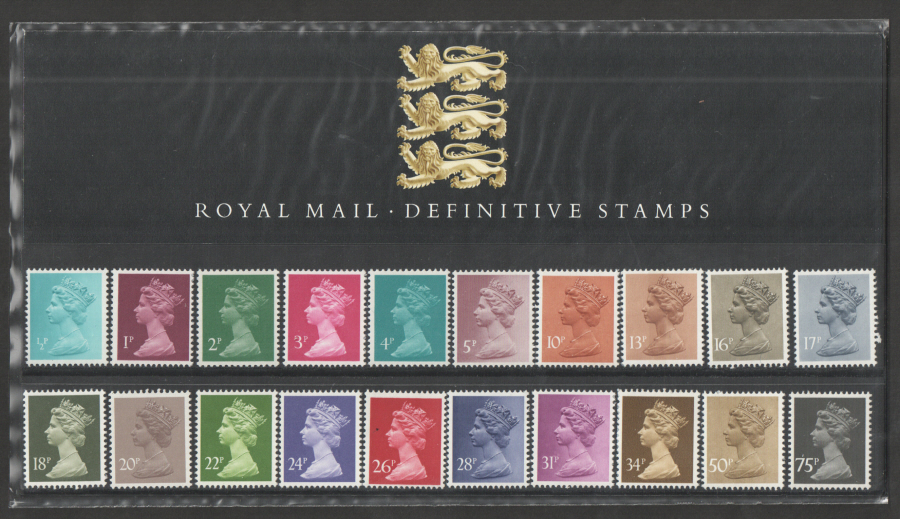
With the United Kingdom of Great Britain and Northern Ireland substituting the monarch’s face for writing its country name on its stamps, Arnold Machin’s standard “definitive” stamp design used since June 1967 is the most simple and effective design possible: the effigy of Queen Elizabeth II, created by Machin in clay, wearing the George IV State Diadem, a crown that includes the roses, thistles and shamrocks that featured separately on the former, more busy standard stamp design; the price value of the stamp; and a single colour used, helping to differentiate from other values of stamp.

I have a stamp collection, mostly kept within one book, and in looking back into it now, the cumulative effect of seeing so many of the “Machin series”, in so many different colours, across so many pages, puts me in mind of Andy Warhol’s pop art screenprints, again reproducing the same image in different colours, except they cost substantially more.


This simplicity and effectiveness of this design has doomed attempts to change it. A proposal to change the Queen’s portrait in 1981, just as Machin’s separate portrait for the original set of decimal coinage was also being replaced, was met with a letter from the subject’s private secretary: “Her Majesty is very content with the Machin effigy and thinks that a work of real quality is required if this is to be replaced.” 


Other attempts to change the design were rejected by Royal Mail’s Stamp Advisory Committee and by Machin himself, but the Queen’s gentle intervention does make you think that, if your face is the only change that can be made to something, you will more than likely say no. With the Queen having final say over her 1967 portrait, and even requesting the colour of the original 4d. stamp to closely match the original 1840 Penny Black, the sense of personal investment is palpable. It has made this portrait of the Queen into possibly most reproduced picture of a single person there has ever been, or will ever be.


Of course, Machin’s design will now have to be changed. My prediction, and hope, is that King Charles’s portrait will simply be used instead, the rest of the stamp staying as it is, but it remains to be seen if the opportunity will be taken to create an entirely new design.