Showing posts with label X-Men. Show all posts

27 May 2023

ALL THE STRANGERS CAME TODAY [398]


Watching television coverage of the RHS Chelsea Flower Show, I thought to myself, “is crypto like tulips?” The 1634-37 speculator bubble surrounding tulip bulbs is considered the first recorded example of the value of one type of product far outstripping its usual price, relative to similar types – I don’t think sunflowers have experienced a similar boom. Likewise, as the innovation and novelty of NFTs caused their explosion in value from 2021 [link], this has largely reversed for reasons including their loss of that novelty value.

I then remembered I previously benefitted from the bust that had followed the end of a speculative boom, one that happened over a decade earlier. 

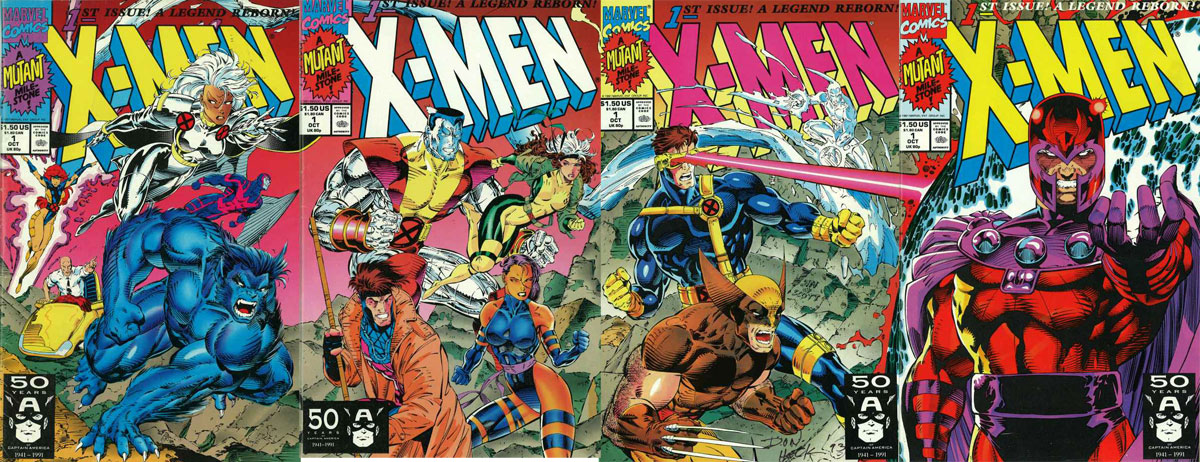
I think it was in the late 2000s, surely before 2010, that I saw piles of American comic books appearing in branches of the discount bookstore The Works. I had only been reading American comic books for a few years, but I already knew enough to know what I was looking at: the first issue of the “X-Men” (volume 2) from 1991, written by Chris Claremont, and illustrated by Jim Lee and Scott Williams. The pile contained the four different covers that made this first issue into a collector’s item at the time, and the fifth that turned them into a gatefold tetraptych. This last version sold for £2.50 in 1991, but here it was three or four copies for £1 – I got the gatefold issue and one of the others, for the story told inside was the same.

Like the value of first edition novels, the values of particular comic books had boomed by 1991, most notably the first appearances of Superman, Batman, Spider-Man and the Incredible Hulk. This was translated special “collectors’ edition” first issues of further new series, featuring higher-quality paper stock, card covers, foil covers, glow-in-the-dark covers, die-cut covers, and so on, all at a premium price compared with a standard book, and seen as an investment by those not necessarily there to read the story inside.

“X-Men” #1 is recognised as the biggest-selling comic of all time, but the 8.1 million copies sold were pre-orders made by comic book stores and newsagents – only half of these were actually sold to customers in 1991, and what I saw must have been the remaining stock being emptied from a warehouse. This continued for some time: I bought two copies of “Superman” #75 from 1992, “The Death of Superman”, one where I opened the black and red bag containing the black armband, trading card and stickers, leaving the other unopened; many issues from the beginning of Image Comics, like “Youngblood”, “Chapel” and “Shadowhawk”, with lots of cross-hatched art and gaudy colours; and various issues of “Spider-Man 2099”, “Punisher 2099”, “Ravage 2099” and so on, more new series and more ways to grab your attention. 

The comics speculator bubble had largely burst by the mid-1990s, leaving readers to carry on as before. Even though Marvel Comics came out of this period worst, having entered Chapter 11 bankruptcy protection in 1996, this also came after a stock market flotation and buying a distributor, but the bubble affected the whole industry. Of course, this was all before the true value was found, by Hollywood, in comic book characters and their stories, over the paper they were printed on.

28 April 2019

NOW THE WORLD IS READY FOR YOU [167]


My local cinema multiplex is showing “Avengers: Endgame” thirty-six times today. Quite rightly, the reviews for the film, in its opening weekend, have remarked on the extraordinary achievement that has been the Marvel Cinematic Universe, and how it ties up the eleven years of connected storylines that unfolded and weaved through large numbers of films and TV series, coming together for event storylines, and characters appearing in each other’s films.
I remember first hearing, in 2005, that Marvel Entertainment had secured a credit facility with Merrill Lynch to start making its own films, intending from the start to make a series of films that would come together, and I just thought, “they’re doing what now?” However, it has not been enough for me to invest the time in watching all these series, as while their characters and storylines were being introduced to the wider public, I had already been catching up on some of them for years.
The first superhero comic book I ever bought was “Robin,” issue 96, dated January 2002, which guest-starred the Blue Beetle. I had no idea what to expect – I didn’t yet know that this was the third Robin so far, and the second Blue Beetle, and I had no idea that “Oracle,” running information checks behind the scenes, used to be the original Batgirl. I didn’t know it was set after a particular crossover storyline, and it didn’t matter. It told a pretty good action-based story, and showed me that superhero stories can be told well, and provided a lesson in how you can arrange time on a printed page. I later picked up the great examples of superhero stories, like “Batman: The Dark Knight Returns” and “Watchmen,” and I have built up quite a collection of books in the years since.

So, here is my problem: why do I need to see a comic book film, when I read comic books? I felt this especially when “X-Men: Days of Future Past” was released in 2014, having already read the original comic, first printed back in 1981. Earlier, “Watchmen” and “V for Vendetta” sought to reproduce the look of the comic as exactly as it could, just as Channel 4’s version of Raymond Briggs’ “The Snowman” had directly used the original picture book as its storyboard. By then, comics using a more “decompressed” storytelling style, like “The Authority,” and Marvel’s Ultimate line of books, were providing a more cinematic and realistic style than before – “The Ultimates,” retelling the Avengers for the Ultimate line, presages the cinematic Avengers in its style, if not the storyline.
I do wonder if comic books could eventually be supplanted by comic book films. Marvel and DC are both owned by major film companies – Marvel has been owned by Disney since 2009, while Warner Bros. realised that year that they had downed DC Comics since 1967, and restructured it as a division of a new company, DC Entertainment, to take better advantage of the stories and characters that had been under their noses for so long. Comic books are essentially the Research & Development section for a film company, and will later serve to provide the tie-in books for their films. All the while, comic book films are the mass market version of a niche industry: “Avengers: Endgame” will be watched by tens of millions of people, but the latest issue of an “Avengers” comic will be bought by tens of thousands, from a specialist comic book shop. It almost doesn’t matter if those readers know what stories will make the films, because those readers number so few.