Showing posts with label Death Wish II. Show all posts

31 October 2021

AND THE FORESTS WILL ECHO WITH LAUGHTER [317]


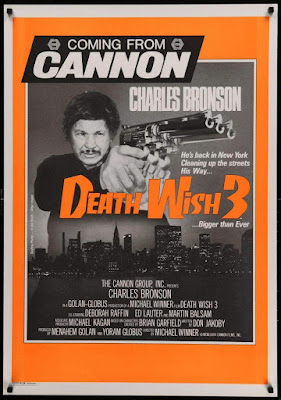
“Death Wish 3” is a 1985 action thriller film starring Charles Bronson as grieving husband turned Rambo-like vigilante Paul Kersey. I’ve had a DVD copy of it on my chair to watch for some time now. In fact, there are two copies – it was so cheap second-hand that I didn’t realise I ordered two copies by accident.

I am used to dissecting films both here and in my education, and the act of looking for something to learn, or to redeem, from any film I watch, means I must have developed a higher tolerance for what the casual viewer would otherwise call crap. I am not going to say that of “Death Wish 3”: it’s competent, it’s serviceable, it’s under an hour and a half, and I watched it until the end. It’s a Cannon Group film from the 1980s, and that was all that was expected of it at the time – it was, at least, better than their film “America 3000” from the following year, which I have reviewed previously [link].

The reason I bought this film was hearing that, to make savings in the budget, a derelict hospital in the Lambeth area of London substituted for the New York projects. It works well enough, but only if you remember to look past that fact afterwards, just like seeing the respected actor and director Alex Winter – Bill, of Bill & Ted – playing a thug. Other than that, Cannon films were very much of their time: its ownership under producers Menahem Golan and Yoram Globus spanned the 1980s, and the lower-budgeted action-led films they are most identified by exist purely to thrill their audience. Their business model was to sell the film to distributors first, then use that money to make the film – delivering maximum bang for their buck was where the profit arrived.

Having said that, thinking about “Death Wish 3” is probably not what Cannon wanted me to do. The violence is glorified, and Paul Kersey is celebrated for his kills, and it is all sanctioned by the plot, Kersey having been given free rein by the police commissioner in the first act. The film is very fast, its story having been set up within the first fifteen minutes, and every scene feels like it was once longer, but then pared down to the bone by editor Arnold Crust, a pseudonym for director Michael Winner. The gang of thugs in this film feel like the most cartoonish pack of rats that could have been written – they only look like people, and having no motivation to write them like people makes Kersey blowing them away that much easier to cheer, if you find yourself doing that. Don Jakoby objected to the rewrites of his script, his name in the credit replaced by “Michael Edmonds”. 

The final ten minutes is one explosion after another, until the gang finally retreats after they see what we assume to be the burning corpse of their leader. The police commander tells Kersey he should go, buying him a few minutes – the credits roll fifteen seconds later, the music starting like the theme from “Seinfeld” later sounded. Wasn’t that show also about “no hugs, no learning”?

Perhaps the easiest gauge of “Death Wish 3” is to look up the sequel from 1987, “Death Wish 4: The Crackdown”. Without watching it, I imagine the same action formula would have been followed, but because Cannon had overspent on prestige productions that did poorly at the box office, like Franco Zeffirelli’s “Otello” (1986), so future productions would be limited to budgets of $5 million, half the budget of “Death Wish 3”. Cannon could afford Led Zeppelin’s Jimmy Page to write and perform the music for “Death Wish II”, then have Mike Moran re-record it with synthesisers for the next one, but the fourth film is down to mostly reusing recordings from previous Cannon productions. Remember, Cannon also slashed the budget for “Superman IV: The Quest for Peace” around this time, which I have also talked about [link].

I was about to write if there was anything I should take away from “Death Wish 3”, but its objective was solely to entertain me. I was diverted, so we’ll call it a score draw.

26 April 2020

GOODNESS GRACIOUS, GREAT BALLS OF FIRE [233]


“Nine hundred years after the Great Nuke. The world man created, he destroyed. Out of the darkness and ignorance of the radioactive rubble emerged a new order... and the world was woggos." (in old speak that means - Crazy!)”

Sometimes, these films just end up finding you. What is the plot of “America 3000”? “In 2890, 900 years after a nuclear apocalypse, warriors Korvis and Gruss stage raids to free men enslaved by the powerful women now ruling Earth.” How lovely does that sound, especially for a film released in the same year, 1986, as the original novel of “The Handmaid’s Tale”?

There is the extra layer of slime in knowing this film was released by Cannon. They had already employed the writer and director of “America 3000,” David Engelbach, to write the script of “Death Wish II” – he later co-wrote the story for the Sylvester Stallone arm-wrestling debacle “Over the Top.” It is quite possible that Cannon were making “Superman IV: The Quest for Peace” at this point too, so “America 3000” may have received some of its budget, as Cannon tried to juggle its various B-movie productions.

Once I actually started watching the film, it appears that “post-apocalyptic” means something that resembles a mix of a medieval village, “Mad Max Beyond Thunderdome” and “The Flintstones” – the music, formed of your typical 1986 rock guitar and keyboards, sticks the film firmly into the past.

It should be made clear that Korvus and Gruss are that bit more intelligent than the enslaved men in “America 3000” because they found, as teenagers, a Ladybird-type book of ABCs, and a top hat. This appears to have been enough to elevate them away from the “machos,” or slaves, and the “toys,” who had their tongues cut out. It looks like a futuristic equivalent of Nadsat or Newspeak was attempted, but not explained, so you will find yourself listening to characters while thinking you missed something earlier, the last time your attention wandered.


I wish I could tell you why the world in the film is the way it is: we know about the “Mericans” and the “Commies,” a “Prezzydent” that will come back to lead them, and the “Great Nuke,” but why a feudal society, based on superiority of gender, with little other knowledge of what the previous world was like, has come about is completely beyond me. You hope this is a pocket of weirdness in the desert (possibly Arizona, but actually filmed in Israel), with life carrying on as normal elsewhere. It is not clear why the women, led by a “tiara” named Frisco, have full hair and make-up styling, other than as “war paint.” 

It is not clear why a ten-minute sequence of brutal conflict is resolved by Korvis and Frisco making kissing in front of everyone else, as everyone discovers this is what they should have been doing all along – I refuse to believe all the women and all the men are straight. It is also not clear why there is a sasquatch-like thing called Aargh the Awful, playing with an air raid siren, and holding a boombox. Finally, for me, it is not clear how a nuclear bunker would survive intact after nine hundred years, with the electricity working, and how the D-sized batteries that must have been in the boombox Korvis found had not leaked in that time.

“America 3000” is a typical example of a cheap film made by Cannon in the 1980s. The bizarre antics on screen did detract from realising the picture was released in 1.33:1 Academy ratio – presumably, all the anamorphic widescreen lenses Cannon owned were being used by “Superman IV.” The actor playing Korvis, Chuck Wagner, thankfully still has a career in musical theatre, in “Beauty and the Beast” and “Les Misérables.” For a futuristic film, “America 3000” is really only of historical interest, but it is online, if you really want to find it.