Showing posts with label vaporwave. Show all posts
26 September 2020
RISE, GO OUTSIDE BITCH [262]
My choice for the song that defines the year 2020 was decided very early on, by the end of March. Furthermore, it was was actually released on 20th December 2019, but reviews raved about it into the new year. “Sick & Panic” is the first release by the electronic music artist Ramona Xavier to use the pseudonym Macintosh Plus since the seminal 2011 album “Floral Shoppe,” a cornerstone of the vaporwave genre. Xavier usually releases under the name Vektroid, so the use of Macintosh Plus this time caused immense anticipation.
For the uninitiated, “Floral Shoppe” is a cut-up of mostly Eighties tracks already drenched in keyboard and saxophone, that are sped up, slowed down, looped and distorted, giving the impression that you have unearthed a cassette tape with no known history, and the tape itself is worn and ragged. The standout track is “リサフランク420 / 現代のコンピュー" (“Lisa Frank 420 / Modern Computing”) – Japanese text is a big feature in vaporwave song titles and album design – which spins out the first ninety seconds of the Diana Ross album track “It’s Your Move” into a seven minute meditation on the idea that time is running out, with the line “I'm giving up on trying to sell you things that you ain't buying” rendered iconic. Vaporwave is a genre defined by hauntology, a longing for a future that never came, and wherever that future went, “Floral Shoppe” is what it left.
In comparison, “Sick & Panic,” released as the precursor to a new Macintosh Plus album later in 2020, is like playing the cassette found stuck inside an old Sony Walkman that was itself found in the back room of an abandoned branch of Currys, after they moved out of the town centre. It gets stuck, it stutters, it has snatches of lyrics, and some melody comes up that may sound familiar, but it is then distorted and enveloped back into itself. Classical vaporwave has to smash through modern EDM noise first. It could be dismissed as noise – twelve and a half minutes of noise, in the same way that The Beatles’ “Revolution No. 9” is eight and a half minutes of noise.
You may start to pick out patterns, because that is how the mind works, but that is only so you can find a hook, an anchor, something to hold. The choppy lyrics, like “Face, face, don't, face” and “Goes, goes get you,” will suddenly make a whole sentence: “I don’t need my body anymore” and “go outside bitch.” The song’s cover art, which sends flying the Apollonian bust from the original “Floral Shoppe” cover, reads, “Rise From Your Grave.” When the drum machine and MIDI sampled keyboard kick in at the half-way mark, it is almost comforting, but the cosy nostalgia that vaporwave hopes to evoke is quickly snatched away again, but this is not the time for that.
Why “Sick & Panic” sounds the way it does may not truly make perfect sense until the rest of the album is released, but it sounds like something unknown is about to burst, and you are being implored to fight its effects. The two-word description of the track on Xavier’s Bandcamp page (https://vektroid.bandcamp.com) is “NO WAR” – from your perspective, you have either not seen the war coming, or you have to start picking which battle to fight. This is vaporwave designed to agitate.
It would have been easy enough to choose “Sick & Panic” as my song of 2020 based solely on the title, but when 2020 is finally talked about in the past tense, it will be as a difficult year to have lived through, the world itself having changed, and with the future having finally arrived. Making sense of the noise is like brushing your teeth these days.
10 May 2020
WHERE ARE YOU COMING FROM [236]
But there is no Dog Police, not at first. Understanding what it was, and how it came to be, involved joining many dots, but it made my new-found love of their songs even greater.
Starting with “Dog Police,” the video from the song, album and band of the same, we have a novelty song about someone’s girlfriend being wanted by the Dog Police, using a New Wave sound and temperament similar to Devo and The B52s. Taking place in a club, it features the band both as themselves on stage, and as the Dog Police, with trenchcoats, fedoras and prosthetic dog faces.
Perhaps the lyrics are not meant to make much sense, but the bass and synthesisers hook you along towards the explosive sound of the chorus, punctuated by barking in time: “Dog Police, where are you coming from / Dog Police, nobody knows who you are!” These lines are adapted from the “Spider-Man” segments from the children’s TV show “The Electric Company,” but are performed like a bombastic, sped-up version of the “Dragnet” theme. It is infectious, strange, unforgettable, and nightmare fuel to the wrong people. This video would be later optioned by NBC for a possible TV series, with one pilot film, again featuring people in dressed as dogs, notoriously featuring actors Adam Sandler and Jeremy Piven before anyone knew who they were.
Underneath this video on YouTube was another Dog Police video, “1-800,” satirising mail order ads and the products they sell, using a phone as an instrument through playing the DMTF dialling tones. While not parodying a song, both the video and song play more like a Weird Al Yankovic piece. Both “1-800” and “Dog Police” feel like they come from an alternate universe where satirical songs became the norm, like John Lennon imagined when writing “Taxman” and “Paperback Writer.”
Then there is the “Dog Police” album. Alongside the title track and “1-800,” there is a heavy, pessimistic dirge titled “Positive Reinforcement,” while a vocoded robot sings “Happy,” and a woman fronts “I’m Butch.” The band plays with their surroundings and expectations in both “Music and “In The Studio,” while they attempt to become Manhattan Transfer with “Are You Middle Class Enough?” The last track is a frantic, bouncy anthem named “Reproduce,” with lines that cut to the chase extremely fast, becoming my favourite song of the lot:
“Don’t be despaired / There isn’t time enough / Why we are here / Is very simple stuff / Why are we doing / What we are doing? / Are we wooing / Only for screwing? / We’re only here to reproduce! / That seems to be our only use.”
What I get from the “Dog Police” album is how the band is very forceful and fast, having mastered their instruments: there are intricate bass and piano lines, with not a single note out of place. They will sound the same if they played live. The lyrics are very cynical and sarcastic, flippant to the point of providing accidental insight: a refrain to “Music” is “stick it in your ear,” reducing all music to product to be consumed, but also becoming a rallying call to do just that.
There is an infectious energy to Dog Police that attracted me immediately – it reminds me of Paul D. Millar, a Texas-based artist who records as Slugbug, similarly providing satirical songs in a New Wave mould through albums like “Truck Month” and “Pointless Journey,” which are available on the music streaming site Bandcamp [link].
However, like vaporwave, another genre found in abundance on Bandcamp, Dog Police almost comes across as a found object with no clear origin. With no easily obtainable evidence about its source, or about what happened after it was made, it appears to have just, well, appeared.
According to the database site discogs.com, the “Dog Police” album was released in 1982 on the Music Masters Ltd label, but I have also heard it was produced and distributed privately in 1985. The songs are written by Tony Thomas, Tom Lonardo and Sam Shoup, who also produced the album with engineer Andy Black, but the band used pseudonyms – “Clark Radio” on keyboards, “Random Ax” playing guitar, bass and trumpet, and “Squeek Owens” on drums. “Butchie Cox” and “The Rocks” also help with vocals. However, we know that Thomas, Leonardo and Shoup are “Clark,” “Squeek” and “Random,” because they appear in the videos. All three are classically-trained musicians, have worked both in commercial music and arrangers and session musicians for other artists. They have been part of the jazz music scene in Memphis, Tennessee for over forty years as The Tony Thomas Trio, releasing the albums “LST,” “Progreso” and “Melodious Funk”. Were they trying a new direction?
![]() |
| Original album cover |
You then have the videos: “Dog Police” was played on MTV, but not as part of a playlist, instead submitted in 1984 to a competition run by “The Basement Tapes,” a monthly half-hour showcase for unsigned acts, and it later played on the variety magazine show “Night Flight” on the USA Network. The video for “1-800” may have also featured on “The Basement Tapes,” but did appear in 1984 on Weird Al Yankovic’s MTV show “Al TV,” blending with the parodies played around it.
One reason the video for “Dog Police” is remarkable is its quality. While the low-grade video and computer special effects in “1-800” is more typical for “The Basement Tapes,” “Dog Police” is shot on 16mm film by director Joe Mulherin and cinematographer Larry McConkey, later to become an accomplished Steadicam operator on major films like “Goodfellas,” “The Silence of the Lambs,” “World War Z” and “12 Years a Slave.” If so much effort was spent entering a competition, you start believing this cynical band were actually aiming for the big time.
Did Dog Police just go back to being The Tony Thomas Trio when their New Wave direction didn’t work out? Was it an elaborate joke by musicians more accomplished than was demanded of them? Was it the remains of something else that never appeared? Was it another person’s idea, or even a dare? The “Dog Police” album has been released on vinyl in 2009 and 2019, and are available on iTunes and Amazon, so someone must be collecting royalties from the intrigue generated by the videos, while being wary of saying anything that might ruin the fun.
Fortunately, after days of looking for evidence, I came across episode 18 of “Contraption: The Drummers’ Podcast” [link], released in February 2020, which interviewed Tom Leonardo. Thirty-eight minutes into the detailed discussion of Leonardo’s career and influences, Dog Police is discussed: “some things never go away,” he says. The Tony Thomas Trio were attempting to record an album, being charged for studio time by engineers that were not really paying attention. In a spare moment, they were riffing an improvised chorus for what became “Dog Police,” using the “Spider-Man” lyrics. The engineer asked what they were playing, and the band said it was a little thing they were working on. The engineer asked if they could record it, right there and then. After taking ninety minutes to write more throwaway lyrics, they recorded the song. The next day, their producer asked the band if they had any more songs like “Dog Police” to record – the studio costs would be paid for them. The further songs dashed off by the band were based on observations they had at the time about themselves and the world around them, but they were of their time, particularly in terms of the music – Stewart Copeland, drummer for The Police, was noted as a comparison, along with local Memphis punk bands with frantic drummers.
In the end, Dog Police was not a means to forge a career, but was a one-time opportunity, meant to last as long as the songs took to write and record, and no longer. Perhaps the videos were as well, but the time and effort spent on them makes you feel this was a more serious endeavour than it really was, no matter what anyone says. Few moments in time last this long.
![]() |
| 2009 reissue album cover |
29 May 2019
WITH SO MANY LIGHT YEARS TO GO, AND THINGS TO BE FOUND [177]
On 30th May 2016, I published the first article of “Leigh Spence is Dancing with the Gatekeepers,” and while I have largely kept to the “nostalgia culture crisis” theme, I have been impressed by ability to lurch from one subject to the next.
The plan has always been to plug the gaps in my own knowledge, report my findings, and improve my writing ability. I just wasn’t expecting culture wars, Brexit and Donald Trump to flare up at the same time – hell, David Cameron was still Prime Minister when this site began. If you have dropped in along the way, wondered where this was all going next, and took a second look, you have my thanks.
For the first time, I present the top ten most read articles from the first three years and 176 articles – it turns out one trademark of this site is my ability to lurch from one subject to the next!
1. THAT’S A BEAUTIFUL SPEECH, BUT NOBODY’S LISTENING [link] (published 21/09/2017)
As “Dada” is an art form that needed its own word to reject one way of seeing the world, I needed a word for when “alt-right” people call themselves “performance artists” – the random word turned out to be “jackanapes.”
2. JUST A DREAM AND THE WIND TO CARRY ME [link] (published 05/10/2017)
The story of the ocean liner SS America, later to take “Ten Pound Poms” to Canberra as the cruise ship Australis, and ultimately shipwrecked over Fuerteventura – more famous as a wreck than it could have hoped as a floating hotel.
3. NOR ANY DROP TO DRINK [link] (published 25/02/2018)
I received a free packet of water with a magazine - I later discovered micellar water works just like washing-up liquid. The French knew what they were doing all along.
4. WHAT THE WORLD WANTS TODAY IS THE REAL THING [link] (published 18/02/2018)
Coca-Cola once advertised itself with a woman in a beach suit, and the word “yes” – perhaps they should have put speech marks around it, like I just have.
5. I’VE GOT PAC-MAN FEVER [link] (published 25/06/2018)
My review of the Nintendo NES Classic Mini, having never owned or played the original - the Sega Master System was more popular in the UK than the NES.
6. TRUE BLUE, BABY I LOVE YOU [link] (published 26/03/2018)
With British passports to change from red to blue covers following Brexit, the contract to make them went to a French-Dutch company, causing the “Daily Mail” to implode with jingoistic bile. The paper has since found a new editor.
7. THERE’S A MAGICAL PLACE, WE’RE ON OUR WAY THERE [link] (published 02/04/2018)
The rise of the “dead mall,” when closing stores create nostalgia for the big, empty spaces left behind. It comes with vaporwave, its own electronic, alienating soundtrack.
8. WHO SAYS A MISS WAS MADE TO KISS? [link] (published 21/11/2016)
I’ll just leave this here: “Donald Trump will be President of the United States from 20th January 2017, and the weight of that office demands respect. However, the holder of that office cannot afford to be given the benefit of the doubt, especially when Trump has never appeared to need it before. He will be given the opportunity to govern in the way he sees fit, but he will be under constant scrutiny, for every single decision, for every public utterance, for the rest of his life...”
9. I AIN’T GONNA STAND FOR IT [link] (published 05/08/2016)
“Ain’t” is a real word, appeared from two different places, and can be written down - Marvin Gaye & Tammi Terrell did not sing “There Is No Mountain High Enough.”
10. WATCH OUT, BEADLE’S ABOUT [link] (published 11/11/2016)
A portrait of Jeremy Beadle - fact collector, writer, broadcaster, concert promoter, charity fundraiser - through a series of “did you know” facts. I am sure he would have approved.
08 April 2018
FOR WHAT I’VE HAD IS WHAT I’LL NEVER GET [104]
It turns out that, when I was writing about dead shopping malls last week, and about vaporwave music before that, I actually wanted to talk about nostalgia, so I shall. Nostalgia formed the critical base for both subjects, and once I ended a thousand-word discussion on shopping malls by saying I wasn’t sure what lessons to take from them, it wouldn’t be long before someone said it would be nice to read a follow-up as my thoughts about them develop.
That person was my sister Layla, of Richee & Layla at His and Hers Reviews, and they made a podcast (sadly no longer available) reviewing Steven Spielberg’s latest film, an adaptation of Ernest Cline’s novel “Ready Player One.” The film’s story is built around OASIS, a virtual reality environment in which people learn, work and play. This world is constructed out of all the popular culture artefacts you can imagine, and the quest taken in the film is based on finding “Easter eggs” hidden by the world’s creator, inviting people to “like” what he likes.
In the podcast, Layla said that “Ready Player One” will live beyond its time in the cinema because the idea of nostalgia is so big. This is not just historic nostalgia for the 1980s – “Back to the Future,” “The Shining,” Atari computer games, “Doom” and so on – but also the vicarious nostalgia of longing for the past, by living through the past of someone else. In “Ready Player One,” characters are being told that something is nostalgic, and that you must like it because it is nostalgic, “and if you are not nostalgic for it, you are a fucking monster” - my sister also brought up the notion of “ruining your childhood,” if the object of nostalgia is not how you personally remembered it.
Nostalgia used to be a diagnosable condition, like depression: it was first outlined by Johannes Hofer in 1688, referring to the state of Swiss mercenaries located in less mountainous areas, in France and Italy, than where they came from, and was known as “the Swiss disease,” in the same way that syphilis used to be the disease other countries called their enemies. The word “nostalgia” came from Greek words for “homecoming” and “pain,” and was originally translated into English as “homesickness.” Medical studies of nostalgia had stopped in the 1870s, by which point soldiers in the American Civil War were diagnosed with it. Psychological studies, however, are obviously still ongoing.
The nostalgia I believe was awoken in me by listening to the ghostly echoes of vaporwave, and in walking through an empty shopping mall, are evoked by the same type of memories “Ready Player One” wants to create – memories for when music, film, TV, and architecture were done that way, because things were better then. I talked about the safe spaces that shopping malls create, and vaporwave makes new connections by cutting up the music of the 1980s. However, these subjects are using that nostalgia to criticise the end of the consumer society, which created the conditions in which vaporwave and dead malls now exist. If the good times evoked by nostalgia for 1980s music and shopping malls had been real, I would not have vaporwave, I would not have made a video about a dead mall near where I live, and I would not be writing about it here.
I had not known what lesson to take from looking at dead shopping malls, but I realise that the nostalgia evoked by them, and by vaporwave, is for something that may not have existed but more of a vision that did not happen to me – I was six years old when 1990 came around, so the 1980s remains an interest because it is on the edge of what I can remember. Like any good postmodernist, I am looking for what references I can bring forward and cobble together to give meaning to the present day, but when you are looking at what happened within your own lifetime, you will always pick the good times first.
02 April 2018
THERE’S A MAGICAL PLACE, WE’RE ON OUR WAY THERE [103]
![]() |
| Forest Fair Village, Cincinatti, Ohio |
It turns out that, when I was writing about vaporwave music a couple of weeks ago, I actually wanted to talk about shopping malls, so I shall.
It has been a torrid time for retail businesses in both the UK and the US, as familiar brands bind us together. I have walked past the Toys R Us store from where thirty years of our family’s toys have come, but I did not have the courage to enter, let alone face the staff that are losing their jobs. My ears were pierced in Claire’s Accessories, and while it has entered into chapter 11 bankruptcy in the US, the UK side may yet file for administration, joining the electronics shop Maplin. Carpetright, fashion chains New Look and Select, and restaurants Jamie’s Italian and Prezzo, have all entered into Company Voluntary Agreements, closing branches to make themselves solvent again, with Prezzo closing its Chimichanga tex-mex chain, one of my favourite restaurants, in its entirety. Then, there are businesses that are doing relatively fine, but still have to adapt – my mother has just helped close the high street department store she worked in for the last eleven-plus years, with its replacement, a food-only store, being based out of town.
Clearly, location is everything, and where we shop is more likely to have an address ending .com, or .co.uk, rather than PO1 1EA. The spaces left behind by this shift have, unexpectedly, become a place for contemplation, as I found out one day.
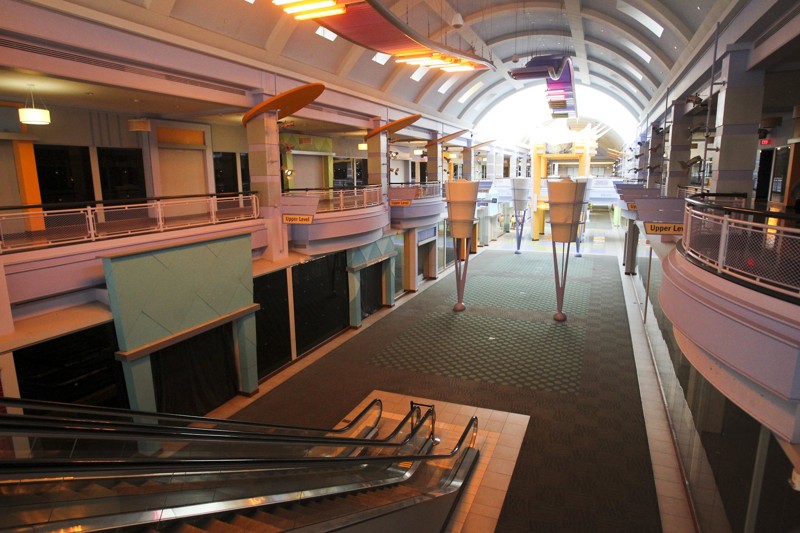
I have no idea what I viewed on YouTube for “Dead Mall Series,” by American filmmaker Dan Bell, to be recommended to me, but I was transfixed from the first video. Each set-up is similar – a first-person walk around a shopping mall, often built in the 1970s or 80s to redevelop former industrial areas. You see the postmodernist appropriation of natural surroundings – marble courtyards, skylights, palm trees and fountains, all garnish for the air-conditioned racecourse of shop fronts, still identifiable long after the business, and customers, left. The effect is alienating and bizarre - some malls once housed over a hundred stores, and are now down to its last few, variously down to larger “anchor” stores leaving, competition from other malls, the rise of online shopping, and crime and neglect, as mortgages and taxes on the mall are unable to be paid. You see where the malls have changed for the worse – plants removed, fountains turned off, whitewash on the walls, or even fake walls put up to repurpose shops as offices, gyms, or even just to make spaces that may never be filled again.
The most extreme example of a “dead mall” known to most people was the Dixie Square Mall, based in Harvey, Illinois, which closed in 1978 after just twelve years, in time for it to be used in a chase scene for the film “The Blues Brothers” (1980). However, it took until 2012 to be demolished, during which time around ten proposals to reuse the space came and went, before crime and vandalism turned it into a derelict ruin. As of 2018, the land is a brownfield site, still waiting to be reused.
In “Dead Mall Series,” and other YouTube-based series like “Ace’s Adventures,” and “Retail Archaeology,” the use of vaporwave music heightened the nostalgia for a mode of living that was dying out, as if this whole capitalism thing wasn’t working out. Going to the mall was once something you could do all day, as restaurants and cinemas often formed part of the same complex. The mall security ensured you had a safe space to hang out, but once fortunes change, there is less reason to keep you there, and less reason for mall owners to keep trying. This is why you see many videos about the same malls appearing, such as for the Forest Fair Village in Cincinnati, Ohio, and Century III Mall in West Mifflin, Pennsylvania – these are cavernous spaces that are almost abandoned, but can be freely explored, because they remain open, even if the plants have died, the roof leaks, and the lights are going out.
For me, these grand spaces are fascinating. The postmodern architecture and aesthetics of shopping malls and vaporwave feed off each other, that area of thought and practice is now coloured turquoise, salmon pink and grey for me, matching the floor tiles and fixtures of many American malls. The stillness of walking through a place that is meant to be buzzing recreates that lost energy in yourself – you wonder what had been made of this space, and what could still be done, but the sadness moves from feeling the lost prestige of times past, to the acknowledgement that buildings that lose all purpose will inevitably be demolished.
Malls in the UK are often smaller, and built around the back of existing high streets, so the experience of walking off a busy street into a scene of desolation is very jarring indeed. Last year, I made a video about The Bridge Shopping Centre, a small mall built in Portsmouth in 1989, which backs onto a supermarket. Last year, I made my own video, walking through what had now become a corridor to the supermarket. Since then, two more shops have closed, a pet shop and jewellery store, with barriers preventing you from walking past the pet shop - there is little incentive for anyone to consider opening a store there. A time capsule was buried when the mall opened in 1989, and it may not be too long before it gets dug up.
I am not sure what lessons I am supposed to take from dead shopping malls, except to treat their insides like a desolate art gallery while they still remain. Our lives no longer see malls as leisure in the way we once did - creating your own nostalgic entertainment through them may be their last possible use. Vaporwave quotes the alienating, desolate feeling of a dead shopping mall as much as the malls themselves tried to take cues the outside world, creating a safe, enclosed space. Maybe I am nostalgic for something that was never really there, but wanted to be there, thinking it would always be there. Maybe that is the power of retail, and why I couldn’t step into Toys R Us one last time.
19 March 2018
IT’S ALL IN YOUR HEAD [101]
It is hard to talk about the genre of music known as vaporwave without understanding its intention. A bit like punk, vaporwave subverts the 1980s consumerist society by cutting up the music and images of the decade, and representing it as an ironic form of nostalgia, and yes, I am still talking about music.
The name “vaporwave” comes from two sources – “vaporware” is a term given to computer software that is announced, but never appears, while it also evocates “waves of vapour,” a term from Karl Marx denoting old ideas and conventions being swept away before they can solidify. It is not a bad way of describing a genre that popped up as a meme, on the social media site Tumblr in 2010, but its having lasted longer than the original burst of punk in the 1970s means the nostalgia for the failed promises of a 1980s consumer society clearly speaks a lot to people.
What does vaporwave do? Just as the postmodern practices of sampling, cutting and pasting, and nostalgia came to the fore in the 1980s, vaporwave takes what that decade gave us and cuts it up again, finding more connections. Most often, a passage in a song is slowed down and looped, partially for the disorientating and alienating effect, but also to focus on particular lyrics or melodies. A major example of this is the song “Computing of Lisa Frank 420 / / Contemporary,” by Macintosh Plus (aka Vektroid, both aliases of the DJ Ramona Xavier) – its original title is in Japanese, a country also borrowed for vaporwave iconography – by cutting up a 1984 Diana Ross album track, “It’s Your Move,” a slick three-minute song becomes a seven-minute brooding dirge, highlighting the refrain of “it’s all in your head.” It could be said to be post-music too, as little or no original music is composed for vaporwave, unless you are trying to recreate the effect by writing an original piece.
For the record, the albums to listen for the beginning of vaporwave are “Eccojams Vol.1” by Chuck Person, the cover of which cuts up the cover for the Sega Mega Drive / Genesis game “Ecco the Dolphin”; “Far Side Virtual” by James Ferraro; and Macintosh Plus’s “Floral Shoppe,” which has an album cover that sums up the visual aesthetics – sorry, I mean A E S T H E T I C S – of vaporwave: a playful mix of pastel and fluorescent colours, cityscapes, patterns, along with Roman busts and columns. For good results, the art should look like it was slightly unplanned, resulting from a glitch, found and revered, just like the music.
For many, this type of experiment makes a hard listen without context, and I first came across the genre through its use in series on YouTube like Dead Mall Series, Ace’s Adventures and Retail Archaeology, which have all used vaporwave as backdrops to video tours of deserted American shopping malls, where the shift to shopping online left the shopping meccas of the 1980s and 1990s to become vacant, deserted, and abandoned. With the accompanying vaporwave soundtrack sounding like it may be playing in the mall during the filming – indeed, background music from the Muzak Corporation is also used for vaporwave tracks – it feels like the utopian safe space of the shopping mall, and the aspirational imagery in advertising, were false promises, but that could just be the Marxist side of it.
Where does all of this effort go? For many, vaporwave will feel like a deliberate joke, an attempt to create something that purports to have depth, when it has none. But like any solid postmodern work, all the meaning is on the surface, and that meaning, at least to me, is to make something of the fractured world the 1980s has left us, and rejoice in it.
Subscribe to:
Posts (Atom)