Showing posts with label DC Comics. Show all posts

03 March 2024

FELIX KEPT ON WALKING [438]

Original and current versions of Felix the Cat and "Felix the cat"

Felix the Cat is an animated cartoon character that first appeared in the cartoon “Feline Follies” in 1919. Like a hand-drawn Charlie Chaplin, but with a tail that magically transformed into anything needed in the moment, Felix’s surreal cartoons were a big hit in the 1920s, making him a mascot to celebrities and sports teams, and entering homes in toy form. Losing out to Mickey Mouse by the end of the decade, Felix continued in newspaper comics strips and on television, now carrying a magic bag that changed shape as required. Having not starred in a major film or series in over twenty years, Felix survives as intellectual property owned by DreamWorks Animation since 2014, his image licensed for merchandise in a manner not unlike that of another character not seen on screen in years, Betty Boop. 

“Felix the cat” has been the mascot of Felix cat food since 1989. Originally a manufacturer of dry cat biscuits in Biggleswade, Felix Catfood Ltd was bought by the Quaker Oats Company in 1970, and a relaunched product range included wet food in tins. A new advertisement campaign launched in 1989, including television for the first time, which featured a realistically-drawn black-and-white cat, named for the product and behaving as mischievously as any regular cat. This campaign continues to the present day, surviving the brand’s change in ownership to Spillers, the former makers of Kattomeat, and to NestlĂ© Purina Healthcare.

Searching “Felix the Cat” on Amazon.co.uk brings up “Felix” ahead of Felix, and while that is an indicator of which one has consistently made more product in the last thirty-five years, it still annoys me – I never got used to one of the UK’s Brexit negotiators being named David Frost, when they were not the same David Frost that interviewed Richard Nixon and presented “Through the Keyhole”.

There is precedence in the UK, also involving cat food and a cartoon cat, of something arriving with the same name, but it resulted in a name change to avoid confusion: Spillers already had a cat food named “Top Cat”, meaning the Hanna-Barbera series was renamed “Boss Cat” on television from 1962. This cat food is no longer produced, so there is no longer any confusion. Later in the 1960s, Marvel Comics were able to introduce their own superhero named “Captain Marvel” in the absence of the original Fawcett Comics character, now largely known as “Shazam” due to new owner DC Comics being legally unable to use their original name to title their books.

With DreamWorks’ copyright for Felix the Cat extending to “prerecorded goods” and “musical instruments, namely, guitars” with licensing of that image from there, there is the space for two Felix-es to exist, and because they exist in industries separate from each other, there should be no issue, apart from my own cognitive dissonance.

What I do find amusing is that, while DreamWorks’ copyright covers the later version of Felix the Cat, with a rounder head, larger eyes, no whiskers, longer legs and shorter body than the 1920s version – this also means that, like the “Steamboat Willie” Mickey Mouse, the original Felix the Cat is in the public domain – the cat food “Felix” that continues to appear in animated ads on television was recently redrawn with larger eyes, a more human-like smile and, like the original Felix, their own song “It’s Great to Be a Cat”, sung by Robbie Williams. However, this will remain contained within the space of an ad break, and away from the original Felix.
27 May 2023

ALL THE STRANGERS CAME TODAY [398]


Watching television coverage of the RHS Chelsea Flower Show, I thought to myself, “is crypto like tulips?” The 1634-37 speculator bubble surrounding tulip bulbs is considered the first recorded example of the value of one type of product far outstripping its usual price, relative to similar types – I don’t think sunflowers have experienced a similar boom. Likewise, as the innovation and novelty of NFTs caused their explosion in value from 2021 [link], this has largely reversed for reasons including their loss of that novelty value.

I then remembered I previously benefitted from the bust that had followed the end of a speculative boom, one that happened over a decade earlier. 

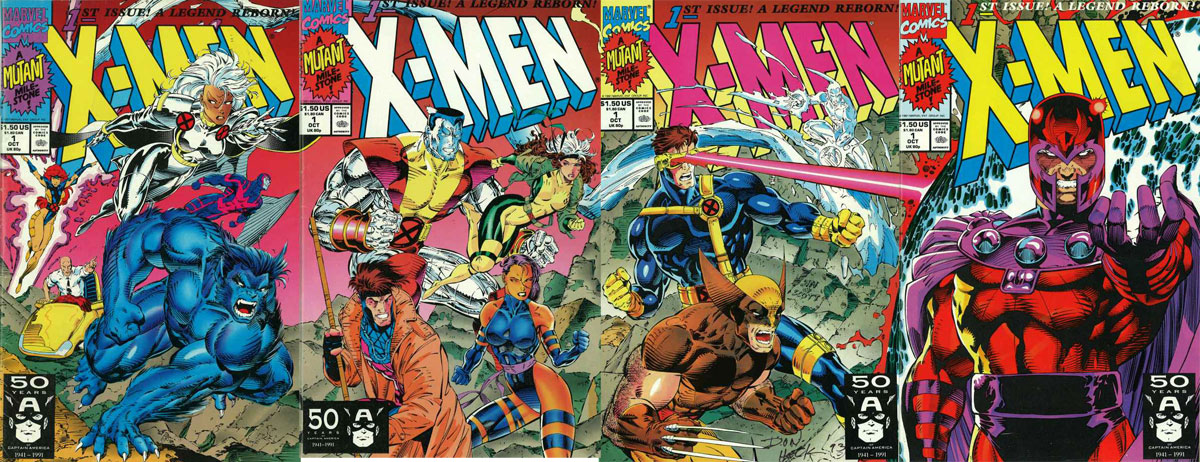
I think it was in the late 2000s, surely before 2010, that I saw piles of American comic books appearing in branches of the discount bookstore The Works. I had only been reading American comic books for a few years, but I already knew enough to know what I was looking at: the first issue of the “X-Men” (volume 2) from 1991, written by Chris Claremont, and illustrated by Jim Lee and Scott Williams. The pile contained the four different covers that made this first issue into a collector’s item at the time, and the fifth that turned them into a gatefold tetraptych. This last version sold for £2.50 in 1991, but here it was three or four copies for £1 – I got the gatefold issue and one of the others, for the story told inside was the same.

Like the value of first edition novels, the values of particular comic books had boomed by 1991, most notably the first appearances of Superman, Batman, Spider-Man and the Incredible Hulk. This was translated special “collectors’ edition” first issues of further new series, featuring higher-quality paper stock, card covers, foil covers, glow-in-the-dark covers, die-cut covers, and so on, all at a premium price compared with a standard book, and seen as an investment by those not necessarily there to read the story inside.

“X-Men” #1 is recognised as the biggest-selling comic of all time, but the 8.1 million copies sold were pre-orders made by comic book stores and newsagents – only half of these were actually sold to customers in 1991, and what I saw must have been the remaining stock being emptied from a warehouse. This continued for some time: I bought two copies of “Superman” #75 from 1992, “The Death of Superman”, one where I opened the black and red bag containing the black armband, trading card and stickers, leaving the other unopened; many issues from the beginning of Image Comics, like “Youngblood”, “Chapel” and “Shadowhawk”, with lots of cross-hatched art and gaudy colours; and various issues of “Spider-Man 2099”, “Punisher 2099”, “Ravage 2099” and so on, more new series and more ways to grab your attention. 

The comics speculator bubble had largely burst by the mid-1990s, leaving readers to carry on as before. Even though Marvel Comics came out of this period worst, having entered Chapter 11 bankruptcy protection in 1996, this also came after a stock market flotation and buying a distributor, but the bubble affected the whole industry. Of course, this was all before the true value was found, by Hollywood, in comic book characters and their stories, over the paper they were printed on.

29 May 2022

BUSTING UP MY BRAINS FOR THE WORDS [346]


The “darkest timeline” is not a way I would describe the world I live in, but I have seen other people use this term to describe the conflict and warfare that dominates the news and, by extension, the decisions that have led to this state. 

With the concept of multiverses now mainstream, from “Back to the Future Part II” to “Rick & Morty”, and “Everything Everywhere All At Once” to “Doctor Strange in the Multiverse of Madness”, using narrative devices to order the randomness of real life has its uses, but the “darkest timeline” is a pessimistic consensus to reach.

I was surprised to find that sitcoms are still watched by enough people to coin words and terms that enter general usage, but instead of coming from “Rick & Morty”, “darkest timeline” comes from creator Dan Harmon’s earlier show “Community”, a show I have also not really watched, perhaps due to an aversion to Chevy Chase. Its inclusion was as a joke: with one episode being based on the outcomes of rolling a six-sided die to determine who will pick up some pizza, each outcome is played out, including one featuring death and alcoholism and a felt beard to indicate an evil version of a character, referencing an episode of “Star Trek”. The “darkest timeline” was also used to describe a period when “Community” was off the air in 2012, again as a joke.

From my own perspective, multiverses are the fault of Gardner Fox, the comic book writer that reintroduced the original version of DC Comics’ The Flash, Jay Garrick, into the updated version’s comic in 1961’s “Flash of Two Worlds!” With “Earth-2” established, Fox wrote various “Crisis on Earth-x” stories in “Justice League of America”, a concept culminating in “Crisis on Infinite Earths”, a company-wide crossover story by Marv Wolfman & George Perez that folded the various earths together into one, including characters bought from other companies that were maintained as their own separate worlds. 

However, what was intended to make a streamlined story universe that was easier to understand has since been supplanted by other series blowing this back out into a multiverse of multiverses, an “omniverse”. No longer able to follow the thread, I long ago decided that the stories being told in the comics themselves are more important than in which world they are taking place.

“Everything Everywhere All At Once” has been the best version of a multiverse story I have seen in a while, although it is also insinuated that “real world” is also the “darkest timeline” by Evelyn, the laundromat owner at the centre of the story, is the worst possible version of themselves, capable of starting many things, but leaving them unfinished, their daughter capable of doing anything in any universe because nothing truly matters. Hope and happiness is what wins out, restoring balance in the film’s characters, let alone the multiverse itself.

It can’t be healthy to say, even as a joke, that we are living in the “darkest timeline”. It sounds like a coping strategy at best, and a deflection at worst.

12 September 2021

A FIGHT FOR LOVE AND GLORY [310]

Warner Bros. 2020 logo redesign by Pentagram

Watching Warner Bros’ latest film “Space Jam: A New Legacy” at the cinema was an interesting experience. With a story based within the company’s computer servers, I needed the cinema-sized screen to catch all the references to the company’s characters from their films and “properties” in the crowd watching the climactic basketball match between LeBron James and the program running the show, “Al-G Rhythm”. 

The film has received negative reviews for the general product placement of, well, Warner Bros. itself: it is strange to see a family film sprayed with characters and locations from far more adult productions, like “Mad Max: Fury Road”, “A Clockwork Orange,” “Game of Thrones,” Pennywise from “It”, and Vanessa Redgrave’s Sister Jeanne des Anges from Ken Russell’s “The Devils” – I sincerely doubt the latter would get as worked up over basketball than what goes on in their own film (really, look it up).


As a film fan and student, I believe Warner Bros. is the Hollywood studio, shaping the art form, staying on top of it for a hundred years, and preserving its past, even if through mergers and acquisitions: the new “Space Jam” film features MGM’s “The Wizard of Oz” and Tom & Jerry alongside Hanna-Barbera characters, including The Flintstones, and RKO Radio Pictures’ original King Kong. The breadth and scale of Warner Bros. today is belied by only just mentioning Looney Tunes now, followed by DC Comics, HBO, CNN, and “Friends”. 


It is meant to be distasteful to bring business into art, but the history of Warner Bros. is the exception that proves the rule: “The Jazz Singer” is not known as “Warner Bros’ Supreme Triumph” for nothing, not least because the studio proclaimed the film as such upon its release in 1927. Far more than making “talking pictures” viable commercially, through Al Jolson’s effortless use of his established catchphrase “you ain’t heard nothin’ yet,” the notion of what a ALL FILMS made before or since “The Jazz Singer”, and the idea of film itself as a medium, will feature a soundtrack of some kind, whether one is added to a “silent” film, or even when a conscious decision is made to be “silent” for any length of time, for Warner Bros. and Western Electric developed the Vitaphone sound-on-disc system to provide musical accompaniment and sound effects in all cinemas, even those that could not afford its own band or orchestra.


For a company only properly incorporated in 1923, and having only built their studios in Sunset Boulevard in 1918, Warner Bros. had enough cash from the box office of “The Jazz Singer” to buy up a brace of music publishers, suddenly a necessary part of film production, and the Stanley theatre chain, which came with a one-third ownership of a far bigger film producer and distributor: the current Warner Bros. studio in Burbank, California was built by First National, whose name continued to be used for some time. These investments helped to pioneer both the musical film genre and the initial use of Technicolor, and to allow a switch to comedy, horror and gangster films when audiences’ tastes changed.


However, the content-rich current state of Warner Bros. is precisely down to the corporate upheavals in Hollywood that took place following the anti-trust lawsuits that separated cinema chains from film producers, the rise of television, and sheer bad luck. Its massive purchase of the Turner Broadcasting System in 1996 reunited Warner Bros. with the pre-1950 films and cartoons it sold in 1956 to support itself at an uncertain time, but this also came with the pre-1986 MGM film library, RKO’s library from “King Jong” to “Citizen Kane”, and all of Hanna-Barbera’s cartoon series too. Ted Turner built up this collection to provide content to his TV networks, from Cartoon Network to TBS and TNT, but he sold on the MGM film company because he overextended himself, despite keeping the rights to their films. Similar divestments by Warner Bros. in previous years included Nickelodeon, MTV and VH1, along with their cable TV network that built these channels, and the computer game company Atari.


Watching “Space Jam: A New Legacy” made me think I was watching a film studio writing a love letter to itself, albeit one I’ll happily act as a co-signatory. What I think the scriptwriters could have done, considering the film is mainly set in a virtual reality run by a computer algorithm, is they could have made more of the connection with “The Matrix”, especially with Warner Bros. releasing the fourth film in the series this Christmas.

28 April 2019

NOW THE WORLD IS READY FOR YOU [167]


My local cinema multiplex is showing “Avengers: Endgame” thirty-six times today. Quite rightly, the reviews for the film, in its opening weekend, have remarked on the extraordinary achievement that has been the Marvel Cinematic Universe, and how it ties up the eleven years of connected storylines that unfolded and weaved through large numbers of films and TV series, coming together for event storylines, and characters appearing in each other’s films.
I remember first hearing, in 2005, that Marvel Entertainment had secured a credit facility with Merrill Lynch to start making its own films, intending from the start to make a series of films that would come together, and I just thought, “they’re doing what now?” However, it has not been enough for me to invest the time in watching all these series, as while their characters and storylines were being introduced to the wider public, I had already been catching up on some of them for years.
The first superhero comic book I ever bought was “Robin,” issue 96, dated January 2002, which guest-starred the Blue Beetle. I had no idea what to expect – I didn’t yet know that this was the third Robin so far, and the second Blue Beetle, and I had no idea that “Oracle,” running information checks behind the scenes, used to be the original Batgirl. I didn’t know it was set after a particular crossover storyline, and it didn’t matter. It told a pretty good action-based story, and showed me that superhero stories can be told well, and provided a lesson in how you can arrange time on a printed page. I later picked up the great examples of superhero stories, like “Batman: The Dark Knight Returns” and “Watchmen,” and I have built up quite a collection of books in the years since.

So, here is my problem: why do I need to see a comic book film, when I read comic books? I felt this especially when “X-Men: Days of Future Past” was released in 2014, having already read the original comic, first printed back in 1981. Earlier, “Watchmen” and “V for Vendetta” sought to reproduce the look of the comic as exactly as it could, just as Channel 4’s version of Raymond Briggs’ “The Snowman” had directly used the original picture book as its storyboard. By then, comics using a more “decompressed” storytelling style, like “The Authority,” and Marvel’s Ultimate line of books, were providing a more cinematic and realistic style than before – “The Ultimates,” retelling the Avengers for the Ultimate line, presages the cinematic Avengers in its style, if not the storyline.
I do wonder if comic books could eventually be supplanted by comic book films. Marvel and DC are both owned by major film companies – Marvel has been owned by Disney since 2009, while Warner Bros. realised that year that they had downed DC Comics since 1967, and restructured it as a division of a new company, DC Entertainment, to take better advantage of the stories and characters that had been under their noses for so long. Comic books are essentially the Research & Development section for a film company, and will later serve to provide the tie-in books for their films. All the while, comic book films are the mass market version of a niche industry: “Avengers: Endgame” will be watched by tens of millions of people, but the latest issue of an “Avengers” comic will be bought by tens of thousands, from a specialist comic book shop. It almost doesn’t matter if those readers know what stories will make the films, because those readers number so few.