Showing posts with label Sierra. Show all posts

01 April 2023

TOO MANY ROADS BYPASS MY WAY [390]


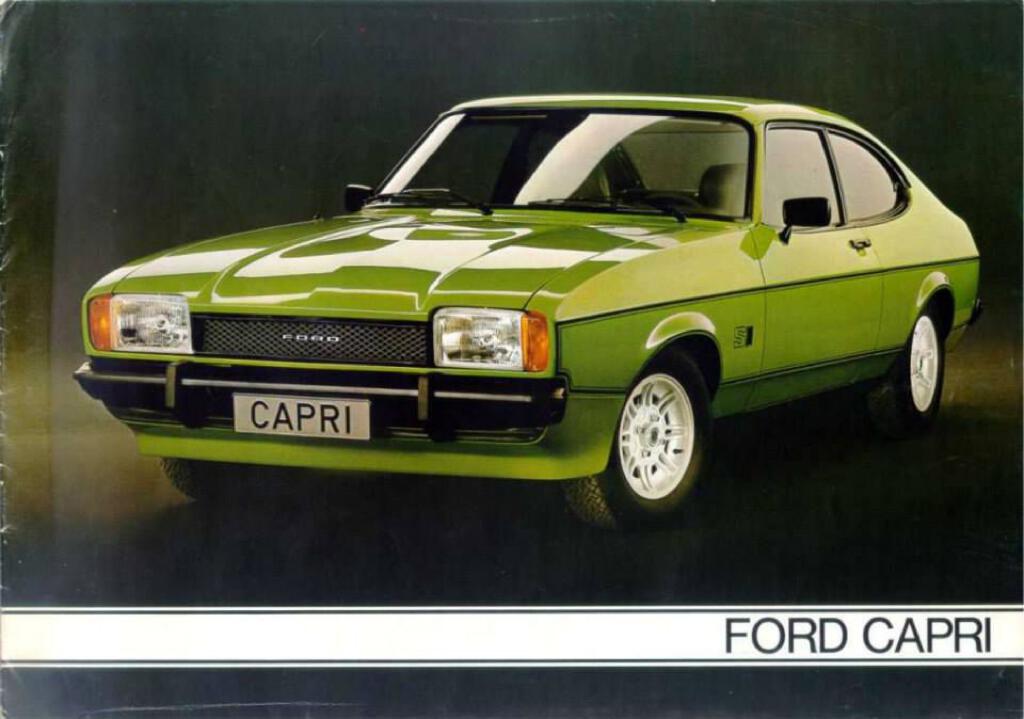
The Ford Capri is a coupé car made by Ford of Europe from 1968 to 1986.

The Ford Capri is a convertible sports car made by Ford of Australia from 1989 to 1994.

The Ford Capri is the possible name of an upcoming sports utility vehicle from Ford of Europe, continuing the replacement of their original car range that included the Focus and the Fiesta [which I talked about here] with a more radical range of electric vans and trucks that includes another new SUV, the Ford Explorer.

However, this will not be the same Ford Explorer as sold in the United States. Ford didn’t really sell Jeep-like cars in the UK until 1993 with the Maverick, but that isn’t the same Maverick as the compact car sold in the US during the 1970s, which was replaced by the Ford Granada... which was supposed to be the same Ford Granada that popped up in Europe at the same time, but too many changes needed to be made to fit American standards and tastes. Lower-specification Granadas were sold in the UK as the Consul, reusing the name of the car it was meant to replace, as Ford was being sued over their use of the name by the TV company and motorway service station group also named Granada, an action which ultimately proved unsuccessful – Granada’s TV channel would later show Granadas being driven recklessly on “The Sweeney” and “The Professionals”. Traditionally the largest car in Ford’s range, the Consul had a coupé variant from 1961 to 1964, known as the Consul Capri...

Just as there initially was animosity over the radically different Ford Sierra replacing the popular Ford Cortina [link], there has been a ground swell in the UK media over the return of the name “Capri” – the Cortina-based European coupé was both an aspiration and rite of passage for British drivers of a certain age, especially those who pretended their entry-level 1.3 litre car was just like the top-line 2.8 or 3 litre V6 model. Since 1986, the Capri niche has been filled by Ford with the Probe, Cougar and Puma, the latter also a small coupé reinvented as a SUV, before being finally plugged by simply selling the Mustang in Europe, having been the Capri’s original inspiration. Nearly four thousand Capris remain on British roads, according to howmanyleft.co.uk – I would say that everyone that wanted a Capri like that has one, while others bought the Audis, BMWs and “hot hatches” that took the Capri’s place in the car market.

Ford can name any car it wants “Capri” – it first used the name on a series of Lincoln cars in the 1950s, and the Australian Capri was sold as the Mercury Capri in the US, just as the European Capri had been in the 1970s. Holding the rights to use names matters in the car industry – Ford of Europe wanted to call their Mustang emulator the “Colt”, but were stopped by Mitsubishi, hence using a name they already owned.

15 October 2022

AROUND THE WORLD, AROUND THE WORLD [365]


The Ford Escort was the biggest-selling car of the 1980s, a statement that applies both the United Kingdom and the United States.


Whether that statement applies to one car is another question. Created as a “world car” between Ford’s American and European divisions, ostensibly to share both expertise and production costs, the Escort on sale in North American showrooms from 1980 shared little more than its engine with its European counterpart, and its design is different enough to call the effort of sharing its development into question.


I had not heard of there being a separate Ford Escort until a couple of weeks ago, but looking at pictures of it brings a sort of an “Uncanny Valley” effect – the European version was so prevalent on British roads, seeing something that purports to be the same thing, while looking almost like it, but not quite, produces an unwarranted feeling of unease.


Reading the 1982 brochure for the North American Escort reveals the difference in approach with Ford of Europe: placing emphasis on its “world car” status, and on having outsold every imported car in the US in 1981, Ford introduced the Escort to replace both the Pinto, a “subcompact” coupé-looking car with a poor safety record, and the Fiesta, Ford’s first attempt at a “world car” that was too small for the United States (and which I have talked about here: link). Both the targets and the stakes were set high, but this situation was only found in North America, and its half of the plan must have inevitably diverged to meet them.


The European Version

Meanwhile, the focus of the European Escort was squarely on aerodynamics, fuel economy and simplicity of design, having launched in the UK with the slogan “Simple is Efficient”. Unlike Ford of America, which attached a globe logo to every Escort sold there in its first year, Ford of Europe make no mention of having developed the car with anyone else. The European Escort’s straight line design was by Uwe Bahlsen and Patrick Le Quément, following it with the futuristic, for the time, Ford Sierra (also discussed previously: link).


The North American Escort could serve to indicate the main differences between American and European cars in general. It has the same wheelbase as the European model, but is nine inches longer, two inches wider, and one inch shorter in height, with a more sloped nose, and chrome trimmings on even the base L model. Only a 1.6 litre engine was offered initially in America, the largest of the engines offered in Europe, and the interior was entirely redesigned, with black, fawn and blue colour combinations joined by an all-interior blood-like colour known as “Medium Red”. The “Squire Option” of faux wood panelling was available on the estate car.


Contributing to the design changes to the North American Escort may have been differing safety standards. Many European manufacturers in the 1970s seen their sleek designs essentially ruined through the process of “federalisation” to meet US safety regulations, often through the addition of thick black shock-absorbing bumpers to protect the headlights and engine in a 5 mph collission – Ford would do this with the Capri coupé when it was sold as the Mercury Capri in the US. This led British Leyland to redesign the MGB and MG Midget to suit, but because the US was their main market, it had to be done.


The Escort would become more of a “world car” through the 1980s, adding production at Brazil, Argentina and Venezuela to the factories in the UK, West Germany, Spain and the United States. However, the Escort produced in South America was the European version – the North American version was only sold in North America, and was only made there too. When Ford of America updated their Escort in 1990, it opted to rebrand the Ford Laser, a car sold mostly in Asia and Australasia, and based on the Mazda 323. Meanwhile, successive updates of the European Escort continued until the Focus began replacing it 1998, the Escort name disappearing in 2002... until it reappeared in 2015, on a redesigned Focus saloon car sold in China and the Middle East. Perhaps the name travels further than the car.


"Medium Red"