Showing posts with label Teletext. Show all posts

03 July 2020

THE IDEAS IN HIS HEAD WERE FOREVER FERMENTING [249]

Calculator, Industry, Work [copyright Paul Rose]

“How Not to Be Seen: A Fucking Didactic Educational .MOV File” is the brilliant title for a 2013 film by the German video artist Hito Steyerl, and can be viewed here: [link]. Using computerised imagery and voiceover mixed with location shooting and The Three Degrees’ “When Will I See You Again,” this satire of instructional films is also about a serious subject: resolution targets, used by the American military in the times of pre-digital aerial photography for calibration purposes, but now left cracked and obsolete – to truly become invisible, you must enter those cracks, be smaller than a pixel, become a picture, or be a female over fifty years old.

Now try this: Petrochemexxx Solutions Corporation presents “Party Phantoms,” simulated guests ready to fill the spaces at your party or other miscellaneous celebration. They can dance, but you must not dance with them; they can hold conversations, but their opinions might be toxic. Apart from the voiceover, and perhaps the music, the video is constructed from stock footage and photographs, especially of frightening medical dummies. The colour and grain of the picture is of a 16mm film where the yellow layer faded away, captured on video tape too late, dating this film to the early 1970s at most, supported by the fonts used on screen, and the spaced-out synthesised sound effects. It appears to have been archived in a forgotten shed. You then remember this film has only just been made.

Seeing Steyerl’s video at Tate Modern, I realised I want to make videos like this. “How Not to be Seen” is presented as an art installation, but it is entertaining, funny, informative, and not far from your more ambitious YouTube video. However, watching the YouTube channel Digitiser [link] has made me think I could achieve this.

Party Phantoms [copyright Paul Rose]

“Party Phantoms” opens “Mr Biffo’s Lost Footage: Eggs,” posted in April 2020, continuing a series of “found footage” videos begun in 2016. “Mr Biffo” is the trickster god persona of Paul Rose, a creator of children’s TV comedy-dramas like “Dani’s House,” “4 O’Clock Club” and “Almost Never,” screenwriter for the 2014’s “Pudsey The Dog: The Movie,” and the writer of “Wrongs of Praise,” the episode of the sitcom “My Parents are Aliens” that crushed a model of a satellite with a bible, and had said parents, through self-idolatry and obsession with celebrity, raising the stakes by getting ready to burn their family on one as blasphemers – I liked that episode a lot. The “Mr Biffo” name comes from the 1993-2003 Teletext video game magazine that began Rose's writing career - “Digitiser” is remembered for the subversive humour and characters that infiltrated the reviews, the anarchic spirit continuing in the YouTube series that has often threatened to injure both Rose and co-host Paul Gannon (also of the CheapShow podcast, as discussed here: link).

In other words, the Digitiser channel is created, like most YouTube channels, in someone’s spare time, but the imagination and ambition of the videos created in that time eliminates that as a limitation. In a Q&A video also posted in April 2020, Rose stated that, apart from scripting voiceovers or pieces that actors will read to camera, and working with the musician Christopher Jerden-Cooke, entire sketches or passages are conceived in the edit, having gathered the necessary stock footage. The 2017 series “Mr Biffo’s Found Footage” has more original filmed sequences, but are treated in the same way. While these videos may not be, as Rose stated, his life's work, they are his favourite hobby.

Digitiser: "Indoor Fireworks" [copyright Paul Rose]

In comparison, two earlier videos by Steyerl, “Strike” (2010) and “Probability” (2012) – the first portraying the breaking of a TV screen, and the second demonstrating a zero-probability event - may have been filmed at home, as so many YouTube videos are, but like Rose’s videos, Steyerl’s confidence and precision in the imagery created, from framing to lighting to sound, is the cut above that turns “just a video” into cinema. It is possible to create cinema in your spare time.

So far, the videos on my YouTube channel [link] are mostly written articles spoken out loud, with pictures. I always thought that, to achieve television or film standard, I needed to devote more time than my regular job would allow me to give. Having discovered this is not true, it is now up to me to make different choices. For all the film theory and rules that have built up since the Lumière brothers filmed their employees leaving their factory in 1895, all they had to do was work out where to place the camera.

Pie Vendors in the Night [copyright Paul Rose]

The final episode of “Mr Biffo’s Lost Footage” appeared on 21st June 2020, titled “The End,” this time presenting a through line of life from birth to death, via your first day of school, birds, pie vendors in the night, parental training tapes, calculators, memories of TV, and a slow, beautiful passage of reaching the end, when there is nothing more, piecing together archive voiceover, prog rock music, and the Apollo moon landings – and then you let go. Watching this on a televisio
n, I did not see “#Funny” written under the picture, and I laughed a lot before then, while making notes on how different layers of photography moved in the “Pie Vendors in the Night” section, but I was not expecting to be emotionally moved myself, by a video on YouTube.

When you remember that “cinema” describes the space as well as the art form, does an art work create the space, or do you just hope it does by putting it there? Maybe some videos just need to be seen on as big a screen as possible.

Because Paul Rose does it, and because Hito Steyerl has done it, I hope I can create cinema in my spare time.

Beanus Likes Beans:
Digitiser co-host Paul Gannon with spirit animal
[copyright Paul Rose]

15 October 2018

AND PLAIN TO SEE THE FACTS ARE CHANGING [131]


Memories are short. Instant access to information via the World Wide Web has only been available to the general public since August 1991, with mobile and broadband internet only becoming commonplace in the last fifteen years. However, if you had the right television, instant recall of news, sport and financial updates, TV and radio listings and even recipes, was possible as early as 1974, before the first home computers appeared. Look down at your remote control, and the remnants of Teletext will stare back, marking where the information superhighway begins.
The world’s first teletext service was the BBC’s CEEFAX (“See Facts”), launched in 1974, following two years of testing technology developed by Philips, which had already launched the first consumer video recorders by then, and were readying what would become the LaserDisc and Compact Disc. The BBC had already been experimenting with “BEEBFAX” in the late 1960s, using TV transmitters to broadcast a page of information overnight, not unlike a newspaper page, to be printed on a fax machine-like printer at home. This project was shelved because the printer was too noisy, but with Philips proposing to use the screen, work started again.

The way teletext worked is down to how old televisions worked, in ways that are still well known to many. Put extremely simply, the reason not all 625 lines are broadcast to make up a TV picture is because the top and bottom of each field of lines is left blank to denote where the picture starts and ends, literally creating the “vertical blanking interval,” also known as the black bar that rolled down the screen on analogue TVs when the channel was not properly tuned in – horizontal blanking intervals also take up some of the width, and digital television makes sure you see none of this at all.

Teletext used the spare lines from the vertical blanking interval to broadcast a cycle of digital code that creates each frame of text. When you enter a three-digit code for the page you want, like 430 for travel news, you would then see the number scroll through the cycle as it is broadcast, until it reaches your page – popular pages were broadcast more than once. Each “magazine” of pages was broadcast on its own line, usually grouped by subject, to a maximum of eight lines. When subtitles for TV programmes were added from 1981, the page for this was usually placed at the end: it was originally 170, and eventually ended up at 888. Each page also had a number of frames, for longer news items and other stories, for which you may need the “hold” button on your remote control.

Later, hyperlinks to other sections of teletext were possible by red, green, yellow and blue “FastText” buttons. A “Reveal” button was also available for parts of pages, like revealing a punchline for a joke. Blocky pictures were also possible using the palette of eight colours, which included the black background, and breaking news could be left to scroll along the bottom of your screen while you continued to watch TV.

Ceefax would grow slowly at the BBC in the 1970s. Initially a staff of nine would write the original thirty-page magazine, broadcast on a single line, which were punched onto paper computer tape, and sent to a different floor of BBC Television Centre to broadcast them – updates only happened on weekdays, as everyone went home for the weekend. From 1981, the BBC Micro computer was used to create pages, and could be received at home with an adaptor – basic computer programs were also broadcast using teletext. Viewers in the UK will also be used to “Pages from Ceefax” filling in gaps on BBC television during the day when there were no TV programmes to show.

Of course, this is all gone now – digital teletext was introduced in 1999, using information from Ceefax, but by the time the end of analogue TV killed off Ceefax in 2012, it was using text from the BBC’s website, and some of the sections could only be found online, because it was just easier. A similar text service that used your phone line, Prestel, allowing you to buy items and view your bank account at home from 1976, had already ended by 1992, mainly because it was cheaper to make a regular phone call for what you needed. 

Even looking at the “BBC Red Button” service today through my TV, it is cut down even from when it began, almost to the point where there is no longer a need for it. However, teletext was built because a need for it was found, a need that continued to find ways to fulfil itself.


07 October 2018

EVERY DAY I WRITE THE BOOK [130]

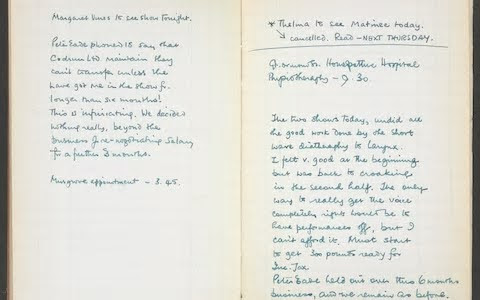
Two pages from the diary of Kenneth Williams

Monday


Is there any point to keeping a diary? You know what you did, and how you feel – is it for reference, or to confront yourself, or as a writing exercise? The last of these was my reason for having first begun a diary fifteen years ago, but also why it has petered out – I have other outlets for that sort of thing, outlets more than one person can see. I could do with a way to collate all those disparate thoughts you have during the week, those ideas that felt like a good idea at the timer, but they let you go before you remember to write them down.

Tuesday

So how did Ceefax work anyway? And why did my mind make me think of this? And why am I now entertaining this as a subject for a future article, instead of looking it up? Teletext is still a recent history for most – oh yeah, that’s why it’s a good idea.

Wednesday

Of course, today is when you actually started writing your diary, in the hope that, when you read through it as preparation for the inevitable autobiography, you will have forgotten what kind of procrastinating person you once were, only to have that thought hit you once again.

Thursday

Of course, your energies were concentrating on work during the week, and there are times where you have nothing to write down, but the idea of skipping an entire day seems about as perverse as making a note that, by the way, nothing else happened – it may be easier to make a note of that having been the case, and move on.

Friday

A manager at work said I had a good speaking voice, but I then decided to say it sounded like it was full of disdain – it was rather a pointless call. I am not exactly sure why I said that, but it does sound like I was being too honest while making a joke. I don’t like taking phone calls. I’ve had the latest iPhone for two weeks, and made one call on it so far.

Saturday

Napping in the afternoon, I dreamt I was walking, then my right foot slipped, I fell forward – and I woke up. This joins other weird dreams of this week, which included retrieving papers, from a red post box in a high street, that I needed for when I was starring in a TV detective drama – a type of show I never, ever watch – and the dream where I found forty-five pence on the floor. I should have gone for a walk, but it was raining – that is, in real life.

Sunday

Wrote an article about “Friday the 13th: A New Beginning” for His & Hers Movie Reviews – it is their Halloween Horror month, and I rarely watch horror films, but I may write a horror film one day, or some sort of horror story. If science fiction portrays our anxieties about the future, then horror does the same for the present.