Showing posts with label Spider-Man. Show all posts

02 August 2026

WHEREVER THERE'S A HANG UP [548]

Art by Steve Ditko from "The Amazing Spider-Man" #5 (1963)

I will freely admit ignorance to anything that isn’t important so, to that end, I didn’t know what “Spidey Sense” was, despite having been a reader of comic books for over twenty years.

This apparent revelation came about due to the release of the new film “Spider-Man: Brand New Day”, the fourth film in the franchise with Tom Holland in the title role, the ninth made by Sony under Columbia Pictures and officially the thirty-eighth film in the Marvel Cinematic Universe. 

I have read the Spider-Man stories I want to read, and the same would go for Marvel Comics as a whole. I am more a fan of DC Comics, but I haven’t really watched their films either for the same reason. Comics are already their own form of visual storytelling, and don’t have to become storyboards for another medium, even if you are trying to increase exposure to the characters and their stories.

Despite all this, it appears I hadn’t been reading the Spider-Man stories closely enough. I have mostly read the 1960s and 70s run of “The Amazing Spider-Man”, mostly written or co-plotted by Stan Lee, Roy Thomas, and Marv Wolfman among others, plus some of the 2000s run from J Michael Straczynski. However, they are Marvel comics, led by action, and Spider-Man is a character that demands to be drawn dynamically, as demonstrated by co-creator Steve Ditko to John Romita, both senior and junior, to Ross Andru and Sal Buscema’s run on the companion book “The Spectacular Spider-Man” in the 1980s. All the posing, the composition of frames, the economy of the storytelling as average page counts for the main story declined across the industry during the 1970s, but I should have been paying more attention to some wavy lines.

The story apparently goes that, when reviewing the pencilled artwork for the first issue of “The Amazing Spider-Man” Stan Lee, in his other capacity as editor, had asked Steve Ditko how Spider-Man knew the story’s villain, the Chameleon, was in the same room as them. Ditko drew lines around the hero’s head, explaining that Spider-Man had “spider senses”, much like a bat can use echolocation. Similar lines were drawn around the character, both as Spider-Man and as Peter Parker, in earlier scenes to add credence to the device.

Now, what I had apparently done was think of these lines as acting like a visual approximation of being startled, like you had just been woken up to the presence of something. You don’t see speed lines or the energy of a “Kirby Krackle” in real life either, so I thought this was just the way the story depicted being startled. Upon realising my omission, the next thing is whether “Spidey Sense” – I am too self-effacing to call Spider-Man “Spidey” – is a “sixth sense” or some sort of precognition, and depending on its use in a particular story, the answer is yes, it is.

If it hadn’t been for two other people being in the same room as me when I said I didn’t know what “Spidey Sense” really was, I would have been given no more reason to think about it. Yes, superheroes lead our current folk tales, or at least those from the United States, but no, not everyone knows these characters inside out. I am still more of a reader of Daredevil, the only Marvel Comics character whose book I pick up each month, and to be honest, his powers are easier to remember: the toxic incident this time around made him blind, but heightened his other senses, so anything about strength is down to training. As far as I know, that’s it.
27 May 2023

ALL THE STRANGERS CAME TODAY [398]


Watching television coverage of the RHS Chelsea Flower Show, I thought to myself, “is crypto like tulips?” The 1634-37 speculator bubble surrounding tulip bulbs is considered the first recorded example of the value of one type of product far outstripping its usual price, relative to similar types – I don’t think sunflowers have experienced a similar boom. Likewise, as the innovation and novelty of NFTs caused their explosion in value from 2021 [link], this has largely reversed for reasons including their loss of that novelty value.

I then remembered I previously benefitted from the bust that had followed the end of a speculative boom, one that happened over a decade earlier. 

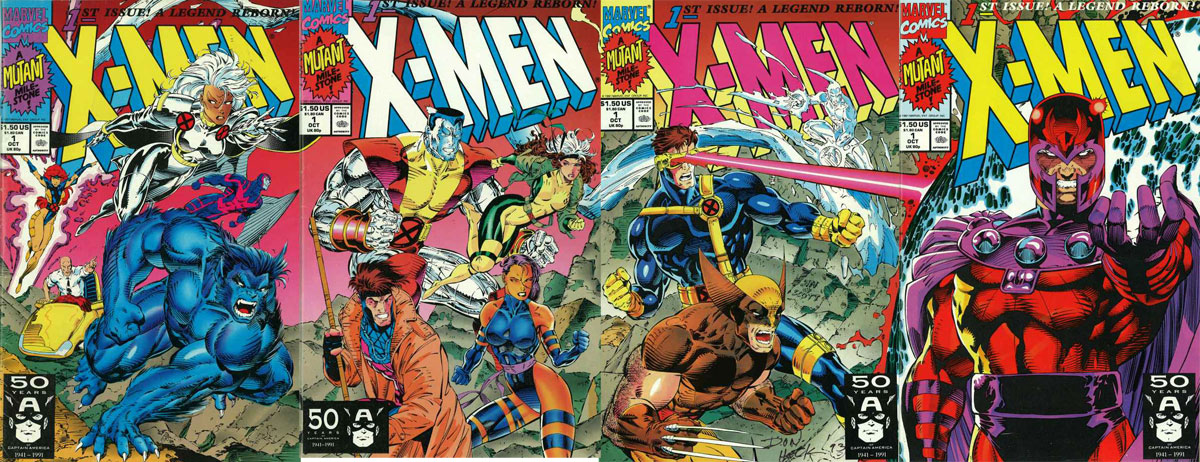
I think it was in the late 2000s, surely before 2010, that I saw piles of American comic books appearing in branches of the discount bookstore The Works. I had only been reading American comic books for a few years, but I already knew enough to know what I was looking at: the first issue of the “X-Men” (volume 2) from 1991, written by Chris Claremont, and illustrated by Jim Lee and Scott Williams. The pile contained the four different covers that made this first issue into a collector’s item at the time, and the fifth that turned them into a gatefold tetraptych. This last version sold for £2.50 in 1991, but here it was three or four copies for £1 – I got the gatefold issue and one of the others, for the story told inside was the same.

Like the value of first edition novels, the values of particular comic books had boomed by 1991, most notably the first appearances of Superman, Batman, Spider-Man and the Incredible Hulk. This was translated special “collectors’ edition” first issues of further new series, featuring higher-quality paper stock, card covers, foil covers, glow-in-the-dark covers, die-cut covers, and so on, all at a premium price compared with a standard book, and seen as an investment by those not necessarily there to read the story inside.

“X-Men” #1 is recognised as the biggest-selling comic of all time, but the 8.1 million copies sold were pre-orders made by comic book stores and newsagents – only half of these were actually sold to customers in 1991, and what I saw must have been the remaining stock being emptied from a warehouse. This continued for some time: I bought two copies of “Superman” #75 from 1992, “The Death of Superman”, one where I opened the black and red bag containing the black armband, trading card and stickers, leaving the other unopened; many issues from the beginning of Image Comics, like “Youngblood”, “Chapel” and “Shadowhawk”, with lots of cross-hatched art and gaudy colours; and various issues of “Spider-Man 2099”, “Punisher 2099”, “Ravage 2099” and so on, more new series and more ways to grab your attention. 

The comics speculator bubble had largely burst by the mid-1990s, leaving readers to carry on as before. Even though Marvel Comics came out of this period worst, having entered Chapter 11 bankruptcy protection in 1996, this also came after a stock market flotation and buying a distributor, but the bubble affected the whole industry. Of course, this was all before the true value was found, by Hollywood, in comic book characters and their stories, over the paper they were printed on.

10 May 2020

WHERE ARE YOU COMING FROM [236]


Finding out the band you have become a fan of does not exist is both frustrating and rare. Two music videos and one album exist, but no singles were released, few articles were written about them, apparently no interviews were taken, and no Wikipedia page has been made. And yet, “Dog Police,” by Dog Police, has become a cult classic album, rereleased twice in the last ten years, and the title track’s video is known widely, nearly spawning a TV show.

But there is no Dog Police, not at first. Understanding what it was, and how it came to be, involved joining many dots, but it made my new-found love of their songs even greater.

Starting with “Dog Police,” the video from the song, album and band of the same, we have a novelty song about someone’s girlfriend being wanted by the Dog Police, using a New Wave sound and temperament similar to Devo and The B52s. Taking place in a club, it features the band both as themselves on stage, and as the Dog Police, with trenchcoats, fedoras and prosthetic dog faces. 


Perhaps the lyrics are not meant to make much sense, but the bass and synthesisers hook you along towards the explosive sound of the chorus, punctuated by barking in time: “Dog Police, where are you coming from / Dog Police, nobody knows who you are!” These lines are adapted from the “Spider-Man” segments from the children’s TV show “The Electric Company,” but are performed like a bombastic, sped-up version of the “Dragnet” theme. It is infectious, strange, unforgettable, and nightmare fuel to the wrong people. This video would be later optioned by NBC for a possible TV series, with one pilot film, again featuring people in dressed as dogs, notoriously featuring actors Adam Sandler and Jeremy Piven before anyone knew who they were.

Underneath this video on YouTube was another Dog Police video, “1-800,” satirising mail order ads and the products they sell, using a phone as an instrument through playing the DMTF dialling tones. While not parodying a song, both the video and song play more like a Weird Al Yankovic piece. Both “1-800” and “Dog Police” feel like they come from an alternate universe where satirical songs became the norm, like John Lennon imagined when writing “Taxman” and “Paperback Writer.” 

Then there is the “Dog Police” album. Alongside the title track and “1-800,” there is a heavy, pessimistic dirge titled “Positive Reinforcement,” while a vocoded robot sings “Happy,” and a woman fronts “I’m Butch.” The band plays with their surroundings and expectations in both “Music and “In The Studio,” while they attempt to become Manhattan Transfer with “Are You Middle Class Enough?” The last track is a frantic, bouncy anthem named “Reproduce,” with lines that cut to the chase extremely fast, becoming my favourite song of the lot: 

“Don’t be despaired / There isn’t time enough / Why we are here / Is very simple stuff / Why are we doing / What we are doing? / Are we wooing / Only for screwing? / We’re only here to reproduce! / That seems to be our only use.”


What I get from the “Dog Police” album is how the band is very forceful and fast, having mastered their instruments: there are intricate bass and piano lines, with not a single note out of place. They will sound the same if they played live. The lyrics are very cynical and sarcastic, flippant to the point of providing accidental insight: a refrain to “Music” is “stick it in your ear,” reducing all music to product to be consumed, but also becoming a rallying call to do just that.

There is an infectious energy to Dog Police that attracted me immediately – it reminds me of Paul D. Millar, a Texas-based artist who records as Slugbug, similarly providing satirical songs in a New Wave mould through albums like “Truck Month” and “Pointless Journey,” which are available on the music streaming site Bandcamp [link]. 

However, like vaporwave, another genre found in abundance on Bandcamp, Dog Police almost comes across as a found object with no clear origin. With no easily obtainable evidence about its source, or about what happened after it was made, it appears to have just, well, appeared.

According to the database site discogs.com, the “Dog Police” album was released in 1982 on the Music Masters Ltd label, but I have also heard it was produced and distributed privately in 1985. The songs are written by Tony Thomas, Tom Lonardo and Sam Shoup, who also produced the album with engineer Andy Black, but the band used pseudonyms – “Clark Radio” on keyboards, “Random Ax” playing guitar, bass and trumpet, and “Squeek Owens” on drums. “Butchie Cox” and “The Rocks” also help with vocals. However, we know that Thomas, Leonardo and Shoup are “Clark,” “Squeek” and “Random,” because they appear in the videos. All three are classically-trained musicians, have worked both in commercial music and arrangers and session musicians for other artists. They have been part of the jazz music scene in Memphis, Tennessee for over forty years as The Tony Thomas Trio, releasing the albums “LST,” “Progreso” and “Melodious Funk”. Were they trying a new direction?

Original album cover

You then have the videos: “Dog Police” was played on MTV, but not as part of a playlist, instead submitted in 1984 to a competition run by “The Basement Tapes,” a monthly half-hour showcase for unsigned acts, and it later played on the variety magazine show “Night Flight” on the USA Network. The video for “1-800” may have also featured on “The Basement Tapes,” but did appear in 1984 on Weird Al Yankovic’s MTV show “Al TV,” blending with the parodies played around it. 

One reason the video for “Dog Police” is remarkable is its quality. While the low-grade video and computer special effects in “1-800” is more typical for “The Basement Tapes,” “Dog Police” is shot on 16mm film by director Joe Mulherin and cinematographer Larry McConkey, later to become an accomplished Steadicam operator on major films like “Goodfellas,” “The Silence of the Lambs,” “World War Z” and “12 Years a Slave.” If so much effort was spent entering a competition, you start believing this cynical band were actually aiming for the big time.

Did Dog Police just go back to being The Tony Thomas Trio when their New Wave direction didn’t work out? Was it an elaborate joke by musicians more accomplished than was demanded of them? Was it the remains of something else that never appeared? Was it another person’s idea, or even a dare? The “Dog Police” album has been released on vinyl in 2009 and 2019, and are available on iTunes and Amazon, so someone must be collecting royalties from the intrigue generated by the videos, while being wary of saying anything that might ruin the fun.

Fortunately, after days of looking for evidence, I came across episode 18 of “Contraption: The Drummers’ Podcast” [link], released in February 2020, which interviewed Tom Leonardo. Thirty-eight minutes into the detailed discussion of Leonardo’s career and influences, Dog Police is discussed: “some things never go away,” he says. The Tony Thomas Trio were attempting to record an album, being charged for studio time by engineers that were not really paying attention. In a spare moment, they were riffing an improvised chorus for what became “Dog Police,” using the “Spider-Man” lyrics. The engineer asked what they were playing, and the band said it was a little thing they were working on. The engineer asked if they could record it, right there and then. After taking ninety minutes to write more throwaway lyrics, they recorded the song. The next day, their producer asked the band if they had any more songs like “Dog Police” to record – the studio costs would be paid for them. The further songs dashed off by the band were based on observations they had at the time about themselves and the world around them, but they were of their time, particularly in terms of the music – Stewart Copeland, drummer for The Police, was noted as a comparison, along with local Memphis punk bands with frantic drummers.

In the end, Dog Police was not a means to forge a career, but was a one-time opportunity, meant to last as long as the songs took to write and record, and no longer. Perhaps the videos were as well, but the time and effort spent on them makes you feel this was a more serious endeavour than it really was, no matter what anyone says. Few moments in time last this long.

2009 reissue album cover