Showing posts with label needletime. Show all posts

15 September 2024

DID I TELL YOU EVERYTHING IS FINE [466]


I came very late to Al Jarreau’s song “Mornin’”, a quite irrepressibly positive piece of smooth jazz with electric piano and strings, and a hybrid animated and live action video to match. It is very easy on the ear.

On my first listen, my first thought was, “this is a bit Pages from Ceefax, isn’t it?”, which is not as obscure a thought as it sounds. Certainly, David Foster’s original instrumental version of “Mornin’” fits that description completely.

Ceefax, the BBC’s teletext service that began in 1974, was initially only seen by owners of sets capable of decoding that part of the TV signal. Meanwhile, with BBC One and Two only broadcasting a few daytime shows outside of the Open University, schools programmes and live events, a test card and music was played to fill the gaps. From 1980, a rotating series of news, weather and information named “Ceefax in Vision”, later “Pages from Ceefax”, began replacing the test card, while continuing to play music. This arrangement was still seen during the day on BBC television as late as 1990, later relegated to early morning and at the end of the day until the end of analogue TV transmissions closed Ceefax in 2012. 

Being of an age where I would have seen “Pages from Ceefax” during the day, I recognised that the music being played was not often heard elsewhere. Without exception, instrumental tracks were played, i.e. no singing, and they were often light or easy listening in nature, or bland an inoffensive at worst. Until 1988, there were still restrictions on the amount of recorded music being broadcasted in the UK, known as “needletime”, so this music would come from sources either exempt from these rules, like foreign recordings, or by licensing cheaper library and production music.
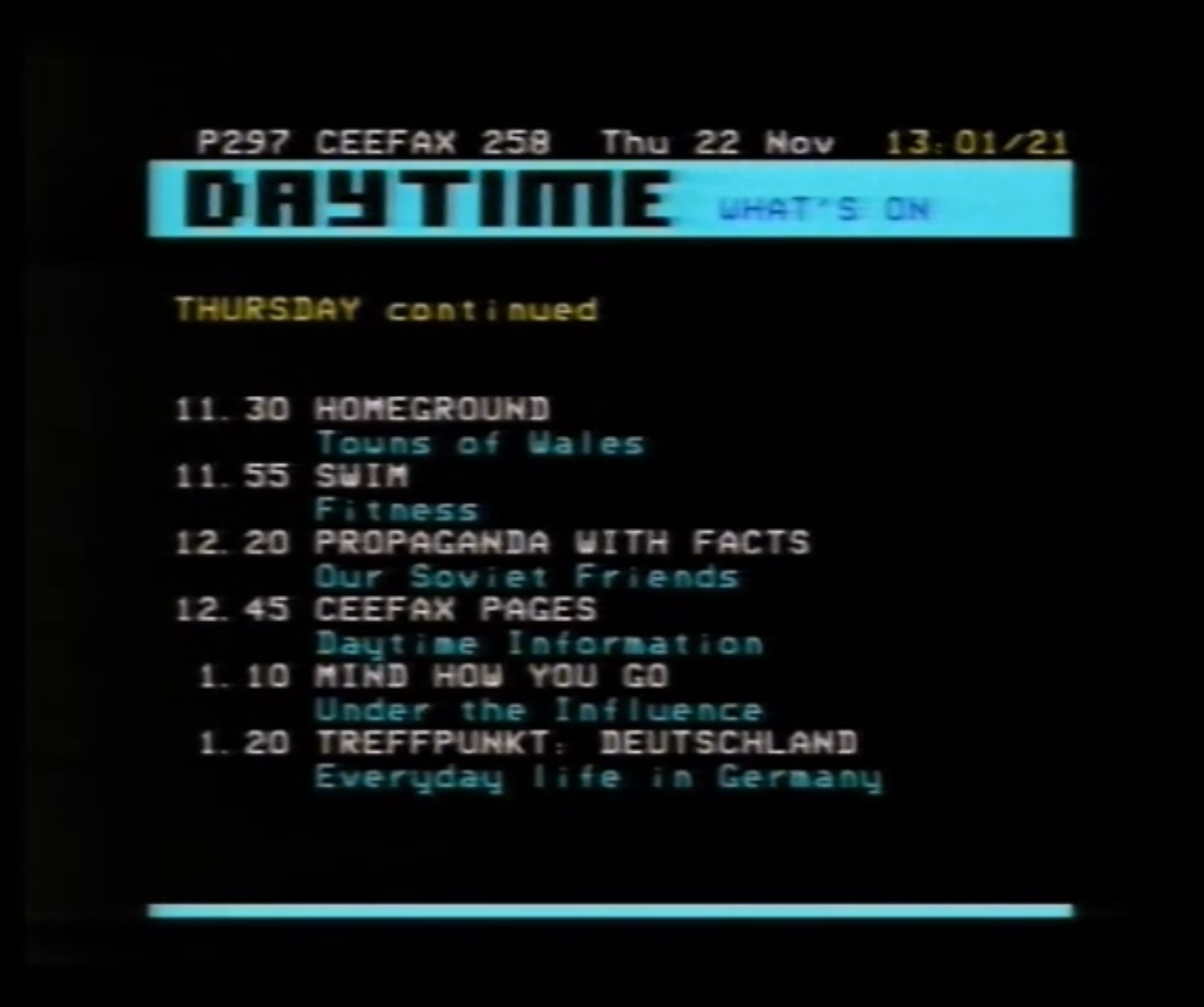


The “foreign recordings” element was often literal: VHS recordings of “Pages from Ceefax” posted to YouTube don’t often have the music picked up by their content ID system, although I found one 1995 example that used the 1981 album “Flashing” by the Japanese jazz pianist Himiko Kikuchi, or another from 1983 using the 1971 album “Sentimentálna trúbka” by the Slovak American trumpeter Laco Déczi.  However, British musicians and composers would also travel to Germany to record, with renowned library music names like Neil Richardson, Alan Moorhouse, Johnny Pearson and Keith Mansfield appearing under pseudonyms like “The Oscar Brandenburg Orchestra”.


Even at the end of Ceefax in 2012, the BBC were still using library music, this time more recent recordings licensed from Funtastik Music, which to me sounded more stereotypically like the “elevator music” under which the earlier tracks could be classified. Notably, the final song played was “B.A.R.T.”  a commercially-released song by Ruby, a rock band that featured Tom Fogerty of Creedence Clearwater Revival, and better known from being played between gaps in BBC schools programmes. This was more a nod to the end of laid-back presentation that could no longer take place in a time when TV channels need to continuously hold the viewer’s attention – no longer can BBC Two casually open up at 9.30am, warn viewers that coverage of the TUC Conference begins in two minutes, then play “Nifty Digits” by Richard Harvey, as they did on 9th September 1982, according to the YouTube channel that put up the recording.


But the earlier popularity of light music under big bands and jazz performers like Bert Kempfaert and Oscar Peterson, and the later existence of groups like The Test Card Circle point to the continued popularity of music of this type on its own terms, even down to CD reissues of production music albums made by labels like Bruton Music and KPM originally not meant for general sale. In this case, my brain has labelled it by where I heard that kind of music most, therefore as “Pages from Ceefax”.


21 April 2017

HEY MR D.J., PUT A RECORD ON [51]


Was there ever a time when hearing music on the radio was considered rare? Whole services are built around non-stop music these days, but there was a time when playing out a recording of a song, the same sort you would buy to listen in your own time, was restricted. This wasn’t considered a bad thing at the time, until people’s tastes changed.
Put simply, there used to be a system in place named “needletime,” literally how long records could be played on the radio. This was a protective measure, as the two groups in charge of it were the Musicians’ Union, who wanted to preserve opportunities for their members to play live, and Phonographic Performance Ltd (PPL), which represented record companies and music licensees.  PPL had been formed after a 1934 court case, when a coffee shop in Bristol was successfully sued for playing records for its customers, creating the notion recordings cannot be played in public without receiving the permission of the copyright holders.
In 1935, the BBC signed its first contract with the Musicians’ Union and PPL, giving them all of twenty hours per week of needletime to play with. This didn’t matter much, as the BBC were engaging bands to record sessions for them, and would start forming their own, with names like the BBC Concert Orchestra, the BBC Northern Dance Orchestra, and the BBC Midland Light Orchestra.

[The BBC Midland Light Orchestra]

However, by the 1960s, radio had been relegated to background listening by the advent of television, and younger audiences were listening to the pirate radio stations moored in the waters around the UK, and to Radio Luxembourg in the evening. These stations were outside any agreements that could be made, and could play as much music as they could get away with. 
Once the pirates were made illegal in 1967, the BBC was obliged to fill the gap with a legal version that used some of the DJs – Radio 1 – and needed the ability to play more records. How many extra hours did they get? Two per day – on Radio 1’s launch day in 1967, only 5 hours and 35 minutes of the day was not shared with the lighter sounding Radio 2, a situation that wouldn’t be broken for the next fifteen years, with only nudges in allowances in the meantime. No wonder Kenny Everett and John Peel complained, although Peel’s famous sessions helped to bridge the gap, but when people were able to listen to their favourite artists freely before, hearing them try to sound the same live or, even worse, have a cover band do a close approximation of it, wasn’t quite going to cut it anymore.

[Kenny Everett]

However, there were ways to get around the rules, if you were prepared to make the effort. Record review programmes, or shows talking about new releases, were exempt from needletime, so long as they mentioned the catalogue number you needed to order your own copy; foreign records were exempt, so coming back from a holiday to the Netherlands with compilations of hits heard at home was very helpful; and, if you really wanted, you can license songs directly from the record company, like the BBC did with Motown and other labels, make your own records, for personal use only, and play them as much as you wanted.
In 1988, what had become a game finally ended, and radio stations now pay for music by the minute, or song, or by a percentage of their revenue. Music is too personal to put restrictions around it, and the situation now in place means that, in the absence of live music, bands will continue to get paid for their work – until MP3s and streaming started cutting that down.

[Reverse of Blondie album made and used internally by the BBC]