Showing posts with label emoji. Show all posts

10 October 2021

IT’S GOT NOTHING TO DO WITH YOU [314]

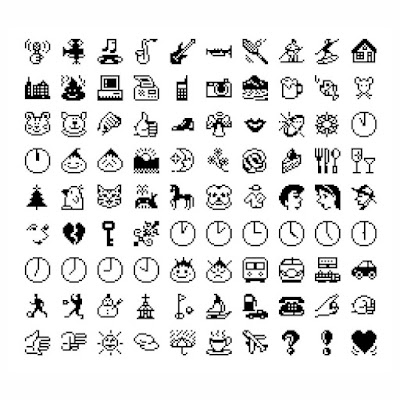
The original JPhone emoji set (1997)

As silly as it sounds, I decided I was not going to use emoji when I realised I didn’t know what any of them were supposed to mean. Their implementation as a keyboard on my phone, one that required me to select it over the regular English keyboard, made me think they act principally as pictograms, to use as word replacements – like a lexicon, but not like a rebus. Unable to find any kind of glossary, mainly because meanings applied to particular emoji are reached over time by consensus, rather than being prescribed, I decided I was better off not using anything that could cause confusion or misunderstanding – it is hard enough doing that using English words.

Mind you, I never used emoticons or Wingdings, both intended to add simple pictures to messages like adding a sticker, so I didn’t see the line that led to emoji. Wingdings was hampered by relying on both the sender and receiver having access to the same font, and emoticons were made less clear by having to be read on their side >:/ 8-> >:-( Analgoues to both systems are found in Japan, through kaomoji (“face character”, read in the same direction as text (ˊ•͈  •͈ˋ) ⸝⸝> ̫ <⸝⸝ ა), and in emoji (“picture character”, with no ties to emotion or emoticons).

With the latest Apple mobile system upgrade to iOS 15, I am now seeing emoji suggestions in their predictive text feature, and I cannot disable this feature, let alone the entire emoji keyboard. I know my mother only uses emoji other than a smiley face in text messages to me if they are suggested to her, like the fish that accompanied a mention of the McDonald’s Fillet-O-Fish. My biggest exposure to emoji has been on social media, where they are used to point, promote, and to clap between words to emphasise points being made. If I have ever used one at all, it may have been for effect, but it was too long ago for me to remember, and I can’t see any reason to start now.

Essentially, emoji began like Wingdings, as a proprietary font available only to users of a particular phone in 1997, the SkyWalker DP-211SW from JPhone, now SoftBank. A competitor, NTT DoCoMo, implemented their own emoji across their i-mode platform, beginning the mass usage that culminated in companies like Apple and Google supporting emoji in Japan first, and the need to attach emoji to Unicode, the international text standard, in order for the same images to be seen between different devices. This led to many pictures that existed in Unicode becoming emoji, including those previously added to the standard from Wingdings, Webdings and Zapf Dingbats.

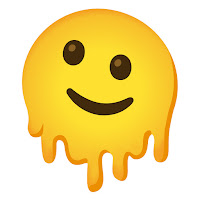
New emoji are added yearly, and Unicode’s emoji proposal guidelines [https://unicode.org/emoji/proposals.html] are specific in what must be excluded, like logos, exact images, or having meanings that are transient or very specific – openness to interpretation and usage is built into the process. Therefore, when the “Melting Face” emoji was included in Unicode 14.0 and Emoji 14.0 from September 2021, people jumped on it as a symbol for our current times, a kind of sarcasm as things fall apart. Indeed, Jennifer Daniel and Neil Cohn, who conceived it two years before, intended it as a kind of embarrassment, a Western version of when Japanese manga characters turn into paper and float away. It sums up my inability to use such an established communication system perfectly.

04 August 2019

GET INTO THE GROOVE [191]


I stand in front of a painting of two figures - one hand a hole in their torso, and is being used as a hula hoop by the other. Their outlines are painted in white acrylic, within a white outline, on red tarpaulin (not canvas – the metal eyelets have been used to fix it to the wall), and all the remaining space within the outline is filled in with short black-lines, zig-zagging and curving around each other. I look closer. It is not hard to see the artist’s brush strokes, as the lines are roughly an inch wide, but the light in the gallery shows up both the thickness of the paint, and the speed with which it was applied – the drip marks either mark moments of consideration for the artist, or the failure of the paint to keep up with them.
I first discovered the art of Keith Haring around fifteen years ago. Already used to the primary colours and thick outlines of Matt Groening’s creations like “Life in Hell,” “The Simpsons” and “Futurama,” Haring’s works appeared superficially similar and iconic, adding the same bright colours to reoccurring elements like the “Radiant Baby,” flying saucers, coyotes, televisions, computers. However, Haring fused painting with performance art – most of his work appeared outside of gallery spaces, first as graffiti, then as murals, becoming events. The scale of some Haring works, filling whole walls and sides of buildings – locations varying from a tenement in Philadelphia, to the Church of San’Antonio in Rome, and the Berlin Wall - and the sheer numbers of figures and icons compacted together, is overwhelming and bewildering. Think “The Simpsons,” then Hieronymus Bosch, followed by acid house, whose colourful aesthetic he inspired.

An exhibition of Haring’s work, titled simply “Keith Haring,” opened at Tate Liverpool in June 2019, the first UK retrospective of his work. I had to go: I have seen so many of his pictures, but only in books, or online. I could find out what size the pictures were, or the materials used, but I would have no sense of the scale, or the pace at which they were made. I already knew the vast majority of his works are labelled as “Untitled,” the work’s meaning coming only from within itself, and I knew that an art gallery was not the right context for this work – from sticking fragments of art to lampposts and door handles around New York, to sketching onto the paper used to blank expired artwork on the Subway, his artwork is best when it is active, just appearing to you, instead of being held in a vacuum. Regardless, these pictures buzz and excite.
Haring was not given enough time to produce his work – he would die of AIDS-related complications in 1990, aged only 31, and his knowledge of his condition only caused him to work faster and bigger still, while supporting gay and AIDS activist groups, posters for which appeared at the exhibition. I wish he could have lived to have seen the rise of emoji – he left the meaning of his own iconography to his audience, and I imagine he would have got a kick out of everyone now doing the same themselves.

Keith Haring wrote in 1978, the year he arrived in New York, “I am not making pictures anymore... My paintings, themselves, are not as important as the interaction between people who see them and the ideas that they take with them after they leave the presence of my painting.” Within a couple of years, he became a contemporary of Jean-Michel Basquiat and Andy Warhol, whose work first inspired Haring to become a painter. What do I do next?

* “Keith Haring” continues at Tate Liverpool until 10th November 2019, moving to the Centre for Fine Arts (BOZAR) in Brussels from 6th December to 19th April 2020, and finally, from 22nd May to 20th September 2020, the Museum Folkwang in Essen.

18 November 2018

IF YOU DON’T ANSWER, I’LL JUST RING IT OFF THE WALL [136]


There appears not to have been a time before the mobile phone or, if there was, it exists in an alternative reality, one where Biff Tannen did not turn the Hill Valley courthouse into a casino. More seriously, the mobile phone has changed how we live, changed our habits, and changed our infrastructure. Like with the World Wide Web, I will be one of the last, at age thirty-five, to remember a time without them.
I had to remind myself of how I used to keep in touch – I actually remember once having to wait until somebody finished using a payphone before I could make my own call, using my pre-paid BT Phonecard. That all changed in 2000 when, ahead of my seventeenth birthday, I bought my first mobile phone, just as they started becoming affordable to everyone. By that year, just over half of UK adults had one.
I’m not sure why I bought the phone I did, but I guess I recognised the name “Philips” more than “Nokia,” who made the phones everyone else had at the time. The Philips Savvy was introduced in 1999, and was a chunky black and blue brick of a basic phone. Its big buttons make it clear it has only one use – cameras were not commonplace on phones for another five years.
If I wasn’t using it to call or send an SMS message – the manual confirms SMS stands for “Short Message Service” - the other reason I had the Savvy in my hand was to unscrew and screw in its external aerial, as a way of keeping your hands busy. Unlike the black slate smartphones for today, if I broke the aerial, I could just buy a new one, and I could replace the battery with a new one, or one I charged earlier, or one with a bigger capacity, which needed its own bigger back cover. Standby time was measured in days, but you could only do so much with the Savvy.
With no information available on internal storage capacity, saving contacts, SMS messages and call history appears to be down to the SIM card only. Details of the last twenty calls you made, and the last ten you received, is the most you can have. No internet service is possible, but you do get a calculator and stopwatch. The LCD screen had space for two lines of text and an icon – the home screen displayed the time using a clock face. There is a primitive pre-emoji list of twenty-five characters you can send with SMS messages, but only an emoticon is sent if the recipient doesn’t have the same phone as you. Short pre-prepared SMS messages are provided, like “please call me back, or “I will be late” – the first such message had only been sent in 1992, over the Vodafone network, and people were not expected to take time writing long messages. The only other “app” was a “biorhythm calendar,” using your birthday and a given date to show your results for Chance, Love, Energy and Success. Amuse your friends, if you can.

In the year 2000 alone, payphone use declined by 12% in the UK – BT responded by increasing the minimum call charge for the first time since 1984, from 10p to 20p, and began charging for directory enquiry calls. BT Phonecards were withdrawn in 2002, except within the prison service. From the peak of 92,000 phone boxes in 1992, there are now only 40,000 on UK streets, with BT expecting to halve that total by 2022.
For all its limitations, I used my Philips Savvy for four years, longer than any other phone I had since. I finally joined the Nokia brigade in 2004 with a 3510i, an updated version of one of the first phones to have a colour screen, and 2007 established the two-year contract pattern to which practically everyone follows. Today, speaking as the owner of a phone that insists on using glass, it would be nice to use a phone I can drop, or throw, with abandon.