Showing posts with label Fritz Lang. Show all posts

30 November 2025

DON’T GO FOR SECOND BEST [520]


David Fincher’s video for Madonna’s song “Express Yourself” (1989) ends with an epigraph: “Without the Heart, there can be no understanding between the hand and the mind." Inspired by the futuristic, utopian and dystopian of imagery Fritz Lang’s science-fiction magnum opus “Metropolis” (1927) – perhaps even down to Madonna’s monocle, although Lang never wore his on a chain – a similar epigram is displayed in capitals at the beginning, middle and end of that film: “THE MEDIATOR BETWEEN THE HEAD AND THE HANDS MUST BE THE HEART!”

The plot of “Metropolis” has become secondary to the visuals, not surviving the film’s being scattered to the wind following its premiere in Berlin. Its plot, a modified retelling of the Tower of Babel story, lost sub-plots and characters when it was re-ordered for Paramount’s US release by Channing Pollock, a playwright and sometime writer of the Ziegfeld Follies. Half an hour shorter than the original 153-minute length, this wider release was also seen across Germany, cut shorter still by Nazi Party censorship in the 1930s – this 93-minute version, archived by New York’s Museum of Modern Art, was pirated for low-quality public domain releases that blew out both greyscales and actors’ faces.

But the imagery shone through. Influenced by the Manhattan skyline, Art Deco and Modernism, the city of Metropolis can be found in “Blade Runner”, “Akira”, Superman and Batman comics, and Osamu Tezuka’s manga also titled “Metropolis”, itself later a film. The “Maschinenmensch” robot, designed by Walter Schulze-Mittendorf, is deliberately more human-looking for reasons explained later, and the underground workers’ city is stark in its comparative lack of detail, simple edifices below a concrete sky, the real sky only visible through grates.

The story is simple. Joh Fredersen, architect of the city of Metropolis, installed at the top of the New Tower of Babel, sees the underground workers that toil to keep the lights on above ground as “off where they belong”. His son Freder, entranced by the appearance of Maria, who came from the depths to show the underground children their “brothers and sisters” in the restricted Eternal Gardens, descends to witness the horror of the M-Machine, the “Moloch” devouring its workers, and works to bring hope. Maria, preaching from the catacombs, retells the allegory of the Tower of Babel, altered from its use as an allegory for why different languages and cultures exist: “But the hands that built the Tower of Babel knew nothing of the dream of which the head that had conceived it had been fantasising… The hymns of praise of one man had become the curses of others… The same language was spoken, but these men did not understand one another.” Freder knows he is the mediator from the start, and will link the hands of his father with the workers’ foreman at the film’s end.

The robot is the most startling image of “Metropolis”, and its reason for looking so close to human was lost among the cuts, along with scenes of the “Thin Man” enforcer trailing Freder, and scenes of the man who swapped places with Freder being tempted to join the hedonistic nightlife he previously could only imagine. The scientist that built the robot, Rotwang, is not the archetypal wild-haired, one-handed mad scientist that James Whale’s “Frankenstein” cemented, for his work to bring the robot to life was to resurrect the memory of a lost love, named Hel, who would eventually marry Joh Fredersen, dying after giving birth to Freder. Joh’s demand to turn the robot into a clone of Maria, to sew discord among the workers, is used by Rotwang as an opportunity to avenge Hel’s death by killing Freder, and to take the real Maria as a substitute. Just as Joh told Rotwang, “Let the dead lie, Rotwang… She’s dead for you as she is for me,” Rotwang’s reply is, “For me, she isn’t dead, for me she lives! Do you think the loss of a hand is too high a price for recreating Hel?”

I have previously mentioned watching four versions of “Metropolis” over the years. One was a 139-minute version on VHS, rented from a library, that undercranked the film to the extent I had to watch it on Fast Forward – that all silent films were made at sixteen frames per second is a misnomer. Giorgio Moroder’s pop music-laden version was comparatively quick, barely over eighty minutes, achieved mostly by replacing intertitles with subtitles, but the reincorporation of Gottfried Huppertz’s original hand-written score from the premiere, the original titles from German censor cards discovered in a film archive in Sweden, and many scenes from multiple sources, most importantly the rediscovery of a near-complete copy of the film in Buenos Aires in 2008, has allowed me to watch the film as near as possible to what was originally intended at its premiere.In terms of what I think about "Metropolis", I appreciate the visuals more now the full story is back in place.

12 June 2022

THEY'RE GONNA PUT ME IN THE MOVIES [348]

Histoire d'un Crime (1901)

Should the period from early film to early cinema (1895-1927) be considered as a film language in its own right, or was it a primitive search for the narrative form we have now?

Much valuable progress in the art of film storytelling was made in the time of "silent film," from the first films of Lumière to the advent of Warner Bros' "The Jazz Singer" (US, 1927, dir. Alan Crosland). Comparing the single unmoving tableau shot of "Sortie d'Usine" ("Workers Leaving the Lumière Factory", France, 1895) with the complicated special effects, storyline and "cast of thousands" in "Metropolis" (Germany, 1925, dir. Fritz Lang) shows the quantum leap made in thirty years, now a relatively short period in the history of cinema.

However, defining the "cut-off point" in this period history at the advent of sound film does not separate early film and early cinema from what followed, as if silent cinema was a separate art and discipline.

The argument for the silent era being an evolutionary period in filmmaking was taken up by Barry Salt who, in his article "Film Form 1900-1906", he looks at the first instances where certain film devices were used - this is because he notices that the development of style in early film has "some analogies with biological evolution, in the way that novel features which suddenly appear like mutations are sometimes rapidly taken up in other films, forming a line of descent, while on other occasions original devices die out because they have some unsuitability of a technical, commercial or artistic nature." (Salt 1990: 31)

Salt notices that, while a dream sequence in "Histoire d'un crime" (France, 1901) appears within the frame of the existing action, the practices of dissolves between the dream and the main action is fully established by the time "And the Villain Still Pursued Her" (US, 1906) was made. This approach to finding first instances of what would become techniques is continued throughout Salt's essay but, when it comes to trick effects, Salt concludes that the large amount of trick films made to 1906 are over-estimated in their importance to the history of cinema as a whole (Salt 1990: 40).

The Gay Shoe Clerk (1903)

Meanwhile, in an article entitled "The Cinema of Attractions: Early Film, Its Spectator and the Avant-Garde", Tom Gunning considers early film to about 1906-07 to have its own form, in which the illusory power of the new technology could be explored. Instead of the "voyeuristic" nature of later, narrative cinema, the "cinema of attractions... is an exhibitionist cinema... [it] is a cinema that displays its visibility, willing to rupture a self-enclosed fictional world for a chance to solicit the attention of the spectator." (Gunning 1990: 57)

Early film came before the days of an institutionalised cinema industry, cinema chains, and even before nickelodeons. You were most often to see a film either as a fairground attraction, or as part of a bill at a music hall. Spectacle is dominant over narrative in film at this point.

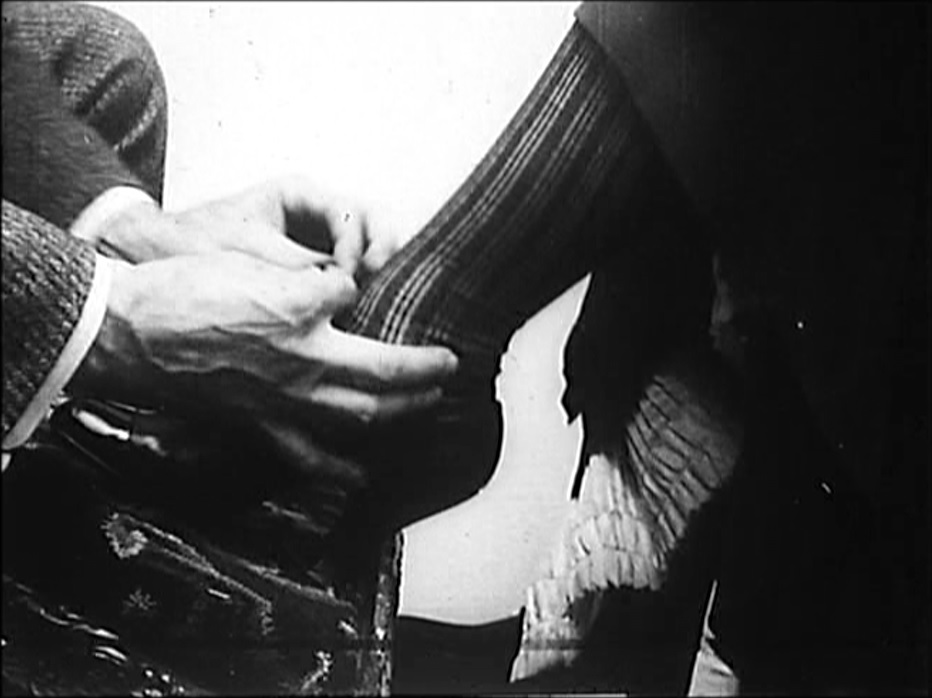
The two schools of thought may conflict, as developments in film techniques may be seen, from a different perspective, as another way of using film to exhibit something - "The Gay Shoe Clerk” (US, 1903, dir. Edwin S. Porter) is seen as a development in the use of the close-up on a key point in the film's plot - the lifting of a lady's skirt to reveal her ankle while being fitted for new shoes. However, according to Gunning, "...its principal motive is again pure exhibitionism." (Gunning 1990: 58) The act of revealing the ankle is, in this case, included to provide titillation for the viewer.

The word "film" became universally recognised as a one-reel dramatic narrative from around 1907-08, coinciding with the industrialisation of film, experiments in technique did continue around this. For D.W. Griffith, such experimentations "were for him the unformulated results of practical problem-solving rather than abstract theorizing... Unrestricted by narrative conventions, since there were few at the time, Griffith simply adopted for his Biograph films what worked best in the particular circumstances, according to the dynamics of the tale." (Cook 1996: 62)

The Lonedale Operator (1911)

It is well-documented that Griffith also used theatrical techniques and the dramatic structure of Charles Dickens’s novels in his films. As an example of the former, the beginning of "The Lonedale Operator" (US, 1911) shows characters leaving the frame on one side, but re-entering in the next scene from the same side - just as you would in a theatre. This was suitable for audiences at a time when such theatrical techniques were more greatly recognised. However, when someone enters through a door later in the film, they leave the frame on one side, but enter the next scene on the opposite side. To use the same technique as described above for this particular piece of action may cause confusion, and wouldn't look right on the screen.

The "novel structure" helps to attract the new middle-class audience in picture houses that was beginning to replace the working-class in nickelodeons as the main target film audience, and, therefore, may be seen as the reason why narrative cinema replaced the "cinema of attractions". According to Gunning (1990: 57), exhibitionist cinema either moved underground - e.g. "Un Chien andalou" (France, 1928, Luis Bunuel), which depicted the dreams of the director and Salvador Dali in a series of irrational images and short narratives - or became incorporated into narrative cinema, like the boxing match in "Broken Blossoms" (US, 1919, D.W. Griffith) provides a break in a melodramatic storyline, while the whole genre of "comedian comedies" (Charlie Chaplin, Buster Keaton, Harold Lloyd, Harry Langdon etc.) features spectacle around a continuing narrative.

It can be argued that the advent of sound brought new ideas to push cinema in a new direction, while silent cinema was effectively ended as an industry within a few years. However, the basis for further growth in this period of cinema was possible due to the developments during the earlier period. There are cases when early film and early cinema can be seen as art in its own right (as trick films and exhibitionist films were mainly concentrated before 1906, for example), but it was instrumental in the search for narrative form.

The notion that early film and early cinema were a primitive search for narrative form seems inappropriate - it suggests that such exploration was confined to the late-19th and early-20th centuries. However, the central questions for any filmmaker - what can the technology do, and what can they do with it - is still relevant today.

Un Chien Andalou (1928)

Bibliography

Salt, B. (1990) "Film 1900-1906" in Elsaesser, T. (ed.) Early Cinema: Space, Frame, Narrative. London: British Film Institute. pp. 31-44.

Gunning, T. (1990) "The Cinema of Attractions: Early Film, Its Spectator and the Avant-Garde" in Elsaesser, T. (ed.) Early Cinema: Space, Frame, Narrative. London: British Film Institute. pp. 56-62.

Cook, D.A. (1996) A History of Narrative Film (3rd ed.) London: W.W. Norton & Company Ltd.

15 May 2022

MAKE ME HAPPY THROUGH THE YEARS [344]


So far, I have seen four versions of Fritz Lang’s 1927 science-fiction masterpiece “Metropolis”: the cut-down and censored film in circulation since the 1930s that muddled the original story, its reputation sustained by its imagery and ingenuity; the 1984 tinted version with songs written and produced by Giorgio Moroder; a 2001 release that scoured the world for any missing pieces, using German censorship records and still photographs to reconstruct the correct story;  and the latest version, using prints discovered in Argentina and New Zealand to present, as of 2010, the nearest we have to the film that premiered over eighty years earlier... bar two scenes still too damaged to include.

Film preservation is never a finished business. Reckoning with past decisions that destroyed and wiped art works before their worth was fully realised, everything new must now be preserved at all costs, for you cannot yet know what you may have on your hands.

This is a bar now raised by the BBC and Queen Mary University, London, which for seven years have gone beyond the definition of “painstaking” to recover the images from a reel of 16mm film discovered in the vault of Nigerian TV station RKTV. The effects of a hot climate and poor ventilation caused the acetate film stock to break down into an acid that will ultimately destroy it – the British Film Institute had recommended destroying the reel to avoid “infecting” other films archived alongside it. 

As explained by BBC Research & Development in 2017 [link], the silver nitrate present in the film raised the possibility of using X-rays to recover images from what had become a lump of plastic, made easier by laser-cutting it into small blocks, ironically destroying it after all. Remarkably, this process yielded enough frames to present a slideshow that refreshes once every second or two seconds, married to a soundtrack discovered separately in Australia. The BBC will release the results on DVD, on Monday 6th June. It is series 1, episode 2 of “The Morecambe & Wise Show”, from 1968.


The TV shows made by Eric Morecambe & Ernie Wise have become so highly regarded in the UK that recovering a previously missing episode in this manner can be justified – there is an argument to be made that their 1971 Christmas special, featuring Shirley Bassey, Glenda Jackson, and the famous sketch of André Preview / Privet / Previn conducting Morecambe in “Grieg’s Piano Concerto by Grieg”, may be the single greatest piece of television the UK has made. Their shows for the BBC reached a such a high watermark of craft in TV comedy, aspiring to be like an MGM musical every week, that interest remains high in their shows and in how they were made. That this missing show comes from their first BBC series, before their classic formula had formed, makes it an invaluable study.


Ironically, the last episodes of their TV career, made for ITV from 1978-83, only just received a full release on DVD in 2021, their reputation as derivative re-treads of the BBC shows having kept them from visibility for so long – we knew where the episodes were, but few were interested. Having them at all to make the comparison is better than discarding them when their perceived worth ran out.


I expect to see a fifth, complete version of “Metropolis” in my lifetime.

09 August 2020

IT WAS A GRAVEYARD SMASH [254]


"Nosferatu," a German horror film directed by Friedrich Wilhelm Murnau in 1921, may now only receive a "PG" rating from the British Board of Film Classification, but I still problems watching it. Count Orlok's unnatural features and movement, the shadows, and the sense of foreboding may now only be advised as "mild threat" by the BBFC, but their cumulative effects beat the jump scares of a flash of red, a spray of blood, or a hunk of flesh.

Meanwhile, auteur theory, centralising a film’s director as the prime creative force in its making, is just as pervasive in film culture as horror movie tropes, making artists out of John Ford, Alfred Hitchcock, Steven Spielberg and George Lucas, and even its proponents, like Jean-Luc Godard. The critic Pauline Kael saw through it, preferring to look at each film individually, through the collective effort of everyone that made it: “The auteur theory is an attempt by adult males to justify staying inside the small range of experience of their boyhood and adolescence, that period when masculinity looked so great and important.”

I only mention auteur theory because I can only assume this is why F.W. Murnau’s skull is still missing from his grave. It remains unknown who broke into it in July 2015, but wax found at the site suggest candles were used in some sort of ritual. I assume the grave has now been sealed by the cemetery, as this was being considered due to previous break-ins – Murnau’s brothers, buried in the same plot, were untouched. The prevalence of auteur theory in how people discuss film still does not mean that Murnau, still revered for “Der Leitze Mann” and “Sunrise,” is entirely responsible for “Nosferatu” as we know it - it’s a bit like saying Wes Craven made “A Nightmare on Elm Street” because he was a psychopath.

"Nosferatu" was deliberately designed to be an occult, supernatural film by its producer and distributor, not the director. Prana Film planned many similar films, had an occult mail order catalogue as a side business. Its co-founder, Albin Grau, a German version of Aleister Crowley, was also the production designer, filling props and backgrounds with occult symbols. Prana Film went into bankruptcy after the release of "Nosferatu," infamously an unauthorised adaptation of “Dracula,” in order to avoid the copyright infringement lawsuits from Bram Stoker's estate.

Before “Nosferatu,” Murnau had already directed one film about a fractured personality, that was also an unauthorised adaptation of a British novel - "Der Janus-Kopf" (1920), starring Conrad Veidt and Bela Lugosi, was based on "Dr. Jekyll and Mr. Hyde" by Robert Louis Stevenson. This film is now lost, but we know the it formed part of the wave of German Expressionist films trying to examine the forces that German society found in itself following the First World War, leading to films like Robert Wiene’s “The Cabinet of Dr. Caligari”, Paul Wegener & Carl Boese’s “The Golem: How He Came Into The World” and Fritz Lang’s “Dr. Mabuse the Gambler” and “Metropolis.”

However, no-one used the power of German Expressionist cinema to disrupt the graves of those directors, or that of Albin Grau.