For about seven months in 1990, British TV audiences had to choose between two satellite TV companies if they wanted to receive more channels, if cable was not available in their area. One company haemorrhaged hundreds of millions of pounds to put their satellites in place to provide a high-quality service in on par with the BBC, ITV and Channel 4. The other provider rented space on someone else’s satellite to provide cheap and cheerful shows and films, but were losing nearly as much money despite having a year’s head start.
Rupert Murdoch’s News International was on the starting line first, having purchased “Satellite Television”, also known as Super Station Europe, which had launched as Europe’s first TV satellite channel in 1982 by using space on an exploratory communications satellite. Renamed to Sky Channel in 1984, other new stations like Music Box, The Children’s Channel, Lifestyle and Screensport launched alongside it, broadcasted by UK cable TV companies that were recently allowed to start broadcasting as many channels as they like, including new ones from themselves. In 1984, cable television was still only available in few areas of the UK, mainly those that experienced receiving regular programmes over the air, and satellite television was the reserve of hobbyists able to accommodate dishes of up to two metres in diameter.
Five satellite TV frequencies were allocated to every country following an international telecommunications conference back in 1977. In the UK, the BBC were never able to make use of the two frequencies assigned to them, mostly because they would be expected to shoulder the cost of building and launching the satellite themselves, and attempts to build a consortium of companies to spread the cost also fell through. The remaining three frequencies were auctioned as a franchise in 1986, the winner gaining all five frequencies when the BBC gave up on theirs – what would become BBC World News, BBC Prime and so on were the result of building across cable services in Europe, starting in Denmark.
The company that won the franchise, British Satellite Broadcasting (BSB), planned to launch with an entertainment channel named Galaxy, incorporating a children’s strand named ZigZag; Now, the UK’s first 24-hour news channel with content provided by ITN; and Screen, a channel showing recent films for an extra fee, with dedicated sports and music channels added later. Among BSB’s owners was owned by ITV companies Granada and Anglia, ITN and the Virgin Group - the presence of the fashion chain Next among later investors was not unusual in the late 1980s, as Lifestyle and Screensport were owned by the bookstore and stationers WHSmith at this point. Programmes would come from independent providers set up by people who previously worked for the BBC among others, and some sports rights were shared with the BBC including Wimbledon, where Sue Barker got her start as a presenter. The planned launch date for Britain’s first satellite TV company would be September 1989.
...then Rupert Murdoch announced, in June 1988, that Sky Television would launch inside a year, providing a revamped Sky Channel, later renamed Sky One, along with their own news, sports and movie channels, by using space rented on a satellite launched by the government and Grand Duchy of Luxembourg, named Astra. Like Radio Luxembourg, whose English service provided pop music in the evenings and on Sundays since the 1930s, when the BBC traditionally did not, Sky Television would be broadcast outside of British territory and regulation, and free to broadcast whatever it wanted, which was initially game shows, American and Australian imported shows, older films, and tractor pulling on Eurosport.It is easy to draw a series of diametric opposites between BSB and Sky, so here they are. BSB were based in a marble-clad building named after their satellites, Marcopolo House, in central London; Sky was based in a business park in Osterley, near Heathrow Airport. BSB were saddled with the building and development costs of both their satellites, and of the D-MAC broadcast system that would provide a robust high-definition signal back to earth; the satellite Sky were renting from only reached its set position four days before the channels launched, and the hope was that its higher-power signal, using existing PAL technology, would reach the ground to the smaller dishes being made by Amstrad. ITN left the BSB consortium when an agreement could not be reached over the Now channel, which was turned into a lifestyle, current affairs and arts channel not unlike BBC Two at the time, with cursory news updates provided by another firm; Sky News innovated from the start, and acted as a fig leaf of respectability for Murdoch’s endeavour. Once running, Now provided the arts programmes Sky initially promised, along with a European Disney Channel, but didn’t launch. BSB spent tens of millions of pounds to secure films for The Movie Channel; Sky Movies had a free pick of 20th Century Fox, Murdoch owning that as well. BSB had to cancel millions of pounds in advertising when the technology was not ready for the intended launch date, to be spent again for its eventual launch in March 1990, and even then the first month was only on cable; Sky’s parent company advertised the channels in its newspapers The Sun, the news of the World, Today, The Times and The Sunday Times, and ads on Sky were often for those papers, in a feedback loop outside of British jurisdiction.
 |
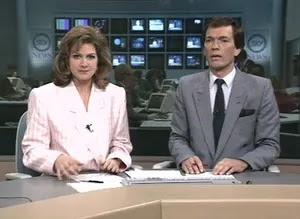
Penny Smith and Alistair Yates present Sky News's first bulletin
|
As reported in Peter Chippindale and Susanne Frank’s 1991 book about this time, “Dished!”, only 14 percent of households in 1990 were even interested in installing satellite television in their homes, and of them, only thirty percent were thinking of having it installed that year, and that is before you get to the choice of provider. Both BSB and Sky were spending millions of pounds over the odds every week just to get the infrastructure there, down to giving away the equipment for free, and cutting spending on programmes led to BSB essentially repeating Now’s entire output for ten weeks, as who had watched it the first time? The eventual merger to form British Sky Broadcasting on 2nd November 1990 was inevitable: Sky’s customers benefitted from BSB’s entertainment, films and sports programmes, and BSB’s customers received free Sky equipment, with the Marcopolo satellites and D-MAC technology lasting into the 2000s in Europe.What remains of this time? The households that had BSB had their video recorders ready to tape a “Doctor Who Weekend” held on the Galaxy channel, which aired classic BBC shows like “Dad’s Army” and “The Goodies” in a manner not unlike the later UK Gold channel. Comedy programmes included an interesting stand-up and sketch show “I Love Keith Allen”, and the satirical nightly news summary “Up Yer News!”. “31 West”, a chat show named after the position of the Marcopolo satellites, presages “The One Show”, Jools Holland presented music show “The Happening”, not unlike the BBC’s later “Later... with Jools Holland”, and the infamous comedy pilot “Heil Honey, I’m Home!”, a parody of 1950s American domestic sitcoms starring Adolf Hitler and Eva Braun, is also a thing. Meanwhile, Sky put its faith in big names, with current affairs, interview and game shows presented by Frank Bough, Derek Jameson, Tony Blackburn, Keith Chegwyn and, once the merger with BSB took place, Selina Scott and Sir Robin Day. Most notably, the show that arguably put Sky into more homes than all of them began on 2nd September 1990: “The Simpsons”.
Ultimately, having a choice of satellite TV provider benefitted no-one, as the market was too small to have a choice, but once the dust settled, satellite television became a viable option. I use it at home, ironically to receive a more robust signal for the BBC and Channel 4, just like cable subscribers once did.