Showing posts with label Vektroid. Show all posts

01 October 2023

AND THEN YOU GOTTA SLOW IT DOWN [416]


Marshall McLuhan is a name that has come up here a few times already, but I somehow forgot that the founder of what we call media studies had recorded an album. Released in 1967, and an LP version of McLuhan and Quentin Fiore’s book of the same name, “The Medium of the Massage” is an audio collage about the effects of media on its consumer, the title’s pun on “message” becoming intentional following a typing error in the original book. 

With McLuhan’s assured tone as a lynchpin, the effect of the album’s sound is not too dissimilar to the later experiments it influenced, like The Beatles’ “Revolution No. 9”. The intention of the album is to totally immerse the listener in a constantly changing landscape that utilises sound as an entirely separate medium of the printed work – this is no audiobook.

I found myself concentrating on the voices and sounds being sped up and slowed down. The collage is constructed of hundreds of pieces of spliced audio tape, played by reel-to-reel machines on top of each other, but the varying of their pace brings more attention to the physical existence of the tape, and how what you hear is essentially a result of friction, as magnetic tape is passed over a playback head. 

The speed of the pinch roller, feeding the tape past the head, can be varied to a desired effect, quite often comic, as anyone with a cassette player at home would find by pressing the “play” and “fast forward” buttons to make your favourite band sing even higher. The age and quality of the tape player, and the tape, also affects the output: you can tune your equipment to remove as much “wow” and “flutter” as you can, but there may still be imperfections in the tape, from its recording to their initial manufacture, to factors acting on the magnetism of the tape to affect its retention of a recording.

None of this is easily replicated digitally. Filtering audio could get close, like applying a “VHS effect” to video, but outright glitches need the original equipment, and both cassette players and “entry-level” Type I ferric tape are still readily and cheaply available. Best known for the vaporwave album “Floral Shoppe” under the name Macintosh Plus, Ramona Langley released “Big Danger” in 2017, under her usual moniker of Vektroid, which sounds like a found object: a sticky, muddy-sounding cassette tape in a damaged player that cannot play at the right speed, and that is the effect being sought – plying it back on a digital file is only the current method of delivering that particular sound.

06 February 2022

GREEN IS THE COLOUR OF HER KIND [330]


For all the planning, research and energy I may put into an article or video, I never usually give much thought to how it looks on screen, other than it should be legible. Since 2018, this has taken the form of black text on a mint green background, topped with a pink logo, and I probably did not give these choices more thought than the time it took to whip up the logo using Adobe Photoshop. 

That said, I have no reason to change them. Green and pink are a strong combination that has come to work as a signal or brand for me and my work from the moment they are seen, either on the canvas of a website, or when reduced to a smudge of colour on a YouTube video thumbnail.

My site began in 2016, with a functional white text on a black background – a style that marked the absence of style. By December that year, black had been swapped for what is meant to be International Klein Blue (RGB hex triplet code #002FA7), an ultramarine blue formulated to be more blue than blue, also my favourite colour – a simple choice, but better than nothing.

Apart from blue being the colour of a clear horizon, its being my favourite colour is much like 26 being my favourite number: there is really no reason for such a thing to exist, although it may have arrived as a result of appearing in a number of places at the same time in November 1993 – I think the BBC held their annual Children in Need appeal night on the 26th of that month.

Charlestowne Mall
 

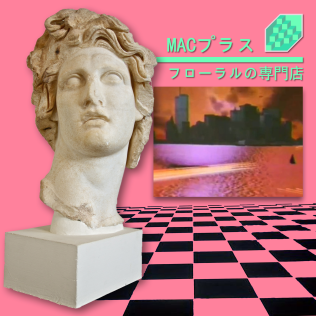
By April 2018, I had arrived at the tagline “nostalgia culture crisis”, and this produced a need to apply branding to support it while looking for something that could be more identified as mine than just the colour blue. The original choice was going to be navy blue text on a peach background, inspired by a carrier bag from the clothes store Next, but what worked on plastic failed on a screen. I changed the peach to a light pink (#f6cac9), and went for mint green (#a3fdd7) based on videos I have seen of dead US shopping malls that were designed in the 1980s and 1990s, particularly the Charlestowne Mall in St. Charles, Illinois, currently due for demolition. I then also realised these were the same colours used on the classic vaporwave album “Floral Shoppe” by Vektroid, using the name Macintosh Plus, so I was on the right track. The pink colour was darkened a bit in May 2021 (#ffb5b2) for legibility, once I decided I should make more use of it as branding in videos.


Does writing about this mean I now have to keep to the scheme of green on pink? It’s more an indication that you can establish something without really thinking about it, and that thinking “if it ain’t broke, don’t fix it”, requires you to properly acknowledge it as a thing first.


26 September 2020

RISE, GO OUTSIDE BITCH [262]


My choice for the song that defines the year 2020 was decided very early on, by the end of March. Furthermore, it was was actually released on 20th December 2019, but reviews raved about it into the new year. “Sick & Panic” is the first release by the electronic music artist Ramona Xavier to use the pseudonym Macintosh Plus since the seminal 2011 album “Floral Shoppe,” a cornerstone of the vaporwave genre. Xavier usually releases under the name Vektroid, so the use of Macintosh Plus this time caused immense anticipation.

For the uninitiated, “Floral Shoppe” is a cut-up of mostly Eighties tracks already drenched in keyboard and saxophone, that are sped up, slowed down, looped and distorted, giving the impression that you have unearthed a cassette tape with no known history, and the tape itself is worn and ragged. The standout track is “リサフランク420 / 現代のコンピュー" (“Lisa Frank 420 / Modern Computing”) – Japanese text is a big feature in vaporwave song titles and album design – which spins out the first ninety seconds of the Diana Ross album track “It’s Your Move” into a seven minute meditation on the idea that time is running out, with the line “I'm giving up on trying to sell you things that you ain't buying” rendered iconic. Vaporwave is a genre defined by hauntology, a longing for a future that never came, and wherever that future went, “Floral Shoppe” is what it left.

In comparison, “Sick & Panic,” released as the precursor to a new Macintosh Plus album later in 2020, is like playing the cassette found stuck inside an old Sony Walkman that was itself found in the back room of an abandoned branch of Currys, after they moved out of the town centre. It gets stuck, it stutters, it has snatches of lyrics, and some melody comes up that may sound familiar, but it is then distorted and enveloped back into itself. Classical vaporwave has to smash through modern EDM noise first. It could be dismissed as noise – twelve and a half minutes of noise, in the same way that The Beatles’ “Revolution No. 9” is eight and a half minutes of noise.

You may start to pick out patterns, because that is how the mind works, but that is only so you can find a hook, an anchor, something to hold. The choppy lyrics, like “Face, face, don't, face” and “Goes, goes get you,” will suddenly make a whole sentence: “I don’t need my body anymore” and “go outside bitch.” The song’s cover art, which sends flying the Apollonian bust from the original “Floral Shoppe” cover, reads, “Rise From Your Grave.” When the drum machine and MIDI sampled keyboard kick in at the half-way mark, it is almost comforting, but the cosy nostalgia that vaporwave hopes to evoke is quickly snatched away again, but this is not the time for that.

Why “Sick & Panic” sounds the way it does may not truly make perfect sense until the rest of the album is released, but it sounds like something unknown is about to burst, and you are being implored to fight its effects. The two-word description of the track on Xavier’s Bandcamp page (https://vektroid.bandcamp.com) is “NO WAR” – from your perspective, you have either not seen the war coming, or you have to start picking which battle to fight. This is vaporwave designed to agitate.

It would have been easy enough to choose “Sick & Panic” as my song of 2020 based solely on the title, but when 2020 is finally talked about in the past tense, it will be as a difficult year to have lived through, the world itself having changed, and with the future having finally arrived. Making sense of the noise is like brushing your teeth these days.

19 March 2018

IT’S ALL IN YOUR HEAD [101]


It is hard to talk about the genre of music known as vaporwave without understanding its intention. A bit like punk, vaporwave subverts the 1980s consumerist society by cutting up the music and images of the decade, and representing it as an ironic form of nostalgia, and yes, I am still talking about music.
The name “vaporwave” comes from two sources – “vaporware” is a term given to computer software that is announced, but never appears, while it also evocates “waves of vapour,” a term from Karl Marx denoting old ideas and conventions being swept away before they can solidify. It is not a bad way of describing a genre that popped up as a meme, on the social media site Tumblr in 2010, but its having lasted longer than the original burst of punk in the 1970s means the nostalgia for the failed promises of a 1980s consumer society clearly speaks a lot to people.

What does vaporwave do? Just as the postmodern practices of sampling, cutting and pasting, and nostalgia came to the fore in the 1980s, vaporwave takes what that decade gave us and cuts it up again, finding more connections. Most often, a passage in a song is slowed down and looped, partially for the disorientating and alienating effect, but also to focus on particular lyrics or melodies. A major example of this is the song “Computing of Lisa Frank 420 / / Contemporary,” by Macintosh Plus (aka Vektroid, both aliases of the DJ Ramona Xavier) – its original title is in Japanese, a country also borrowed for vaporwave iconography – by cutting up a 1984 Diana Ross album track, “It’s Your Move,” a slick three-minute song becomes a seven-minute brooding dirge, highlighting the refrain of “it’s all in your head.” It could be said to be post-music too, as little or no original music is composed for vaporwave, unless you are trying to recreate the effect by writing an original piece.
For the record, the albums to listen for the beginning of vaporwave are “Eccojams Vol.1” by Chuck Person, the cover of which cuts up the cover for the Sega Mega Drive / Genesis game “Ecco the Dolphin”; “Far Side Virtual” by James Ferraro; and Macintosh Plus’s “Floral Shoppe,” which has an album cover that sums up the visual aesthetics – sorry, I mean A E S T H E T I C S – of vaporwave: a playful mix of pastel and fluorescent colours, cityscapes, patterns, along  with Roman busts and columns. For good results, the art should look like it was slightly unplanned, resulting from a glitch, found and revered, just like the music.

For many, this type of experiment makes a hard listen without context, and I first came across the genre through its use in series on YouTube like Dead Mall Series, Ace’s Adventures and Retail Archaeology, which have all used vaporwave as backdrops to video tours of deserted American shopping malls, where the shift to shopping online left the shopping meccas of the 1980s and 1990s to become vacant, deserted, and abandoned. With the accompanying vaporwave soundtrack sounding like it may be playing in the mall during the filming – indeed, background music from the Muzak Corporation is also used for vaporwave tracks – it feels like the utopian safe space of the shopping mall, and the aspirational imagery in advertising, were false promises, but that could just be the Marxist side of it.
Where does all of this effort go? For many, vaporwave will feel like a deliberate joke, an attempt to create something that purports to have depth, when it has none. But like any solid postmodern work, all the meaning is on the surface, and that meaning, at least to me, is to make something of the fractured world the 1980s has left us, and rejoice in it.