Showing posts with label Star Wars. Show all posts

15 February 2026

WHAT A WONDERFUL WORLD THIS WILL BE [529]

With so many visions of the future in narrative fiction having proved to be incorrect, mostly because they were written to comment on the present at the time of their creation, it does not mean that I should subsequently be nostalgic for visions of the future that, for all the longing and hope they generate, did not come to pass.

That said, I wouldn’t mind seeing “The Jetsons” again. As of February 2026, the HBO Max streaming service is weeks away from launching in the UK and, while its US version has a spotty record of maintaining access to animated shows, regardless of how recent they are – so much for the Internet being permanent, I suppose – this may not be true elsewhere in the world.

More than Hanna-Barbera Productions flipping its successful show “The Flintstones” from the Stone Age to the Space Age, “The Jetsons” is about a family living in a utopian society one hundred years in the future, where people live above the clouds, work only a couple of hours a week, and need only exercise their fingers.

However, because it was first broadcast in 1962, the family is still a two-plus-two unit – father George, mother Jane, children Judy and Elroy, with pet (talking) dog Astro, and their robot maid Rosey. This makes it a standard family sitcom, but one where the family is the only familiar feature. 

Whereas “The Flintsones” is more like the “present day”, but with a Stone Age sheen – any device can be opened to find to being worked by an animal, saying “it’s a living!” – “The Jetsons” will have a little more ingenuity to its jokes, like George being caught in a traffic jam of flying cars, until a message appears to fly to a different place, but all the others do so as well, or a robot having a malfunctioning voice that requires it to knock itself to work properly, like a human would do to an old TV. The future has arrived, but it isn’t perfect.

Everything from buildings to cars in “The Jetsons” are in the space-age Googie style, prevalent from the end of the Second World War, but the show appeared just as ostentatious fins and rocket motifs started to disappear from American cars, replaced by cleaner Modernist lines. Predictions of flat TV screens, videophones and flying cars were also tempered by then-current understanding of how technology worked: a device that could 3D-print your dinner was programmed by inserting the right punched card into a slot, instead of selecting from a screen.

It is interesting to compare “The Jetsons” with “Futurama”, a similarly future-based animated show that has been revived more than once over the years. “Futurama” has a more cynical, ironic edge, and its world is more identifiably our own – one in which you can imagine yourself living, despite being set a thousand years into the future – than the utopia of “The Jetsons”, without sliding into dystopia. This familiarity has meant “Futurama” hasn’t needed to retrofit its idea of the future as the decades have progressed – rather than just being the style of the show, the buildings in “The Jetsons” are on poles to lift them above the pollution on the ground, an addition made with “Jetsons: The Movie” in 1990.

It appears I am not the only one done with “The Jetsons”, as talks were reported in October 2025 for a live-action version of the show, starring Jim Carrey and with Colin Trevorrow directing. With no-one having any comment on this report, least of all Warner Bros. as the owner of the property, we have nothing to go on about what the vision of the future in this version, apart from Trevorrow’s extensive background in science fiction films, from “Star Wars” to “Jurassic World”. So long as it looks forward, and not down, I’ll be happy.
06 March 2022

AND I SAID WHAT ABOUT BREAKFAST AT TIFFANY’S? [334]


I have thought about this question every so often, and I will be answering it in my capacity as Leigh Spence, B.A. (Hons) in Film Studies from Solent University, Southampton: what is my favourite film? 


Erm, I don’t really have one, but there are candidates for what may be my favourite film. 


This situation is borne from my taking a critical eye to absolutely everything, both in nature and by training: it was pointed out from the outside that film studies is an arts and humanities subject, and a cinema screen is as much a mirror as a blank canvas. Everything has its virtues, everything has its foibles.


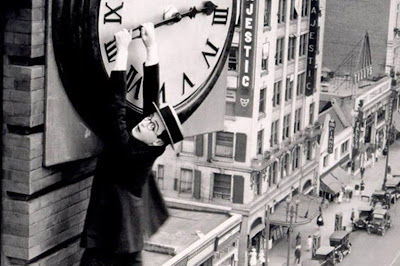
There are films that serve as personal landmarks: “Who Framed Roger Rabbit?” was the first film I saw at a cinema, and the “Back to the Future” trilogy (1985-90) is part of our family, right up to our seeking out the ride when it was still at Universal Studios – the real studio, not the theme park. VHS copies of Hayao Miyazaki’s “Castle in the Sky” (1986) and Disney’s “Fantasia” (1940) were present in my childhood, and I am fortunate to have been exposed to silent comedy from Harold Lloyd, Buster Keaton and Laurel & Hardy from early on, particularly Lloyd dangling from a building in “Safety Last!” (1923), a film I have, of course, now have on Blu-ray.


My go-to-answer for my favourite film is usually Alfred Hitchcock’s “North by Northwest” (1959), having long been a fan of his careful suspense plotting, the shadows of both pictures and character, and his style and humour – I remember a lecturer once stating that, while teaching Hitchcock’s films in a film studies degree is the most obvious thing to do, like he is the Shakespeare of film, the reason why they do teach him is because he is the Shakespeare of film which, having seen “The 39 Steps”, “Rear Window”, “Vertigo” and everything inbetween, I am inclined to agree. Ernest Lehman’s script for “North by Northwest” was deliberately a combination of all of the best Hitchcock motifs to that point, working as a perfect summation of why I like them – the fact that Hitchcock then blew this apart the following year with “Psycho” the following year is another reason for loving the director’s work, but is not as representative of his entire body of work as his previous film.


An easy metric would be for me to list the films I have watched the most times, to find a favourite there. Uniquely for me, I saw Pixar’s “Wall-E” at the cinema more than once, with the Monty Python canon, “Network” (1976), and Terry Gilliam’s “Brazil” (1985) sustaining multiple home viewings. However, films I don’t like – Neil Breen’s “Twisted Pair” (2015) and my personal bĂȘte noire, “Myra Breckinridge” (1969) – have required repeated viewings just to understand what happened, both in front of my eyes and behind the scenes.


It would be very easy for me to rely on lists of best films to formulate an answer, had it not been for the British Film Institute’s journal of record, “Sight and Sound”, producing a decennial “greatest films of all time” list from a poll of hundreds of directors and critics, making for the most definitive, answer for such a subjective question. The 2012 list, asking more industry people than ever, famously had Hitchcock’s lush psycho-drama “Vertigo” (1958) knocking “Citizen Kane” (1941) off the top spot for the first time since 1962. Orson Welles’s film is undeniably the greatest debut anyone has made with a film, and remains one of the best films ever made, but it also proves that you can only decide how good a film is by taking a good twenty years to think about it. The first poll, in 1952, stuck “Citizen Kane” just outside the top dozen films, and placed Vittorio De Sica’s “Bicycle Thieves” at the top, released only four years earlier – the 2012 poll placed it at number 33, below “The Godfather Part II” (1974) and “Taxi Driver” (1976). People asking why no “Star Wars” film is on the list should notice that “2001: A Space Odyssey” (1968) and “Blade Runner” (1982) are there. That said, a new poll is due in 2022, so there is still time.


My most diplomatic answer to why I don’t really have a favourite film is because I have not seen every film. But I know my tastes: I will have had to search it out, it won’t be on a mainstream streaming service, it won’t be a genre film – unless “Hitchcockian suspense” is a genre - and it certainly won’t be “The Sound of Music” (1965), as I have done a good job of avoiding it up to now.

20 September 2020

WHO CARES WHAT PICTURE YOU SEE [261]


On the evening of 16th March 2020, the Prime Minister of the United Kingdom announced the start of the lockdown that would attempt to suppress the outbreak of Covid-19, of which one measure was the closure of cinemas across the country, to prevent people coming into close contact within a closed space.

Two days later, my bank sent me six free cinema tickets, to use at my local multiplex. The current account I have with my bank allows me to choose an extra perk from a list each year, like a magazine subscription, or money off in restaurants, but every March, when the bank asks me what I want next, I always choose the cinema tickets.

On 19th September 2020, I see a film in a cinema for what was the first time since 23rd February – that film was “Greed,” the comedy satirising the clothes shop magnates that squeeze sweatshops for profit, starring Steve Coogan as a Sir Philip Green analogue that builds a plywood Colosseum using migrant labour to celebrate their birthday. It was a good film, if earnest at putting its point across, but I only remembered I saw it after realising that watching “Cats” (a film I still like) in a cinema was such an overpowering experience, it obliterated the following two months of film-watching memory – either that, or 2020 has been as long a year as everyone else has said.

Cinemas in the UK were allowed to reopen from 4thJuly, but my local cinema reopened on 7th August, having been postponed from 10th July. My local chain is Vue, a British chain partly owned by a Canadian pension fund. However, the gap between its reopening and my finally walking through the door was entirely mine, as I deliberated what to see next – the future of local government employees in Ontario depended on my decision.

The canary in the cinema coalmine, used to gauge how quickly people would return, was Christopher Nolan’s “Tenet,” but I did not want to watch another large film, with a large story, with large ideas, and a large cast – I am not usually one for blockbuster tentpole films anyway. I had considered watching the rerelease of an older film, namely “The Empire Strikes Back,” but I didn’t care enough about Star Wars to watch what has been turned into the middle film in a middle trilogy. I certainly wouldn’t wait until November to watch “No Time to Die,” but when it comes to series that define how Britain is portrayed in film, I am more likely to choose a Carry On film over James Bond.

So, childhood nostalgia it is – I’m seeing “Bill & Ted Face the Music,” itself postponed from 21st August, 14thAugust, and 28th August, finally arriving on screens on 16thSeptember. The film itself was great, but you will get more out of it if you have seen the other two films. Oddly, it felt like it was made by fans of the first two films, even when you know it was the original team.

As long as it took for me to choose a film to watch, the bigger problem was at the cinema itself. The capacity of the screen showing “Bill & Ted” was 422 seats, the biggest in the fourteen-screen multiplex. The number of people in the audience was FIVE. It may have been 10:10 on a Saturday morning, but before the lockdown, showing ANY film would get a bigger audience than five.

Losing access to cinemas for a period of time has run the risk of upending the idea of films altogether in a way I wouldn’t have thought. We are now so used to home video releases of films coming only a matter of weeks after their cinema release, that it becomes ever easier to skip the cinema release altogether: the Tom Hanks film “Greyhound,” made for $50 million, was released online in July 2020 after the lockdown made its cinema release impossible. What was meant to have been a Columbia Pictures Release became a success for Apple TV+ instead. “Trolls World Tour” made a $30 on-demand cost for one film justifiable, later copied by Disney with the live-action “Mulan,” making the audience being a Disney+ subscriber a pre-requisite before paying any more. If it is made any easier for film companies to do this instead, there will be no more need for cinemas.

I prefer to think of cinema as the medium rather than the film – films are made to be watched in a cinema. Watching a film in any other circumstance takes away from the singular focus on the screen. All TV screens, and especially all mobile phone screens, are too small for cinema, too inadequate to deal with intimate detail and expansive views. Both the sound and vision of cinema do not have to complete with that is happening outside where the film is playing, but once it leaves, that is all that ever happens – films can be shown on television, and films can be posted to YouTube, but films are not television, and films are not YouTube.

I have five free tickets left – my cinema will have these well before next March.

13 September 2020

BUCKAROO BANZAI IS NOT JUST A MOVIE [260]


Very rarely do American blockbuster films try to defy explanation, but films with titles like “The Adventures of Buckaroo Banzai Across the 8th Dimension!” appear to be designed to do just that. It defies pigeon-holing, but because it defied the efforts of some to explain it, the film was only promoted to fans of “Star Wars” and “Star Trek” at the time of its release.

The film is based in a world where the celebrity of a polymath is unquestioned, for Buckaroo Banzai is a neurosurgeon, scientist and rock star, leading the band Buckaroo Banzai and the Hong Kong Cavaliers, its members also sidekick scientists that work for his institute. Banzai has mastered inter-dimensional travel, something that drove a previous scientist to insanity, but cracking entry to the 8th dimension reveals it has been used as a prison by an alien race, the Red Lectroids, which remains in conflict with another race, the Black Lectroids from the same planet, and wants to set off a nuclear explosion to annihilate them once and for all. The earth is, quite literally, at stake.

(Having seen “Buckaroo Banzai” some years ago, seeing how the Red Lectroids “successfully” hid themselves humanoids on Earth by all calling themselves John – “John Parker,” “John Emdall,” “John Small Berries” – led me to fill a database I was testing at work with fictional people named Jeff – “Jeff Muggs,” “Jeff Miggs,” “Jeff Over,” “Jeff Under,” and so on. A major problem was identified in the database when the majority of the Jeffs had disappeared overnight.)


The plot of this film is exactly what you expect from a 1980s blockbuster, still bathing in the radioactivity of the first “Star Wars” trilogy, but “Buckaroo Banzai” has a postmodern knowingness to it that is a little difficult to follow on a first viewing,  apart from the consciously artificial special effects. The world the film creates is fully realised and detailed, but not explained, because it doesn’t feel the need for it. All you have to do is accept the lead character is a man whose time is fragmented across many different abilities, sometimes within the same scene, and even the opening narration that explains this is someone who is destined to live his life “in all directions” is not enough to prepare you for that – no wonder he has his own comic book series, and that everyone knows who he is. That this is the case, not just for Banzai but for his “band,” which only becomes apparent as you go along. Everything you need to help you understand the film is there, on the surface, with character also explained though costume, but the surface is a tough one to crack.

The rich character histories and personalities come from an understandable process: Earl Mac Rauch first conceived the title character in 1974, but never finished many of the “Banzai” scripts – the final script, written over an eighteen-month period, folded in many of the remnants. Knowing this makes little scenes about why a watermelon is held in a vice in one room (“I’ll tell you later”), or Banzai coming across the long-lost twin of his ex-wife – hints at a larger story outside of the film, presaging the Marvel Universe, but without having the films to fill in the backstory. Likewise, trying to write something cohesive about this film is proving difficult to me, as there is so much to cover, except to say that only the villains act over the top, especially Christopher Lloyd and a “3rd Rock from the Sun”-level John Lithgow, and Jeff Goldblum is practically playing himself too. That is enough for most, but the film, to bridge the narrative gaps in the background, requires something of its audience not often found in American mainstream cinema: work.


06 June 2020

TOUCH MY BUMPER, HEY, LET’S MAKE A DEAL [244]


Between 1984 and 1989, Billy Ocean could do no wrong, topping the charts in both the UK and US with punchy electric rock songs: “Caribbean Queen,” “Loverboy,” “When The going Gets Tough, The Tough Get Going,” and the outlier ballad “Suddenly”.  Audiences in the UK saw the beginnings of this force through “Love Really Hurts Without You” and “Red Light Spells Danger,” but Ocean’s voice has a rich tone that he can project effectively, like asking Lionel Richie to go hard or go home.

What made Ocean’s 1980s songs particularly memorable were the videos, in particular how “When the Going Gets Tough...” features Kathleen Turner, Michael Douglas and Danny DeVito on “backing vocals,” the song having been used by their film “Romancing the Stone.” The video made for “Loverboy,” a fantasy filmed at Durdle Door in Dorset that evokes Jim Henson productions like “The Dark Crystal” or “Labyrinth,” make you want to see the whole film, until you realise that this was one Ocean song that was not used for a soundtrack.

The reason the video for Ocean’s 1988 song, “Get Outta My Dreams, Get Into My Car” – also used in a film soundtrack, for the Corey Haim and Corey Feldman vehicle “License to Drive” - sticks in my mind even more than that of “Loverboy” is that it is so entirely of its time, from the synthesisers used in the song, to the choice of colours used in the video, and the animation – the video had to have been made in 1987, and at no other time. It is possible to make fun of the choices made in its production now, and call it the most Eighties thing to have ever Eighties-ed, but it was made in the Eighties.


Sometimes it is easiest to say what you see. The video is set at night, and all the artificial light is switched to pastel shades as Ocean drives his Porsche through a car wash, which cycles through becoming a Jeep, a Volvo 740 and a Renault 5. After passing through, the car fills with animated water, and a fish swims by, singing the backing vocals. Rolling down the window to let the water out, an animated duck speeds past, wearing green and pink clothes, and carrying a boom box. The car wash workers dance around the car – there is a 1950s style to the set, and to the costumes, evoking nostalgia for the childhoods of the people making the video. With his date, Ocean stops at a petrol station, where the old-style petrol pumps sprout eyes and lips, again to sing backing vocals. People are literally dancing in the street, and Ocean appears to be chasing the duck from earlier. They arrive at a drive-in cinema, and Ocean watches himself appear on the stage as the song key’s changes, dancing alongside the duck, that had been playing along to Vernon Jeffrey Smith’s saxophone solo.

Music videos only need to grab your eye as it gives you the song, so making sense is a secondary concern. The animation is a surprise: with a release date of January 1988, “Get Outta My Dreams...” came five months before “Who Framed Roger Rabbit?”, although stacking animation alongside live-action is used here for pure visual effect, and for no reason of narrative. The pastel colours and 1950s American setting are playing off the sunny, bouncy energy generated by the song, and presage the choices made now when evoking the 1980s itself.

The video was directed by Terence Bulley, who was cinematographer for David Mallet’s video of David Bowie & Mick Jagger’s “Dancing in the Street” – yes, that video – alongside other projects for Queen, Culture Club, Cliff Richard, The Cure, the Style Council, and many others, seemingly responsible for developing a more filmic look for music videos that helped them be taken more seriously. Bulley is also director of aerial photography for “Eddie the Eagle” and “Star Wars Episode VIII: The Last Jedi,” but he still made Billy Ocean dance with an animated duck.

17 November 2019

WE’RE THE MASTERS OF SPACE [207]


As I write, the latest “Star Wars” trilogy is due to end, with “The Rise of Skywalker.” I was not stirred when watching the trailer at the cinema – it was the same tropes, characters and references, in a different order, with all the finality of a “Friday the 13th” film’s ending. Mind you, the unsettling experience of watching the feature, “Joker,” perked me back up, using its own bag of intellectual property to create a powerful psychological portrait. 


No wonder a “Star Wars” parody appeals to me – forcing yourself to be original by approaching your source material from a different direction. Even better, "Spaceballs" is not just a good parody of "Star Wars," but a credible science fiction film in its own right, after I forgot I was watching a parody.

In 1987, the original "Star Wars" trilogy had been complete for four years, giving the pre-internet general public, not just hardcore fans, enough time to soak in the references that Mel Brooks would work against. However, the home rental video market helped out, as shown when Rick Moranis' Darth Vader clone, Dark Helmet, finds out where Princess Vespa is by renting a copy of the film he is in, and fast forwarding to a later scene. "Spaceballs" itself lived on in home video form, becoming as much of a cult as "Star Wars" appears to most people.


"Spaceballs" is a welcome contrast from the cynical, tired retread of the source material that the "Laugh It Up, Fuzzball" trilogy from "Family Guy" was, with jokes inserted in a way that does not distinguish itself from any other "Family Guy" episode. Like "Blazing Saddles," "Young Frankenstein," and "High Anxiety," "Spaceballs" is a very Brooks-ian cross between a compendium of jokes, like "Airplane" and the then upcoming "Naked Gun" films, and a visually accurate parody. The production employed Apogee Inc., a visual effects company formed by ex-Industrial Light and Magic employees, lending credibility to all the pissing about going on around those effects, like Dark Helmet being surrounded by Assholes, the surname of the majority of the crew on his ship, and when a radar is jammed by launching a gigantic jar of jam at it.

The year 1987 also meant that "Spaceballs" was in a prime position to pick timely references from what turned out to be a golden period for Hollywood. Rick Moranis had already starred in "Ghostbusters," while Bull Pullman's Han Solo analogue, Lone Starr, is also suitably close to Indiana Jones. Like "Ghostbusters," "Spaceballs" also has its own cheesy tie-in song, when the ship Spaceball One, a very long ship first introduced in a very long shot, is about to self-destruct.

The most daring parody of "Star Wars" is how Mel Brooks, as Yogurt - no need for explanation there - and his "Ewoks" make their money from merchandising, an idea that rose from George Lucas requesting that, in allowing "Spaceballs" to be made, there would be no merchandising, as it would look too similar to the "real thing." "Spaceballs" merchandise, from bedspreads to toilet roll, is randomly seen throughout the rest of the film, including a scene where Dark Helmet plays action figures of himself and Princess Vespa. The turning of Spaceball One into a "mega-maid," to suck up the air that the Spaceballs need from Princess Vespa's home planet - a suitably mad sci-fi plot - prompts the timely line, "it's not just a spaceship, it's a Transformer."


Parody is very carefully detailed for maximum effect. The majestic theme by John Morris, minus the zapping sounds, could have been by John Williams, while the explanatory scrolling introduction is ended by a line that appears in the distance: "If you can read this, you don't need glasses." After a long exposition of the plot, Dark Helmet looks at the audience to ask, "everybody got that?" Instead of the main characters being captured by the "stormtroopers," their stunt doubles are caught by accident, and when one is zapped in the behind by a gun, his leap is accompanied by the "Wilhelm scream" that "Star Wars" sound editor Ben Burtt has shoehorned into every film he made. Even when it is not "Star Wars," the chest-bursting scene from "Alien" can only be properly parodied if you get someone that looks like John Hurt, so what you do is get the actual John Hurt, exclaiming, "Oh no, not again!"

The success of "Spaceballs" as a good a work of comedy and science-fiction can even be expressed in numbers. "Superman IV: The Quest for Peace," the final film with Christopher Reeve in the starring role, was released in Christmas 1987, with "Spaceballs" released earlier in the summer. However, what was intentionally a serious piece of work was let down by the woolly anti-nuclear plot, and the poor special effects caused by Cannon Films' financial troubles producing a reduced budget. "Superman IV" cost $17 million to make, while "Spaceballs" was Mel Brooks' most expensive film at $22.7 million, but with all the money on screen. The final box office results were $15.6 million for "Superman IV," and $38.1 million for "Spaceballs" - this is when taking comedy seriously has results.

10 November 2019

I SEE IT ALL, IT HAS NO GLORY [206]


“Deliberately scarifying and highly commercial shocker with little but its art direction to commend it to connoisseurs.”


With Halloween over, we are approaching that time to be thankful again and, for lovers of films, Christmas roots you to your sofa, with the biggest TV premiĂšres saved for the festive period. You may also be given a book or two as a present, a popular choice being books with curated, “definitive” lists, with titles like “1001 Movies You Must See Before You Die” – ironically, updated versions of that book come out each year, so anyone who saw a film displaced by new entries for the 2019 edition, like “Sorry to Bother You” and “The Favourite,” may have to reassess their options.

The above quote, for Ridley Scott’s original “Alien” (1979), came from “Halliwell’s Film Guide,” an originator of the annual film guides that forced their ways into homes each Christmas, from magazine publishers like “Radio Times, “Empire” and “Time Out,” and from critics like Leonard Maltin and Roger Ebert. Originally published in 1964, the last “Halliwell’s” edition came in 2008, long after Leslie Halliwell death in 1989, and after other authors took over to rewrite his original opinions – my copy of the 2008 edition kept the first half of Halliwell’s original “Alien” review but, diplomatically, stated the art direction was “on its own terms,” before deeming it a “classic,” which had already been decided elsewhere by then.

Leslie Halliwell was not a film critic, but more people depended on his verdicts than those from critics, because they often determined what films you could watch. Originally the manager of a cinema in Cambridge, and later a publicist for the Rank Organisation, his encyclopaedic knowledge of film made him indispensable in the growing television industry. In 1959, Halliwell joined Granada, a part of the ITV network that grew from a chain of cinemas. By 1964, his initial personal assistant job had been swapped for buying foreign programmes (read: United States) for Granada, and in 1968, Halliwell became the “Head Buyer” for the whole ITV network. For UK audiences, Halliwell is the reason you have really only seen the James Bond and Star Wars films on ITV, along with classic TV series like “Murder, She Wrote,” “The A-Team,” “The Incredible Hulk,” and “The Six Million Dollar Man,” cementing the good reputation of US TV by keeping the crap away.


When Channel 4 began in 1982, Halliwell also started buying up films and TV shows for them, helping to establish the channel as the place to go for more off-beat stuff, like “Raging Bull,” “Last Tango in Paris,” and “Hill Street Blues,” too offbeat to be shown on the mainstream ITV – in fact, the growth of TV movies and mini-series in the 1970s, like “Columbo,” was the new Hollywood’s answer to needing product that people like Halliwell could actually show to families in the early evening.

Read this way, Leslie Halliwell appears to be the Father Christmas of British television, influencing choices still made today, but some reviews in his guides, like his summary of “Alien,” are indicative of a snobbery that don’t work as helpful criticism – “abysmal apologia for loutish teenage behaviour” does not help you to decide whether “The Breakfast Club” or not, as it does not tell you enough what the film itself is like, while “a feast of hardware and noisy music; not much story,” does not tell you why people still watch “Top Gun.” In fact, my copy of the 2008 guide was solely to check cast and crew details, and awards won – the reviews were the least of it. Perhaps, the rewriting was to help make it more, well, helpful.

Since the last Halliwell’s guide was published, the reference books do appear to have been replaced by “definitive list” books, and by cloud-sourced websites like the Internet Movie Database (IMDB), Rotten Tomatoes and Wikipedia. No new guides from “Time Out,” “Empire” or “Total Film,” and while “Radio Times” published a guide for 2019, no 2020 edition has so far materialised. It seems the criticism of the films themselves has been replaced with making lists.

08 May 2019

WE’RE OFF TO SEE THE WIZARD [171]


How is this for a career path: starting as a journalist in Southampton, John Boorman ran the newsroom of Southern Television, launching the evening news magazine “Day by Day,” a forerunner of the local news programmes seen across the UK. From there, he moved to Bristol, to make documentaries for the BBC. He was asked to make use of those documentary techniques to reproduce “A Hard Day’s Night,” except starring the Dave Clark Five. The resulting film, “Catch Us If You Can,” opened up an opportunity to direct a film in Hollywood, “Point Blank”, starring Lee Marvin. After the next film, “Leo the Lion,” was made back in the UK, Boorman’s next American film was “Deliverance.” In twelve years, Boorman made it to the Deep South, from the South of England.
So, by 1974, John Boorman could really make any film he wanted. Because “Star Wars” was still three years away, there was no appetite for something on the scale of “Lord of the Rings,” which was his original plan. However, science fiction films involving big ideas, like “Silent Running,” “Soylent Green,” “The Omega Man,” and “Phase IV,” were in vogue. Meanwhile, Sean Connery was still in demand, but not on the same scale as when he was James Bond – Connery accepted the role of Zed in “Zardoz” after it was originally offered to Burt Reynolds and Richard Harris.

This set of circumstances made for a very odd, but prescient film. It is also a film that gives itself away with an opening narrative, not unlike the sort Universal Pictures did at the start of their “Dracula” and “Frankenstein.” We are told we are watching a satire, based in the future, involving an immortal person masquerading as a God. We are told the film is “full of mystery and intrigue,” which is just as well, as a full hour is spent building the world of a futuristic, yet medieval caste system, of which Zed is an anomaly – a lower order that stumbled upon the truth.
“Zardoz” is a deeply layered fable that concerns the holders of knowledge and power, who have become immortal themselves in order to keep the old world going, but have become corrupt in itself, fencing themselves off, with a literal force field, from those left to work the land. In a situation like this, the “Eternals” are shown to have inevitably become corrupt, save for one that, like a trickster god, experiments to create a group of people that keep those outside at bay, but one would be led to discover the ultimate point of their existence, which is to destroy the higher order – this sis where Zed comes in, led by his maker to discover that Zardoz is a trick, inspired by a certain novel by L. Frank Baum.
Because it is ostensibly a mystery story, writing anything about “Zardoz” involves some kind of spoiler alert – I neglected to enter one for fear of writing nothing at all. Any story involving an immortal person reintroducing the idea of death is worth a look, not least for the bizarre costumes here, including Sean Connery’s loincloth. Few science fiction films are more eccentric than “Zardoz,” but really should be.

17 December 2018

IT’S AUTOMATIC, IT’S SYSTEMATIC, IT’S HYDROMATIC [140]


So many ways have been used to get music, TV and films into the home over the years, but there is a reason I am going to talk about Sony’s U-Matic here, apart from it being the world’s first video cassette: it is the nexus point of all that has been, and all that remains, in the last fifty years of audio-visual formats, and that isn’t hyperbole either.
U-Matic, named after how the tape was threaded around a large chrome cylinder that contained the record and playback heads, was first shown off as a prototype in October 1969, and went on sale to the public in 1971, beating Philips’ VCR (Video Cassette Recording, also known as N1500) and Avco’s Cartrivision by a year. Home video recorders were already on sale for nearly ten years by then, but these were open-reel devices, not unlike reel-to-reel audio recorders – U-Matic simply encased the tape in an anti-static cassette, making it easier to handle. Like the EIAJ standard agreed among open-reel machine manufacturers, Sony also persuaded other companies, like Panasonic and JVC, to agree to make their own U-Matic machines.
However, for all the ease the format gave the general user, they were still ruinously expensive to buy, approaching the price of a small family car. However, businesses, schools and colleges could afford them, which caused Sony to move their efforts towards them – the “VO” prefix on the machines’ model numbers already stood for “Video Office.” The failure to get U-Matic into homes led Sony to develop the smaller Betamax format, and much has already been written about the format war between it and VHS, ironically developed by JVC, with help from their owner at the time, Panasonic.


Holding a U-Matic tape in your hands defines “industrial.” While a smaller E-180 (3-hour) VHS tape weighs 195g, a 60-minute U-Matic tape weighs 505g, and that is mostly the tape: while VHS runs at a maximum of 1.3 inches per second (PAL region, Short Play), using tape half an inch wide, U-Matic’s three-quarter-inch tape runs at 3.75 inches per second – 60 minutes is all you can get into the case, unless you make the tape itself thinner. However, more tape per second means higher quality, and rather than people at home using them to record TV programmes, the programme makers themselves were using them instead.
Until U-Matic, if you wanted to go out and record a news report, you needed to take a 16 mm film camera with you, which would have to be developed before you could edit it and show it to anyone. This had begun to change slowly – Sony had developed a “Portapak” system that used open-reel tape, but once the U-Matic S Type (for “small”) cassette was developed, Electronic News Gathering (ENG) took off in the United States from the mid-1970s. It did not matter if the picture was less detailed than film, it did not matter if U-Matic had a problem with making the colour red too saturated, and it did not matter if the S Type cassette only held 20 minutes at most – making the news became easier and faster, and did not need as many people to make it work. It took another ten years for ENG to become commonplace in the UK, as unions argued it put too many jobs at risk – the BBC took a film developing unit to the Falklands War – but technology was moving on.
As UK TV news began using ENG, other formats were becoming available, and even Sony had a replacement for U-Matic: while the cheaper and more convenient VHS beat out the technically superior Betamax, Sony simply reworked their second cassette for the professional sector as well, creating Betacam (later Betacam SP, later DigiBeta). While these became the industry standard, Sony still supported U-Matic, because companies still used it: there is evidence that films like “Star Wars Episode III: Revenge of the Sith” (2005), and the Studio Ghibli film “Ponyo” (2008) had clips issues to TV stations in the US using U-Matic tapes. I couldn’t find the date for when Sony stopped supporting U-Matic but, considering they only stopped making Betamax cassettes in March 2016, it can’t have been that long ago.
While U-Matic was central to the development of video, it was to audio as well: before the Compact Disc, video tape was the only way of recording music digitally, and U-Matic was often used for mastering music this way in the 1970s and 80s, once connected to early PCM adaptors. Because the digital signal would be encoded using the number of lines in a TV signal, a combination of the number of lines that make up the picture, and the number of audio samples made up one line, meant that a total of 44,100 samples could be recorded per second, otherwise known as 44.1 kHz – CDs use the same rate for this reason, and practically everything else has since.