Showing posts with label Pepsi. Show all posts

29 April 2023

TASTE OF A NEW GENERATION [394]


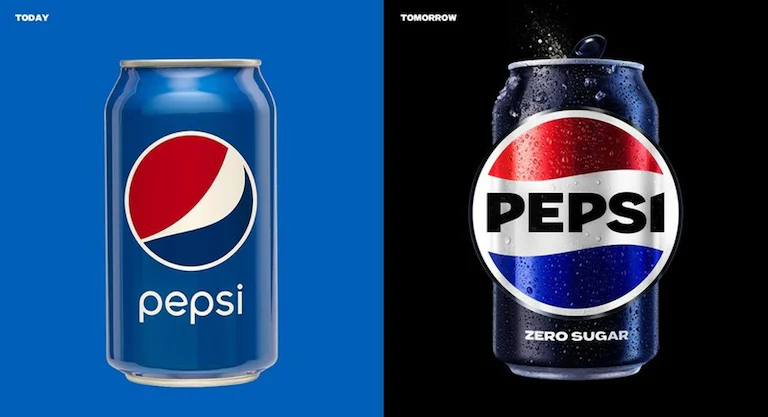
Marking its 125th anniversary in 2023, despite having first gone on sale as “Brad’s Drink” in 1893, Pepsi unveiled its latest rebrand in North America on 28th March, rolling out to the rest of the world in 2024. Currently a red and blue circle bisected by a white line with “pepsi” placed under it, the new logo returns the name in bold capitals to the newly wavy line, termed by them as a “pulse”, in what is essentially a refresh of the branding used from the 1960s to the 1990s.

Pepsi’s Chief Marketing Officer, Todd Kaplan, said in PepsiCo’s press release that “This new visual system brings out the best of the Pepsi brand's rich heritage, while taking a giant leap forward to set it up for success in an increasingly digital world.” Not unlike the BBC’s brand refresh from 2021 [which I discussed here], the press release accepts their brand needs to work beyond the static logo featured on the products themselves: “the revitalized and distinct design introduces movement and animation into the visual system, unlocking more flexibility for Pepsi to move between physical and digital spaces, from retail shelves to the metaverse.”


However, the sentence that made me react irrationally was: “The logo and visual identity thoughtfully borrows equity from its 125-year history and incorporates modern elements to create a look that is unapologetically current and undeniably Pepsi.” My initial thought was, “Borrows equity”? Surely it would have been easier to admit “our older logo is more recognisable, and our customers are more nostalgic for it, so we are introducing a new version of it”? And doesn’t “equity” mean the value of something minus its liabilities, so Pepsi are removing elements of their branding that aren’t working? Does this explain why the Pepsi brand isn’t as timeless as that of Coca-Cola, despite how many “Coke” wordmarks they have used over time?

I now know that “brand equity” is a more specific term, relating to the social value of a brand-name, measuring its worth as a financial asset, as a product among other similar items, and public awareness. Reinforcing brand awareness not only involves removing elements that no longer work, but questioning whether what does still works as effectively as it did upon introduction, introducing new elements while maintaining consistency. The BBC logo was changed because it was required to be more flexible on screen; the cultural goodwill towards Volkswagen engendered by their Type 2 camper van helped it pass the “Dieselgate” scandal with the new, nostalgic ID. Buzz electric vehicle; the Co-Op Group reintroducing the original version of their “cloverleaf” logo in 2016, a much stronger brand than had been used in the previous twenty years [which I also talked about here].

In the knowledge of the “cola wars” of the 1980s, the chief objective is to delay changing the product for as long as possible. Coca-Cola famously blinked in 1985, using the “New Coke” controversy to reintroduce the original recipe under the new brand “Coca-Cola Classic”. Likewise, Pepsi was reformulated in the 1920s, after it had been bought out of bankruptcy. For me, Pepsi will remain the cola sold when the restaurant doesn’t serve Coke, but I am well aware of it. 

11 December 2022

THE HIT OF THE WHOLE FRUIT [374]


As much as I like Coca-Cola, I am increasingly turning to British soft drinks. Dinner usually includes a glass of Vimto, while I may choose Tango or Tizer when I am out somewhere. If I find a pub serving Pepsi instead of Coke – I really don’t like Pepsi - that means their supplier should have also stocked them with R. White’s lemonade, so I will choose that instead.

I don’t think this is because my tastes have changed, more than my consciously trying other flavours because my tastes do not include alcohol, let alone tea or coffee. I am happy Guinness 0.0 now exists, while I consider Vimto, a cordial of blackcurrants, grapes and raspberries, to be a non-alcoholic version of Pimm’s No. 1, until they join the bandwagon. A good non-alcoholic drink should taste similar to the fuelled-up version anyway, as Budweiser Prohibition Brew (now Budweiser Zero) also proved.

And then there’s Tizer. Introduced in 1924, Tizer is like a mid-point between Vimto and the strange, sherbet-like (to me) taste of Irn-Bru, the official drink of the Cop26 climate summit when it was held in Glasgow, and a drink I have since found contains quinine to taste, and whose colour I keep calling “Agent Orange” instead of “sunset yellow”. With Tizer having a strong citrus flavour comprised of whatever has been put into it, including what gives it its particularly red colour – it’s not just Coca-Cola that employs the idea of “secret recipe” in their mystique, I mean advertising - I usually say that Tizer “tastes of red”. The flavour is of itself, making comparisons difficult. Tizer’s original name was “Pickup’s Appetizer”, named for its inventors Fred and Tom Pickup, making it an aperitif in the same way that Jägermeister is meant to be a digestif.

Tizer has been owned and made since 1972 by A.G. Barr plc of Cumbernauld, originators of Irn-Bru in 1899, moving the drink there from its native Manchester, from where Vimto also appeared. Drinks sold under the “Barr” name include their own cola, cherryade, lemonade, orangeade, limeade, bubblegum flavour, ice cream soda, ginger beer and “shandyade”. Reading through this list made me realise that supermarket own brand drinks have also supplanted the old brands, being sold just as widely, taking up as much space on shelves at a lower cost, and probably not too dissimilar in taste.

From what I can see, or from what the shelves of my nearest corner shop can attest, Barr is the last of the regional soft drink makers that were the main suppliers of soft drinks for its local area, much like channel 3 on British televisions was for Granada, Meridian or Tyne Tees, before “ITV” became the main name. Other such brands with history reaching back to the 19th century like Corona, Alpine and R. White’s, of which only the lemonade now remains on sale, wouldn’t be sold nationwide until the 1960s and 70s.

As it stands, British soft drinks are dominated by three companies: alongside A.G. Barr is Britvic, which owns Tango, Robinsons fruit drinks and R. White’s in addition to producing Pepsi, 7Up, Gatorade and Lipton’s Ice Tea under licence; and Coca-Cola which, despite being an outpost of the US giant, originated the pineapple and grapefruit drink Lilt in the UK in 1975. In other words, they compete on brands rather than flavours. It isn’t a surprise that Corona, bought by Beechams in 1958 and sold to Britvic in 1987, has failed to survive while its orange soda brand Tango, which was introduced in 1950 and produced alongside a separate Corona orangeade, that must have tasted different in some way to be worth the effort, has thrived since the 1990s through its use of surreal and absurdist advertising – “You know when you've been Tango'd” was a slogan used in everyday life at one point, whereas “I’se Got the Ize”, from a 1986 Tizer ad that showed the drink changing the drinker’s speech, didn’t take so well. 

The temperance movements of the late nineteenth and twentieth centuries have, while losing out to liberation and moderation, have left their mark in what I get to drink instead. With Coca-Cola gaining popularity quickly due to its being introduced in 1886, the same year alcohol was banned in its home city of Atlanta, “Vim Tonic”, later Vimto, was introduced in Manchester in 1908 just as a new Licensing Act sought to increase alcohol duty and reduce the number of pubs. This history gives the impression that soft drinks are what you have “instead”, which for me is preferable from umpteen types of beer and wine.

That said, I can’t think of an alcoholic equivalent of Tizer. Aperol? Ruby Grapefruit Bacardi Breezer?

02 August 2020

A WHOLE LOT OF FUN, PRIZES TO BE WON [253]


Coke Zone was the name of a loyalty points scheme operated by Coca-Cola from 2008 to 2013 across its range of soft drinks. By collecting codes printed on bottles, boxes and can ring pulls, the points you accumulate could buy money-off vouchers to use in stores, magazine subscriptions, cinema tickets and, if you were lucky, expensive electrical items like games consoles and cameras.

I have great memories of Coke Zone. Diet Coke is still my favourite drink, and because I rarely ever drink anything alcoholic, Diet Coke is often all I ever drink, apart from water. Introducing a loyalty scheme to a product for which I was already a loyal customer was very welcome indeed.

To be honest, I practically fleeced Coca-Cola when they ran Coke Zone. I diligently collected the codes to enter on their website to collect the points, and friends and work colleagues that knew I was collecting the codes gave me their bottles and cans to throw away, after I wrote the codes down. You were only allowed to collect fifty points per week, and while a 330ml can gave you one point, a 500ml bottle gave you two, and a multipack scored five points, I often reached their weekly limit due to the codes I was given.

In return, I received many things: 100 points could be exchanged for £5 vouchers to use at HMV to buy CDs and DVDs – before 2011, when HMV also owned the bookshop chain Waterstones, I could redeem them for books as well. I received quite a few tickets to watch films at my local cinema, also at 100 points each. I had a year’s free subscription to the film magazine “Empire.” I also had a money-off voucher for a clothes shop, which I remembered using on a pair of shorts.

The high point was when I actually caught a big-ticket item on the Coke Zone website, which often disappeared as quickly as they appeared: on a day off from work, having collected enough points to participate, I spent 600 points to buy a Sony Cyber-Shot DSC-T90 camera, which cost about £250 in 2009 – it was either one of them, or an Xbox 360 console. I still own and use this camera.


When Coca-Cola started to wind down Coke Zone in 2013, the offers had become less enticing – increased participation from people in the points scheme had caused inflation, with vouchers costing 100 points having increased to 150, then 200 points, while larger items, previously costing over a thousand points, were replaced with prize draws, spending fewer points to enter. Coca-Cola provided a final round of larger products to burn up the piles of points that some, like me, had amassed – I bought a nineteen-inch Sony Bravia television which, like the camera four years earlier, would have costed around £250, but costed 1,500 points. Once Coke Zone finally closed, I had received prizes and vouchers worth a total of over £650.

I have never been that lucky since, although I rarely enter any competitions. However, I have benefitted from other points reward schemes: HMV started their own, Pure HMV, whose money-off vouchers came in good use when I realised I needed David Bowie’s complete discography after he died. Like Tesco Clubcard and the Boots Advantage card, my loyalty to buying products from them that I could have bought elsewhere is being rewarded, rather than buying one brand instead of another – I guess the 1980s “cola wars” between Coke and Pepsi never really ended. Meanwhile, my bank introduced a current account in 2014 that offered its own yearly choice of rewards, one of which was six free cinema tickets per year. I have paid to watch a film in a cinema only a few times in the last ten years, and one of those times was for “Cats.”

My Coke Zone online login apparently still works, but Coca-Cola’s website now only offers product news and the occasional competition, which is perhaps all it should ever have done. Coca-Cola is a brand that does not need to advertise as much as other products, such is its place in popular culture – I wish I could find a copy of the poster I once saw that shows a Coke bottle with the slogan, “And what would you like to eat?” They only need to advertise to remind people they are there, which is why you see Coca-Cola ads most often at Christmas, Easter and during the summer.

Fortunately for Coca-Cola, I would have continued drinking Diet Coke regardless of whether Coke Zone existed, but I took advantage of it while it was there. My continual loyalty to them has since been measured in pounds Sterling, rather than points.

29 October 2018

JUST FOR THE TASTE OF IT [133]


Every so often, I will look in a shop that purports to sell American candy and drinks, or look online, to see if they have cans of Tab, the original Diet Coke, for sale. It has been over two years since I last tasted Tab, and over two years since the shop I bought it from had closed. A seller on Amazon is apparently selling two cases of twelve cans, imported to the UK, for nearly £60 – this is approaching wine prices, but unless I can find something for less, it may be my last resort. Is it the taste, or the thrill of the chase, that keeps me looking?
It’s not just me – even in its country of origin, people are getting desperate. Stories have been running about the largest independent distributor of Coca-Cola drinks in the US, covering fourteen states, deciding to discontinue Tab. With what remains on store shelves, supplies are drying up, and the search for its delightfully bitter aftertaste – a result of sweetening with saccharine, instead of the smoother taste of aspartame – continues into neighbouring states, and further afield.
Really, it’s not that surprising that Tab is easier to find – its original success threatened its company’s brand. Coca-Cola introduced Tab in 1963 as a zero-calorie alternative to, well, itself. It’s pink-coloured can was marketed to women, and its name, originally chosen from a computer printout of random letter combinations, because the name “Diet Coke” was considered heresy to the original drink at the time, was marketed to everyone with their weight on their mind. All of Coca-Cola’s zero-calorie drinks used the Tab name in the 1970s, including what became the diet versions of Sprite and orange Fanta.
However, diet Coke (originally with a small “d,” with the strapline “just for the taste of it”) was launched in 1982 at the point where the original Coke was losing out to the growing market of diet drinks – there was a diet Pepsi by then too. The taste was enough, making Diet Coke the fourth-biggest drink in the US by the end of 1983, and just to show the power of the Coca-Cola brand, taste tests showed people favoured Diet Coke from vending machines even when the cans actually contained Tab – no wonder present Tab cans take pains to tell you where they came from.

However, taste tests can lead you down a blind alley. The Tab formula was changed in 1984 to use the smoother-tasting aspartame, as used in Diet Coke, and an outcry reversed it – saccharine is just part of the taste. The New Coke debacle of 1985 repeated it, because more people said, in tests, they preferred a sugary version of Diet Coke. In both cases, habits were changed, and taste buds went mad. Now, in the face of replacing Tab with Diet Coke because you cannot get Tab anymore, the same thing will happen.
I would like to see where this goes. In the UK, there has been a conspiracy on social media that Coca-Cola Cherry has been withdrawn, when this is not the case – that doesn’t bother me, I have only ever bought it by accident. However, should something only receive a resurgence when there is a threat to take it away? I would rather not spend £60 on soft drinks, I know that much.

19 October 2017

I’LL PICK A ROSE FOR MY ROSE [78]


A weekend trip to a home furnishing shop led to my gazing at a display of artificial flowers – yes, you can now find fake horse chestnut branches, free of bleeding cankers, with spiky capsules and all. However, looking at the limited selection of roses, I thought to myself, “if you can’t make real blue roses, how come you can’t buy a fake one?”

Blue roses, something never found in nature, are desirable precisely because they are unattainable: in Chinese folklore, the idea of them are used to signify unrequited love, while in the western world, mystery, the impossible, and quests for the impossible are often highlighted by the flower. These ideas were formed at a time when the colour blue itself was very expensive, formed using cobalt or lapis lazuli, and featuring rarely until synthetic dyes were introduced in the 19th century. Rudyard Kipling’s poem “Blue Roses” depicts a man’s “idle quest” across the world to find the roses his love truly wants, despite being able to freely pick red and white ones – when he finally returns, she has died: “It may be beyond the grave / She shall find what she would have.”
So, if you have bought a blue rose, it will have been a white rose dyed blue, unless you have come across “Applause,” a rose cultivated after twenty years of research between the Australian company Florigene, and Suntory, its Japanese parent company. It appears to be as “blue” as a blue greyhound – it is actually more lilac in appearance, and the research on producing a bluer rose is ongoing. In the meantime, “Applause” is on general sale as a luxury item, particularly geared towards a Japan, where “Ikebana,” its tradition of flower arranging, is taught in schools.

The strangest aspect of this rose is the presence of Suntory, as its company in the UK is known as Lucozade Ribena Suntory – in January 2014, it bought the drinks division of GlaxoSmithKline, minus Horlicks, which the British pharmaceutical company opted to keep. Suntory began as the name of a whisky, but now own brands such as Jim Beam, Teacher’s whisky, Courvoisier brandy, and Orangina. Suntory owns the vineyard Château Lagrange, in Bordeaux, where a high percentage of the grapes planet are cabernet sauvignon – delphinidin, the blue pigment in this type of grape, was transferred to “Applause.” Meanwhile, Suntory’s business as the exclusive Japanese bottler and distributor for Pepsi has made its way into the anime version of the manga series “Tiger & Bunny,” where its superhero characters receive on-screen sponsorship by real-life companies –  the character sponsored by Pepsi is named “Blue Rose,” which I have concluded is a happy accident.