Showing posts with label Nosferatu. Show all posts

12 March 2023

THEN FIRE, MAKE YOUR BODY COLD [387]


I had wanted to buy a copy of Carl Theodor Dreyer’s “The Passion of Joan of Arc” for a while. I now have the Eureka Entertainment "Masters of Cinema" series edition, making it part of an excellently-produced series that includes the definitive versions of silent films like "Metropolis," "Nosferatu," and "The Cabinet of Dr. Cagliari," along with later films like "Nashville" and "Grey Gardens" - although, if you are a serious film collector and scholar, you will be already aware of this.


My reason for buying this film is, like "Citizen Kane," it is considered one of the greatest films of all time. Both films also suffered the fate of the original camera negative being destroyed in fires. However, with the reputation of "Citizen Kane" only being firmly established after the critic Pauline Kael wrote about it in the 1970s, "The Passion of Joan of Arc" was seriously studied from the start, even if everyone was watching the wrong version of it.


As befits a religious-themed, pre-"Life of Brian" film, and one not made by a French person, "Joan of Arc" was subjected to cuts mandated by French film censors and the Archbishop of Paris. The fire happened after that, and in a time when copies of films were easily discarded after use, and when those copies were routinely made from the original negative, the original film was as good as lost.


What do you do from here? Carl Dreyer was able to stitch together a second version of the film, using alternate takes, and other shots not originally used.


That version was also destroyed by a fire in 1929. "Safety film" was not introduced until the 1940s, meaning an entire art form had to rely on nitrate film stock, combustible when stored or even moved wrongly.


Until 1951, the only widely-available version of the film was a cut-down version with a commentary from an American radio personality. The rediscovery of a print of the second version consigned the bastardisation to the bin, but this version had a Baroque-style film score and subtitles added by the person who found it. All the while, the director had to look on and object to what happened to what was left of his work.


This is where it gets weird, if it didn't feel so already. In 1981, a copy of the original version was discovered, in its original wrapping from the Danish film censor, in a janitor's cupboard in a mental hospital in Oslo - in 1928, the director of the hospital asked for a copy, as they had written about French history. The Norwegian Film Institute was contacted to see if they wanted it. They took it, then stored it for three years without watching it. When they finally did, it was found to be perfect.


This sort of miraculous discovery is not new - two episodes of "Dad's Army" were rescued from a skip, some Patrick Troughton "Doctor Who" episodes were recently found in Nigeria, and the now complete version of "Metropolis" used elements found in Argentina and New Zealand. The simple thing is never to throw anything away, as you may not be the one who realises how much it is worth.

09 August 2020

IT WAS A GRAVEYARD SMASH [254]


"Nosferatu," a German horror film directed by Friedrich Wilhelm Murnau in 1921, may now only receive a "PG" rating from the British Board of Film Classification, but I still problems watching it. Count Orlok's unnatural features and movement, the shadows, and the sense of foreboding may now only be advised as "mild threat" by the BBFC, but their cumulative effects beat the jump scares of a flash of red, a spray of blood, or a hunk of flesh.

Meanwhile, auteur theory, centralising a film’s director as the prime creative force in its making, is just as pervasive in film culture as horror movie tropes, making artists out of John Ford, Alfred Hitchcock, Steven Spielberg and George Lucas, and even its proponents, like Jean-Luc Godard. The critic Pauline Kael saw through it, preferring to look at each film individually, through the collective effort of everyone that made it: “The auteur theory is an attempt by adult males to justify staying inside the small range of experience of their boyhood and adolescence, that period when masculinity looked so great and important.”

I only mention auteur theory because I can only assume this is why F.W. Murnau’s skull is still missing from his grave. It remains unknown who broke into it in July 2015, but wax found at the site suggest candles were used in some sort of ritual. I assume the grave has now been sealed by the cemetery, as this was being considered due to previous break-ins – Murnau’s brothers, buried in the same plot, were untouched. The prevalence of auteur theory in how people discuss film still does not mean that Murnau, still revered for “Der Leitze Mann” and “Sunrise,” is entirely responsible for “Nosferatu” as we know it - it’s a bit like saying Wes Craven made “A Nightmare on Elm Street” because he was a psychopath.

"Nosferatu" was deliberately designed to be an occult, supernatural film by its producer and distributor, not the director. Prana Film planned many similar films, had an occult mail order catalogue as a side business. Its co-founder, Albin Grau, a German version of Aleister Crowley, was also the production designer, filling props and backgrounds with occult symbols. Prana Film went into bankruptcy after the release of "Nosferatu," infamously an unauthorised adaptation of “Dracula,” in order to avoid the copyright infringement lawsuits from Bram Stoker's estate.

Before “Nosferatu,” Murnau had already directed one film about a fractured personality, that was also an unauthorised adaptation of a British novel - "Der Janus-Kopf" (1920), starring Conrad Veidt and Bela Lugosi, was based on "Dr. Jekyll and Mr. Hyde" by Robert Louis Stevenson. This film is now lost, but we know the it formed part of the wave of German Expressionist films trying to examine the forces that German society found in itself following the First World War, leading to films like Robert Wiene’s “The Cabinet of Dr. Caligari”, Paul Wegener & Carl Boese’s “The Golem: How He Came Into The World” and Fritz Lang’s “Dr. Mabuse the Gambler” and “Metropolis.”

However, no-one used the power of German Expressionist cinema to disrupt the graves of those directors, or that of Albin Grau.  

24 April 2019

I PUT A SPELL ON YOU [166]


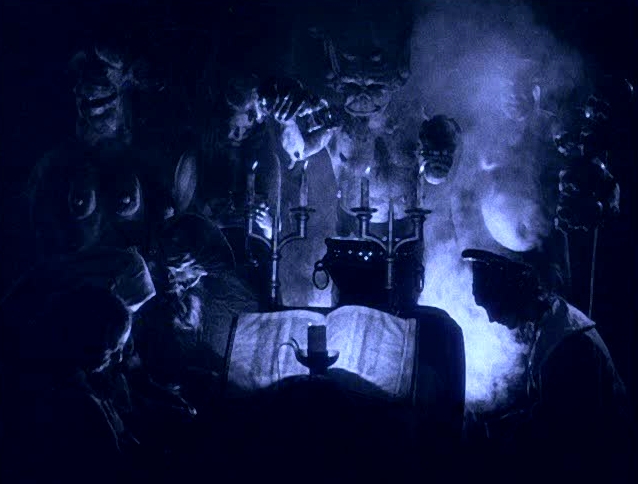
Few films could ever get away with the explanation that extreme violence and imagery is required to tell its narrative correctly, and “Häxan” (Swedish for “The Witch,” and pronounced “haexen”), looking at the history of mysticism and the occult, is one of the rarer cases that invented a new type of film to do it. Introduced as “a presentation from a historical and cultural point of view, in 7 chapters of moving pictures,” “Häxan” is one of the first examples of documentary, one with historical reconstruction too, but the events retold were so horrifying it was heavily censored around the world, and was banned outright in the United States for many years.
I had always got the impression “Häxan” was a bit like “Nosferatu,” in that the producer was involved with the occult in some way - in fact, the money was provided by Svensk Filmindustri, later Ingmar Bergman’s employer, and still running today. The idea for the film did come from its maker, the film and stage actor/director Benjamin Christensen, buying a copy of the 15th century treatise on witchcraft “Malleus Maleficarum” (“Hammer of the Witches”), written by an expelled German Catholic clergyman, which provided the legal and theological basis for witch trials – the reconstructions in the film essentially dramatize what the “Malleus Maleficarum” said you should do with witches. However, there is no evidence that Christensen took this interest beyond it being a good subject for his film, although he would play the plum role of the Devil himself, horns and all.

The film begins by laying out its academic credentials: ““Benjamin Christiensen wrote the script and produced the film between the years of 1919 and 1921... My main sources are mentioned in the theatre’s playbill...” What does begin as a necessary lecture of lantern slides and woodcut pictures, dioramas where a wooden stick appears to point out details, and a lot of reading, even for a silent film, the action really picks up when all that cinema could do is then thrown at you: sumptuous Medieval sets; people dressed in animal costumes, having been transformed by the devil; cannibalism of human babies at night, the film stock tinted blue; cavorting nuns in a church; medieval jump scares as the Devil appears; reversing film as money disappears out of a room, to tempt someone to chase it; double exposure to show witches flying on broomsticks; and even very early stop-frame animation, portraying a tiny demon appearing through a wall.

As explained in the film, there are a great many contemporary accounts from women that can be drawn upon for how they thought they were possessed, and what happened in their minds, and the last part of “Häxan” explains this through the more “modern” and psychological understanding of hysteria, now known as conversion disorder. Modern instances of pyromania and shoplifting are deliberately reconstructed using the same actress from the medieval scenes, because we are told that is what and why they are doing it. A shot of a woman under a “temperate” shower at a clinic fades to a woman burning at a stake, highlighting an undercurrent in how the same illness has been dealt with, even by the film’s release in 1922.

Even if the United States would not show “Häxan,” Christensen would be in Hollywood within two years, directing films for MGM and Warner Bros., although he would be back in his native Denmark by 1930. His only other horror films were in a trilogy of short feature films co-written with Cornell Woolrich, two of which are now lost. Ironically, Christensen did work with Lon Chaney, but it was in a 1927 film about the Russian Revolution called “Mockery.”

“Häxan” would be reworked into “Witchcraft Through the Ages” in 1968, featuring a highly distracting jazz score, and narration by William Burroughs, the author of “Naked Lunch,” reworking Christensen’s intertitles, but Burroughs’ voice almost speaks of experience when, as a woodcut picture is shown, he says, “...whilst another old biddy has maliciously cast a spell on a man’s shoes.” She was then captured and taken to Interzone...