Showing posts with label BBC iPlayer. Show all posts

24 October 2021

YOU’RE STILL THE ONE [316]

Back in 2017, I wrote about BBC One replacing its channel idents with the “Oneness” series of group portraits, photographed by the artist Martin Parr [link]. I ended that article by saying: “…getting audiences to programmes do not rely on individual channels so much, unless you count the BBC iPlayer or Netflix as a ‘channel.’ For the BBC, Martin Parr’s new idents may be more important for the ’BBC’ on screen, rather than for the ‘One’.”

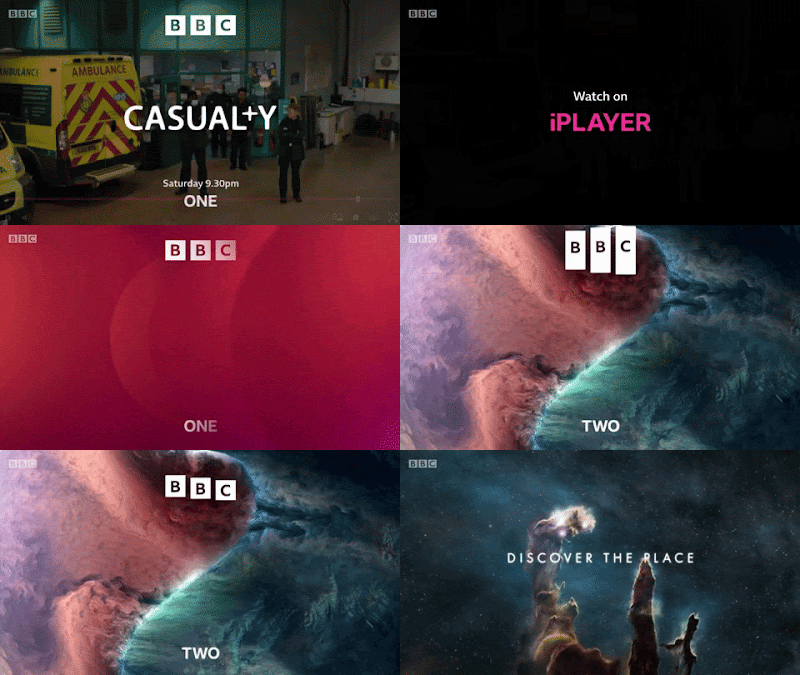
On Wednesday 20th October, the BBC unveiled new branding that placed their restyled logo at the top of screens, programme trailers and poster advertising, and their channel names in smaller letters at the bottom, underlining the inevitability of the move – all programme trailers end with “available on iPlayer,” placed prominently in the middle of the screen, just as “iPlayer” and “Sounds” replaced the “TV” and “Radio” categories on BBC Online. Long gone are the days of simple radio-like announcements over slides of upcoming shows. Moreover, the way the new logo is used highlights, at a fundamental level, the change in how we watch television over the last twenty-four years.

I have always changed my website’s logo and branding when it was needed, as proved by my 300th article showing five logos over five years [link], as I zeroed in on the most effective way of presenting myself and my work. Likewise, the BBC’s logo, a variation of three letters in three boxes since it was first introduced in 1958, has been modified as its uses have changed, from identifying a broadcaster to supporting the quality of British programmes sold worldwide, to being a mark of reputation to sell tie-in merchandise, to being a sigil for a British national identity portrayed through cultural soft power. 

As much as some people search for the opportunity to complain about taxpayers’ money being perceived to have been wasted on a logo change that is still superficially similar to the previous version, you have make changes when your current branding is found to have stopped working effectively. As stated by the BBC’s Chief Customer Officer, Kerris Bright [link], “Our research tells us that audiences think some of our services look old fashioned and out of date. They want a modern BBC that is easier to use and navigate to find the content they love and enjoy.” 

If people in its own country are saying that, then perhaps it was being said elsewhere. The latest BBC logo was introduced in April 2021 on an online streaming service aimed at North America, BBC Select, and on the Australian TV channel BBC Kids, six months before the UK saw it on screen. Because these are subscription services, their audiences are also, indirectly, paying for the new logo. Meanwhile, the latest Cadbury logo, using thinner lines and closer to the company founder’s original signature, was first seen on chocolate bars sold in Australia. 

A big feature of the BBC’s new branding, and one that has been introduced gradually for a couple of years, before reaching the logo, is the font. “Reith,” in its sans serif form, may not immediately be too different from the previous use of Gill Sans to the casual user, but the one-off cost of the BBC buying its own font, to use it as much as it wants, contrasts with the yearly fees to use Gill Sans, Helvetica, Futura and other fonts over the years. I could not find how much the BBC pays to use fonts, but I could also not find out how much Ikea saved in 2009 by switching their shops and catalogues from using Futura to Microsoft’s cheaper font Verdana.


The previous BBC logo was introduced in 1997. The logo that version replaced was deemed not to work when made smaller on screen – the lines under the blocks, and the spaces in the letter B, began to disappear. Its replacement was simplified, easier to reproduce and was more legible on screen.


What has changed since then is the screen. In 1997, people were still watching cathode-ray tube (CRT) televisions, beaming a raster pattern of electrons onto a fluorescent screen. LCD and LED televisions did become commonplace until 2006, when regular HD television broadcasts began in the UK. In 1997, the BBC still played their idents for their channels from laserdisc, with servers not being used until widescreen broadcasts began in 1998. They still only had two channels to worry about – the BBC News Channel began in November 1997, followed by BBC Choice in 1998. Aside from all this, watching television from a non-television screen only properly began when the BBC iPlayer download service began in 2005, only becoming a streaming platform in 2007, the same year Netflix began their own service – the flood of mobile, tablet and other connected devices began from there.


What made me realise this was using the BBC News app in beta mode. I knew about the new logo from the reports of BBC Select introducing it, finding that an upcoming update to the News app will use it. In using it, I found that the logo, placed at the top of my phone’s screen, placed its blocks further apart so they can animate more clearly: swiping down to refresh the page would stretch the blocks before reverting to their correct shape, and they would shrink to lines as I moved down the page, maintaining their presence as a constant reminder. 


I thought this animation was something cute at the time, because it is something you could do on your phone, but I didn’t think it would happen on television. With the blocks making the Channel 4 logo having been broken up and thrown about since it began in 1982, and with a new ident on ITV seemingly every week as part of an artist initiative, it is now time for the BBC to stop being defined by three static, immovable blocks. 


Now, they rarely ever sit: they move in, they fall into place, they move up, down, in and out. Perhaps this could have been done fifty years ago, but when BBC One and Two had idents that were live feeds of clockwork models, it wouldn’t have been practical. It certainly does not feel like the logo of a corporation that is approaching its hundredth anniversary in 2022, but that is entirely the point: this will be the last BBC logo made for a regular television screen, if not for a linear television channel. Next time: holograms, probably.


There is a lot to be said for the triviality of a broadcaster changing its logo, as I have proved, but because of the unique way it is funded, the BBC belongs to everyone, and it represents us all to the rest of the world. I want it to look its best.

06 March 2021

IT’S MORE THAN I DARE TO THINK ABOUT [285]


One of the many arguments for public service broadcasting is the ability to commission and broadcast a long-form polemical documentary, composed almost entirely of stock footage, telling a huge and difficult story, with the guarantee that it will be watched by a small but highly engaged audience and, because of the rights for the stock footage, cannot be issued on home video. It is entirely the sort of project in which the BBC is expected to invest, but it is also the signature form of Adam Curtis, whose latest series “Can’t Get You Out of My Head” was unveiled on the BBC iPlayer in February 2021.
 

Curtis specialises in densely-packed stories about how power is structured, from how memory and history is manipulated by politicians in 1995’s “The Living Dead,” through the exploration of concepts of freedom in 2007’s “The Trap,” to how computers distorted our view of the world in 2011’s “All Watched Over by Machines of Loving Grace.” From the feature film-length “Bitter Lake” (2015), which looked at the failure of the political good-versus-evil narrative, Curtis’s work was freed of the constrictions of TV schedules, free to flourish on the BBC iPlayer, telling stories bigger still: “HyperNormalisation” (2016) was a two hour, forty-minute film about how we reached where we are as a society today, and why we don’t know where to go next. 


These series and films mix sociology, politics, psychology, philosophy, along with eclectic uses of music and stock footage to support the narrative: Curtis has explained that his signature use of the latter, starting from 1992’s “Pandora’s Box,” came from trying to find a way of illustrating the concepts of rationalism and systems analysis found in that series, compounded by the twin threats to a filmmaker of desperation and deadlines. Watching films by Curtis can be intoxicating in the conviction with which his narratives are told, and with the inspiration in the visuals chosen, but you can also see how his work inspired similar videos on various subjects on YouTube and other video services, as stock footage libraries and professional video editing become ever more accessible. 


Lasting seven hours over six parts, the last running for two hours, “Can’t Get You Out of My Head” is billed as an emotional history of our times, about how power shifted from the old ruling classes and elites towards individuals, and how this shift created its own set of problems. The lives of individuals like Jiang Qing, the single-minded Chinese actress who became wife of Mao Zedong and chief of Chinese propaganda; Michael X, an enforcer for a London slumlord who became a Black revolutionary; and Julia Grant, a transgender woman whose transition challenged the medical gatekeeping of her time. Good or bad, they were out on their own by necessity, and despite the system. 


Watching all six parts of the series is overwhelming – I am supposed to be sceptical of grand narratives like the one weaved by Curtis through these episodes, building a picture of a world that has lost its way, but the central premise of the series is that it is not clear where we are going, so having Curtis attempt to untangle the threads, building on both the themes and the weight of his previous work, is welcome. I get the feeling that the final two-hour episode was originally envisaged to be the whole story, but you realise the magnitude of events being weaved together required the previous five hours of explanation first. My takeaway from it was that revolution is not possible because the world has been made too complex to understand in a predictable way, and that while using computers made the complexity more manageable, it rendered consciousness essentially useless – you can see the world how you want, but it won’t make any difference. This is where populism and social media could then exploit “high-arousal” emotions in people, like outrage and suspicion. Anything can be made to be anything, and societies have become exhausted.


I was grateful for two examples of human gullibility, excavated and woven into the narrative, that I should have framed: “Operation Mindfuck,” the thought experiment that placed a fake letter in “Playboy” magazine about the conspiracy theory of the Illuminati, because an 18th century Austrian society being in charge of the world today was supposed to be transparently a silly thing to believe; and that the imagery of the Ku Klux Klan was not only a fictional creation from the novel on which the film “Birth of a Nation” (1915) was based, but that the novels of Sir Walter Scott that inspired that imagery was itself fictional.   


It is hard to expect a documentary series to provide answers for how we should get out of the hole that has been described, but “Can’t Get You Out of My Head” makes clear that whatever comes next, especially after the catastrophe of Covid-19, will be something we have to think about, and whether individualism is something stays or melts back into society, we may have more reason to be confident about making those decisions than we thought. 


The series is a towering achievement for Adam Curtis, not least because of its size and ambition, but also because it feels like the climax of the stories he has told across the last three decades. It is also telling that BBC Three, the online channel for which the series was nominally made, has been chosen to return as a regular over-the-air TV channel from January 2022, as if the stories told for it need to be seen as widely as possible. I suspect Curtis is already looking for what that next story will be.


The series ends with the line chosen to begin it, written in Curtis’s customary bold Arial font, from the anthropologist David Graeber, from his book “The Utopia of Rules: On Technology, Stupidity, and the Secret Joys of Bureaucracy”: “the ultimate, hidden truth of the world is that it is something we make, and could just as easily make differently.” I have a copy of that book, so I should perhaps read it again.

20 October 2019

WHEN YOU TELL ME WHAT WILL BE [203]


I don’t like being given opportunities to feel old, especially as I am still in my thirties, but the inevitability of progress in technology, working against my human stubbornness to adapt to a new way of working, will provide more situations to reflect on where that progress leaves you.


What am I talking about? It’s more that I don’t expect my devices to talk back at me, mainly because I turned off their ability to talk. Even more, I have turned off their ability to evaluate my commands.

Before I make myself sound even more paranoid, this is based on the principle of knowing that, if I want something, I will ask for it. I will not say “Alexa...” or “Hey Siri,” “Hey Google,” “Hey Cortana” – I’m not really a “hey” kind of person – and expect the artificial intelligence based on previous interactions to throw up what it thinks is the right answer, or what is the first answer, or the answer most accessed by others. 

The only virtual assistant I do use is Siri, on my Apple TV box, purely to speak the name or title I want to search on YouTube, Vimeo or the BBC iPlayer, an expediency over just typing it, which is the final resort when it doesn’t accept how I’ve pronounced a vowel.


While the debate over the application of virtual assistants is currently focussed on the microphone – your voice being recorded and analysed, even when you are not using it – my concern is on its ability to act as a bridge in human thought, making evaluations over the answer it thinks I will need, without informing me on how it came to that decision. There is an implication of trust on my part, which turns into a lack of trust in practice.

If so, why am I happy using a search engine like Google? Is it the trust gained over twenty years of usage, that virtual assistants need to demonstrate? (Siri, the oldest of them, began in 2011.) Is it having a screen to view the answers of the search engine providing the illusion of choice? Is it that the algorithms that influence the search results are more well-known? (For Google, PageRank evaluates the links to pages, and between pages, Panda promotes higher-quality sites, while Hummingbird emphasises natural writing over forced keywords – how am I doing so far?)

Perhaps, I am still looking at virtual assistants as being in their infancy, as having pretensions over previous voice-activated units that acted as glorified hands-free switches. It comes back to trust over the answers I would expect them to give, if I tried to use them. I just need something to explain how they came to their decisions, like a screen, and something to choose and edit the answer, like a keyboard.


14 May 2018

HE’S GOT A TV IN EVERY ROOM [109]


It has been nearly two years since I added a smart TV box to my television, and my viewing has never recovered. Unless I want to watch a programme right away, instead of catching up later, my TV will be switched from “DTV” to “HDMI-2,” so I can dive into the BBC iPlayer, YouTube and Netflix – “HDMI-1” is for my blu-ray player, having got there first. I am very suited to this arrangement, as I now have a larger screen to watch the video essays you often find on YouTube for films, music, computer games, dead shopping malls, and other subjects that may be too niche for “regular” TV.
Because I don’t often watch traditional TV programmes, my TV has turned into a multipurpose screen for whatever I can put onto it, including films and podcasts. The same can be said of my phone, as well as my tablet and desktop computers: they all are now types of computers, able to do most, if not all, the same as each other. It reminded me of a Venn diagram I copied out of a book over fifteen years ago, where Nicholas Negroponte, founder of, among other things, MIT’s Media Lab, the One Laptop Per Child initiative, and “Wired” magazine, had predicted that media, telecommunications, and consumer electronics, with few overlaps even by the 1990s, will have become a conglomeration of “edutainment” by about 2005 – Negroponte described this in the mid-1980s, even referencing the idea of “surrogate travel” using virtual reality.

Now we have our all-purpose screens, what I have realised is that, now that “television” is – was – a bit of a magpie medium to begin with. Films have been a big part of schedules since the very beginning, but that involved taking an established form out of its usual setting, a pitch-black, quiet room – and making it a background object in the corner of a room. Comedy programmes, panel games and discussion shows, especially when in front of a studio audience, have their origins in theatres and halls – drama used to be the same, but have become more filmic themselves. News is often nothing more than radio with pictures – indeed, BBC News reports are planned as a one-minute piece for Radio 5 Live or the World Service, before pictures are added further down the line. What was television offering all this time, other than making it more convenient to access moving pictures?
Decades ago, I would have asked the same question of cinema, radio and newspapers, as television has been described as the death knell for all of them, but I just don’t think that TV won if you can now access all of these through a screen. I don’t think the internet won either, because describing it as a medium, in the same way that the others are types of media, doesn’t really work either – everything is online because it is higher in quality and efficiency for getting content to you than by sending it over the air, or by printing it out. The restraints on different genres of content were also freed from TV more quickly than it took for TV to adopt them, but everything moves faster these days, and you can never say there is nothing to watch on TV anymore.