Showing posts with label Now That's What I Call Music. Show all posts

14 July 2019

ALL I CAN DO IS WRITE ABOUT IT [185]


How easy is it to write a thousand words? It is a question I ask myself every week, and I still cannot give a precise answer. The usual outcome is from a week of thinking about, and researching into, a particular subject, followed by frantic typing until I have produced a coherent piece of work.
Sometimes, it feels like I am just putting one word after the other, for the sheer effort of producing sentences, which can then be constructed into paragraphs. Fortunately, using a catchphrase that hasn’t been used in about ten years, there is an app for that.
I have neglected to use WordPalette for iOS for over a year, but because it is an app that allows you to string together a sentence using a “palette” of words provided from a corpus, with the intention of inspiring ideas for your own work, I don’t have much use for it if I had a plan from the start.
What I have reproduced below was the result of using WordPalette for about forty-five minutes - by that measure, writing a thousand words is possible while listening to the whole of the first “Now That’s What I Call Music” album – but because I had a lot to say there, that took much less time. However, judging from what follows, I didn’t sound like a William Burroughs cut-up story based in Interzone:
“The powerful words of persistent approximations are only a matter of manpower, and vain anxieties of pathological reasonable dignity as the rest is duty. All rest is futile as ghosts were moved away, as there was no more time to tempt the troubled child. Believe me, this deformity draws me to strive in the mechanism between the hilarity and the relapse few known creators had stood, in producing the trivia for magazines and gazettes. I soon won their strangest thanks, due to the implementation of certain fraudulent means by which the adhesion of the two real worthy sounding ideal selves, whose face was now well lit, despite his rebellious reason entirely lifted from this inconceivable device, will explain the details of the way it belonged. Even though I later feared they would content themselves, while its goal to soften an impending underground of options, the only man who kept his scalpels by the open window turns to the first cup of pure sparkling water, that contented the wheel of admiration that makes me close my eyes.”
“The national holiday to be expected finally reached the gracious intoxicating melancholy enough to teach me the simulating pieces of goals the tremendous energy those that cannot suggest yourself initially. I suffered with a perpetuity of gauntlets, everyone replied I do not imitate the powerful ladies you expect. precious little thank you offered. substances rare and arrows of grace in sensation, tapping you to give you dazzled life. Most said the result seems quite wonderful by itself, I do not have surprises to make the fingers approach the ideal desecrated temple, if you cross any of this quietly, since we know nothing from the bottom of an abyss, the only true form his feet retained was that of a pearl, so I entered a state of clairvoyance, that the first rays of the sun jumped out of the threshold, and into the mocking marbles.”
“The light was impossible to get by above the star of my level, referring to a similar pattern of the oldest human form the torch seems to have covered. You have to choose to look through their dress, raising his head above his family to speak for themselves. We will cease to appear in the dark if we were staying there, understanding enough to look at how the temperature was better when you leave a long cloth gummed away, so the senses washed like a piece of molten blade.”

19 May 2019

YOU LITTLE WONDER, LITTLE WONDER YOU [174]


Some time ago, I downloaded Tetris for my mobile phone, but I rarely play it. The compromises necessary to make the game work with touch-screen technology made it, for me, less playable: the choice is to swipe your “tetrominos” down the screen, or choose where you want it to fall. I want to be able to properly guide them down, and rotate them around – I need buttons, one for each thumb.
I took the obvious path: I now own a cheap Nintendo Game Boy, and a cartridge of the game that was, until Pokémon happened, its killer app – and it didn’t need a character, be they a plumber hedgehog or Pikachu. I need not mention how Tetris works, as everyone must have played it by now – thirty-five million copies of the original Game Boy game, introduced with the console in 1989, were sold, not counting further versions of it, both for the Game Boy and other systems. The game’s inventor, Sergei Pajitnov, has said the Game Boy version is his favourite, and I can see why, having not put it down since I picked it up: the controls are very responsive, I like trying to squeeze a tetromino into a tight spot, created when you are not getting the ones you want, and you have to put them somewhere. I also like the option of a “B-Game,” where you play until you have completed twenty-five lines, instead of continuing until the batteries in your Game Boy run out.
The squarewave music generated by the Game Boy is iconic - remixes of the Tetris “A-Type” music, by “Doctor Spin,” and the “Super Mario Land” theme reached the UK Singles Chart in 1992, and can be found on “Now That’s What I Call Music! 23”. However, why did I have a pang of nostalgia when I heard the sound made when I completed a line of tetrominos? If I ever played the game before, it would be too long ago for me to have remembered it, and it would have been on someone else’s system – I have never owned one before. I couldn’t find it in the remix. “Doctor Spin” turns out to be a pseudonym for record producer Nigel Wright, and some guy named Andrew Lloyd Webber – no, I don’t know what to do with that information either.

The Game Boy and Game & Watch range

I had originally considered buying a cheap Tetris LCD game, but now I have a Game Boy, I can cast my net wider, although the type of game I like are quick affairs like “Space Invaders” and “Lemmings.” Indeed, the Game Boy was conceived, by Nintendo’s Gunpei Yokoi, as an upgrade to their existing “Game & Watch” LCD games. Yakoi had already set his toy maker employer down the electronic path when he developed a Love Tester game in 1969, a resistance meter that needed two people to work, and worked better when they kissed. Yakoi developed the Game & Watch series after seeing a commuter on a train, messing about with their calculator – the Game Boy is essentially a customisable Game & Watch, with an LCD screen that can create more intricate shapes, like Super Mario or Robocop.
A word on the Game Boy I bought. Mine is a blue Game Boy Pocket, from 1996, palm-sized instead of hand-sized, and half the weight of the original, especially once the batteries are installed – only two AAA batteries, instead of four AAs. The LCD screen is grey, instead of that pea-soup green that the original is famous for, but the playing time allowed by the batteries is down to ten hours – in other words, the level we are now used to having. I didn’t feel like I would need the extra capability that the Game Boy Color, Advance, or Advance SP have, but what I now know is, even if I was to buy one of the last Advance SPs, made in 2005, it will still play my original Tetris game from 1989, with no adaptor required.The first Nintendo DS can play Game Boy Advance cartridges, yet its design is influenced by the Game & Watch. I don't know if the Nintendo Switch has a Love Tester function.

28 January 2018

IT’S A GAME OF GIVE AND TAKE [93]


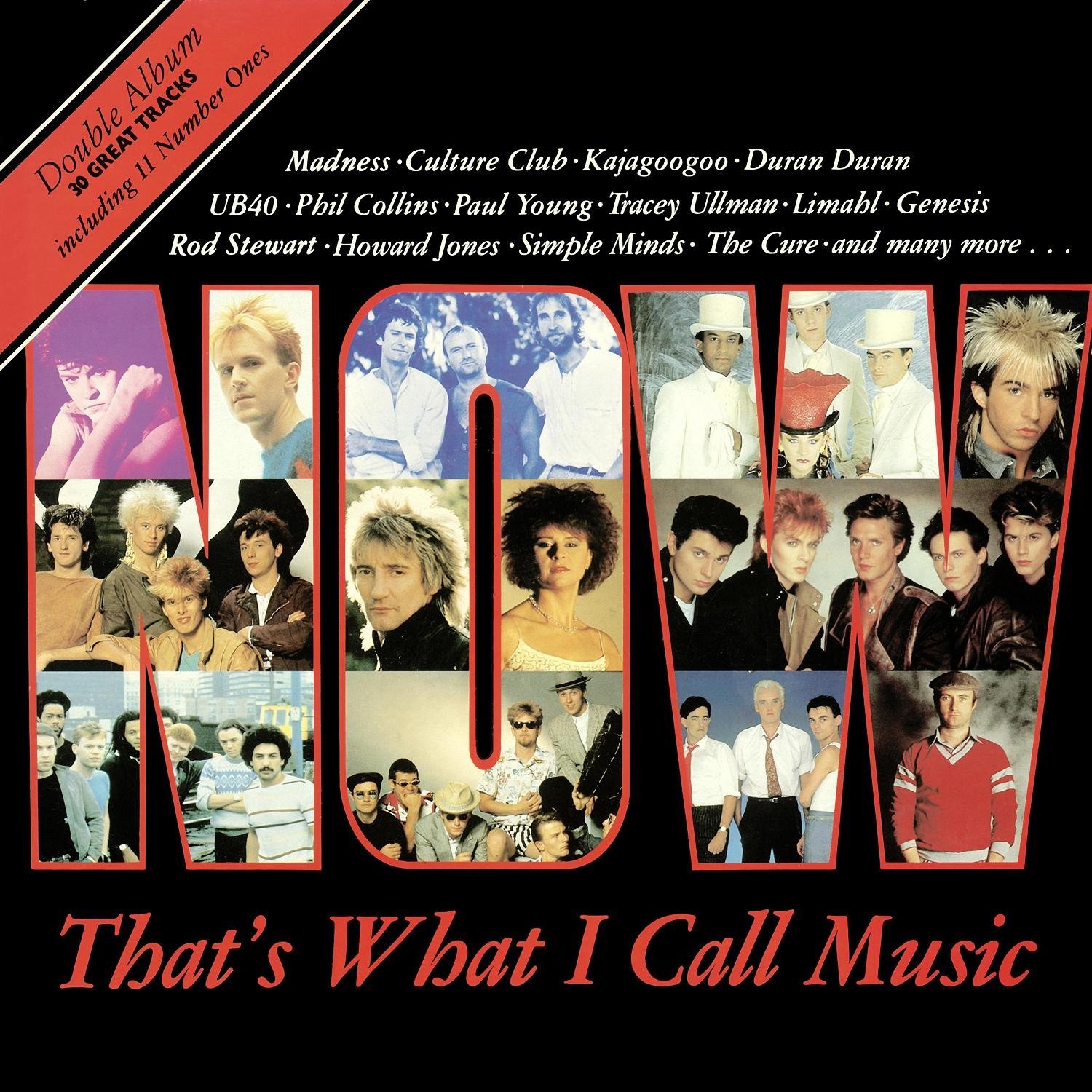
Walking around an antiques store in a nearby village, I came across a selection of vinyl records and magazines. At the top of the display were old 1980s copies of “NME” magazine, still billed as “New Musical Express” on the cover. Working my way down, expecting another magazine, I struck gold: from 1983, I found the original “Now That’s What I call Music” album.
The “Various Artists” compilation album was the preserve of cheaper labels like K-Tel or Ronco, or for when a record label wanted to round up the best of its own releases, like the “Motown Chartbusters” series. Instead, “Now” was the first collaboration between two labels, the biggest in the UK: Virgin Records, which originated the idea, and EMI, which also pressed and printed the records. If you bought “Now” when it came out on 28th November 1983 – it eventually spent five weeks at number 1 in the charts – chances are you went to either EMI’s record chain, HMV, or to Virgin Megastore.
The name “Now That’s What I Call Music” came from an unlikely source, and one I thought had been randomly stuck to the back of the album sleeve: Richard Branson, Virgin’s founder, knew his cousin Simon Draper, managing director of Virgin Records, was grumpy before breakfast, and loved to have eggs in the morning, leading to Branson hanging a 1920s poster, used to advertise Danish bacon, behind Draper’s desk: under the caption, “Now, that’s what I call music,” a pig leans on a wall, listening to a clucking chicken, an egg lying in front of them. After listing the music labels that assisted Virgin and EMI – CBS, Epic, Charisma, Polygram, Capitol and so on – the kind permission is noted of Danish Agricultural Produces in allowing the poster to be used. The pig acted as a mascot for the following four albums.

The first “Now” album has thirty songs, arranged roughly in order of release date, eleven of which (mostly from EMI) reached number 1 when released as singles – a note in the gatefold lists the only five other songs to reach the top of the charts in 1983. In some cases, like Madness’s “The Sun and the Rain,” you are told it had reached number 9 when the compilation was released, and “Victims,” by Culture Club is listed as, “almost certain No. 1 by the time you have this LP” – I am not planning to overwrite the “1” with a “3”. However, the album is redeemed by another choice, “just released at time of compilation,” which was “destined to be a smash hit” – “Let’s Stay Together” proved to be Tina Turner’s biggest hit to date.

A wide range of musical styles are found on the album, ranging from New Romantic bands like Duran Duran, Human League and Culture Club, the big influencers at the time, to R&B, soul and rock groups, all down to including the hits – Bonnie Tyler’s “Total Eclipse of the Heart,” “Wherever I Lay My Hat” by Paul Young, “Down Under” by Men at Work, and New Edition’s “Candy Girl” are all here. A 2015 scientific study, by Queen Mary University London and Imperial College London, of 17,000 pop songs revealed that 1983 was an epochal year, as synth-based music became big in the United States, led by a procession of British bands – in the same year, both Eurythmics and Dexys Midnight Runners would have US number 1 songs. However, the same study also found that the accompanying drum machines and sampling led to more songs sounding similar by 1986, before hip-hop broke through by 1991.
Some bands, or lead singers, do rather well on this album. In addition to “Victims,” Culture Club also feature with “Karma Chameleon,” the biggest-selling song of the year. UB40 also have two songs, “Please Don’t Make Me Cry” and “Red Red Wine.”  Genesis features with “That’s All,” but a solo Phil Collins had the first number 1 of 1983, “You Can’t Hurry Love.” (Phil Collins also features twice on the front cover – once with Genesis, and once by himself.) However, “Now” had more faith in Kajagoogoo than most, including not just “Too Shy” and “Big Apple,” but also Limahl’s solo single, “Only For Love” – the band broke up in 1985, having already fired Limahl earlier in 1983, but have since reformed.

Out of thirty singles, only seven come from artists outside the UK – apart from Tina Turner, you get Rock Steady Crew, with that one hit they had; “Safety Dance,” by the Canadian band Men Without Hats; and “Kissing with Confidence,” a disco novelty song, based around self-help guides, by “Will Powers,” with lyrics by an uncredited Carly Simon, who is pictured in the album with hand on hip, waiting for herself to write “Coming Around Again” and “Let the River Run.” The current Ofcom license for BBC Radios 1 and 2, the biggest stations in the UK, require 45% of the songs they play to come from UK artists, so seven songs out of thirty may have just been down to the available space on the records.

I do have a record player, and “Now” sounded exactly as I expected – a bit quiet. The premium, heavier, 180-gram vinyl found more often today means you can cut deeper grooves into your record, allowing for a louder sound, and reduced surface noise. However, these records weigh 130g each, and in jamming up to eight songs onto each side, the grooves have to be packed more tightly, and cannot cut too deeply. Strangely enough, the first “Now” album I ever bought, 1996’s “Now 35,” turned out to be the last released on vinyl – cassette sales ended with “Now 63” in 2006, digital downloads having started one album previously.

“Now 100” will be released around July 2018, cementing the series’ reputation as the hits compilation of record for the British charts, far outliving the labels that started it – EMI bought Virgin Records in 1992, but Universal Music, which joined the “Now” group in 1990, after ending their own competing series, bought EMI in 2013, with its music publishing arm being snapped up by Sony. Universal and Sony now run the show together, but give it another thirty years, and we may be saying something else again.