Showing posts with label the bridge. Show all posts

03 October 2020

LEAVE A LIGHT ON FOR ME [263]


[The script of this video is reproduced below.]

Hello there, I decided to return to The Bridge Shopping Centre in Portsmouth after a year away. On my first visit there, in 2017, it had been a dead shopping centre that had been reduced to a corridor between the main road and the Asda superstore that both overlooked it, and owned it. However, by 2019, some local businesses had begun reopening the spaces that national chains had left behind, and the atmosphere was slowly returning. All the while, I continued receiving messages asking about the centre, or sharing their memories of it.

To be honest, the video I shot inside The Bridge this time around is not very good, and the reason was because the centre was JUST TOO BUSY. More shops have opened, and more people are walking through. It’s easy to film the late Eighties design in an empty centre, when few people had a reason to walk through, other than the Asda of course, but this time, there were simply too many people to film around, and standing still being ready to film something looks arguably more suspicious than just walking around with a camera. However, what this meant is that we have a success story - this dead mall is no longer dead.

What I will do now is play you the footage I have, and I will be back with more in a moment.

[VIDEO]

...and that was that. As you can see, more shops have opened: an African food market, a further furniture outlet, a baby buggy shop and a barber shop. The Cubana Beach Club outside has now been replaced with one of those virtual reality escape room places. Asda has done a good job of enticing businesses back in but, as you can see, it is primarily local businesses that are responsible for the renewal of the centre, and with national chains continuing to close stores, it will be local businesses that will keep The Bridge open.

Once again, this is a dead mall success story.

Thank you for watching. As ever, the nostalgia culture crisis continues at [www.leighspence.net].
02 April 2018

THERE’S A MAGICAL PLACE, WE’RE ON OUR WAY THERE [103]

Forest Fair Village, Cincinatti, Ohio

It turns out that, when I was writing about vaporwave music a couple of weeks ago, I actually wanted to talk about shopping malls, so I shall.

It has been a torrid time for retail businesses in both the UK and the US, as familiar brands bind us together. I have walked past the Toys R Us store from where thirty years of our family’s toys have come, but I did not have the courage to enter, let alone face the staff that are losing their jobs. My ears were pierced in Claire’s Accessories, and while it has entered into chapter 11 bankruptcy in the US, the UK side may yet file for administration, joining the electronics shop Maplin. Carpetright, fashion chains New Look and Select, and restaurants Jamie’s Italian and Prezzo, have all entered into Company Voluntary Agreements, closing branches to make themselves solvent again, with Prezzo closing its Chimichanga tex-mex chain, one of my favourite restaurants, in its entirety. Then, there are businesses that are doing relatively fine, but still have to adapt – my mother has just helped close the high street department store she worked in for the last eleven-plus years, with its replacement, a food-only store, being based out of town.

Clearly, location is everything, and where we shop is more likely to have an address ending .com, or .co.uk, rather than PO1 1EA. The spaces left behind by this shift have, unexpectedly, become a place for contemplation, as I found out one day.

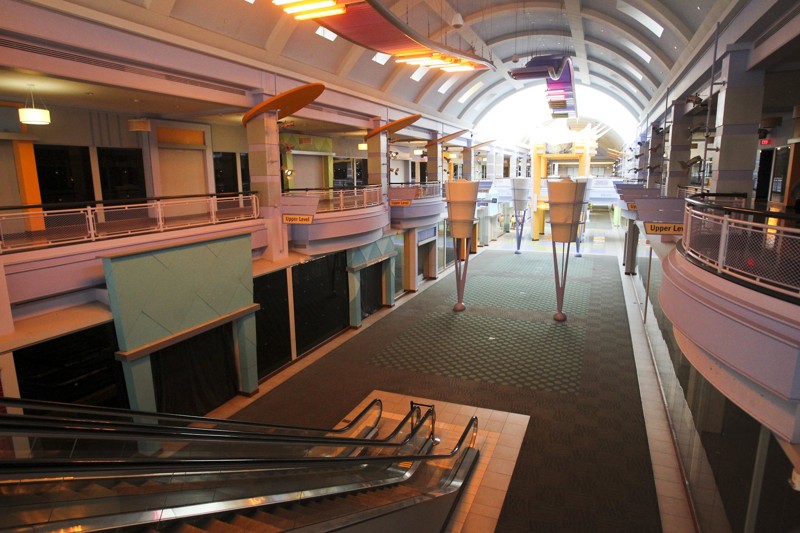
I have no idea what I viewed on YouTube for “Dead Mall Series,” by American filmmaker Dan Bell, to be recommended to me, but I was transfixed from the first video. Each set-up is similar – a first-person walk around a shopping mall, often built in the 1970s or 80s to redevelop former industrial areas. You see the postmodernist appropriation of natural surroundings – marble courtyards, skylights, palm trees and fountains, all garnish for the air-conditioned racecourse of shop fronts, still identifiable long after the business, and customers, left. The effect is alienating and bizarre - some malls once housed over a hundred stores, and are now down to its last few, variously down to larger “anchor” stores leaving, competition from other malls, the rise of online shopping, and crime and neglect, as mortgages and taxes on the mall are unable to be paid. You see where the malls have changed for the worse – plants removed, fountains turned off, whitewash on the walls, or even fake walls put up to repurpose shops as offices, gyms, or even just to make spaces that may never be filled again.

Randall Park Mall, North Randall Ohio - now demolished

The most extreme example of a “dead mall” known to most people was the Dixie Square Mall, based in Harvey, Illinois, which closed in 1978 after just twelve years, in time for it to be used in a chase scene for the film “The Blues Brothers” (1980). However, it took until 2012 to be demolished, during which time around ten proposals to reuse the space came and went, before crime and vandalism turned it into a derelict ruin. As of 2018, the land is a brownfield site, still waiting to be reused.
In “Dead Mall Series,” and other YouTube-based series like “Ace’s Adventures,” and “Retail Archaeology,” the use of vaporwave music heightened the nostalgia for a mode of living that was dying out, as if this whole capitalism thing wasn’t working out. Going to the mall was once something you could do all day, as restaurants and cinemas often formed part of the same complex. The mall security ensured you had a safe space to hang out, but once fortunes change, there is less reason to keep you there, and less reason for mall owners to keep trying. This is why you see many videos about the same malls appearing, such as for the Forest Fair Village in Cincinnati, Ohio, and Century III Mall in West Mifflin, Pennsylvania – these are cavernous spaces that are almost abandoned, but can be freely explored, because they remain open, even if the plants have died, the roof leaks, and the lights are  going out.

For me, these grand spaces are fascinating. The postmodern architecture and aesthetics of shopping malls and vaporwave feed off each other, that area of thought and practice is now coloured turquoise, salmon pink and grey for me, matching the floor tiles and fixtures of many American malls. The stillness of walking through a place that is meant to be buzzing recreates that lost energy in yourself – you wonder what had been made of this space, and what could still be done, but the sadness moves from feeling the lost prestige of times past, to the acknowledgement that buildings that lose all purpose will inevitably be demolished.
Malls in the UK are often smaller, and built around the back of existing high streets, so the experience of walking off a busy street into a scene of desolation is very jarring indeed. Last year, I made a video about The Bridge Shopping Centre, a small mall built in Portsmouth in 1989, which backs onto a supermarket. Last year, I made my own video, walking through what had now become a corridor to the supermarket. Since then, two more shops have closed, a pet shop and jewellery store, with barriers preventing you from walking past the pet shop - there is little incentive for anyone to consider opening a store there. A time capsule was buried when the mall opened in 1989, and it may not be too long before it gets dug up.
I am not sure what lessons I am supposed to take from dead shopping malls, except to treat their insides like a desolate art gallery while they still remain. Our lives no longer see malls as leisure in the way we once did - creating your own nostalgic entertainment through them may be their last possible use. Vaporwave quotes the alienating, desolate feeling of a dead shopping mall as much as the malls themselves tried to take cues the outside world, creating a safe, enclosed space. Maybe I am nostalgic for something that was never really there, but wanted to be there, thinking it would always be there. Maybe that is the power of retail, and why I couldn’t step into Toys R Us one last time.

Bargate Shopping Centre,  Southampton, UK - currently being demolished

08 October 2016

THERE IS A LOVELY COUNTRY [21]


A “Danish moment” is upon us. Last weekend, I bought a book titled “How To Be Danish,” from a bookshop that had a table laden with books about Danish and Scandinavian culture, all vying to be Christmas presents. Why Denmark, and why now?
Where we once had “Feng Shui,” we now have “hygge,” a term meant to describe a particularly Danish brand of homeliness and conviviality. It is a feeling already known as “Germütlichkeit” in German, but Danes usually swap their translation “gemytlig,” for their word for “snug,” as in being hygge as a bygge in a rygge. (However, “hygge” is pronounced “hoo-guh,” so that joke doesn’t work.)
In essence, hygge is a year-round version of that relaxed feeling everyone has between Christmas and New Year, meeting up with family, enjoying good food and conversation in the glow of a candlelight, wearing a woolly jumper, drinking mulled wine, relaxing by a fireplace, away from the cold – lots of blankets, candles and food are involved. Step into a branch of Tiger, which is being renamed to the original “Flying Tiger Copenhagen,” and all your hygge needs will be met.
What I realise is, in the UK, we have no time for this during the rest of the year. That the Danes have this as part of their everyday lives goes some way to explaining why the sinister-sounding Happiness Research Institute recently reported that Danes are the happiest people in the world.

Hygge may work for Denmark, but Denmark is a different society to the UK, with its own solutions. Social mobility is not an aspiration, but an (unofficial) high minimum wage means it is not really a thing. It has among the highest tax rates in the world, but numerous, and generous state benefits, such as student grants, mean people are more likely to see what they pay for. Ostentatiousness is not part of the Danish character, and there is a smaller wealth gap than in most countries. In Denmark, your lifestyle is more likely to be shared, and more likely to be given a single name.
Having seen, when I picked up my copy of “How to Be Danish,” books with titles like “Hygge: The Danish Art of Happiness,” and “The Little Book of Hygge: How to Bring Danish Cosiness Into Your Life,” these Christmas stocking fillers feel less like guides to how others live their lives differently, and more like self-help books describing how others live better lives than you.
It reminded me of the 1996 TV ad for Ikea, imploring the British public to “Chuck Out the Chintz,” changing tastes more quickly than Sir Terence Conran managed with Habitat. That chintz itself was imported from India in the 17th century is more an indicator of how British culture absorbs influences from other cultures so easily, and so often. Ikea likes to sell us a lifestyle but, for some, it is also somewhere else to go when you are bored with Argos.
Perhaps that is what we should do – take the bits that work, then move on. We watched “The Killing,” “The Bridge” and “Borgen,” and proceeded to make “Broadchurch” and “Top of the Lake.” We like what we like, then make our own version, like we’ll do with hygge.