Showing posts with label Kenneth Williams. Show all posts

28 November 2021

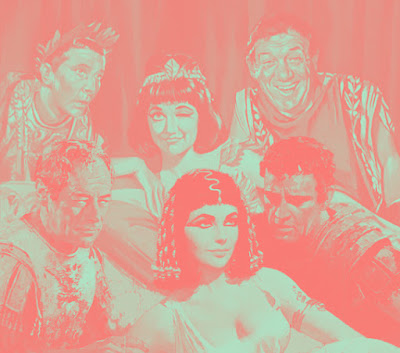
YOU WILL REALISE OUR AIM IS THE SAME [321]


It is well known that the line “infamy, infamy, they’ve all got it in for me,” from the 1964 film “Carry On Cleo”, was not written by its scriptwriter Talbot Rothwell, but was borrowed, with permission, from Frank Muir & Denis Norden and their radio series “Take It From Here” (1948-60), which included the prototypical dysfunctional family sitcom The Glums.

Of course, “Carry On Cleo” borrowed rather more than that, namely the leftover sets and costumes from the blockbuster historical picture “Cleopatra”, for which 20th Century-Fox had moved production from Pinewood Studios in Buckinghamshire, to Cinecitta in Rome, in 1961. 

“Cleopatra” would be released in June 1963, having first signed Elizabeth Taylor to the starring role in September 1959. Meanwhile, “Carry On Cleo” was shot in July and August 1964 for a release in cinemas in December of the same year. Ironically, “Carry On Cleo,” in both its thrift and haste, is actually closer to what “Cleopatra” was meant to have been.

The “Cleopatra” crew had left behind an opulent and elaborate group of interior sets, and a standing outdoor set that was overwhelming in scale, but were constantly deteriorating in the dire British weather, requiring daily touch-ups on paint and masonry, and tropical vegetation to be replaced for each day of shooting. When Taylor developed a cold, later a fever and meningitis, a better climate was required for all aspects of production, and with the 1960 Summer Olympics now over, Rome became a more favourable option once more. With the decision made to start afresh, the $600,000 set and other items were left behind.

"Carry On Cleo”, starring Amanda Barrie as Cleopatra, Sid James as Mark Anthony and Kenneth Williams as Julius Caesar, was concocted as a way of using what was left behind, injecting British bawdiness into more luxuriously appointed surroundings than normal. However, producer Peter Rogers and director Gerald Thomas approached the shooting of the film in the same manner as their other productions, using mostly medium and close-up shots that work for the comedic acting and dialogue, but making no use of their sets’ scale. Mind you, this was only the second “Carry On” film to this point to be shot in colour, and its poster had to be made less similar to that of “Cleopatra” to avoid legal action, so expectations perhaps have to be set accordingly.

However, "Carry On Cleo" was what "Cleopatra" was originally intended to be: a quick, $2 million, 90-minute romp starring Joan Collins, who had been tested extensively for the role, while also intending to get 20th Century-Fox out of a sticky position with their finances by remaking the script for the almost-entirely lost 1917 “Cleopatra”, starring Theda Bara. The ambition of producer Walter Wanger, following the success of “Invasion of the Body Snatchers”, and the subsequent signing of Elizabeth Taylor, caused the production to spiral into a $44 million behemoth that nearly sank the entire company, having been seduced by how much more they could have if they had bigger production values and bigger stars. The contractual obligation to use a widescreen film process owned by Taylor, Todd-AO, developed by her late husband Mike Todd, is one of the less likely sequences of words in the history of filmmaking.

A later film shot at Cinecitta, the notorious adult film “Caligula”, also had its set reused for a parody, “Messalina, Messalina!”, made by “Caligula” co-producer Franco Rossellini. The film was released in 1977, two years ahead of its target - like "Cleopatra", "Caligula", a film of similar opulence and reputation, had its own set of problems.

30 September 2018

I WON’T DO WHAT YOU TELL ME [129]


“If you didn’t live in that time, you’re not allowed an opinion in my view.”
This sentence has rattled through my head for the last week, because I have never heard anyone say something like this before. I also cannot think of a situation where you could get away with saying something like it. How do you respond to it? Am I allowed?
When writing about why I don’t like chat shows [link], I came across an interview gave to the “Mail on Sunday” newspaper in 2016 [link], just as a book on his encounters with Muhammad Ali was published. Even if I wouldn’t have made a point of tuning in to “Parkinson” in the 1970s, if I had been around then, I probably would have if Ali, or Billy Connolly, or Peter Sellers, or Kenneth Williams was a guest – some people are worth hearing, even if they are mainly there to promote something.
Although the article was to promote the Ali book, the headlines came from when Parkinson was asked if there were any moments in his career that he regretted. Saying he has been accused of being old-fashioned, Parkinson used the example of the 1975 interview he had with Helen Mirren, who was introduced on the show was the “sex queen” of the Royal Shakespeare Company and, after a theatre critic was quoted as saying Mirren was good at “sluttish eroticism,” Parkinson asked if Mirren thought her “equipment” got in her way of performing as an actress. After clarifying he was referring to her figure, Mirren replied, “Serious actresses can't have big bosoms, is that what you mean?”
The interview can easily be found online, and while it has since been decried as sexist since, it was perfectly fine for broadcast in 1975 – “it was OK at the time” is a phrase often heard in cases like this, usually because it may not be these days. In the “Mail on Sunday” interview, Parkinson said he may have overreacted, but he was reacting to the provocative figure Mirren presented. When asked if they had made up since, Parkinson said, “I don't want to. Nor does she. I don't regard what happened there as being anything other than good television. There is no need to apologise, not at all. She didn't want to do an interview and after about ten minutes I didn't want to interview her. There's no problem, it's not World War III for God's sake.”
For her part, Dame Helen Mirren, later quoted in an article for “The Telegraph” website [link], said, “That’s the first talk show I’d ever done. I was terrified. I watched it and I actually thought, bloody hell! ... I did really well. I was so young and inexperienced. And he was such a f------ sexist old fart. He was. He denies it to this day that it was sexist, but of course he was.”
This leads me to where I became unstuck. In his interview, Parkinson is reported reacting to the notion of his interview with Mirren being a defining moment of the “sexist” Seventies: You have to judge it by what happened in that time. If you didn't live in that time, you're not allowed an opinion in my view [my underline].... I’ve not done anything that I'm ashamed of. I can see everything in the context of the time I did it. I can think, 'Ooh, I wouldn't do that now.' But that doesn't mean to say I was wrong at the time.”
The interviewer, challenging that one sentence, writes, “if one of his guests had said that, he would have challenged them strongly,” but I wished it was challenged in this interview, although we do get the odd quote later, “Am I a sexist? No, I'm Yorkshire. I don't know what the answer is or what a sexist means, basically. I've been married for 57 years so something must be going right. I wouldn't say I'm a sexist at all.”
To be honest, I just needed to write about that one sentence, “If you didn’t live in that time, you’re not allowed an opinion in my view,” but I also needed to present the context in which that was uttered. I will go with Dame Helen’s reaction to the interview, because she definitely was there at the time, but to say you are not allowed to have an opinion on something is a red flag that needs as much oxygen as possible – if I said that to anyone, I would be demolished in response. Perhaps it is easier, for Sir Michael Parkinson, not to use his chat shows as primary sources.