Showing posts with label Friday the 13th. Show all posts

22 March 2020

TOMMY CAN YOU HEAR ME [227]


“This is a mess. No way. I refuse to do this! You're the one who keeps fucking around with it so get off your ass and fix it! You understand?”

I rarely make a conscious decision to watch a horror film, but when I do, I am more likely to choose one from before the mid-1980s, before the cliché, excess and self-referencing set in. You can say the same about any genre, but horror films have more long-running series of films that eventually turn in on themselves. 

I thought the intention of the “Friday the 13th” series of films, alongside “Halloween” and “A Nightmare on Elm Street,” was to kill the killer so definitively, it provided the perfect starting point for next time – how do you bring them back? I know better now: “Friday the 13th” was originally planned to end as a trilogy, but a fourth was then ordered, deliberately titled “The Final Chapter”. However, because part 4 did so well at the box office, another new trilogy was planned, with part 5, “A New Beginning,” released within a year.

Tommy Jarvis, the child who killed Jason Vorhees at the end of part 4, is now older, released into a halfway house from a mental institution, still having flashbacks to Jason – you know he will become him, so the plot becomes a case of guessing who isn’t Jason, once the killings start. John Shepherd, taking over from Corey Feldman as the older Tommy, worked in a mental hospital in preparation for his role, before being told that “Repetition” was a fake title for a “Friday the 13th” film - his performance hides his disappointment very well.

This film feels like it was made to a very strict plan. Killings happen at a steady rate of about one every seven to eight minutes of screen time, as mandated by Paramount Pictures, with a shock or scare if there is no kill, and a liberal sprinkling of sex, gore and gratuitous shots of women’s breasts. For this reason, you have little reason to care when a character dies, as you are only given enough of them to begin caring, before it doesn’t matter anymore. (If anyone can tell me the reason for the redneck mother and son in this film... that's fine, but please still keep it to yourself - it was probably so they could also be killed off.)


This film has a more psychological plot than previous “Friday the 13th” films have, the guessing game around the killer’s identity requiring more of the audience, but switching attention to an ambulance driver, and later revealing his son was staying at the halfway house, was rather jarring. By the end, Tommy has had so many hallucinations you are practically waiting for the final reveal. 

In the end, it all counted for nothing, as Jason Vorhees was simply brought back for part 6, “Jason Lives,” replaying the classic “Friday the 13th” formula, except with more jokes. The actors signed up for a sequel to “A New Beginning,” their characters having survived, had their contracts terminated, with a third actor playing Tommy Jarvis. John Shepherd next appeared in “Thunder Run,” a Cannon Group film that was essentially “Smokey and the Bandit,” but with plutonium instead of Coors.

03 April 2019

I WANT YOUR PSYCHO, YOUR VERTIGO SHTICK [160]


Alfred Hitchcock’s “Psycho” is regarded as the ur-text of the American horror genre, but its three sequels have proved harder to find, because of their being perceived as both inferior to the original, and, and as an obvious and poor answer to the rise of slasher film franchises like “Halloween” and “Friday the 13th”. However, Arrow Video have released “Psycho II” on DVD and Blu-ray, under licence from Universal Pictures, so I braced myself, and handed over some money.
As much as Hitchcock did not like the idea of sequels to his own films - although he had remade his British film “The Man Who Knew Too Much” in Hollywood, with James Stewart and Doris Day - “Psycho II” was always going to be out of his hands, especially by his dying three years before its 1983 release. Hitchcock had sold the rights to “Psycho” and his “Alfred Hitchcock Presents” TV series to Universal in 1968, with the film having already made $18 million at the box office – not bad for having spent $800,000 of your own money in the first place. Hitchcock became the third largest shareholder in Universal, which had been bought by his agent, Lew Wasserman, and his company MCA in 1953. As inevitable as a “Psycho II” was going to be by 1983, it was the perfect opportunity to both commemorate and capitalise on Hitchcock’s work.

I am happy to say that this is a sequel worth watching. I was worried that “Psycho II” was either going to be some hackneyed, by-the-numbers horror flick, even though its director, Richard Franklin, had studied Hitchcock’s work, and had met with him during the making of “Topaz” (1969). Fortunately, it is also not the academic exercise of remaking the original that Gus Van Sant’s 1998 “Psycho” is known for being – just because you can now do the opening aerial shot of Phoenix, Arizona, that Hitchcock could not in 1960, due to technical constraints, doesn’t mean you should, whether you can do it in colour or not. Instead, what we have is a story that makes good use of the twenty-year gap in both the film’s events and of the public’s knowledge, while learning Hitchcock’s lessons in filmmaking without just copying them (although starting the film by replaying the original’s shower scene is a bit on the nose for me).

After twenty-two years in a mental facility, Norman Bates is deemed to be fit and well, and is released, against the wishes of Marion Crane’s sister Lila, who cannot believe that a murderer is not imprisoned for life – it is pointed out from the start that he was found to be insane, not a murderer. Initially working at a diner, he befriends and helps out Mary, who was thrown out of her boyfriend’s place. Norman and Mary take up residence back at his mother’s house and Bates Motel – the sleazy manager, played to greasy perfection by Dennis Franz, is first to die, at the same point as in the first film (after about forty minutes).

As the murders occur, Norman begins to see his mother again, which Mary sees as being part of his mental illness, something that could not make him a murderer. What is worse, Mary knows who is framing Norman: Lila, her mother, who wants him put into jail, using a “mother” costume secreted in the house. The climax of the film is that those who are implicated in the murders are those that have been shown to have been cool and calculating all along, and not the one shown to be almost incapable – fortunately, Norman is shown at the very end to have regained his equilibrium, and his mother, with the use of a spade, though not in the way you might think. As much as you think that “Psycho II” might be playing with notions of mental illness, the definition of what is “sane” is also shown to be different for everyone - as Norman Bates says in the original film, “we all go a little mad sometimes.”

The older Anthony Perkins seen in this film looks perpetually haunted, and this is to his advantage here, which is also the case for the returning Vera Miles as Lila Loomis, née Crane – his father is said to have died, presumably in an explosion with Michael Myers at the end of “Halloween II.” As Mary, Meg Tilly is the audience’s point of identification, but she is, and we are, ultimately proved wrong in the end, setting up 1986’s “Psycho III,” directed by Perkins himself.
The black and white of the original “Psycho,” and the stark string soundtrack, are traded for full colour and a lush orchestra, which could be seen as a way of muddying the waters. At the end of the first “Psycho” we got a nice summary of how Norman Bates took over his role as his own mother, but we don’t get anything so easy to understand here... but it sets up a sequel rather well.

07 October 2018

EVERY DAY I WRITE THE BOOK [130]

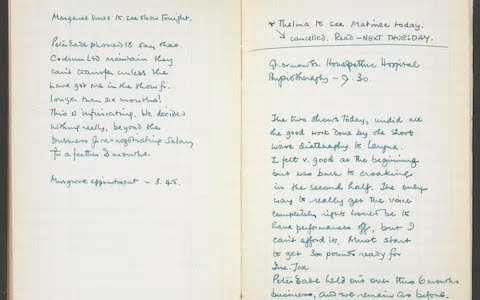
Two pages from the diary of Kenneth Williams

Monday


Is there any point to keeping a diary? You know what you did, and how you feel – is it for reference, or to confront yourself, or as a writing exercise? The last of these was my reason for having first begun a diary fifteen years ago, but also why it has petered out – I have other outlets for that sort of thing, outlets more than one person can see. I could do with a way to collate all those disparate thoughts you have during the week, those ideas that felt like a good idea at the timer, but they let you go before you remember to write them down.

Tuesday

So how did Ceefax work anyway? And why did my mind make me think of this? And why am I now entertaining this as a subject for a future article, instead of looking it up? Teletext is still a recent history for most – oh yeah, that’s why it’s a good idea.

Wednesday

Of course, today is when you actually started writing your diary, in the hope that, when you read through it as preparation for the inevitable autobiography, you will have forgotten what kind of procrastinating person you once were, only to have that thought hit you once again.

Thursday

Of course, your energies were concentrating on work during the week, and there are times where you have nothing to write down, but the idea of skipping an entire day seems about as perverse as making a note that, by the way, nothing else happened – it may be easier to make a note of that having been the case, and move on.

Friday

A manager at work said I had a good speaking voice, but I then decided to say it sounded like it was full of disdain – it was rather a pointless call. I am not exactly sure why I said that, but it does sound like I was being too honest while making a joke. I don’t like taking phone calls. I’ve had the latest iPhone for two weeks, and made one call on it so far.

Saturday

Napping in the afternoon, I dreamt I was walking, then my right foot slipped, I fell forward – and I woke up. This joins other weird dreams of this week, which included retrieving papers, from a red post box in a high street, that I needed for when I was starring in a TV detective drama – a type of show I never, ever watch – and the dream where I found forty-five pence on the floor. I should have gone for a walk, but it was raining – that is, in real life.

Sunday

Wrote an article about “Friday the 13th: A New Beginning” for His & Hers Movie Reviews – it is their Halloween Horror month, and I rarely watch horror films, but I may write a horror film one day, or some sort of horror story. If science fiction portrays our anxieties about the future, then horror does the same for the present.