Showing posts with label Disney+. Show all posts

22 February 2026

DON’T TELL ME IT’S NOT WORTH TRYING FOR [530]


I had been waiting to see the Looney Tunes film “The Day The Earth Blew Up” for longer than I realised, so I was surprised to find my local cinema had already been showing it for a week.

The Looney Tunes characters have become to Warner Bros. what the Muppets are to Disney: a well-loved and historic franchise subjected to multiple reboots in search of nostalgia, relevance or both, before ultimately finding success by just letting it do what it does. The revival of “The Muppet Show” on Disney+, a one-off special with the possibility of further episodes, proved the formula still works if given a confident script and the right special guests, while the latest “Looney Tunes Cartoons”, running on HBO Max from 2020-24 and headed by Pete Browngardt, returned their characters to the hellzapoppin’ era of the 1930s and 40s, inspired by director Bob Clampett. “The Day the Earth Blew Up”, directed by Browngardt, extends this series from 3 to 10-minute shorts to feature length, and proves that all you need to do is let the characters breathe.

Originally conceived for a release to Cartoon Network and HBO Max in 2022, “The Day the Earth Blew Up” instead received a theatrical premiere in June 2024, and has slowly been released around the world since then. Distributed by Vertigo Releasing in the UK, with little or no advertising, I am watching a film that has already received a home video release in other countries.

“The Day the Earth Blew Up” begins with both an asteroid and a UFO hovering into view, the latter crashing through the roof of the film’s stars Porky Pig and Duck (both voiced by Eric Bauza). They were adopted as babies by the Mufasa-like “Farmer Jim”, who instils them with the belief that, so long as they stick together, they will be responsible. However, with their house now in peril, they need to find work for the first time, inexperience and irresponsibility limiting them to push-button work at their town’s bubble gum factory. Porky and Daffy encounter Petunia Pig, (Candi Mylo), an eccentric scientist at the factory in search of the perfect flavour, and whose initiative is needed when Daffy discovers that goo from the UFO has been dumped into a gum that is being relaunched, putting consumers under the control of The Invader (Peter MacNicol), who wants a bubble blown around the world.

The one thing I loved about the new “Looney Tunes Cartoons” was the return of Daffy Duck to his original characterisation. Instead of being a scheming foil for Bugs Bunny, Daffy is instead unpredictable and uncontrollable, to his and others’ detriment. Porky Pig, instead of being a foil to Daffy, is now the nominally responsible one, the Hardy to Daffy’s Laurel, acting as the conscience for the pair. With Porky’s attention swayed by Petunia, and with Daffy destroying her more practical plan for defeating The Invader, both friction and literal tears will come before Porky and Daffy realise how they can complement each other, and save the world together.

The twist that The Invader is also trying to save Earth – the bubble gum was meant to bounce the oncoming asteroid away from harm – was a good idea, although I did find it a little forced that The Invader didn’t make his intention known earlier in the story, unless you reason that the bizarre scheme of blowing a bubble around Earth could only be done by force, let alone an alien travelling across galaxies to drink Boba tea.

The “Looney Tunes” characters already work across a feature-length running time, as proved so many times, but I don’t know if “The Day the Earth Blew Up” will herald more. There was meant to have been “Bye Bye Bunny”, a Bugs Bunny musical film, but this had been cancelled, with Eric Bauza having recorded dialogue and songs for it. Notoriously, “Coyote vs. Acme”, a live-action and animation hybrid to be released in August 2026, was shelved three years earlier for Warner Bros. to obtain a tax write-off, before allowing its producers, Warner Bros. Animation, to find another distributor for the film, much as it has done with “The Day the Earth Blew Up”. 

Perhaps the prospect of more Looney Tunes output in 2027, including a revived “Bye Bye Bunny”, should be taken as recognition by Warner Bros. of the true value of their franchise. Of all their characters, only Porky, Daffy and Petunia appear in “The Day the Earth Blew Up”, so there should be plenty of opportunity for other characters to get their own spotlight.

15 December 2024

GIVE THEM MOON AND CLOUDLESS SKIES [479]

from "The Simpsons" episode "Barthood", a parody of Richard Linklater's "Boyhood"

It isn’t unusual to want Bart, Lisa and Maggie Simpson to grow up OK when you have been watching them on television for most of your own life. You hope that our real world, both reflected and created by the show, will ultimately be as kind to them as you want it to be for ourselves.

With “The Simpsons” having now run for an astonishing thirty-five years, three years away from eclipsing “Last of the Summer Wine” to become the world’s longest-running sitcom, its status quo means that, while I was younger than Lisa when I first saw the show, I am now older than both her parents. We have grown up with these characters, but they can only grow through lessons learned, fleshing out their backstory.

I fell out of watching “The Simpsons” for some time, returning upon subscribing to Disney+ to find a show that, while not having folded over itself by pandering to its audience’s nostalgia, has become playful with its own history: it began its thirty-sixth season with a “series finale” that stopped questions on how the show would eventually end, having previously broadcast a fake clip show of leaked episodes purportedly too outlandish even for later-period “The Simpsons”, and a “Treehouse of Horror” story created a “Westworld”-like theme park of the moments adopted as internet memes.

The 2022 episode “When Nelson Met Lisa” was when I realised that my favourite episodes of “The Simpsons” depict an imagined future for its characters, seeing what their experiences have made them, regardless of it being a parody of “When Harry Met Sally”. Lisa has been shown to have a crush on Nelson Muntz before, but a series of scenes across the years builds this into a mature, happy and hopeful ending, one you hope will be canonised.

By necessity, the future depicted in “The Simpsons” can’t be set in stone, because that could get in the way of a good story, but there have been elements built up on each other, then knocked down and rebuilt: Bart could become a deadbeat divorced dad, living in a Springfield Elementary converted to makeshift apartments; Lisa is successful, but marries Milhouse; and Maggie, the eternal silent wildcard, becomes the biggest noise in pop music, and the most constant depiction of her future. Thankfully, Bart and Lisa’s future has been depicted more hopefully, with Bart becoming a BMX stunt champion, artist and a repair shop owner, while Lisa will attend Harvard and have the world as her oyster. 

Then again, Bart could also become a Supreme Court judge after missing “The Itchy & Scratchy Movie”, and Lisa could become President of the United States, having inherited “quite a budget crunch from President Trump”, although the episode “Bart to the Future”, broadcast in 2000, would not have known which Trump presidency it would be. 

Predicting the future can be futile, despite the number of times situations and jokes in “The Simpsons” replayed themselves in real life, from predicting the discovery of the Higgs boson to Disney buying 20thCentury Fox, but imagining the future should be encouraged, except for preparing for when “The Simpsons” eventually ends – I don’t think anyone is truly prepared for that. Perhaps it could then be rebooted with an older Bart, Lisa and Maggie – it happened with "The Flintstones" and “The Pebbles and Bamm-Bamm Show”.

17 March 2024

YOU ARE EVERYTHING, AND EVERYTHING IS YOU [440]


The Pitt Rivers Museum is the most overwhelming I have experienced to date. Holding around seven hundred thousand objects, most of which are on display, it is a museum of archaeology, anthropology and ethnology: devoted to the study of humanity through its objects, it is the closest I have encountered to a museum of “everything”. It naturally also becomes a museum of museum displays, charting how the acknowledgement and understanding of our past has developed.

Publicly accessed via a single arched doorway at the back of the Oxford University Museum of Natural History, despite being of a similar scale, the Pitt Rivers is a grotto of glass cases, more specifically a gigantic room with a hive of cabinets spread through the ground floor, with two mezzanines looking over it. Deciding to start at the top, the lift opened at a display of handguns and rifles, itself facing a wall of rudimentary clubs – spears and harpoons were at the other end of the walkway.


Among the pictures I took while at the museum were a helmet made from the skin of a porcupine fish; packs of various playing cards, displaying the link to the original tarot cards; American Indian headdresses; “a string of Chinese cash”; sword sheaths; boomerangs; Samurai armour; a box of the original table tennis game for which the name “Ping Pong” was trademarked; and various wooden shields, including four painted with depictions of the comic book hero The Phantom. 

Armed with the knowledge of what a Colt .45 looks like, you get a hang of how the museum is organised ethnologically by type of object, aiding comparisons between cultures, rather than simply by time – it feels more like browsing an encyclopaedia, or searching Wikipedia, than reading a history book. Augustus Pitt Rivers, the retired Army officer and archaeologist whose collection formed the basis of the museum, to which others’ expeditions and donations have since contributed, was among the first to insist upon all discovered artefacts being methodically catalogued and preserved for study, rather than just looking for treasure. At the same time, having such a repository for examples of many types of objects that matched when I have bought examples of physical media, like a laser disc or a Sony U-Matic tape, so I could experience them by touch – reading about something is often not enough.


This record-taking developed over time: an ivory harpoon head has its origin and catalogue number written directly on it: “W. Eskimo / P.R. Coll / 1884.20.30”, although a caption under it also specifies its North American origin and leaf-shaped stone blade along with correcting itself to “Inuit” – sometimes the catalogue details is all we know about the item. Knotted tags of handwritten text, and tiny captions of densely-packed text in Times New Roman, eventually gives way to numbered pointers to clearer captions to the side in larger sans-serif fonts like Helvetica and Gill Sans. 

With the density of objects on show, it was inevitable that, unless I sat down for a while, I would start looking past them, or through them, to the construction of their displays – if they had not removed their display of shrunken heads during the pandemic-enforced closure in 2020, part of the efforts in decoloniality that further enhance the understanding of the museum’s objects, I doubt I would have noticed.

My main takeaway from the Pitt Rivers Museum was that I don’t know of anywhere else like it – all that is missing are objects from the present day. There is a feeling of clutter, which was also felt sixty years ago: a proposed new building, designed by Pier Luigi Nervi, would have arranged its categories circularly around a glass dome, spreading outwards through time. It looked not unlike the future pavilions at Disney’s Epcot Center, but fundraising efforts petered out by 1970. A new building, with more space to think about the objects, should be considered again, or at least build its own entrance from outside. 


17 September 2023

MY HEART WENT DOWN SOUTH [414]


Recent history can still turn to dust without anyone noticing, and if that history reflected your local area, that stings further.

Television South (TVS) provided ITV programmes for the south and south east of England from 1982 and 1992, back when Southampton, and TVS’s second base in Maidstone, was as major a producer of television shows as Bristol, Leeds, Birmingham or Newcastle, places reduced to outposts for regional news as ITV merged itself into a national company based primarily in London and Manchester. Travelling into Southampton took my family past the TVS (formerly Southern, later Meridian) studios, and it commanded my attention every time.

TVS sold its news output to Meridian when it took over the southern ITV franchise, but the rest of its programme library is currently missing, believed lost or destroyed, creating an eleven-year gap covering children’s programmes like “No. 73”, “Motormouth”, “How 2”, “Tugs” and “Mr Majeika”, dramas like “C.A.T.S. Eyes” and “The Ruth Rendell Mysteries”, game shows “Catch Phrase” and “All Clued Up”, comedy shows by Bobby Davro, “Summertime Special”, the sitcom “That’s Love”, international co-productions including the UK segments of “Fraggle Rock” and a 1987 film about Nelson Mandela starring Danny Glover, along with a large number of documentaries and local public affairs programmes that could have visited my local town.

This is, once again, a case of “lost media” meaning an archive is lost, and not just unavailable online. Many off-air recordings of TVS programmes have been put online by members of the public, but finding them is difficult, as searching the straightforwardly named “tvs” or “television south” is often counterproductive.

TVS is the only ITV company whose output is unavailable, with other former franchise holders having their programmes taken over by the companies succeeding them, or by local archives and businesses. However, the owner of the TVS library, wherever it is, has been The Walt Disney Company since 2001, after a long process of company takeovers that involved evangelical Christian preacher Pat Robertson and “Power Rangers” producer Saban Entertainment. This process appears to have shed the paperwork associated with the library, crucial to making the programmes available to view on home video or online, the last such incidence being the release of “The Ruth Rendell Mysteries” on VHS cassette in 2000. 

Later enquiries made by people to Disney about the location of the tapes themselves has led to the unsatisfactory conclusion that they are unavailable or lost. It is not likely that the tapes were “wiped” because the price of broadcast-quality cassettes had declined enough by the 1980s to avoid a practice of reusing them, and because the potential of revenue from home video necessitated retaining them, just as when Pat Robertson launched a UK version of The Family Channel using TVS repeats. 

It is not known if these tapes have been mislaid, or simply thrown away, and the perceived worth of the archive to The Walt Disney Company is also unknown – I cannot imagine they had much use for a daytime magazine show titled “Not for Women Only”, but someone may do, if only for research purposes.

This could be an argument for needing an audio-visual equivalent of the British Library – the British Film Institute has a vast archive, which includes some TVS programmes they have received over the years, but they do not act in that sort of capacity. When a programme’s worth cannot be foreseen, being unable to make that decision because it has already been lost is difficult to take – even if is a Bobby Davro sketch show so “of its time” that the cultural references make no sense, it would be useful to see why.

This situation required a campaign to find parts of a major international show made in my lifetime, “Fraggle Rock” – the UK wraparound segments filmed by TVS starred Fulton McKay and later John Gordon Sinclair as a lighthouse keeper. Only twelve episodes were known to exist in broadcast quality, later raised to twenty-nine after the search – the remaining sixty-five episodes exist as off-air recordings made by members of the public.

I only got rid of my VHS cassettes because I knew I did not own anything that didn’t otherwise exist. This cannot be confidently said for anyone owning a recording of a TVS programme.

24 April 2022

LISTEN TO ME, DON’T LISTEN TO ME [341]


Hearing the term “fear of missing out” or “FOMO” gives me no reason to fear. It sounds like a term invented to encourage you to “keep up with the Joneses” by tying that impulse to your quality of life, turning it into something too dangerous to get involved with. “FOMO” was first observed as a phenomenon by a marketing strategist, Dr Dan Herman, in 1996, reinforcing this thought for me.


I may have also dealt so often in nostalgia that I believe it is possible to return to everything. There is no fear of missing out on something because there is no way you can miss out, unless you limit its availability. This may be the result of the “Disney vault”, where The Walt Disney Company limited VHS releases of their classic films to keep them special and scarce, until DVD, Blu-ray and streaming video made this practice obsolete.


I thought the limited-edition Coca-Cola Intergalactic flavour, the first in a series of “Coca-Cola Creations”, was only to have been available in North America, but coming across it in my local supermarket was enough for me to try it. The Coke website stated that “we will collaborate to create new flavours, designs and experiences with CocaCola, reimagining our iconic product in time-limited edition flavours which take inspiration from relevant moments across culture, music and gaming”. In this case, Coca-Cola was the first soft drink launched into space, on the Space Shuttle Challenger on 12th July 1985, the day after the Coca-Cola Company announced they were returning from New Coke to the classic formula.


Starting with Coca-Cola Zero Sugar, Intergalactic turned its dark caramel colour to red, its ingredients including carrot and blackcurrant from concentrates, while the taste is much like the existing vanilla Coke, with a slightly chocolate aftertaste, at least to me. It tasted fine, but not to dissimilar to a Coke flavour I can continue to drink after Intergalactic is withdrawn.


Meanwhile, I have only just started playing Wordle, a daily online word game so successful upon its launch in 2021 that it was bought by “The New York Times” for a substantial sum. Up to now, I had only seen the yellow and green grids posted on Twitter by other players, showing how well they did in guessing what letters made up that day’s five-letter word, and where that letter was placed, although the abstract nature of just seeing the letter-less grid meant it took until an idle moment on approximately day 290 of the game’s history for me to even think of trying the game. I have since concluded the first of my six attempts to guess the word should always be “quiet”, covering two vowels and the first row of my keyboard.


Wordle is a “special edition” word game in the sense that everyone is given the same word to guess in each twenty-four hour period. With no ability to go back to previous games, and with “The New York Times” issuing cease-and-desist orders on copycat websites where you can play previous days’ games, or multiple games a day, you must make a daily appointment to play, or risk missing a game on which you can never catch up. This becomes particularly frustrating if you failed to guess the word that day, or continuously failing to get the rest of a word when you got the second half fairly easily. All word games lead me to think my vocabulary is too small, so that might just be my problem.

The abbreviation “FOMO” was coined by Patrick J McGinnis in 2004, in the Harvard Business School magazine “The Harbus”, but alongside it was “FOBO”, for “fear of a better option”, the act of not making a choice because you are waiting for a better opportunity.

To me, Coca-Cola Intergalactic and Wordle are impacted by “FOBO”. One is a further dilution of the original Coke formula that had no variations until the launch of Diet Coke, but while soft drink manufacturers are fighting to hold attention, the Coca-Cola Company itself took a bolder decision by acquiring Costa Coffee in 2019 to catch where some consumers were going. While “The New York Times” may have avoided its own fear of missing out on the next big thing by buying Wordle, closing down unauthorised copies, without offering what made them so popular as an alternative to their own product, makes me think that eliminating other options for diversifying the game was needed over providing those options themselves, especially to keep the “FOMO” factor of the standard Wordle format. 

06 November 2021

LET YOUR JOURNEY START FROM HERE [318]


It is a fact of 1990s family life that some VHS cassettes were repeatedly watched until the tape wore out. My family had many: “Who Framed Roger Rabbit?”, “Back to the Future”, and “Fantasia”. All would be replaced as time and home video formats progressed, but one tape, which became lost within the family home, could not be replaced until the film’s eventual DVD release in 2006.

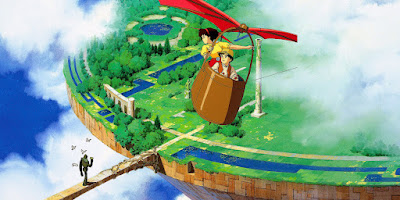
It turned out our lost copy of what was being called “Laputa the Flying Castle,” recorded from a TV airing on 31st December 1988, was from the first occasion that a Japanese animated feature film had been shown on British television. That this was shown at 9.25am on the populist ITV network, more known for cramming their Christmas schedules with Star Wars, Harry Potter and James Bond, is even more remarkable. If they ever did it again, I am not aware of it.


A story of mystical cities, escaping kidnap and airborne pirates, “Castle in the Sky” was directed by Hayao Miyazaki and released, in 1986, as the official first film from Studio Ghibli, founded on the success of “Nausicaä of the Valley of the Wind” two years earlier. Like much of Miyazaki’s work involving planes, airships and other flying devices, “Castle in the Sky” has become widely influential as a classic of the steampunk genre.


The flying island itself is lifted in name and concept from Jonathan Swift's novel "Gulliver's Travels," while also influencing the plot of wanting to harness the castle for political, nefarious ends, before ultimately crashing to the ground. Unlike Swift's satire, Miyazaki's Laputa was old technology and reason, overgrown and reclaimed by nature, to be left alone - it is allowed to escape at the end, but irreversibly marked by human hands.


The setting of a small mining town was familiar to British audiences. Miyazaki visited Wales in 1984 as part of the film’s research, and his witnessing of the aftermath of the Miner's Strike influenced characters as well as architecture. A later noted steampunk work, 2004’s “Steamboy”, Katushiro Otomo's eventual follow-up to "Akira," was explicitly set in Victorian industrial Manchester. “Castle in the Sky” would later be shown in Aberystwyth in 2011, a charity screening to support relief efforts following the Tōhoku earthquake and tsunami, using its original Japanese soundtrack.


Despite The Walt Disney Company’s release of Studio Ghibli’s films on DVD, our lost copy of the ITV airing of “Castle in the Sky” would not truly be replaced until around 2018, my sister having sourced a copy of the Japanese DVD version originally released in 2002 – I immediately asked her to order another one for me. This was the only place we could find the English dubbed soundtrack prepared by Magnum Video Tape and Dubbing, for use in Japan Airways trans-Pacific flights, and later in American art-house screenings – it is a straight translation of the original Japanese, with music and sound effects left intact. Pazu, the boy who rescues central figure Sheeta from kidnap, is voiced by Barbara Goodson, now best known as Rita Repulsa from “Power Rangers”, while Sheeta, who possesses a magical crystal of the sort that allowed the city of Laputa to fly, is voiced by Lara Cody, who later dubbed voices for English-language versions of “My Neighbour Totoro” and “Kiki’s Delivery Service”. This was the version I remembered from my childhood, even if it is not the film’s own original soundtrack, but I knew I had the correct version the moment I heard Pazu deliver a lunch at work: “meatballs for the boss.” As Proustian as a madeleine biscuit, I’m sure you will agree.


It was important for me to have the version of “Castle in the Sky” that I remember, because that version was the reason one of my formative experiences of watching a film – I was five years old when ITV broadcast it – has led me to be spoiled when it comes to the expectation of what an animated feature film can accomplish in scope of story, technical detail and emotion. Arguably, only Studio Ghibli have matched it since, and only Pixar have come close.


It is already noted that the English-language dub of “Castle in the Sky” now most widely available, recorded by Disney in 1998, took liberties with the soundtrack that were later revised and scaled back on further home video releases. The original sixty minutes of synthesised musical score, reworked by the original composer Joe Hisaishi into a lavish, and overwhelming, ninety-minute orchestral performance, was restored, as were periods of silence that were filled in with background noise. However, the increase in Pazu and Sheeta’s ages, from pre-teen to mid-teen, and lines that made Sheeta a potential romantic interest to the airborne pirates instead of a mother figure, were retained, perhaps because James Van Der Beek and Anna Paquin would have had to be recast. The original changes were authorised by Studio Ghibli, but with this now also being the English-language track on Japanese DVDs, following a re-release in 2014, it leaves only the original Japanese soundtrack as being the “correct” version available. Perhaps this is how it always should have been, but accessibility doesn’t usually require a rewrite.

20 September 2020

WHO CARES WHAT PICTURE YOU SEE [261]


On the evening of 16th March 2020, the Prime Minister of the United Kingdom announced the start of the lockdown that would attempt to suppress the outbreak of Covid-19, of which one measure was the closure of cinemas across the country, to prevent people coming into close contact within a closed space.

Two days later, my bank sent me six free cinema tickets, to use at my local multiplex. The current account I have with my bank allows me to choose an extra perk from a list each year, like a magazine subscription, or money off in restaurants, but every March, when the bank asks me what I want next, I always choose the cinema tickets.

On 19th September 2020, I see a film in a cinema for what was the first time since 23rd February – that film was “Greed,” the comedy satirising the clothes shop magnates that squeeze sweatshops for profit, starring Steve Coogan as a Sir Philip Green analogue that builds a plywood Colosseum using migrant labour to celebrate their birthday. It was a good film, if earnest at putting its point across, but I only remembered I saw it after realising that watching “Cats” (a film I still like) in a cinema was such an overpowering experience, it obliterated the following two months of film-watching memory – either that, or 2020 has been as long a year as everyone else has said.

Cinemas in the UK were allowed to reopen from 4thJuly, but my local cinema reopened on 7th August, having been postponed from 10th July. My local chain is Vue, a British chain partly owned by a Canadian pension fund. However, the gap between its reopening and my finally walking through the door was entirely mine, as I deliberated what to see next – the future of local government employees in Ontario depended on my decision.

The canary in the cinema coalmine, used to gauge how quickly people would return, was Christopher Nolan’s “Tenet,” but I did not want to watch another large film, with a large story, with large ideas, and a large cast – I am not usually one for blockbuster tentpole films anyway. I had considered watching the rerelease of an older film, namely “The Empire Strikes Back,” but I didn’t care enough about Star Wars to watch what has been turned into the middle film in a middle trilogy. I certainly wouldn’t wait until November to watch “No Time to Die,” but when it comes to series that define how Britain is portrayed in film, I am more likely to choose a Carry On film over James Bond.

So, childhood nostalgia it is – I’m seeing “Bill & Ted Face the Music,” itself postponed from 21st August, 14thAugust, and 28th August, finally arriving on screens on 16thSeptember. The film itself was great, but you will get more out of it if you have seen the other two films. Oddly, it felt like it was made by fans of the first two films, even when you know it was the original team.

As long as it took for me to choose a film to watch, the bigger problem was at the cinema itself. The capacity of the screen showing “Bill & Ted” was 422 seats, the biggest in the fourteen-screen multiplex. The number of people in the audience was FIVE. It may have been 10:10 on a Saturday morning, but before the lockdown, showing ANY film would get a bigger audience than five.

Losing access to cinemas for a period of time has run the risk of upending the idea of films altogether in a way I wouldn’t have thought. We are now so used to home video releases of films coming only a matter of weeks after their cinema release, that it becomes ever easier to skip the cinema release altogether: the Tom Hanks film “Greyhound,” made for $50 million, was released online in July 2020 after the lockdown made its cinema release impossible. What was meant to have been a Columbia Pictures Release became a success for Apple TV+ instead. “Trolls World Tour” made a $30 on-demand cost for one film justifiable, later copied by Disney with the live-action “Mulan,” making the audience being a Disney+ subscriber a pre-requisite before paying any more. If it is made any easier for film companies to do this instead, there will be no more need for cinemas.

I prefer to think of cinema as the medium rather than the film – films are made to be watched in a cinema. Watching a film in any other circumstance takes away from the singular focus on the screen. All TV screens, and especially all mobile phone screens, are too small for cinema, too inadequate to deal with intimate detail and expansive views. Both the sound and vision of cinema do not have to complete with that is happening outside where the film is playing, but once it leaves, that is all that ever happens – films can be shown on television, and films can be posted to YouTube, but films are not television, and films are not YouTube.

I have five free tickets left – my cinema will have these well before next March.

09 February 2020

WHO CARES WHAT PICTURE YOU SEE [221]


Talking about business when talking about art feels vulgar, but “Hollywood” means both, and its success is measured in box office figures and, perhaps soon, subscribers.

Each media conglomerate – behemoths like Disney; Comcast, owners of Universal Pictures, Sky TV and NBC; AT&T, recent buyers of Warner Bros. and HBO; and ViacomCBS, which includes Paramount Pictures – will soon have their own streaming services, requiring you to opt in to their service to get the shows they make, and the films they own. Netflix are already concentrating on their own productions as a result, saddling themselves with debt in the process. The entry of a phone company, AT&T, into this industry is not unusual, with technology and IT infrastructure companies already running their own services, like Google, Amazon and Apple.

Hollywood is now part of a vertically-integrated media industry, as in one company will now own the entire process from making a film to releasing it, controlling access to it at each stage. Ironically, the Hollywood studios were engaging in this themselves over seventy years ago, to the point where it was outlawed. 


Paramount Pictures is singled out in Classical Hollywood history for this, only because the name of the court case, “United States v. Paramount Pictures, Inc,” named the largest studio, but all the main studios were caught up in what became known as the “Paramount Decree,” which separated film studios from the theatre chains they owned. 

Through these chains, the studios were able to engage in practices such as “block booking,” which tied theatres into showing a number of films from one studio for a particular time – this could also be tied into “blind buying,” where the block could be bought without the theatre knowing what the films were. Other short films that made up a programme, like documentaries or cartoons, could be included as part of the block that had to be shown alongside the main features.

Theatre chains and film studios were linked for a number of reasons. Paramount started their own chain, while Warner Bros bought one that gave them a share in a bigger studio, First National, which they also bought. Meanwhile, the Loew’s theatre chain bought one film company to provide them with films, then bought another to increase the quality, then hired a manager for both of them by buying out their company as well – this became Metro-Goldwyn-Mayer, in that order.


As early as 1925, the Loew’s, Paramount and First National chains, and the film studios that made and distributed their films to them, were being described as a “film trust,” the same kind of trust that established Hollywood as the centre of the film industry in  the first place: the enforcement, by the Motion Picture Patents Company, of Thomas Edison’s patents for film cameras led to an exodus of many producers from New York by 1915, when it was deemed to have been illegally restraining the filmmaking trade, particularly in attempting to restrict films to one reel in length (about 11-16 minutes).

Like the “Edison trust,” the theatre practices were broken both by progress, and a court case. The US federal government took Paramount, MGM, Warner Bros, 20th Century-Fox, RKO (another studio founded by a theatre chain), Universal, Columbia and United Artists to court over the control they exerted as theatre owners, or through block booking their films. The new rules established in 1943, but only enforced after the case reached the Supreme Court in 1948, was that block booking would be limited to five films in each block, with no shorter films included, and studios had to screen films to exhibitors so they knew what they were booking... and the studios had to sell their theatres.

[Warner Bros sold their pre-1950 library to a.a.p. in 1956, for just $21m. 2019 value: $197.3m]

That this happened in 1948 is more crucial, as this was when television started properly entering homes, and the first full schedules of programming appeared on TV networks. Film studios made numerous deals to sell the rights for their films to TV – in some cases, studios like Warner Bros left themselves with no rights to their films prior to 1950, as there was no other way to make money from them at the time. Warner Bros would finally buy those rights back in 1996, after the home video boom, but ahead of online streaming.

Ultimately, the “Paramount decree” made it easier for independent film companies, previously reliant on the bigger studios for exposure, to put films into cinemas. One such company had always believed its films were worth more than what RKO had been paying them, never having sold them away to TV, eventually setting up their own distributor in 1953, named Buena Vista [“good view”] Film Distribution Company, since renamed Walt Disney Studios Motion Pictures.

28 July 2019

THERE’S FAR TOO MUCH TO TAKE IN HERE [190]


I have just seen the new version of Disney’s “The Lion King,” a film that needs no spoiler  warning, because apart from how it has been made this time, it is simply the first film done again. The visuals are breathtaking, and every part of the production is of high standard, from the voice acting to the music. Following “Rocketman,” I have another reminder of how brilliant Elton John is as a composer, and I can draw a line from “Border Song” to “Hakuna Matata.” However, the entire opening sequence of the original film, and the iconic title drop, is copied in this version, and I realised this as soon as I saw the meerkats.
This film invited comparisons with Gus Van Sant’s 1998 shot-for-shot remake of “Psycho,” whereby its of the original film only served to bring attention to how it was constructed, especially whenever it tried anything different. I am not sure that kind of lesson needed to cost $60 million.
I should also say that the screening I attended of “The Lion King” I attended was at 9.15 am on a Saturday, alongside parents that took their toddler-age children with them, but because the film uses its “PG” rating very effectively, especially towards the end, a number of them left before the end, nostalgic parents realising, through the cries of their children, this was not their version after all.

There are now two versions of “The Lion King,” but that is not why I have decided to write about it. The new version uses photorealistic 3D computer animation, instead of hand-painted animation 2D animation, which is why Disney are marketing it as “live-action,” but that is not why I went to see it. The new version has exactly the same plot as the original, with the same scenes in the same order, but that is why I can’t say if it is better or worse than the original – it is just “The Lion King.”
What made me think, yes, I will have to write about “The Lion King” was nothing to do with my background as a film scholar of some repute. Instead, it was my looking up its Original Negative Cost, or how much it cost to physically make it, minus all the marketing and distribution costs. I knew it would have been an astronomical amount, as the film is essentially one long CGI special effect – the electricity bill for the computer servers would be high enough. The amount I have seen quoted is two hundred and sixty million dollars, or just over a quarter of a billion dollars.
I have never thought of using the word “billion” when describing how much a film cost to make. The only reason I didn’t do this with “Avengers: Endgame,” which cost just over a third of a billion dollars, or $356 million, is because I had no interest in watching it, and so never looked up that figure. Disney, obviously, has no problem spending these amounts, as people have flocked to both, with “Avengers: Endgame” now the highest grossing film at the worldwide box office.

My next thought was spending such an astronomical amount on any film, let alone a remake of “The Lion King,” felt like some perspective had been lost – you’re making a movie, not developing a new car. However, the most famous lion in cinema as “Ars Gratia Artis” written around it – “art for art’s sake,” regardless of the cost. Metro-Goldwyn-Mayer was always once the most dominant, and most opulent film producers in the Classical Hollywood era, producing “Ben-Hur,” “The Wizard of Oz,” a string of musicals, and “Tom & Jerry”, but it all costs money. Hollywood became the filmmaking centre of the United States over a hundred years ago because companies were escaping license fees on cameras and film set by a group protecting Thomas Edison’s patents, but that saving was soon wiped out by all the advances made since then: animation, special effects, sound, colour, widescreen, computers, and Dwayne “The Rock” Johnson.
It shouldn’t have to cost a quarter of a billion dollars to tell a story – a compelling one can be heard for free, so long as you keep an ear out for one, but Hollywood films have high costs associated with bankability: blockbuster franchises, based on established properties, starring big name actors. Disney could spend less: the company itself, made of stories, is the franchise, and its characters are the actors.

As I watched “The Lion King,” knowing that this photorealistic concoction was being described as “live-action,” I thought to myself, give it a further five years, and a reduction in the cost of computing in that time, and Disney won’t need actors anymore. The worlds in which all their film take place will be created exactly as required, meaning no more sets, but no more location shooting either. Star quality will no longer be a thing, as the actors can look as beautiful, ugly, tall, short, thin or fat as they require. The voices can be created in software, eliminating both voice actors and re-takes. Alfred Hitchcock once said he wanted to be able to feed a script into a computer, and have a finished film come out, and it was precisely down to the compromises that he had to make as a filmmaker – that compromise is gone.

However, for this version of “The Lion King,” there has been “The Nutcracker and the Four Realms,” based on a section of “Fantasia,” and for “Beauty and the Beast,” there has been “Pete’s Dragon.” A key function of blockbuster films is that they are made to be bankable and dependable in order to recoup the losses made by riskier endeavours – for Disney, these have turned out to be films like “A Wrinkle in Time,” “Tomorrowland” and “The Finest Hours,” where they have attempted to tell a different story through film than those they have already done. The Marvel films sell themselves, because the stories have been stacked onto each other, in the same manner as the comics, to get the full story. “Pirates of the Caribbean” has remained Disney’s biggest gamble in recent years, as pirate films had not been attempted in Hollywood for years. They could try something as original again, but what if it doesn’t have the desired effect this time? As the great Hollywood scriptwriter William Goldman said, “in Hollywood, nobody knows anything.”
Gus Van Sant remade “Psycho” because he had never seen anyone do a shot-for-shot remake of a film as an experiment. Disney have, more or less, done the same with “The Lion King” because they knew it would work.

24 July 2019

WE’RE ON THE BALL, WE’RE ON THE BALL [189]


I normally have no interest in football, mainly due to the amount of attention it already demands, but the current form of England’s football teams, in both World Cups, has meant even I have needed to take notice. If the current performance of our team pays out in tourism and culture in the UK, then that’s fine, but I will only even learn the offside rule against my will.
So, why would I talk about football when I should be talking about film? It is because that, when I usually think of football, the first thing is the unexpected turn of events closer to home, when Portsmouth Football Club was bought by Michael Eisner. It is more accurate to say it was The Tornante Company, named by Eisner after the Italian term for a hairpin bend in a road, that bought Pompey for £5.67 million in 2017, but Eisner’s signature is the company’s logo. A quote from Eisner at the time was, “When I passed through the Fratton Park turnstiles I felt like I did when I stepped through the doors at Disney - a sense of excitement and of a rich history.”
The primary result of this news was that I began to watch “BoJack Horseman,” made by Tornante’s TV division. It is strange to see, on Tornante’s website, the Pompey crest listed on the same line as BoJack’s head, and next to the Topps trading card company, also the makers of Ring Pops.

Because Eisner is primarily known as a businessman, even if it was The Walt Disney Company for which he was in charge, this was how his takeover of Pompey was viewed. The club had been through a succession of unscrupulous owners before being put into bankruptcy protection in 2010, while also falling three football divisions within five years. The club only survived when members of Pompey Supporters Trust paid £1,000 a head to take ownership, so for anyone to literally take the club away from the fans can only be painted in a bad light.
However, Eisner’s promise of continuity and further £10 million investment sealed the deal, meaning he will still be spending far less than on “BoJack Horseman,” although the value of a football club is usually measured in goodwill, along with fixtures and fittings.

The inevitable fears of a “Disneyfication” at Portsmouth Football Club have been unfounded – in fact, it may benefit from that kind of rigorous work. Eisner’s tenure at Disney leavened its princesses with a great deal of sport, not least in its taking over of the TV networks ESPN and ABC, where Eisner helped to place American football in primetime: the “Mighty Ducks” series of ice hockey films led to Disney creating a real-life team in 1993, although they would not win the Stanley Cup until the year after they were sold, and the baseball film “Angels in the Outfield” led to Disney buying the California Angels team, itself originally founded by the country music singer Gene Autry. A literal quote from Eisner upon completing the Pompey deal was: “All of Disney's sports films had the same theme - the triumph of the underdog. With Portsmouth we hope to get it right in fact, not fiction.We will get there - being slow, steady and smart.”
So, Eisner’s taking control of Portsmouth F.C. is not like the Ark of the Covenant being left in a warehouse – I only make this reference because Eisner was CEO of Paramount Pictures at the time of “Raiders of the Lost Ark,” as well as “Grease,” “Saturday Night Fever,” and the start of the “Star Trek” franchise. He may not be the one writing and directing these films, but he knows how to pick a hit.

28 April 2019

NOW THE WORLD IS READY FOR YOU [167]


My local cinema multiplex is showing “Avengers: Endgame” thirty-six times today. Quite rightly, the reviews for the film, in its opening weekend, have remarked on the extraordinary achievement that has been the Marvel Cinematic Universe, and how it ties up the eleven years of connected storylines that unfolded and weaved through large numbers of films and TV series, coming together for event storylines, and characters appearing in each other’s films.
I remember first hearing, in 2005, that Marvel Entertainment had secured a credit facility with Merrill Lynch to start making its own films, intending from the start to make a series of films that would come together, and I just thought, “they’re doing what now?” However, it has not been enough for me to invest the time in watching all these series, as while their characters and storylines were being introduced to the wider public, I had already been catching up on some of them for years.
The first superhero comic book I ever bought was “Robin,” issue 96, dated January 2002, which guest-starred the Blue Beetle. I had no idea what to expect – I didn’t yet know that this was the third Robin so far, and the second Blue Beetle, and I had no idea that “Oracle,” running information checks behind the scenes, used to be the original Batgirl. I didn’t know it was set after a particular crossover storyline, and it didn’t matter. It told a pretty good action-based story, and showed me that superhero stories can be told well, and provided a lesson in how you can arrange time on a printed page. I later picked up the great examples of superhero stories, like “Batman: The Dark Knight Returns” and “Watchmen,” and I have built up quite a collection of books in the years since.

So, here is my problem: why do I need to see a comic book film, when I read comic books? I felt this especially when “X-Men: Days of Future Past” was released in 2014, having already read the original comic, first printed back in 1981. Earlier, “Watchmen” and “V for Vendetta” sought to reproduce the look of the comic as exactly as it could, just as Channel 4’s version of Raymond Briggs’ “The Snowman” had directly used the original picture book as its storyboard. By then, comics using a more “decompressed” storytelling style, like “The Authority,” and Marvel’s Ultimate line of books, were providing a more cinematic and realistic style than before – “The Ultimates,” retelling the Avengers for the Ultimate line, presages the cinematic Avengers in its style, if not the storyline.
I do wonder if comic books could eventually be supplanted by comic book films. Marvel and DC are both owned by major film companies – Marvel has been owned by Disney since 2009, while Warner Bros. realised that year that they had downed DC Comics since 1967, and restructured it as a division of a new company, DC Entertainment, to take better advantage of the stories and characters that had been under their noses for so long. Comic books are essentially the Research & Development section for a film company, and will later serve to provide the tie-in books for their films. All the while, comic book films are the mass market version of a niche industry: “Avengers: Endgame” will be watched by tens of millions of people, but the latest issue of an “Avengers” comic will be bought by tens of thousands, from a specialist comic book shop. It almost doesn’t matter if those readers know what stories will make the films, because those readers number so few.

12 March 2019

WITH YOU I CAN RUN FOREVER [155]


The three VHS cassettes most prominent among my childhood were of the films “Who Framed Roger Rabbit?”, “Laputa: Castle in the Sky”, and “Animalympics” – our family really had some taste. "Animalympics" re-entered my mind after the 2012 Olympic Games, after coming across sections of it on YouTube, and its images ingrained themselves further in my mind than I realised. Released in 1980, it is seldom seen today – it only saw a DVD release in the United States in 2018 - but the story behind the film makes me lucky to have seen it all.


“Animalympics” began as a satire of the Olympic Games using exaggerated cartoon characters, in the tradition of the parodies made in Warner Bros. cartoons of old, but also in line with big sports shows like ABC’s “Wide World of Sports” and the BBC’s “Grandstand”. Stephen Lisberger, the director who conceived the idea, and whose studio was busy making TV advertisements and short children’s films, secured a grant from the American Film Institute to create a short segment of his idea. NBC, the TV network that would be showing the 1980 Olympic Games, bought it up straight away: Lisberger proposed they could have little cartoon films for each sport, which could be collated into an hour-long Summer Olympics special, and a half-hour Winter version, before the whole was released as a feature film. Not only did Lisberger ger the go-ahead to make the cartoons, his studio would also produce the on-screen branding for NBC’s coverage of each sport – these also feature in the final film, adding to the sophistication and effectiveness of the parody.


However, note the timing. The Winter special was shown, but the 1980 Olympic Games was taking place in Moscow, and with Russia entering Afghanistan, the United States boycotted the Summer Games. NBC cancelled their coverage, and Lisberger’s studio, having finished most of the film, and in pre-production on their next film, ran out of money. However, with Disney showing interest in that next project, "Animalympics" was completed and premiered, as a feature film, at the Miami Film Festival in 1980. It never had a theatrical release in the US, making its way to cable channels like HBO and The Disney Channel, but made its mark in Europe: to that end, my DVD copy of the film comes from Germany, titled “Dschungel-Olympiade”.


Despite its origins, there are a couple of stories that run through the film: for the Winter games, you have skier Kurt Wuffner, who passes out in a snowstorm and discovers Shangri-La, while the Summer games focusses on the growing rivalry, then relationship, between the marathon runners Rene Fromage, a goat, and Kit Mambo, a lioness. Also featuring are Japanese karate penguin Bruce Kawakamoto, sprinting crocodile Bolt Jenkins, and ice-skating flamingo Donnie Turnell, who literally dances her feathers off. For a film full of athletic, anthropomorphic animals, this is a furry’s paradise, and must have inspired more than a few imaginations.


Each story was written using storyboards first, with dialogue coming later, giving each animator the chance to create exactly what they wanted. Each animator has produced famous work: Roger Allers, who animated Kit Mambo, became co-director of Disney's "The Lion King" (1994), while Bill Kroyer, who animated an ice hockey game that became a war film, directed "FernGully: The Last Rainforest" (1993). And then, there was Brad Bird, who directed the flamingo ice skating: "The Simpsons," "The Iron Giant" (1999), "The Incredibles" (2004), "Ratatouille" (2007), "Mission Impossible: Ghost Protocol" (2011).

"Animalympics" may have been lucky with having talent at the start of brilliant careers, it also had actors from “Saturday Night Live” voicing the characters, a result of the deal with NBC: among all  the animal roles, Gilda Radner utilises her best Barbara Walters impression, Billy Crystal improvises as much as possible, and Harry Shearer provides the avuncular sports anchor personae he had already perfected by then.


This is even before I even mention the music - good, strong songs, "We've Made It to the Top," "You and I Can Run Together," "Love's Not for Me," all things that Stephen Lisberger said to songwriter and performer Graham Gouldman when he was trying to describe the context of the sketches, only to have them made into lyrics. Gouldman, of the band 10cc, which produced "I'm Not in Love," "The Wall Street Shuffle," "Dreadlock Holiday," and "Life is a Minestrone," is the first person to be credited after the title appears on screen, and before Billy Crystal, and this is over a decade before Elton John and Tim Rice won Academy Awards for their work on "The Lion King", and is one of the first cases of pop and rock songs being written for an animated feature film. There was a soundtrack album, and of course I have it as well.


I would just recommend people watch “Animalympics” for the sheer work that was put into it – for a small studio to go to the expense of properly inking their cels, when even Disney was photocopying instead, is worth witnessing. Talking of Disney, what was Stephen Lisberger’s next project, the one that interested Disney to produce it with him?

"Tron".

10 September 2018

WE’VE JUST BEGUN TO DREAM [126]


The Walt Disney World Resort is almost its own entertainment nation state, made up of theme parks instead of cities. At thirty-nine square miles, it is the size of the Caribbean island of Montserrat, or slightly bigger than Jersey.
Its second theme park, Epcot, opened in 1982 as a celebration of human endeavour, a kind of answer to how the Magic Kingdom came to be. Building from Walt Disney’s original idea for the Experimental Prototype Community of Tomorrow, where traffic would travel in tunnels under a lush garden city, the “EPCOT Center,” to use its original name, would combine two further theme park concepts, one of technology and another of international cultures, into what was often labelled a permanent World’s Fair. Disney’s involvement in the 1964/65 New York World’s Fair is a precursor to Epcot, where its attractions “It’s a Small World” and the “Carousel of Progress” would be relocated to Disneyland after the fair ended, while Disney’s first full animatronic display, “Great Moments with Mr. Lincoln” would be reworked as Disneyland’s Hall of Presidents.
I would have loved to have seen the original EPCOT Center, having become aware of it – when it opened, the future was coming thick and fast, with the advent of home computers and compact discs, while British TV audiences still had its own primetime showcase for new technology in “Tomorrow’s World,” coming live from the site of the 1908 Franco-British Exhibition, proving that, in building BBC Television Centre on the land, you should still look to the future as much as you can.

Like the World’s Fair, Epcot would use corporate sponsorship to maintain and develop the rides – World in Motion, now Test Track, has always been sponsored by General Motors, now using the Chevrolet brand, while the Universe of Energy was sponsored by oil company Exxon, now ExxonMobil. However, this model has its problems: Horizons, the ride that specifically looked towards the future, lost General Electric as its sponsor in 1994, and carried on until 2004 without ever having been updated in twenty years.

The worst example of this was how Journey Into Imagination, sponsored by Kodak, went from being Epcot’s most popular ride to its most reviled, with Kodak’s reluctance, and later inability, to spend too much on updates, resulting in a cheaper ride that had its length cut from thirteen to five minutes. When the ride’s original mascot, Figment, was brought back to irritate the shorter version’s host, Eric Idle, it smacked of a lack of imagination, especially as the ride has not been updated since 2002.

These days, Epcot rarely has sponsors, the united nations of the World Showcase have been somewhat undermined by the Trumpery of “America First,” the health-oriented Wonders of Life pavilion is now the centre of the International Food & Wine Festival, while Innoventions, a technology showcase formerly named Communicorp, is mostly empty. The current edutainment-led rides at Epcot, already using some familiar Disney properties like Finding Nemo and Frozen, will be joined with rides fully based on them, with a “Guardians of the Galaxy” rollercoaster replacing the Universe of Energy from 2021 – there had already been a plan to supplant the idea of a “FutureWorld” with a more thrill-based “Discoveryland,” and it sounds like it is now on its way.


Is the future over? Even if I am no longer able to visit the future, as seen from 1982, I would have loved to have visited an Epcot that ran with the future theme all the way, visiting a pavilion titled “The Wonderful World of Graphene,” displaying roll-up computers with antiseptic surfaces, or something. Meanwhile, I could be fired like a proton through a virtual Large Hadron Collider, much like you can take a rocket to Mars on the current Mission: Space ride.

Mind you, as we hark back to the 1980s... and as “Guardians of the Galaxy” harks back to the 1980s... and as BBC Television Centre is redeveloped as apartments, using its history as a TV studio as a selling point, I am left with the ghost of a theme park I can never visit. At Epcot, the future has been cancelled.