Showing posts with label Superman. Show all posts

30 November 2025

DON’T GO FOR SECOND BEST [520]


David Fincher’s video for Madonna’s song “Express Yourself” (1989) ends with an epigraph: “Without the Heart, there can be no understanding between the hand and the mind." Inspired by the futuristic, utopian and dystopian of imagery Fritz Lang’s science-fiction magnum opus “Metropolis” (1927) – perhaps even down to Madonna’s monocle, although Lang never wore his on a chain – a similar epigram is displayed in capitals at the beginning, middle and end of that film: “THE MEDIATOR BETWEEN THE HEAD AND THE HANDS MUST BE THE HEART!”

The plot of “Metropolis” has become secondary to the visuals, not surviving the film’s being scattered to the wind following its premiere in Berlin. Its plot, a modified retelling of the Tower of Babel story, lost sub-plots and characters when it was re-ordered for Paramount’s US release by Channing Pollock, a playwright and sometime writer of the Ziegfeld Follies. Half an hour shorter than the original 153-minute length, this wider release was also seen across Germany, cut shorter still by Nazi Party censorship in the 1930s – this 93-minute version, archived by New York’s Museum of Modern Art, was pirated for low-quality public domain releases that blew out both greyscales and actors’ faces.

But the imagery shone through. Influenced by the Manhattan skyline, Art Deco and Modernism, the city of Metropolis can be found in “Blade Runner”, “Akira”, Superman and Batman comics, and Osamu Tezuka’s manga also titled “Metropolis”, itself later a film. The “Maschinenmensch” robot, designed by Walter Schulze-Mittendorf, is deliberately more human-looking for reasons explained later, and the underground workers’ city is stark in its comparative lack of detail, simple edifices below a concrete sky, the real sky only visible through grates.

The story is simple. Joh Fredersen, architect of the city of Metropolis, installed at the top of the New Tower of Babel, sees the underground workers that toil to keep the lights on above ground as “off where they belong”. His son Freder, entranced by the appearance of Maria, who came from the depths to show the underground children their “brothers and sisters” in the restricted Eternal Gardens, descends to witness the horror of the M-Machine, the “Moloch” devouring its workers, and works to bring hope. Maria, preaching from the catacombs, retells the allegory of the Tower of Babel, altered from its use as an allegory for why different languages and cultures exist: “But the hands that built the Tower of Babel knew nothing of the dream of which the head that had conceived it had been fantasising… The hymns of praise of one man had become the curses of others… The same language was spoken, but these men did not understand one another.” Freder knows he is the mediator from the start, and will link the hands of his father with the workers’ foreman at the film’s end.

The robot is the most startling image of “Metropolis”, and its reason for looking so close to human was lost among the cuts, along with scenes of the “Thin Man” enforcer trailing Freder, and scenes of the man who swapped places with Freder being tempted to join the hedonistic nightlife he previously could only imagine. The scientist that built the robot, Rotwang, is not the archetypal wild-haired, one-handed mad scientist that James Whale’s “Frankenstein” cemented, for his work to bring the robot to life was to resurrect the memory of a lost love, named Hel, who would eventually marry Joh Fredersen, dying after giving birth to Freder. Joh’s demand to turn the robot into a clone of Maria, to sew discord among the workers, is used by Rotwang as an opportunity to avenge Hel’s death by killing Freder, and to take the real Maria as a substitute. Just as Joh told Rotwang, “Let the dead lie, Rotwang… She’s dead for you as she is for me,” Rotwang’s reply is, “For me, she isn’t dead, for me she lives! Do you think the loss of a hand is too high a price for recreating Hel?”

I have previously mentioned watching four versions of “Metropolis” over the years. One was a 139-minute version on VHS, rented from a library, that undercranked the film to the extent I had to watch it on Fast Forward – that all silent films were made at sixteen frames per second is a misnomer. Giorgio Moroder’s pop music-laden version was comparatively quick, barely over eighty minutes, achieved mostly by replacing intertitles with subtitles, but the reincorporation of Gottfried Huppertz’s original hand-written score from the premiere, the original titles from German censor cards discovered in a film archive in Sweden, and many scenes from multiple sources, most importantly the rediscovery of a near-complete copy of the film in Buenos Aires in 2008, has allowed me to watch the film as near as possible to what was originally intended at its premiere.In terms of what I think about "Metropolis", I appreciate the visuals more now the full story is back in place.
27 May 2023

ALL THE STRANGERS CAME TODAY [398]


Watching television coverage of the RHS Chelsea Flower Show, I thought to myself, “is crypto like tulips?” The 1634-37 speculator bubble surrounding tulip bulbs is considered the first recorded example of the value of one type of product far outstripping its usual price, relative to similar types – I don’t think sunflowers have experienced a similar boom. Likewise, as the innovation and novelty of NFTs caused their explosion in value from 2021 [link], this has largely reversed for reasons including their loss of that novelty value.

I then remembered I previously benefitted from the bust that had followed the end of a speculative boom, one that happened over a decade earlier. 

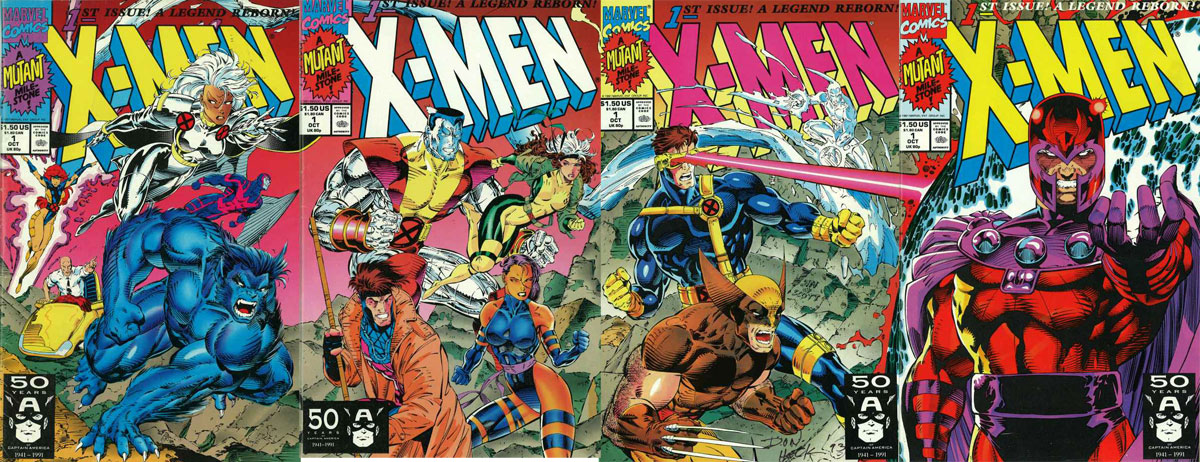
I think it was in the late 2000s, surely before 2010, that I saw piles of American comic books appearing in branches of the discount bookstore The Works. I had only been reading American comic books for a few years, but I already knew enough to know what I was looking at: the first issue of the “X-Men” (volume 2) from 1991, written by Chris Claremont, and illustrated by Jim Lee and Scott Williams. The pile contained the four different covers that made this first issue into a collector’s item at the time, and the fifth that turned them into a gatefold tetraptych. This last version sold for £2.50 in 1991, but here it was three or four copies for £1 – I got the gatefold issue and one of the others, for the story told inside was the same.

Like the value of first edition novels, the values of particular comic books had boomed by 1991, most notably the first appearances of Superman, Batman, Spider-Man and the Incredible Hulk. This was translated special “collectors’ edition” first issues of further new series, featuring higher-quality paper stock, card covers, foil covers, glow-in-the-dark covers, die-cut covers, and so on, all at a premium price compared with a standard book, and seen as an investment by those not necessarily there to read the story inside.

“X-Men” #1 is recognised as the biggest-selling comic of all time, but the 8.1 million copies sold were pre-orders made by comic book stores and newsagents – only half of these were actually sold to customers in 1991, and what I saw must have been the remaining stock being emptied from a warehouse. This continued for some time: I bought two copies of “Superman” #75 from 1992, “The Death of Superman”, one where I opened the black and red bag containing the black armband, trading card and stickers, leaving the other unopened; many issues from the beginning of Image Comics, like “Youngblood”, “Chapel” and “Shadowhawk”, with lots of cross-hatched art and gaudy colours; and various issues of “Spider-Man 2099”, “Punisher 2099”, “Ravage 2099” and so on, more new series and more ways to grab your attention. 

The comics speculator bubble had largely burst by the mid-1990s, leaving readers to carry on as before. Even though Marvel Comics came out of this period worst, having entered Chapter 11 bankruptcy protection in 1996, this also came after a stock market flotation and buying a distributor, but the bubble affected the whole industry. Of course, this was all before the true value was found, by Hollywood, in comic book characters and their stories, over the paper they were printed on.

13 June 2021

ABLE TO LEAP TALL BUILDINGS IN A SINGLE BOUND [301]


In the 1987 film “Superman IV: The Quest for Peace,” Clark Kent rushes from the Metropolis Hyatt hotel in an attempt to appear simultaneously as himself and Superman to Lois Lane and Lacy Warfield. Clark dives into a car, getting out the other side as Superman, before stepping on a granite planter to fly away.

Thirty-four years later, I sat on that very step, to eat a yoghurt I bought from the Sainsbury’s down the road. This was something I only realised later.


Last week, I was in the town of Milton Keynes to visit an exhibition of postmodern furniture from the 1980s Memphis collective. Anyone who knows me heard my anticipation of this visit for months. However, I also knew the modern grid of Central Milton Keynes – shortened to “CMK” on all the street signs I passed – had once been used to substitute for Metropolis, a city that, like Batman’s Gotham City, is an analogue for New York, a city distinctly more vertical than a town unofficially intended to be no taller than its tallest tree.


This substitution is nothing new in filmmaking, even for the Superman franchise: 1983’s “Superman III” uses the Canadian city of Calgary for its outdoor scenes, the first two films used New York itself, and all four films recreated New York street scenes on UK sound stages at Pinewood Studios and Elstree Studios, combined with second-unit photography of the real thing. What distinguishes “Superman IV” from the others is its shooting of interior scenes in CMK as well, for both aesthetic and budgetary reasons.


centre:mk shopping centre and walkway, hidden by trees

Formally incorporated in 1967 as a new town, Milton Keynes deliberately avoided being built like a regular town centre. Squares created by the grid of roads became neighbourhoods, supported by a central business and shopping district. Pedestrians are separated from traffic, surrounded by trees and plants – I had not expected to see so many dragonflies. I stayed in a hotel based in a mirrored glass office building, across from centre:mk, originally known as the courageously dull "the shopping building," a half-mile long shopping mall in a light and airy modernist design, now protected as a listed building. I had expected CMK to feel rigid and ordered, but I now want to live there. A town centre never felt so pleasant to me. Absolutely none of this sounds like Metropolis.


As explained in Oliver Harper’s 2017 documentary “Superman IV: The Man of Steel and Glass,” John Graysmark, as production designer, chose CMK as “essential for the budget… Basically, it’s the most contemporary architectural exercise within an hour’s journey from Elstree. That was the brief - otherwise we’d have gone to Toronto.” Graysmark was also dealing with a budget of only $17 million, less than half of the cost of the previous three films, a result of the franchise’s move to Cannon Films, a company in financial trouble that usually sold their films’ distribution rights in advance to pay for their production. This perhaps is why CMK is erroneously thought as being all the production could afford, rather than consciously selecting the best possible location. Putting a fire hydrant outside Milton Keynes train station to make it look like the outside of the United Nations building looks more than a little self-conscious, but as a wide public square, surrounded by glass buildings, it was more effective than what London could offer at the time. (The only location shooting completed in London was for the United Nations building itself, substituted by Wembley Conference Centre, demolished in 2006.)


Milton Keynes train station

One neighbourhood square along Avebury Boulevard contains Avebury House, now used as the headquarters for the retail store chain Argos, but had only just been completed when “Superman IV” was in pre-production in 1986. Next to it is a Holiday Inn hotel, and a health club and Winter Gardens, sheltering tropical trees and plants, is on the other side. Avebury House served as the foyer to the Metropolis Hyatt hotel, while one floor of the building became the offices of the “Daily Planet”. The entrance of the Winter Gardens became the newspaper’s foyer, while the gardens themselves became the Metropolis Museum of Modern Art, where Lex Luthor steals a strand of Superman’s hair from a display to create his “Nuclear Man”. The health club is also used as a gym in one scene. The Holiday Inn was not used on screen, as it hosted the cast and crew.


“Superman IV: The Quest for Peace” is a film that suffers when you look at it too closely. Its plot was rendered incomprehensible when test screenings led to forty-five minutes being cut from its runtime, with no reshoots. As mentioned, the horizontal nature of Milton Keynes clashes with the second-unit footage of New York, but only if you are watching the background rather than the action. The film is derided by many, including myself, as one of the worst ever made, but this comes from poor special effects, a choppy plot, and the result suffering in comparison to previous films in the series. Arguably, the film is unfinished. There is no problem with the production design – Metropolis hadn’t looked so modern before.


I remain surprised that no other town centre in the UK has been built, or rebuilt, like Milton Keynes. Nowhere so modern should be made to feel like a museum piece, but nowhere this modern will remain so for years to come.


Walkway under a road, garnished with rental cycle and electric scooter

15 July 2019

WHOOPS NOW, SORRY I CAN’T GO [186]


British comedy owes quite a lot to the writers Andrew Marshall and David Renwick. While the most recognisable TV shows by them were those they wrote on their own – Marshall has “2point4 Children,” “Health & Efficiency” and “Dad” to his name, while Renwick created “One Foot in the Grave,” “Jonathan Creek” and “Love Hurts” – they had fifteen years of writing as a double act on sketch shows “End of Part One,” “There’s a Lot of It About” and “Alexei Sayle’s Stuff,” while creating satirical sitcoms such as “Hot Metal,” set inside a newspaper. Their most recognisable work from this time were first written for their radio series “The Burkiss Way,” often compared with “The Goon Show,” and reworked for TV: a sketch involving a clueless hi-fi system buyer was re-enacted on “Not the Nine O’Clock News” (“Do you want speakers? Do you want rumble filters? Do you want a bag on your head?”), and a sketch where a “Mastermind” contestant gives the answers to the previous question was reworked by Renwick, and performed by Ronnie Barker & Ronnie Corbett.
What may be their greatest achievement, now I have seen it, is their 1982 sitcom “Whoops Apocalypse,” satirising the leaders of the nuclear powers that will, probably, kill us all. It is a hard sell – the opening titles begin with a vision of a destroyed city that could have come from the documentary series “The World at War,” ending on a woman selling poppy-like remembrance badges, with the phrase, “Wear Your Mushroom with Pride.”

Fortunately, the comedy is as broad as it is cutting. The President of the United States is the Reagan-like Johnny Cyclops, obsessed with his ratings, and is even shot to increase his popularity. His Secretary of State, a religious fundamentalist, is nicknamed “The Deacon,” with Marshall & Renwick having no knowledge that Ronald Reagan’s real-life chief was known as “The Vicar.” Meanwhile, the UK is led by the left-wing politician Kevin Pork, who believes he is Superman. Soviet Russia’s leader, Dubienkin, is in fact a series of clones, a new clone coming in once the previous one dies.
In 1982, it would have been hard, even then, to imagine politics being so chaotic: a nuclear alert is caused by a malfunctioning Space Invaders arcade cabinet; the deposed Shah of Iran, attempting to find sanctuary, is shunted between Britain and France over most of the series, unable to leave a cross-channel ferry, until he is stowed onboard a space shuttle; the insane Prime Minister is blackmailed by Russia into joining the Warsaw Pact, leading his foreign secretary and Chancellor of the Exchequer to go mad themselves, becoming Hawkman and Green Lantern; two American captives of the Russians are aware the US know they are captured because they had a newspaper delivered with their continental breakfast, meaning they will have no choice of jam until after they make a confession; a counter-revolution by Iran is discovered by Russia after the Shah’s pet parrot; and events are reported at all hours of the day by dramatic US newsreaders, CNN having only began in 1980.

“Whoops Apocalypse” is a brilliantly-written show - a favourite line, even though it is also from "The Burkiss Way," was of how an admirer of Frank Sinatra sold a lock of his hair back to the singer for an undisclosed sum. The show's bite still holds up even now, although the story it tells is rooted firmly in the early 1980s, before the conversation over nuclear weapons became, well, deathly serious, and before the seminal dramas “The Day After” and “Threads” were made. For that reason, the remaking of “Whoops Apocalypse” as a film in 1986, released in the US in 1988, suffers in comparison with the TV original – with the urgency dissipating from the situation, and almost gone by the end of the decade, lampooning leaders didn’t feel like enough, and replacing Iran with a Falkland Islands-like conflict was an obvious step. Still, it has Rik Mayall as the leader of a too-gung-ho SAS unit...