Showing posts with label LCD. Show all posts

27 September 2026

NAME IT, READ IT, TUNE IT, PRINT IT [554]


I am not saying that you shouldn’t buy the Canon TR4750i combination inkjet printer and scanner, I am just saying that using one is never straightforward.

I needed to print out some tickets, sent to me by e-mail, for a visit to an art gallery, a standard failsafe for me because the last thing you want to do is rely entirely on your phone to hold the key to visiting places – the same has gone for airline boarding passes. 

I bought my first inkjet printer when I was completing my A-Levels – carrying on into my degree, I remember the satisfaction of submitting coursework and essays without the added worry of finding somewhere to print them first.

However, that was a time before wi-fi. Attempting to print the tickets from my phone via Apple’s AirPrint standard did not pick up the printer at first, necessitating my restarting the printer. Once my phone finally connected, the printer just fed the paper through itself without making a mark. 

Two further attempts at printing, with the same outcome, led me to shine a light, literally, on the LCD panel on the printer – it is not backlit, and I have put the front-loading printer on a shelf due to available space, which obscures my view of this display – to be told that the device needs to complete a firmware update before it will do anything else. You would have thought Canon could have sent such a message to the print properties screen on my phone, or even print it on the paper I was trying to use.

I later turned on my desktop computer, reasoning I can better see and control what is going on, which made no difference to what the printer was doing. The QR codes showing on the tickets were not appearing in the preview screen, which led to my finding they were being treated as part of the document’s background, instead of as the main reason for doing any of this. Finally, having changed all the settings I could see, I printed the tickets off, and got on with my life.

Rather than the usual gripe about inkjet printer cartridges being so expensive that buying a new set of black and colour cartridges could set you back as much as the printer initially did, a comparison per millimetre of ink with the price of champagne, mine is with the actual ability to print. I let two months pass from the purchase of the tickets until I could sum up the energy to print them out, knowing it will never do it how I want the first time.

I think I may have also expected too much from it for the money. The printer loads and feeds out its paper from the front, meaning you can place it on the shelf, but more expensive models have its control screen on the front flap too, meaning you will be able to see if it needs a firmware update. I also have my suspicions that its ability to print double-sided leads it to spew out an empty page if processing the request becomes too difficult.

Admittedly, the scanner was my main reason for this printer’s purchase, intending for it to eliminate more sheets of paper than it will ever be expected to print. Somehow, I have had no software problems there so far, so perhaps Canon is encouraging me to reduce my use of paper?
20 November 2021

AND THROUGH THE WIRE I SEE YOUR FACE [320]

In 2020, I bought a new television. My previous LCD TV, bought in 2011, was becoming clunky and slow in comparison for what I can now get for two-thirds the cost, in addition to a higher-quality LED screen. Connected to it is an Apple TV box, a Blu-ray player, and a secondary DVD player that allows me, living in Europe, to watch region 1 DVDs from the United States, a cheaper option than buying a Blu-ray player that covered this requirement.


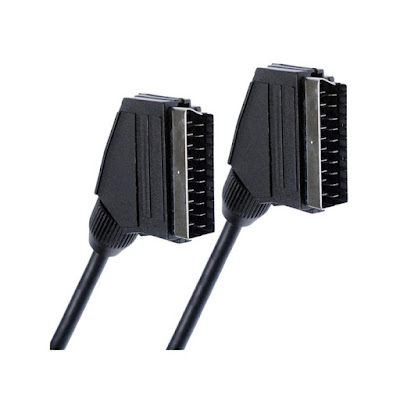
However, I still expected to connect the DVD player via SCART, the only option available on it. What I had not banked on was the almost wholesale dropping of SCART connections from audio-visual (AV) equipment since I last had to buy a television. 


Known as PĂ©ritel in its originating country of France, and first appearing in 1977, SCART is the acronym of an organisation of manufacturers that created a shared AV connector standard, and the name of the connector itself. The intention of creating a shared standard was to simplify the connecting of different AV devices, whether they were analogue or digital, and to avoid incorrect connections. To that end, twenty-one pins were supplied to carry composite, RGB, S-Video and YPbPr component video signals, and analogue, optical or digital audio signals – your devices would then choose the best connection to make. SCART connectors also carry the control signals that allow, for example, a DVD player to be “woken up” from standby mode when your TV switches to its connection, and you could daisy-chain devices together.


This is something I did not realise until much later, because I did not know: for a long time, SCART leads were often the only connectors available to televisions in the UK apart from that needed for an aerial, and while we may be used to HDMI offering similar ease of use, HDMI is for transmitting digital audio and visual data, and not the analogue signals from older devices – there have been HD televisions and laser-disc players that used an analogue component signal of 720 or 1080 lines, but this was used mainly in Japan, where a version of SCART also gained traction, and was extremely expensive.


Where did this leave me, with my region 1 DVD player? There is a spare HDMI connector available on my TV, but the requirement to turn the analogue signal from the DVD player into a digital one that can be accepted by HDMI means that the cost of a converter was higher than I wanted to spend, while also requiring a power source to assist in processing the signal from analogue to digital. You can use the VGA connector that is now often included to turn your TV into a computer monitor, but while that will carry a component visual signal to the TV, it won’t carry the sound. 


In the end, I had to buy an adaptor to break out the composite signals from the scart lead to use the red, white and yellow AV connectors at the back of the TV. For the record, while SCART has not been a requirement on French TVs since 2015, which is perhaps what led to it being dropped elsewhere, the inferior composite signal and connectors created by RCA in the 1950s have apparently proved too ubiquitous on TVs worldwide to kill off.