Showing posts with label Diary. Show all posts

12 April 2026

ALL I NEED IS HELP FOR A LITTLE WHILE [536]

IBM MT/ST

When the spy thriller writer Len Deigthon died in March 2026, his 1970 novel “Bomber”, about a fictional air raid during World War II, was reportedly the first novel to have been written during the word processor. However, Deighton did not use what we would picture to be one: the IBM MT/ST recorded the keystrokes of an IBM Selectric typewriter onto a magnetic tape drive built into a desk, most devices having at least two drives to allow merging sections together, often onto a third drive. The instruction manual advised users to “Think Tape”, like inputting a program. There was no screen, but it could “play back” its output to the typewriter.
 

Introduced in 1964, and intended more for composing mail for businesses, IBM withdrew the MT/ST in 1970, as floppy disc drives and terminals with screens became more commonplace. But Deighton’s reason for using the machine was clear: it eliminated the constant retyping of drafts by his assistant, chapters often being revised dozens of times, gaining the ability to edit something that already existed. The tapes are now considered to be lost, but it may be the first time where the record of a novel-in-progress was held on something other than paper.

Over fifty years since the writing of “Bomber”, it appears I still need to reckon with what I should consider to be a permanent record of my work, and where that should be held.

I have two writing projects to which I attach a “permanent record” status: these articles, and a diary. The former exists, save for written notes, as computer files, each one holding the numerous re-edits made during their writing. The latter is a succession of books, written out longhand, and in many cases, especially from 2012-19, ripped out of other books and kept in folders, with some vague intention of copying them up at some point.

Both approaches carry risks, from the lack of backup made of those computer files, to the corruption of data, to paper getting mislaid or removed, or coming into contact with water – only one incident like that will lead you to writing with semi-permanent ink as a minimum for the rest of your life. But should I print out my articles, or type up my diary in future?

The short answer is to embrace the fact that both options require levels of maintenance in order to attach a notion of permanence to them: computer files need to be backed up, ideally to more than one place, and at regular intervals to avoid data loss through file corruption and the lifespan of the devices on which you hold the data; written works can be copied, either by hand, scanning them or typing them up.

Ideally, I should wean myself off pen and ink, leaning more into typing as where the creative work starts, instead of where it ends. Because I essentially come to the screen with something to finish, I am already less perturbed by the flashing cursor on a blank screen than if I started with it. I should make use of that fact.

26 February 2023

PUT ONE FOOT IN FRONT OF THE OTHER [385]


I write to learn, so I remain perplexed about the growth, and more recently the explosion, of the use of artificial intelligence in the construction of essays and articles – I hesitate to describe it as “writing”. Having set myself the challenge in 2023 of writing at least one A4 page of diary every day, running to approximately three hundred words, then the mere act of writing one word after another really isn’t hard at all, even if you must go back on yourself to edit redundant words. Writing an article won’t take much effort if you know your subject, unless you are also relying on your AI program to gather the necessary information on that subject.

I promise the above paragraph was typed by hand. I have thought of engaging the use of an AI chatbot to see what it would come out with, but it is very hard to find one that could produce a satisfactorily entertaining result, or not require me to create a login or pay to use it – if you want help, or you simply want to cheat time and process, then you have now created a marketplace, and the producers want paying. Not only is it more rewarding to write that essay yourself, but it is also cheaper.

ChatGPT has been the AI chatbot causing the most ructions right now, for its delivery of prose, and even poetry, in a both a naturalistic style and in imitation of other writers. As a “Generative Pre-trained Transformer” with as many available samples of the written word stacked behind it, ChatGPT has been fine-tuned to sample a number of desired outputs from the question posed to it, rank those outputs in order, and uses an evaluator protocol that optimises and produces the most rewarding answer, both for the end user and in the future machine learning involved in “training” the chatbot to continue producing the correct answer. However, the overall aim is to take a word, and decide what the next word should be. Basic rules of grammar will get you half the way, until you must make a decision.

One limitation to ChatGPT is it can sometimes produce a nonsensical answer due to having no source of truth to draw upon in its sample writing, or that previous training caused it to be too cautious in selecting the correct answer, or even select the incorrect answer altogether. This is described in artificial intelligence terms as a “hallucination”, despite a person’s hallucination appearing to be real without having any external stimulus. What I would be worried about is proofreading: no-one should take anything they read entirely as read without proper evaluation, or trust in the evaluation another person has done.

With OpenAI, the research team behind ChatGPT, looking into “watermarking” its answers to avoid plagiarism, the turning point will not be when AI can produce infallible answers – the machines will only take over when their hallucinations are eliminated.

20 March 2022

YELLOW MATTER CUSTARD [336]


“Have you been able to get a good start on your new day yet so far? Thank goodness for letting me see you all the way back around here. I did not have any questions at the first time this week, so hopefully this will help you out for me. Good luck on the next update and I appreciate it letting me have it done.”

I think my phone is bored.

The above paragraph was written using only the predictive text function on my phone, based entirely upon the words I have entered previously, and what words my phone thinks I will use again. 

When I use my phone to write something, it is only to write text messages to say I have done something, that I need someone to do something, or to say I will see someone later. I found myself writing my diary on it when 2022 started, but writing that longhand feels more appropriate to me.

“Thank goodness I have just a few of those who work for the next couple of hours before they turn left. Know how much it turned into the last time you got it? Very nice thank you. So I’ll send you the link to your account tomorrow and then I can see what it looks like for the next week of February or November.”

I am being given either “thank”, “I” or “have” as my starting word, no matter how many times I start a sentence – my previous choices do not change them. I also tried typing a word by entering the letter “f”, and it was suggested I enter “g” instead.

“Thank goodness I have just a few of those who work for the next couple of hours before they turn left. Know how much it turned into the last time you got it? Very nice thank you. So I’ll send you the link to your account tomorrow and then I can see what it looks like for the next week of February or November.”

I am not sure I should be impressed: no matter the choice made in the next word to pick, my writing style has either been exposed as banal by machine learning, or rendered so. My choice of words to construct a sentence are constrained only by those I have used, so I either need to read a dictionary to audition new words, or type the text of William S. Burroughs’s novel “Naked Lunch” into my phone – that’ll teach it a lesson.

“Good luck with your help today and I hope you have received an amazing feeling that we will continue to be happy with the time of our own family. Hi there I hope you’re doing good with your work schedule today for you all the afternoon and thank goodness you have had been more productive today than usual, but it will take me too many times for the rest of the week.”

My starting words have now changed to “I”, “Hi” and “Hello”. My phone is either sentient, or I am using it as a ouija board. Good bye.

07 October 2018

EVERY DAY I WRITE THE BOOK [130]

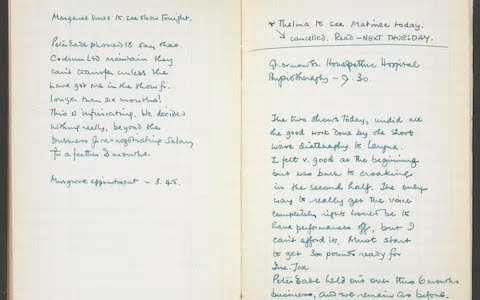
Two pages from the diary of Kenneth Williams

Monday


Is there any point to keeping a diary? You know what you did, and how you feel – is it for reference, or to confront yourself, or as a writing exercise? The last of these was my reason for having first begun a diary fifteen years ago, but also why it has petered out – I have other outlets for that sort of thing, outlets more than one person can see. I could do with a way to collate all those disparate thoughts you have during the week, those ideas that felt like a good idea at the timer, but they let you go before you remember to write them down.

Tuesday

So how did Ceefax work anyway? And why did my mind make me think of this? And why am I now entertaining this as a subject for a future article, instead of looking it up? Teletext is still a recent history for most – oh yeah, that’s why it’s a good idea.

Wednesday

Of course, today is when you actually started writing your diary, in the hope that, when you read through it as preparation for the inevitable autobiography, you will have forgotten what kind of procrastinating person you once were, only to have that thought hit you once again.

Thursday

Of course, your energies were concentrating on work during the week, and there are times where you have nothing to write down, but the idea of skipping an entire day seems about as perverse as making a note that, by the way, nothing else happened – it may be easier to make a note of that having been the case, and move on.

Friday

A manager at work said I had a good speaking voice, but I then decided to say it sounded like it was full of disdain – it was rather a pointless call. I am not exactly sure why I said that, but it does sound like I was being too honest while making a joke. I don’t like taking phone calls. I’ve had the latest iPhone for two weeks, and made one call on it so far.

Saturday

Napping in the afternoon, I dreamt I was walking, then my right foot slipped, I fell forward – and I woke up. This joins other weird dreams of this week, which included retrieving papers, from a red post box in a high street, that I needed for when I was starring in a TV detective drama – a type of show I never, ever watch – and the dream where I found forty-five pence on the floor. I should have gone for a walk, but it was raining – that is, in real life.

Sunday

Wrote an article about “Friday the 13th: A New Beginning” for His & Hers Movie Reviews – it is their Halloween Horror month, and I rarely watch horror films, but I may write a horror film one day, or some sort of horror story. If science fiction portrays our anxieties about the future, then horror does the same for the present.