Showing posts with label RCA. Show all posts

26 November 2023

BY MAKING GROOVY MOVIES [424]


On Thursday 23rd November, I received an extremely unexpected e-mail: 

“Beginning December 4, 2023, limited quantities of the KODAK Super 8 Camera will be available to U.S. customers. Availability outside the U.S. will be announced at a later date. If you are interested in purchasing a camera once it is available in your country, you must sign up on Kodak's NEW camera reservation list by November 28, 2023, opting in to communications from third-party retailers authorized by Kodak. By completing the new form by the deadline, you will maintain your position from the previous list.”

The Kodak Super 8 Camera was originally announced in 2016, at which point I joined the reservation list. In the absence of further announcements in the following years, I seriously considered whether Kodak was serious: like Polaroid, RCA, and Blaupunkt, the Kodak name has been licensed for everything from cheap AA batteries to tablet computers and blockchain mining, its original business of making camera film now the preserve of professional and “prosumer” especially, especially if a roll of 35mm still camera film can cost nearly £10.

Still, I was intrigued by the possibilities of shooting motion pictures on Super 8 film, using Kodak film cartridges, with a camera that included innovations from camcorders like an LCD screen for a viewfinder, and the ability to record sound onto an SD card placed into the camera. Once developed, the film would be returned to you with a link to download a video film in 4K resolution. I was excited by the possibilities of what I could make – the two-and-a-bit minute run time of a cartridge would be a fun challenge. Kodak announced this camera with a projected price of between $400 and $750 – seeing as the next nearest camera available is the Arri 416, a 16mm industrial film camera with a 2023 price tag of £78,000 (but available to rent), the Kodak Super 8 Camera would have fostered its own industry of filmmakers.

The price of the camera has increased after seven years, but not with inflation: Kodak will now be charging a horrifying $5,495 for a camera that does not appear to have been developed since 2016, having retained the originally announced design. This will be purely for professional use only, demanding professional prices, completely severing me from the possibility of buying one for myself – even the new registration film assumes you are working in the film industry, with a space to write in “other” occupations and intended uses. In 2023, the presence of a replaceable battery should have been enough of a sign this will be a professional product, even if charging it by micro USB appears to be a holdover from 2016. It feels like what could have been a mass-produced camera will now be assembled by hand like a Swiss watch.

For most, the Kodak Super 8 camera’s place in film history has been taken by the Apple iPhone, because its camera has been constantly developed to approach a professional results while being as simple or as advanced to use as its user requires. For the next level up, the Blackmagic Pocket Cinema Camera 6K Pro, with a DSLR form factor producing 6K pictures approximate to Super 35 film, a cinematic motion picture standard, costs half what Kodak are charging for their camera, even if you have to buy the lenses separately. You can apply the film grain in post-production...
20 November 2021

AND THROUGH THE WIRE I SEE YOUR FACE [320]

In 2020, I bought a new television. My previous LCD TV, bought in 2011, was becoming clunky and slow in comparison for what I can now get for two-thirds the cost, in addition to a higher-quality LED screen. Connected to it is an Apple TV box, a Blu-ray player, and a secondary DVD player that allows me, living in Europe, to watch region 1 DVDs from the United States, a cheaper option than buying a Blu-ray player that covered this requirement.


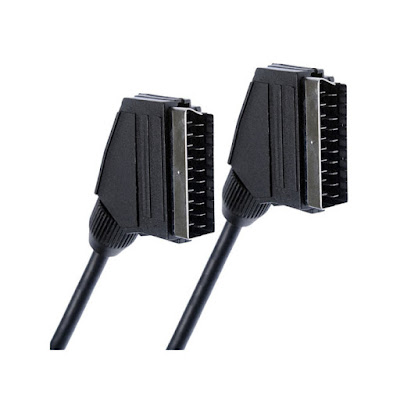
However, I still expected to connect the DVD player via SCART, the only option available on it. What I had not banked on was the almost wholesale dropping of SCART connections from audio-visual (AV) equipment since I last had to buy a television. 


Known as Péritel in its originating country of France, and first appearing in 1977, SCART is the acronym of an organisation of manufacturers that created a shared AV connector standard, and the name of the connector itself. The intention of creating a shared standard was to simplify the connecting of different AV devices, whether they were analogue or digital, and to avoid incorrect connections. To that end, twenty-one pins were supplied to carry composite, RGB, S-Video and YPbPr component video signals, and analogue, optical or digital audio signals – your devices would then choose the best connection to make. SCART connectors also carry the control signals that allow, for example, a DVD player to be “woken up” from standby mode when your TV switches to its connection, and you could daisy-chain devices together.


This is something I did not realise until much later, because I did not know: for a long time, SCART leads were often the only connectors available to televisions in the UK apart from that needed for an aerial, and while we may be used to HDMI offering similar ease of use, HDMI is for transmitting digital audio and visual data, and not the analogue signals from older devices – there have been HD televisions and laser-disc players that used an analogue component signal of 720 or 1080 lines, but this was used mainly in Japan, where a version of SCART also gained traction, and was extremely expensive.


Where did this leave me, with my region 1 DVD player? There is a spare HDMI connector available on my TV, but the requirement to turn the analogue signal from the DVD player into a digital one that can be accepted by HDMI means that the cost of a converter was higher than I wanted to spend, while also requiring a power source to assist in processing the signal from analogue to digital. You can use the VGA connector that is now often included to turn your TV into a computer monitor, but while that will carry a component visual signal to the TV, it won’t carry the sound. 


In the end, I had to buy an adaptor to break out the composite signals from the scart lead to use the red, white and yellow AV connectors at the back of the TV. For the record, while SCART has not been a requirement on French TVs since 2015, which is perhaps what led to it being dropped elsewhere, the inferior composite signal and connectors created by RCA in the 1950s have apparently proved too ubiquitous on TVs worldwide to kill off.

14 April 2019

WE DO OUR BEST, WE TRY TO PLEASE [163]


Fifty years have now passed since the release of “Philosophy of the World,” the first album by The Shaggs. Fifty years have also passed since it started being described as one of the worst records ever made: the most often repeated critique, from a review in “Rolling Stone,” described the group of three sisters as sounding like “lobotomised Trapp family singers,” while their playing is described as amateur at best, incompetent at worst.
I first came across the album from a video online, describing it in terms of being “so bad it’s good.” With musical taste being entirely subjective, I needed to listen for myself. What I heard conjured up words like “naïve,” “nervous,” “charming,” “claustrophobic” and “insightful.” The Shaggs sound like a typical 1960s American garage band, but one that was caught on record before they were ready to play in public.
Discussing the music of The Shaggs in 2019 is entirely bound up with the story of the Wiggin family: Dorothy on vocals and lead guitar, Betty on vocals and rhythm guitar, Helen on drums, and Austin as the Svengali father that took them out of school, giving them music and singing lessons, because his mother, a palm reader, predicted he would marry a woman with strawberry blond hair, have two daughters before she died, and that his daughters would become a popular music group. The Shaggs, named after both shaggy dogs and the “Shag” hairstyle they were all given (later known as the “Rachel”), became a band because their father had a mission, not through their own ambition, and despite eventually achieving some success performing in the area around their town of Fremont, New Hampshire, they disbanded upon the death of Austin Wiggin in 1975, their claustrophobic career now able to end.

Knowing The Shaggs’ backstory makes listening to “Philosophy of the World,” made because Austin decided it was time for them to record an album, more difficult than it should be. It is not possible to recreate the conditions under which the album first became known. Only a thousand copies were printed, before the label owner absconded with nine hundred copies and the money paid to him, leaving the rest to be picked up as, essentially, found objects, with no other context than the record sleeve, picturing the band in front of a green curtain, and liner notes (written by Austin) proclaiming the band are “real, pure, and unaffected by outside influences.” Noted fans include Frank Zappa, Terry Adams of the band NRBQ, and Kurt Cobain.

After discussing the album’s reputation, I can finally enjoy the music by itself. All twelve tracks were written by Dorothy Wiggin, and their titles reveal a kind of teenage grasping for meaning: “Philosophy of the World,” “Things I Wonder,” “Why Do I Feel?,” “What Should I Do?” and “Who Are Parents?” The lyrics themselves are simple and straightforward: “There are many things I wonder / There are many things I don’t / It seems as though the things I wonder most / Are the things I never find out.” This does not mean that the lyrics can’t also be playful: “My companion is with me / Wherever I go, it goes too / My Companion is with me / No matter what I do.” There can be frivolous songs, about Halloween or a sports car, but another will aim for depth: “But then there’s times when you are very different / I just don’t understand / How a minute you can be so mean / The next minute so grand.”
The music written to these lyrics is jangly, played in a similar style across all twelve tracks. Dorothy and Betty almost always sing the same melody, with no harmonising, and Helen’s drumming either leads or follows the guitars. The band plays in time, but the time varies. Regardless, the rhythm is there, the melody is there, the chords are there. There is also a knowing eye fixed straight on their father: while “Who Are Parents?” states, “Parents are the ones who really care... Parents are the ones who are always there,” the title track also makes clear, “There will always be someone who disagrees / We do our best, we try to please / But we’re like the rest, we are never at ease.”

Pop music is so formulaic as a concept – two guitars, bass and drums, three chords, two verses, chorus, middle-eight and so on – that it is not no surprising that anyone can do it, whether the result is polished or not. Its presentation as an album, with printed vinyl, cover and liner notes, is using the form to add credibility, owing to Austin Wiggin paying to access the record-making process. If The Shaggs had appeared in 2019, the process would be so much easier: YouTube videos, an account on Bandcamp, self-releasing their songs via iTunes. If it was fifteen years before, they would have a MySpace page. If it was 1976, the year after the band broke up, they could have looked on as the punk aesthetic led to people picking up instruments and performing even quicker than they could ever have done, had they wanted to in the first place.

I cannot say that “Philosophy of the World” is a bad album, or even a technically inept album. Enough of the pop music formula is broken by The Shaggs that you are compelled to stay with them. Alright, other people can perform better, or write better songs, but they made an album, and you have not, even if it is far easier for you to make one than it had been for them.
The following fifty years redeemed the band – a 1982 release of later recordings, titled “Shaggs’ Own Thing,” was less successful, because their continued improvement as a band, and their sounding more confident, made them sound more conventional than before. The master recordings of “Philosophy of the World” were rediscovered by Dorothy Wiggin in 1988, leading to their re-release by a major record label, RCA. Dorothy released an album of new songs in 2013, titled “Ready! Get! Go!” – “Banana Bike” is a particularly good song. The Dot Wiggin Band, which continues to this day, also performs Shaggs covers from the original sheet music, idiosyncratic drums, jangly guitars and all – of course they knew what they were doing.

16 April 2018

NO MATTER WHO’S THE LEADER WHEN THE SUN SETS DOWN [105]


The idea of owning a personal copy of a film or TV programme is only around forty years old. Unless you had spent thousands on your own cinema set-up, or on a new-fangled home video tape recorder, 1978 was the year home video began in earnest, and anyone buying into it had to decide which direction they would take.
Sony introduced the Betamax video recorder in 1975, with VHS, JVC’s competitor format, launching the following year. They were marketed with a specific use in mind – the ability to time-shift your television viewing. A two-hour video tape costed as much as £20, but were expected to be reused often - pre-recorded tapes cost at least three times as much, taking as long to make as they took to play back. With the recorders themselves costing up to a thousand pounds, selling films to the general public would have to be done another way.
The answer was, as will be with DVD and blu-ray, to copy the main method of getting music into homes: pressing video onto a disc. The first disc format, usually known as LaserDisc, went on sale in 1978. It was originally known under the hilarious name “MCA DiscoVision” – the name had been chosen back in 1969, before disco music appeared, but if you are forming a company to hold video-on-disc patents held by MCA, then owners of Universal Pictures, and the electronics group Philips, it was the right name to choose. LaserDiscs look like 12-inch CDs, recording their data in a similar track of spaced pits - the discs are big enough to see the track with the naked eye - but the pits are used to interpret the waves of a composite analogue signal, rather than binary code. A LaserDisc player was two-thirds of the cost of a VCR, requiring fewer moving parts, and pre-recorded films, the first of which was Universal’s “Jaws,” cost as much as a blank tape did.

The second format was CED, or “Capacitance Electronic Disc,” launched by RCA in 1981 under the "SelectaVision" brand they also used for their VCRs. However, the release date was originally meant to be 1977, with the project having started back in 1964. However, the long gestation period was because RCA was perfecting their own patents: instead of using a laser on a reflective plastic disc, the CED would be made of the same vinyl that made audio records (with carbon added for conductivity), could be made on the same presses, and would even be read with a diamond stylus that physically touched the record. The video signal is then generated from the resonance measured from the changes in electrical capacitance between the disc and the stylus. Because the merest piece of dust on the disc would disrupt this process, attracting moisture from the air, the records would be shielded from view within a cartridge, from which the player would retrieve the record without the owner touching it. The first CED on release was not “Jaws,” but the more laid back film “Race for Your Life, Charlie Brown.”

This is where the problems started – stacked against LaserDisc, which could be mistreated like a CD and still play, CEDs would be too temperamental, only produced a VHS-level picture against the higher quality of LaserDisc and, of course, was released too late. RCA announced they would stop making CED players in 1984, which paradoxically caused demand for the discs to increase, until they finally ended in 1986, when RCA was broken up for sale, after losing $600 million on the whole endeavour – the UK would only see the whole system on sale for six whole months. LaserDisc would carry on much longer, having proved very popular in Japan, with discs on sale until 2001, and players still being made as late as 2009 – its analogue picture quality was still on a par with early DVDs, and its ability to provide chapter searches and audio commentaries made it the premium alternative to VHS, through film series like the prestige Criterion Collection. Pioneer Electronics, which had bought out MCA and Philips’s stake, changed the name, and pushed the format to the very end - when they bought into it, in 1980, it was Pioneer that started pushing the more futuristic "LaserVision" as the name for the format, and "LaserDisc" for, well, the discs. In 1987, Philips tried naming the format "CD Video" in Europe, using gold-coloured discs, but LaserDisc had already failed to catch on there, so it lasted only a few more years. 

VHS became the dominant home video format for twenty years, but this was only achieved through economies of scale. While the cost of a pre-recorded tape was initially too much for most, it created the market for rentals instead, increasing what demand there was, and reducing the cost of making each tape. More companies began making both recorders and tapes to meet demand, and the overall cost continued to fall. The only downside of the ubiquity of VHS was that, when it came to replace them with DVDs, the plastic used to make the tapes was not recyclable – presumably, my collection remains in a landfill to this day.
Right now, “home video” no longer involves ownership for many people – online video streaming has replaced both the rental market and the need to record TV shows to watch at a later date. I have bought films on Blu-Ray because they were no longer available on Netflix, and recording TV shows to keep now involves a dongle attached to a desktop computer. When a problem is solved, it shouldn’t slowly reappear like this.

17 November 2017

HIT IT, PAUSE IT, RECORD AND PLAY [82]


Modern-day ingenuity means that popular forms of old technology can have their useful lives extended far longer than ever intended. For example, I have a 1983 BBC Micro computer, sadly no longer working, which could connect to my TV via a SCART lead, and could save BASIC programs to an SD card.
Likewise, improvements in sound recording and playback mean we can play new vinyl records that sound as good as CDs, through heavier records, cutting the groove at a slower speed, and direct-drive turntables. Even CDs sound better through 24-bit mastering not available when they were introduced, meaning my 2015 copy of David Bowie’s album “Never Let Me Down” sounds louder, more dynamic and clearer than my 1987 copy, which I only bought because Bowie hated his song “Too Dizzy” enough to delete it from all future reissues.

However, with retailers now offering more cassette players and blank tapes for sale than seen in the last ten or fifteen years, including various devices to copy cassettes to MP3 format, I must point out the new players and tapes will sound WORSE than what you threw away, or gave away, all those years ago, because the improvements made to cassettes when they were popular are no longer made.

When Philips introduced the Compact Cassette in 1962, the virtue of its compactness – the earlier RCA tape cartridge, as well as Sony’s later Elcaset, were the size of a VHS cassette – was outweighed by its lack of actual sound fidelity. Running at a quarter of a speed of then-conventional reel-to-reel tape, and on tape about half as wide, the iron oxide-coated “ferric” tape rendered only enough to use in dictation, and little else. The introduction, in 1972, of tape using a chromium dioxide coating, known as “chrome” or “Type II,” began the slow replacement of pre-recorded 8-track cartridges with tapes that could would be wound backwards as well as forwards, while 1979’s “Type IV” or “metal” tapes, using iron or chromium instead of their oxides, meant you could start approaching CD quality – “Type III” was a combination of the first two types by Sony, which did not last beyond the mid-1970s.

Meanwhile, the ubiquitous hiss of tapes could be reduced if your recorder incorporated Dolby Noise Reduction, with Dolby B being the first consumer standard introduced in 1968, followed by Dolby C in 1980, and Dolby S in 1989, just as CD sales began impacting cassettes. Unlike the industry standard Dolby A and SR, Dolby B and C were directed at the higher and lower frequencies at which the hiss would be heard, but Dolby S improved the whole dynamic range.

For anyone in the market for a new cassette player, I can now tell you that just about EVERYTHING I have just told you will be unavailable. Unless you can find someone selling unopened old stock, you will only find the base level Type I tapes available, for only these are still made. Even worse, Dolby stopped licensing their noise reduction systems a number of years ago, concentrating their efforts on digital and home cinema systems instead. Even worse, because modern hi-fi systems are not concerned with including cassette players, you can expect the overall quality of the players themselves to be less than before, although making sure the playback heads are clean and aligned always help. Playing back a Dolby-encoded tape will still work, but you just won’t get the benefit.
If you are prepared for the expense of matching the cassette experience you remember having, you may well have to buy your old system back from eBay – you may find me there, trying to buy a replacement BBC Micro.