Showing posts with label Peter Sellers. Show all posts

26 May 2019

YING TONG DIDDLE I PO! [176]


Hercules Grytpype-Thynne asks Count Moriarty to “Take a letter in gargling fluid... To the Postmaster General. Dear General [gargling noises], according to the shape of my knees [gargling noises], I believe that an illegal raffle [gargling noises] for the Equator is being held, and for certain monies I will reveal the organiser [gargling noises]. Let's have that back, please.” The message is spat out. “You filthy swine! You've watered my peony.”
“What time is it Eccles,” asks Bluebottle. “I’ve got it written down ‘ere on a piece of paper,” replies Eccles. A nice man wrote the time down for him that morning. “Supposing when somebody asks you the time, it isn't eight o'clock?” “Ah, den I don't show it to dem.” “Well how do you know when it's eight o'clock?” “I've got it written down on a piece of paper!”
Neddie Seagoon is asked to speak to Fred the Oyster, after insisting oysters can’t talk. He shouts, “Good morning, I see that it's early closing for oysters!” The oyster creaks open. We hear the hee-haw sound of a donkey, played backwards, followed by a forceful raspberry, before closing. Neddie exacts his revenge by eating the oyster. We later hear the oyster inside Neddie, through bubbling and warbling noises, singing, “I’m only a strolling vagabond...”
Now why am I telling you all this?

Comedy often doesn’t sound like this. Comedy is subjective and risky, and pushing boundaries requires effort, both from the performer and the listener, and when they meet, friends will be made for life. “The Goon Show” is like this for me, a radio comedy that took the more surreal strain of post-war British comedy and turned it into Surrealist, Dadaist art, full of wordplay, nonsensical plots and deranged sound effects – no wonder I turned out the way I did.
I worry that I will not hear anything as good as “The Goon Show,” despite the decades of opportunity for others to have tried. Perhaps, with the more boundaries that have been pushed, the perception grows that fewer boundaries are left, both with what you can say, and what you can make. Nostalgia grows for that misplaced sense of a time when more risks could be taken.
The show began on 28th May 1951 as “Crazy People,” a half-half mix of comedy sketches and musical items starring Peter Sellers, Harry Secombe, Michael Bentine (for the first two years) and Spike Milligan, and written mostly by Milligan. The first three series were not much different from your standard BBC comedy series for the time, except it took longer to build an audience because the comedy was not as obvious. But that audience did build, and as Milligan’s determination to use radio to its full extent grew, the show changed.

From the fourth series, producer Dennis Main Wilson moved to “Hancock’s Half Hour,” and “The Goon Show” gained Peter Eton, who worked in drama productions – sketches were linked to make a narrative, musical items were reduced, and Angela Morley, then known as Wally Stott, became the show’s musical director, providing the kind of cinematic scope that she would feature on the song “Jackie,” by Scott Walker, and in the Oscar-nominated soundtrack to the film “Watership Down.” The relentless push to create sound effects that could define the world within the show, replacing closing doors and feet on gravel with explosions, foghorns, water splashes, sped up and slowed down voices, proved the need for the BBC to create a unit that produces this “concrete music”: the BBC Radiophonic Workshop, formed in 1958, contributed as much to “The Goon Show” as much as it would to “Quatermass and the Pit” and “Doctor Who.” Furthermore, the growing success of the show led to it being specially recorded for broadcast around the world, something not routinely done in 1954, but something I’m thankful for the BBC deciding they should do – in fact, some lost episodes were remade in 1957-58 as a result, something not done with “Hancock’s Half Hour” until over fifty years later.

The last “Goon Show” aired on the BBC Home Service on 28th January 1960. Other radio comedy shows have come close to its anarchic nature, or its technical ambition – shows like “The Burkiss Way” or “The Hitchhiker’s Guide to the Galaxy” – but “The Goon Show” still looms large over it. In 2018, the latest “Hitchhiker’s” series, based on Eoin Colfer’s novel “And Another Thing,” continued in the same vein as its previous incarnations, but a part of me still thought that the only other opportunity I will have that week to listen to a comedy series on that kind of scale – no panel shows, no stand-up performances, no sketches – will have been made sixty years earlier. There’s that naughty brown leather nostalgia again.

One more example: Henry Crun and Minnie Bannister are at the bank of some water, enveloped with fog. However, there are so many foghorns playing over them, Spike Milligan is laughing at them, along with the audience, until Crun tells Minnie to put her saxophone away.
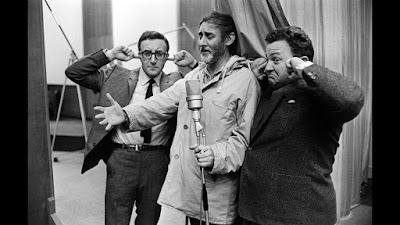
Just go listen to “The Goon Show,” you’ll be doing yourself a favour!

30 September 2018

I WON’T DO WHAT YOU TELL ME [129]


“If you didn’t live in that time, you’re not allowed an opinion in my view.”
This sentence has rattled through my head for the last week, because I have never heard anyone say something like this before. I also cannot think of a situation where you could get away with saying something like it. How do you respond to it? Am I allowed?
When writing about why I don’t like chat shows [link], I came across an interview gave to the “Mail on Sunday” newspaper in 2016 [link], just as a book on his encounters with Muhammad Ali was published. Even if I wouldn’t have made a point of tuning in to “Parkinson” in the 1970s, if I had been around then, I probably would have if Ali, or Billy Connolly, or Peter Sellers, or Kenneth Williams was a guest – some people are worth hearing, even if they are mainly there to promote something.
Although the article was to promote the Ali book, the headlines came from when Parkinson was asked if there were any moments in his career that he regretted. Saying he has been accused of being old-fashioned, Parkinson used the example of the 1975 interview he had with Helen Mirren, who was introduced on the show was the “sex queen” of the Royal Shakespeare Company and, after a theatre critic was quoted as saying Mirren was good at “sluttish eroticism,” Parkinson asked if Mirren thought her “equipment” got in her way of performing as an actress. After clarifying he was referring to her figure, Mirren replied, “Serious actresses can't have big bosoms, is that what you mean?”
The interview can easily be found online, and while it has since been decried as sexist since, it was perfectly fine for broadcast in 1975 – “it was OK at the time” is a phrase often heard in cases like this, usually because it may not be these days. In the “Mail on Sunday” interview, Parkinson said he may have overreacted, but he was reacting to the provocative figure Mirren presented. When asked if they had made up since, Parkinson said, “I don't want to. Nor does she. I don't regard what happened there as being anything other than good television. There is no need to apologise, not at all. She didn't want to do an interview and after about ten minutes I didn't want to interview her. There's no problem, it's not World War III for God's sake.”
For her part, Dame Helen Mirren, later quoted in an article for “The Telegraph” website [link], said, “That’s the first talk show I’d ever done. I was terrified. I watched it and I actually thought, bloody hell! ... I did really well. I was so young and inexperienced. And he was such a f------ sexist old fart. He was. He denies it to this day that it was sexist, but of course he was.”
This leads me to where I became unstuck. In his interview, Parkinson is reported reacting to the notion of his interview with Mirren being a defining moment of the “sexist” Seventies: You have to judge it by what happened in that time. If you didn't live in that time, you're not allowed an opinion in my view [my underline].... I’ve not done anything that I'm ashamed of. I can see everything in the context of the time I did it. I can think, 'Ooh, I wouldn't do that now.' But that doesn't mean to say I was wrong at the time.”
The interviewer, challenging that one sentence, writes, “if one of his guests had said that, he would have challenged them strongly,” but I wished it was challenged in this interview, although we do get the odd quote later, “Am I a sexist? No, I'm Yorkshire. I don't know what the answer is or what a sexist means, basically. I've been married for 57 years so something must be going right. I wouldn't say I'm a sexist at all.”
To be honest, I just needed to write about that one sentence, “If you didn’t live in that time, you’re not allowed an opinion in my view,” but I also needed to present the context in which that was uttered. I will go with Dame Helen’s reaction to the interview, because she definitely was there at the time, but to say you are not allowed to have an opinion on something is a red flag that needs as much oxygen as possible – if I said that to anyone, I would be demolished in response. Perhaps it is easier, for Sir Michael Parkinson, not to use his chat shows as primary sources.

29 July 2018

I COULD MAKE IT LONGER IF YOU LIKE THE STYLE [120]

Here are a few of those stories that, while not becoming full-length articles, still needed to be told:

1. PUT THE TAPE ON ERASE: After learning how the FLAC format preserved the sound of my CDs onto my Sony Walkman [link], I was disturbed by the clicking noise on the test track I used. Was it caused by the Walkman, the transfer program, or a scratch on the (brand new) CD? No – it was the original recording. I used “Through Being Cool” by DEVO, a song written in revolt at the sudden popularity of “Whip It,” and a song I played multiple times a day at the time, putting the clicks down to the YouTube upload I found. I later found it was down to the record company: DEVO’s “New Traditionalists” album was recorded using a new brand of analogue tape from 3M, but after finding the tape was falling apart from the edges, DEVO appealed to Warner Bros to re-record their work – they refused, so DEVO had to transfer the now-imperfect recordings to another tape in order to complete the album. The darker, less polished sound of the album could be said to be an unhappy accident, but when DEVO wanted to “spank the pank who tried to drive you nuts,” they could have been singing at Warner Bros.

2. I AM SAILING STORMY WATERS: “Captains of the Queens” was a memoir by Harry Grattidge, a commodore for the Cunard line of ocean liners, and he writes in it about how, in 1949, a piano fell through the floor of a dining room on RMS Aquitania, while a corporate lunch was taking place. The Aquitania entered service in 1914, alongside the Mauretania and Lusitania, ships originally in competition with White Star’s Titanic and Olympic. However, after thirty-five years, two world wars and three million miles, it was not in the best shape, with leaking decks in poor weather. Aquitania would be withdrawn from service by the end of 1949, deemed too expensive to refit, after three years ferrying people emigrating to Canada, and scrapped in 1950. The image I have in my head was that the piano was being played as the floor started to collapse – people then stood around the eventual hole, the piano having impacted the floor below, as one person tells the player, “well, it made a better noise than you did.”

3. DON’T YOU FORGET ABOUT ME: “The Goon Show,” the surrealist masterpiece by Spike Milligan, Peter Sellers and Harry Secombe, was nonetheless a BBC radio show from the 1950s, and had an announcer to, well, announce the episode. Enter Wallace Greenslade, who joined the BBC’s European service in 1945, becoming an announcer on the Home Service (now Radio 4) in 1949 to link programmes and read the news. Greenslade joined “The Goon Show” with its third series in 1952, just as it was turning from programmes of sketches into single three-act stories.  Greenslade’s clipped, authoritative delivery made Milligan’s diversions deceptively understandable and reasonable, proving to be the perfect straight man, playing other straight parts in stories as required. He was also allowed to be belligerent: “The Six Ingots of Leadenhall Street Part 2, or the Two Ingots of Leadenhall Street Part 6, whichever you like, I don’t care.” With “The Goon Show” playing out across the world, including on US radio by NBC, Greenslade also became one of the first on-screen newsreaders on British television, making a trademark of taking off his glasses when wishing viewers a good evening at the end of the bulletin. Greenslade died of a heart attack in 1961, aged just 48, only one year after “The Goon Show” ended, never to have knowledge of the place he has in British comedy to this day, as the man who subverted authority by playing the very voice of authority.