24 June 2023

AND IT TASTES LIKE LEMONADE [402]


For a British person on holiday in the United States, I don’t think we encountered a single situation over five days in New York where British and American words and idioms became confused – I think we absorbed the required knowledge when our plane entered US air space. 


The only one we apparently missed was what we mean when we talk about lemonade.


Avoiding the smog [https://www.leighspence.net/2023/06/get-into-my-big-black-car-401.html], we took shelter in the Hard Rock Café in Times Square, formerly the lobby of the Paramount theatre, which is itself now office space. I had a Diet Coke with my Legendary Steak Burger, and when I was asked about another drink, I asked for a lemonade. Upon this, the server leapt into a routine about how, when British people ask for lemonade, what they actually want is Sprite, something that must have happened many times. I was asked if I wanted was Sprite, and I decided to say yes.


I was already aware that American lemonade is characteristically cloudy, still and sweet, made with fresh lemons, and is known as “cloudy lemonade” in the UK. “Our” lemonade is clear, fizzy and has a sharper, more citric taste and, as I now know, is not routinely sold in the United States, meaning the country has no reason to make the distinction. One drink I hoped to find while there was Arizona Ice Tea’s half-tea, half-lemonade “Arnold Palmer”, named after the golfer – in fact, it was a US gallon (3.78 litre) bottle that lasted the week, and it was lovely and sweet overall, despite the taste of the tea, well, clouding the lemonade. This is more than I could say for orange Fanta, the US version of which contains no juice, has the same sunset yellow colour as Lucozade and Irn-Bru, and tasted like them as well.


Then there is Sprite, which is not lemonade. Introduced in 1959 by Coca-Cola in West Germany as a clear, coloured, lemon-flavoured variant of Fanta, it was introduced into the US two years later as a competitor to 7-Up. Labels on Sprite bottles and cans term it a lemon-lime soda, but previous US packaging created a word: “Great Lymon Taste!” I since found that one US variation of the drink is “lymonade” – you can buy Sprite pre-mixed with lemonade, with “Sprite Lymonade Legacy” adding strawberry into the mix. 


I wish I known about Sprite Lymonade before we ate at Hard Rock Café – it would have been the best of both worlds.

17 June 2023

GET INTO MY BIG BLACK CAR [401]


I have now been to New York City twice, but one major detail I don’t remember seeing in 2011 became a fixation in 2023: the slow-moving traffic being punctuated by grossly oversized sports utility vehicles, always coloured black, with blacked-out windows, criss-crossing the city’s grid.

The only kind of vehicle as prevalent as these cars were the taxis, the old Checker cabs and Ford Crown Victorias long replaced by the Ford Escape (sold as the Kuga in the UK), the Nissan NV200 van and the Toyota RAV4 SUV – the Nissan took us from JFK airport, and the Toyota brought us back. But, of course, they were taxis, brightly coloured with uniform decals making them clearly visible as vehicles for hire. 

The black SUVs, other than their number plates, were unmarked, their purpose unclear. The tinted windows in the back of my parents’ car makes me feel like a low-level diplomat when I’m sat inside, but there can’t be that many of them in New York – the United Nations headquarters was at the end of the 42nd Street hotel in which we were staying, but I saw none of them stopping there.

The only clue to these cars’ identities was at the end of our trip, when we asked the hotel concierge to book a taxi, and we were asked if we wanted a taxi or SUV. Of course, we said we wanted a taxi, but that finally made the embarrassingly late connection for me.

I am now aware about the numerous private companies providing “black car service” for airport transfers and around the city, replacing purpose-built limousines, and particularly stretch limousines, with more discrete SUVs that have the same design as each other. They are all around 220 inches long (5.6 metres), weigh nearly three tons, have bonnets/hoods that come up to my shoulder and, most importantly, have three rows of seats, carrying up to nine people, making them sound more like a bus.

I now also know that the gargantuan Cadillac Escalade, the black car flashing the most chrome, was introduced in answer to the Lincoln Navigator, but just as the Lincoln is a warmed-up Ford Expedition, the Cadillac is a more luxurious Chevrolet Suburban or GMC Yukon and, fitting the evolution of the American SUV, they are all longer-wheelbase versions of other cars and pick-up trucks made by Ford and General Motors. The only reason I didn’t see a Chrysler badge on any of these cars is because their competing brand is Jeep, and I never saw a black one of those.

The original Chevrolet “Carryall Suburban” went on sale in 1934 as a station wagon built on a truck body, while the luxury 4x4 vehicle originates with the low-stance, car-like Jeep Wagoneer of 1962. Separately, the Range Rover was introduced in 1969 as a more liveable version of Land Rover’s utilitarian vehicles, still having an interior that could be hosed down if required, and later officially arriving in the United States through more highly appointed “Vogue”, after the magazine, and “Autograph” trim levels. Now, they all occupy the same luxury space, the current Range Rover now over three feet longer than its original model, but far less visible in New York than the American brands of truck.

Now I know what they are, did I miss out on taking a ride in one of these black SUVs? No – it would have felt like being driven around in my hotel room.

11 June 2023

UNDER THE RED SKY [400]

New York City, Wednesday 7th June 2023, 18:17 ET

Between Monday 5th and Friday 9th June, I took my first holiday outside of the United Kingdom, to New York City with my parents, since beginning this website in May 2016. This wasn’t intentional, but more because my last couple of holidays have been guided by museum exhibitions, resulting in my trip to Tate Liverpool in 2019 to see art by Keith Haring, and travelling to Milton Keynes in 2021 to see furniture by the Memphis collective. To this end, expect an American flavor, instead of flavour, to some upcoming subjects.


The main takeaway from this week in New York, however, is that I experienced its worst air quality in sixty years, and walking for miles in it will sting your eyes.


I did not watch the news on the morning of Tuesday 6th June, having chosen Looney Tunes cartoons instead, but I was told the main news was the ongoing effect of wildfires in Canada. They began in March, but by June had affected eleven million acres of forest, around fifteen times more than expected for this time of year, displacing 120,000 people in the progress. Two thirds of the over four hundred wildfires were categorised as “out of control”, and their smoke was being carried south towards the north-eastern United States.


New York City, Wednesday 7th June 2023, 18:12 ET

Fortunately, our plans that day took us to the Hudson River side of Manhattan and away from the skyscrapers – I am mindful enough of the tall buildings in London holding in exhaust fumes, so New York City was a perfect incubator for all the incoming particulates. All we experienced was a bit of rain, and the grey haze in the sky turning a bit yellow – otherwise, we were fine.


The air quality index used in the United States since 1968 usually puts New York into the yellow “moderate” category, with a value between 101 and 150, indicating a risk to people sensitive to air pollution, but otherwise acceptable. Overnight, and through Wednesday 7th June, this index reached 484 at 5pm local time – the maroon “hazardous” category begins at 301, described as “health warning of emergency conditions: everyone is more likely to be affected”. The highest level ever recorded on this index, New York City was briefly the most polluted city on Earth, the sky having turned orange.


On the ground, those who already wore masks from the COVID-19 pandemic continued to war them as normal, and everyone else did not. Fire stations began handing out N95 and KN95-standard masks, again left over from the pandemic, but this did not start until Thursday 8th June – by then, Mayor Eric Adams had appeared behind various lecterns telling people to curb their activity, to stay indoors, and that they could skip exercising their dog. 


New York City, Wednesday 7th June 2023, 18:17 ET

Meanwhile, my parents and me carried on as normal: the sky had become a sandy colour once we entered the Museum of Modern Art, becoming orange while we were inside. We took refuge in the toy shop FAO Schwarz, in the Rockefeller Center, and later at the Hard Rock Café on Broadway. We only heard from Mayor Adams in the early evening, having walked around more shops. We had reduced our activity, but this meant walking for eight miles instead of twelve. Despite wearing glasses, my eyes had begun to sting, but not enough for them to tear up. 


We took as many pictures of the sky as everyone else, both locals and tourists, and we had to be outside to do it. We were there for an experience, and this was the only one not planned. On Thursday 8th June, the sky was clearer, turning to blue through the day, as the wind blew the smoke further east, and we kept ourselves around the outside of Manhattan once again. Now back home, we have no side effects from the smog, but we were lucky, as we could leave. On Sunday 11th June, the air quality index registered at 109.


It is not a case that I believe in climate change, for we have experienced the effects of it. This may have been an extreme event, but it is one more likely to take place. Not modifying our behaviour all that much was unwise, but this will have been an event where the advice will now be anticipated for next time. That this event will be described as a one-off, or rare, belies the effect that, around the world, they are happening more often. If you thought you could do something to mitigate the damage caused, you would do it. If you thought you had a way to prevent it, you would do it. I only sound like I am babbling because I feel the need that someone really should be doing something.

03 June 2023

TEA FOR TWO, AND TWO FOR TEA [399]


I thought I knew what let myself in for by watching “The Beales of Grey Gardens.”
 

The film is a sequel to “Grey Gardens,” Albert & David Maysles’ 1975 documentary that followed “Big Edie” and “Little Edie” Bouvier Beale, cousins to Jackie Kennedy, living in poverty within a crumbling mansion in East Hampton, New York. The faded grandeur of the house, and the defiant beauty of the characters, has bewitched audiences ever since. 

For me, it came across as a cross between Bean Wheatley’s film of J.G. Ballard’s novel “High Rise”, with a tower block and its residents decaying into chaos while indifferent to the outside world, and “Steptoe and Son,” with the child bound to the parent and the house, but yearning to leave. Little Edie did eventually leave, and moved around a lot since, but only after her mother’s death, and after she could guarantee that any buyer of Grey Gardens would not demolish it. When the 2002 Academy Awards had its memorial montage of film industry people that died over the year, Little Edie was included, such was the cultural impact “Grey Gardens” has made.


“The Beales of Grey Gardens” was released in 2006, utilising more of the conversation that would not have been given time to breathe in the original film. The Maysles were proponents of “Direct Cinema,” which aimed to show life as it really is, achieved through developments in lighter and more portable cameras and sound equipment, and through using it to present the objective truth, without outside opinion or narration. However, in both this film and the original, the Maysles are a passive audience for both Big Edie and Little Edie - if the characters are inviting you into their lives, it makes it hard to stay detached for too long.

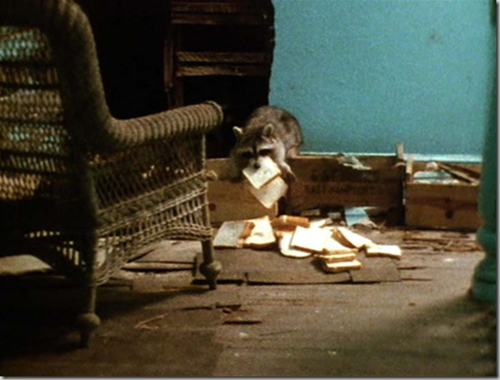
One sequence that I could not believe was left out of the original film is where you see the Maysles become active participants. They turn up for filming as usual, and Little Edie yells that the house is on fire. Sure enough, on the landing upstairs, a fire has broken out in a corner, an inevitability of tinder-dry wooden houses in that part of the US. Bowls of wood, and a blanket that was a gift from Jackie Kennedy, is used to put out the fire. Later, we see the hole caused by the fire has grown, from the wall into the floor, and a raccoon has made home in it. The answer? Lay down some bread for it, and allow the wildlife to continue taking over the house.

Anything I try to write here will not do justice to what you see in the films themselves, or to the people whose lives were followed. All I know is, the Beales live the way they wanted, Grey Gardens itself was restored, having been bought in 1979 for $220,000 and sold in 2017 for $15 million, by married “Washington Post” journalists Sally Quinn and Ben Bradlee, the latter portrayed by Tom Hanks in Steven Spielberg’s film “The Post”. The hole was replaced by a door.


27 May 2023

ALL THE STRANGERS CAME TODAY [398]


Watching television coverage of the RHS Chelsea Flower Show, I thought to myself, “is crypto like tulips?” The 1634-37 speculator bubble surrounding tulip bulbs is considered the first recorded example of the value of one type of product far outstripping its usual price, relative to similar types – I don’t think sunflowers have experienced a similar boom. Likewise, as the innovation and novelty of NFTs caused their explosion in value from 2021 [link], this has largely reversed for reasons including their loss of that novelty value.

I then remembered I previously benefitted from the bust that had followed the end of a speculative boom, one that happened over a decade earlier. 

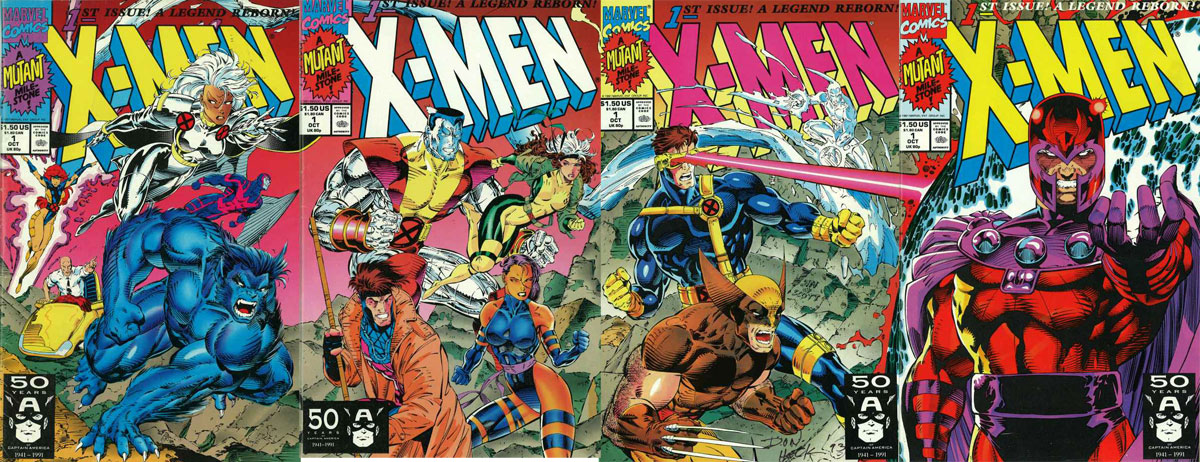
I think it was in the late 2000s, surely before 2010, that I saw piles of American comic books appearing in branches of the discount bookstore The Works. I had only been reading American comic books for a few years, but I already knew enough to know what I was looking at: the first issue of the “X-Men” (volume 2) from 1991, written by Chris Claremont, and illustrated by Jim Lee and Scott Williams. The pile contained the four different covers that made this first issue into a collector’s item at the time, and the fifth that turned them into a gatefold tetraptych. This last version sold for £2.50 in 1991, but here it was three or four copies for £1 – I got the gatefold issue and one of the others, for the story told inside was the same.

Like the value of first edition novels, the values of particular comic books had boomed by 1991, most notably the first appearances of Superman, Batman, Spider-Man and the Incredible Hulk. This was translated special “collectors’ edition” first issues of further new series, featuring higher-quality paper stock, card covers, foil covers, glow-in-the-dark covers, die-cut covers, and so on, all at a premium price compared with a standard book, and seen as an investment by those not necessarily there to read the story inside.

“X-Men” #1 is recognised as the biggest-selling comic of all time, but the 8.1 million copies sold were pre-orders made by comic book stores and newsagents – only half of these were actually sold to customers in 1991, and what I saw must have been the remaining stock being emptied from a warehouse. This continued for some time: I bought two copies of “Superman” #75 from 1992, “The Death of Superman”, one where I opened the black and red bag containing the black armband, trading card and stickers, leaving the other unopened; many issues from the beginning of Image Comics, like “Youngblood”, “Chapel” and “Shadowhawk”, with lots of cross-hatched art and gaudy colours; and various issues of “Spider-Man 2099”, “Punisher 2099”, “Ravage 2099” and so on, more new series and more ways to grab your attention. 

The comics speculator bubble had largely burst by the mid-1990s, leaving readers to carry on as before. Even though Marvel Comics came out of this period worst, having entered Chapter 11 bankruptcy protection in 1996, this also came after a stock market flotation and buying a distributor, but the bubble affected the whole industry. Of course, this was all before the true value was found, by Hollywood, in comic book characters and their stories, over the paper they were printed on.

20 May 2023

THIS IS MY IDEA OF FUN [397]


The perception of the Commodore Plus/4 computer is of an aberration that was dead upon arrival in 1984, putting off software developers by being incompatible with the more capable and cheaper Commodore 64, being saddled with built-in productivity programs that were not useful enough, and having graphics capabilities that were not fully utilised by games developers for decades. It became our family’s first computer, but was swiftly replaced by the more widely-supported Acorn Electron [link].


The Plus/4 had been conceived as part of an effort to fill two gaps in Commodore’s product range: low-cost computers mainly used for gaming, like Sinclair’s ZX81 and ZX Spectrum, and business-oriented machines. Commodore did have the VIC-20 to represent the former category, but used more integrated circuit chips than the Sinclair computers, and the more seriously-minded PET had already been withdrawn in 1982. To that end, one chip would be designed to reduce costs by handling video, sound and keyboard input, along with memory refresh and interval timing. 


The MOS Technology 7360/8360 was known as the “Text Editing Device”, shortened to TED, and while its it could produce multiple graphic modes and up to 121 colours, outstripping most 8-bit machines, hardware sprite capability was left out as it was not required for running forty-column text-based business programs, and only two channels of square-wave sound were provided for the same reason – this was still one channel more than the initial ZX Spectrum, and two more than the ZX81, and sprites could still be generated for games using software.


To that end, the Commodore 116 would be the entry-level model with 16K RAM and a $49 price, followed by the business-oriented 264, with 64K RAM and a $100 price, and a larger 364 that would have an extra numeric keypad and a voice synthesiser. The 264 and 364 had ROM sockets that would be filled by chips containing programs you specified at purchase, which gave me the impression that, with the low cost of the machine, you could retain a number of them for different purposes, like one containing an advanced word processor, or another as a software development kit, swapping them out as needed.


Having a separate ecosystem was almost commonplace in 1984 – Commodore’s PET, VIC-20 and 64 were incompatible with each other, and Tandy’s various TRS-80 ranges, including the Colour Computers and Model 100 pocket-sized machines, were all distinct. However, they all had the support of the manufacturers behind them, but the TED-based machines did not have this. With Commodore’s founder Jack Tramiel leaving the company ahead of its going on sale, the computers were left to the company’s marketing department to package and sell the machines. At the same time, the business computer market was to be taken over by the growing number of IBM-compatible PCs, built using off-the-shelf parts and operating systems, mostly compatible with each other through competing with one system.


The 364 never appeared, and the 116 was produced in small numbers, and sold mostly in Europe, its place taken by the Commodore 16, using a Commodore 64 case and keyboard and selling at twice the price. The 264 was renamed the “Plus/4” to indicate the filling of its two vacant chip sockets with a built-in, cut-down word processor, spreadsheet, database and paint program – while a cassette data recorder was made for it and the Commodore 16, the Plus/4 could only save work from its built-in programs to a disc drive. The Plus/4 sold for $299, more than the Commodore 64, and was gone after a couple of years.


I wish we kept hold of our Plus/4, but we did not know the new games that would be made for it in the decades since by its dedicated following, but it wasn’t there when it was needed. Commodore experienced the same issue with the Amiga 1000 the following year, but the potential for that 16-bit computer was, thankfully, realised far more quickly.

13 May 2023

COULDN’T ESCAPE IF I WANTED TO [396]

Mae Muller performing "I Wrote a Song" for the UK


May 2023 has been a good time for politically charged camp spectacles held in the United Kingdom, the Coronation of King Charles III having been followed by a week of events for the Eurovision Song Contest, held in Liverpool on behalf of Ukraine after Russia’s war left them unable to host after winning last year. If the Prime Minister calls a General Election next week, I am going to explode.

Much like trying to follow the overnight results of a General Election, I have fallen asleep before the end of the last five Eurovision finals. Starting at the usual 8pm UK time, this year’s contest was scheduled to finish at midnight, which was 2am in Ukraine, or an hour past my natural power-down time. This has been a result of the gradual change in both the presentation and significance of the contest, and my sleeping habits not having changed in that time.

How did I do in 2023? It turns out that deciding to write an article about the programme you are watching requires you to remain alert, although I began flagging during the reading out of the scores, which will always be slower paced than everything that came before it. With the UK’s brilliant entry, Mae Muller’s “I Wrote a Song”, finishing second from last on the night, or 25th out of 37 overall, I finally called it a night at 12.05am, ten minutes before the end of the contest, and before Sweden’s entrant, Loreen, could reprise her winning song “Tattoo”. Whatever time it is planned to end, the Eurovision final is always destined to overrun by about fifteen minutes.

But that is hardly the point. With the theme of the contest being “United by Music”, with Ukrainian music and culture emphasised from the start, and culminating in the most effective performance of “You’ll Never Walk Alone” there has probably been, every part of the contest that has grown bigger since the UK last held it in 1998, from the opening flag-waving procession of entrants, through the use of video walls in the staging of each song, to the scale and length of the interval acts, and the ultimate gruelling wait to find out the public vote only gave the UK nine points (even if that was still four more than Spain), everything had a reason to be there.

The scale of the coverage given this year by the BBC, as host broadcaster, made the Eurovision Song Contest into a week-long event this time, from the opening ceremony in Liverpool the previous Sunday, the two semi-finals on the Tuesday and Thursday, and various programmes celebrating the music and history of the contest. The semi-final had been introduced in 2004, with a second added five years later, as broadcasters from more countries joined the European Broadcasting Union (EBU) during the 1990s. Australia’s love of the contest made them honorary Europeans to compete themselves from 2011, but Australia has been represented in the EBU since it was formed in 1950, alongside Canada and New Zealand. (“Active” and “Associate” membership of the EBU is determined using the “European Broadcasting Area” as defined by the International Telecommunications Union, for those who still ask why Israel competes each year.) 

Held in Birmingham, the 1998 contest still closely resembled how it began in 1956, a one-night event linking countries both through friendship, music and technology, with all twenty-five entrants singing in their home languages with the backing of an orchestra. Lower-scoring countries were still required to skip the following year to allow other countries the chance to compete at least every other year, a scheme introduced in 1993 to replace an off-air qualifying round. Pop music, very much mainstream in 1998, remained disseminated by TV, radio and physical sales of music, and “Top of the Pops” aired on BBC One the night before the contest, like it did every Friday night. It was primarily a song contest, and one the UK was always destined to take very seriously.

But changes were already underway: 1998 was the last year for both the language rule and the orchestra, and the first year where a public vote by telephone replaced scoring from professional juries, where the phone network of competing countries allowed – years of chopping and changing the scoring system has now arrived at the jury and phone/online votes being treated separately and weighted the same as each other. Furthermore, the choice of the National Indoor Arena cemented the contest’s move away from theatres to larger venues, from stalls to standing crowds.

I did start by saying Eurovision was a camp spectacle, the subtext of outrageousness and gaudiness in both the songs and their staging having now become both outright text and a major selling point of the contest. It is no surprise that the growing inclusivity of other countries and cultures would lead to the contest being adopted as a symbol of inclusivity. The backlashes and death threats against Israel’s transgender competitor in 1998, Dana International, and Austria’s drag queen entrant Conchita Wurst in 2014, are mostly forgotten because their songs went on to win the contest. Dana International’s song “Diva” becoming the first to win when (almost) all the people of Europe were given the chance to vote may prove to be the most poignant moment in the history of the contest.