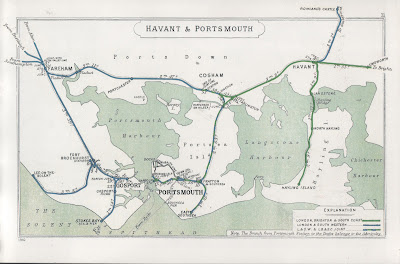
Here are the facts: my home town of Gosport, Hampshire, has an estimated population of eighty-five thousand people. It is a dormitory town, so most of its inhabitants work outside of it, making the main A32 Fareham Road and the B3334 Rowner Road gridlocked at least twice a day. The last passenger train left Gosport on 8thJune 1953, a whole decade before the Beeching cuts that severely reduced the UK’s rail network, but the first motorway in the UK, the Preston bypass, now forming part of the M6, opened on 5thDecember 1958. Rowner and Bridgemary, two major areas of Gosport, were built into suburbs in the 1960s without any further major roads being built in and out of the town.
The train line continued to be used for freight until 1969, and while the southern half continued to be used to move naval ordnance until 1991, the rest was converted to a cycle track. Eventually, public transport returned to the northern half in 2012, the tracks replaced by a busway removing one type of vehicle from gridlock – an extension to this busway opened in December 2021, using up part of the converted cycle track, reducing the length of the average bus journey by two minutes. Gosport Train Station was redeveloped into housing in 2010, having been left derelict for fifty years.
The reason any of this has been on my mind is because, having rolled around local history in my mind for so long, the fact there was a gap between the end of passenger trains in Gosport and the opening of the first motorway meant that no-one would have thought to plan for when reliance on roads would continue to increase: the nearby M27 motorway between Southampton and Portsmouth did not begin to be constructed until 1972.
It doesn’t necessarily mean I think a motorway needs to be cleaved into the town to reduce the time taken to get in and out, because the upheaval caused by attempting something like that now would carry its own cost over that of the concrete, tarmac and labour. While there is a bypass nearing completion in nearby Stubbington, where the land is available to build one, it serves to highlight the reliance on cars in Gosport, as I have mentioned previously on how a number of industries have left the town in the last thirty years [link].
I am not certain if trains should be reintroduced to Gosport, especially now that buses have taken over the track, but this is only because I am not sure trains were the answer to begin with. Gosport Train Station was opened in 1841, outside the town walls when they were still there, because it was less of a security risk to build there than in the home of the Royal Navy at Portsmouth Harbour, a situation which had changed by 1876. Branch lines to Stokes Bay and Lee-on-the-Solent had died out by 1914 and 1930 respectively – the former is now also a cycle track, while Lee-on-the-Solent station has been used an amusement arcade for so long that any indication of its previous use is almost accidental. If it wasn’t used so much for naval ordnance, the track probably would have closed to passengers before World War II.
You might be surprised that people continue to use Microsoft Internet Explorer but, these days, there are people that will never have used it. Since I registered www.leighspence.net, Internet Explorer accounts for only 1.3% of all access to this site so far – two thirds of access was made by Safari for iOS and iPadOS, distantly followed by Google Chrome, Mozilla’s Firefox and the desktop version of Safari. Hardly anyone used Opera to access this site, despite it now being used on more desktop computers than Internet Explorer, which held a 95% share of all desktop computer web browsing in 2003.
I have only just found out that Microsoft is finally withdrawing Internet Explorer on 15th June 2022 – people who upgraded to Windows 11 have already found it has disappeared, and it will not work if a re-download is attempted, but considering the last major update to the browser was made in 2013, you are only looking to continue using it if you need it. Microsoft’s other browser, Edge, retains an “Internet Explorer” mode so people can continue to access older systems, in some cases the server access sites they need to continue working from home. My moving from PC to Mac means that compatibility issues are both expected, and accounted for – if I work from home, signing into one web page starts a program that will bridge any gaps between my computer and the server at work – but forcing progress on PCs has been slow.
The “Internet Explorer” mode on Edge was meant to have been provided from 2015, when Windows 10 and Edge first appeared, before it was decided to push the browser as the new one that people should be using, despite the untidy situation created of supplying an operating system with two web browsers. What causes the difference is the browser engine used, which renders the HTML code used by the browser into a viewable page: Internet Explorer used its own proprietary engine, MSHTML, while Edge, which originally also used its own engine, now uses an open-source engine also used by Google Chrome, Opera, Amazon and Samsung. Decisions on which engine to use determine how the internet develops, as proved when Apple announced they would not support the Flash plug-in on its browsers in 2011, forcing developers to use alternatives for web graphics.
I know I can download any browser I want, but I use Safari on my phone and computer because it was simply the browser those devices came with, and I have not had a specific reason to need a different one. In bundling Internet Explorer with later updates to Windows 95, then Windows 98 onwards, and insisting new computers using Windows came with the software, Microsoft created the impression that a web browser is part of your device’s operating system, before it became the most used part of it. Even if Windows is not the only operating system anymore, and a PC is not the only computer, this perception persists, as viewers to my site have perhaps proven.
Please see below for the script I used in completing this video:
Coming up, I take a fond look back on how I wrote a song about nostalgia, how it won a song contest, and why this is not case of “this is how _I_ did it” more than “is _that_ how I did it?”
[OPENING TITLES]
[TITLE: “How to Win a Song Contest, apparently” or “Don’t Take a Stand ‘til You Reach for That Landfill”]
Hello there. In May 2021, the “CheapShow” comedy podcast ran the second Urinevision Song Contest, following the success of the previous year’s event in substituting for the pandemic-hit Eurovision Song Contest. This time around, I had an idea for a song, and decided to enter, despite never having properly written, recorded and sung a song before. I effectively sent my entry to answer the question, “is this anything? Does this sound like something I should be doing?” I faithfully watched the ceremony live on Twitch, to see if I had made the shortlist, and I yelled “yes!” when “Nostalgia’s Gonna Get You” appeared as the ninth song out of thirteen, meaning my work would now be judged by a panel of thirteen comedians, actors and singers, and I would find out if I had embarrassed myself or not. But… that wasn’t the end of it.
[“RECONSTRUCTION” caption on screen, waveform in background, as Eli Silverman announces: “The winner of Urinevision 2021 is Nostalgia’s Gonna Get You by Leigh Spence.” I am as open mouthed as I can be.]
I was devastated. I genuinely was not prepared for this outcome, especially after hearing the other entries, songs like “Down at the Spoff & Pickle” by Ukulele Jon, and “Piss Crystals” by L.J. Goody, thinking how much more they fit the themes and energy of “CheapShow” as a podcast, and how much more professionally recorded the other songs sounded, at least to me. I do remember feeling incredibly confident for a while after submitting my song, but that was me thinking, “wow, I made a thing,” not “I’m gonna win this thing.” So, thank you to “CheapShow” for putting on a great show, and for the lovely shirt I won, featuring art by their in-house artist Tony Vorrath, and thank you to everyone for all the nice things they said both during the contest and online afterwards.
Before I go any further, I implore you to listen to “CheapShow” as it is a great podcast, and one I have written about at length. Hosted by Real Ghostbuster Paul Gannon, and pickle of destiny Eli Silverman, “CheapShow” rummages through the charity shops, the bargain bins, the thrift stores, the flea markets, the pound shops and record bins of the known world, to give you the treasure amongst the trash. It also has its own tie-in magazine and merchandise, which may itself be the subject of future discussion in another geneeration’s podcast. It is an absurdist comedy machine with an enjoyably filthy mouth on it, like Derek & Clive meets Blue Peter on the bus home from a night at the Cabaret Voltaire. It is a magazine show: you may have board games and charity shop finds one week, novelty records and weird soft drinks another week, celebrity guests or an audio drama with mad characters the week after – it’s great that there is a podcast I can download each week and not know what form it is going to take, other than in minutes and seconds, and you need to cherish something like that if you find it.
And so, in order to explain “Nostalgia’s Gonna Get You”, I must play it to you first, using the lyric video I created previously. I will be back in a moment.
[PLAY VIDEO]
I should say the reason I am playing the recording instead of singing it live is because…
Singing at my limit is a mountain to climb,
So I broke the lyrics up and sang two lines at a time.
…and edited it together. On the night of the contest, I did like how the presenters visualised the songs by using puppets. [Clip of ostrich.] Here is some of the reactions from the judges…
[Play selection of some, ending with response to Imran Yusuf: if you can pay for it, you can be my guest.]
I will say the response that made me happy immediately was from co-host on the night, Ash Frith: [“Who performed that, that was amazing!”] …I’m going to play that again. [“Who performed that, that was amazing!”]
There was only one rule for the Urinevision Song Contest: your song had to be between one and two minutes long. How I interpreted this was that I would need to fit as much song as I possibly could into two minutes, working out how many bars of 4/4 time I can get when using a hundred and twenty beats per minute, divided by two bars per line. Rather than entirely sounding like a maths exercise, my favourite Eurovision song, “Ding-a-Dong” by Teach-In, which won for the Netherlands in 1975, clatters along at such a pace that it doesn’t need all of the three minutes it was allowed. At the same time, Tony Christie’s song “Avenues and Alleyways,” the theme to the TV drama “The Protectors,” doesn’t have a chorus as such – Christie sings “in the avenues and alleyways” a second time, followed by an entirely new set of lyrics. Therefore, aside from a short intro and outro, I have three whole verses, a vast middle section to list nostalgic things, and exclaim “Nostalgia’s Gonna Get You” – I’ve only since realised I unintendedly wrote “nah-nah-nah-nah-naah-naah, nostalgia’s gonna get you!”
The music itself is kept very simple, performed in C sharp major to stretch to what should be out of reach, and to sing just slightly out of my range, but I deliberately chose instruments that evoked the 1980s: a drum machine, synth chords and a synth bass that jumped up and down by one octave to fill the sound. Far cheaper than spending a few thousand pounds on the real thing, Apple’s BandCamp lets you pick a LinnDrum, one of the first sample-based drum machines, and the machine most associated with Prince, from “1999” to “Purple Rain”, with “When Doves Cry” essentially being a LinnDrum featuring Prince. What also helps is that, if you choose the right drums, you can make a pattern that sounds like a clock.
The chords were played on my Yamaha Reface DX, a proper FM synthesiser like the original DX7, replicating the original Electric Piano 1 setting with the same glassy sound that characterises the era, as Yamaha sold thousands of DX7s to musicians who, apart from Brian Eno, used the same thirty-two built-in patches from piano to bass, to brass to marimba, because it was too hard to program.
I am absolutely happy to be compared to them, but I must admit I was initially perplexed by the comparison to Squeeze made by co-host and TV writer Paul Rose, aka Mr Biffo [“Cool for Cats” quote, followed by Depeche Mode.] My only reason for this was my having been so focussed and influenced during this process by the Eighties-est artist of them all, and a recurring name on “CheapShow”: Phil Collins. Yes, I own the sheet music to the “No Jacket Required” album. What happened was I was listening to a local radio station, Wave 105, on a Sunday morning, and after they played a jingle, there was silence, almost like they fell off air. When a song eventually started, it was the dum-da-da-dum-clap of “Take Me Home”, followed by, yes, chords played on a Yamaha DX7. Having since bought the album on CD, I think “Only You Know and I Know” may be one of the catchiest songs ever devised, even more than “Sussudio,” but what I did find were the demos that Phil Collins made of his songs – they are simply a drum machine, a DX7, and his singing almost in tongues to get the melody and the energy down before writing the lyrics. The simplicity of these demos was what I decided to go with in my finished song, but while I wrote the lyrics, I did have the sound of the Phil Collins demos in my head… [Imitate them using “Nostalgia’s Gonna Get You” tune.]
In terms of the lyrics, I intended to use my three verses to build up into a preposterous situation: start with giving into nostalgia, followed by something weird, then complete all-consuming hysteria – instead of “the greatest hits of yesteryear will do for you now,” it was originally “because there’s no hope for you now.” However, I had the final line “don’t take a stand ‘til you reach for that landfill” from the start as a line that sounds utterly bizarre by itself, but entirely in context by the time you get to it – that is why I was happy for how one of the judges, Tom Mayhew, reacted to it: [Tom Mayhew clip].
I felt it was easy to refer to liminal spaces, hauntology and Jacques Derrida in the song, as they have all been discussed on “CheapShow”, although I didn’t yet know there was a song by Scritti Politti titled “Jacques Derrida”. Dead shopping malls are almost a genre of video on YouTube as people film walkthroughs of places that were once safe and busy, rendered eerie and empty by changing times – while they can be perfect examples of places you have to pass through, but you don’t think that you should be there, I think watching them might be my version of ASMR. Having said that, “That vape shop once sold games on tape for my Spectrum Plus” was the hardest line to condense, and then sing – I only realised later that Sinclair made a computer branded as a Spectrum+, because I was originally working down from Spectrum Plus 2. I also originally wrote “once sold cassette games for my Spectrum Plus,” proving you need to be as clear as you possibly can – this was why I had to change “Birds Eye Potato Waffles, still alive”, which I like, to “Findus Crispy Pancakes, still alive” which I hate – it has to be dah-dum, dah-dum, dah-dum, not dum-dah...
The middle section was always meant to be a list, but I then had to find items that were a stretch to be nostalgic about, like Polaris, which was Britain’s nuclear deterrent at the time, maintaining a base in my home town, but then also had to rhyme with each other, like The Naked Gun and “Pebble Mill at One,” thanks to my pronunciation of “wun” instead of “won.” I loved how the BBC’s daytime TV show, a forerunner of “The One Show”, also made it into another song in the contest, “Watching Shit Old Daytime TV” by the Electric Chair Orchestra. By the way, I was meant to sing “didn’t die” instead of “still alive”, until I had to sacrifice the alliteration when I realised I was singing “die, die, die” all the way through.
My favourite verse is obviously the last one – once I worked out how to talk about the monotonous “rhythm” of the nightly news, the alternate 1985 of “Back to the Future Part II” came to mind very quickly, an easy way to say “what went wrong?” and retreat into the past. “Tomorrow’s World Is Cancelled” both means exactly that, and the fact that the BBC’s science show of that title ended in 2003, the same year that Concorde flew for the last time, as if our idea of what the “future” was, and where you would find it, had ended.
If I had one regret with the song, it was not following Stephen Sondheim’s rule of no half-rhymes all the way through, having left “sounds” rhyming with “around” in the first verse. I think, by that point, I had to stop writing, and put my pen down.
So, what happened next? The Urinevision Song Contest 2021 album is available to listen to and download on Bandcamp – I never expected to be found on the home of vaporwave, so that is mind-blowing in itself. Entering the contest was the best thing I could have done, it has been the highlight of 2021 for me, and if I ever do anything as successful or as popular again, I will remember that it started with “Nostalgia’s Gonna Get You” - it’s as simple as that.
What this experience also confirmed for me is that, within strict legal definitions, I can apparently sing, and I have music confirmed as one more outlet, one I intend on making much more of, after writing a new opening and closing theme for this show. [Closing theme starts.] All I know for sure is this: if you enter your song into a contest, and it moves someone to say [Ash Frith clip] “who performed that, that was amazing,” you must be doing something right.
Thank you for watching. Comment, like and subscribe to let me know what you think, and until next time, the nostalgia culture crisis continues at www.leighspence.net, the new home for dancing with the gatekeepers.
It is well known that the line “infamy, infamy, they’ve all got it in for me,” from the 1964 film “Carry On Cleo”, was not written by its scriptwriter Talbot Rothwell, but was borrowed, with permission, from Frank Muir & Denis Norden and their radio series “Take It From Here” (1948-60), which included the prototypical dysfunctional family sitcom The Glums.
Of course, “Carry On Cleo” borrowed rather more than that, namely the leftover sets and costumes from the blockbuster historical picture “Cleopatra”, for which 20th Century-Fox had moved production from Pinewood Studios in Buckinghamshire, to Cinecitta in Rome, in 1961.
“Cleopatra” would be released in June 1963, having first signed Elizabeth Taylor to the starring role in September 1959. Meanwhile, “Carry On Cleo” was shot in July and August 1964 for a release in cinemas in December of the same year. Ironically, “Carry On Cleo,” in both its thrift and haste, is actually closer to what “Cleopatra” was meant to have been.
The “Cleopatra” crew had left behind an opulent and elaborate group of interior sets, and a standing outdoor set that was overwhelming in scale, but were constantly deteriorating in the dire British weather, requiring daily touch-ups on paint and masonry, and tropical vegetation to be replaced for each day of shooting. When Taylor developed a cold, later a fever and meningitis, a better climate was required for all aspects of production, and with the 1960 Summer Olympics now over, Rome became a more favourable option once more. With the decision made to start afresh, the $600,000 set and other items were left behind.
"Carry On Cleo”, starring Amanda Barrie as Cleopatra, Sid James as Mark Anthony and Kenneth Williams as Julius Caesar, was concocted as a way of using what was left behind, injecting British bawdiness into more luxuriously appointed surroundings than normal. However, producer Peter Rogers and director Gerald Thomas approached the shooting of the film in the same manner as their other productions, using mostly medium and close-up shots that work for the comedic acting and dialogue, but making no use of their sets’ scale. Mind you, this was only the second “Carry On” film to this point to be shot in colour, and its poster had to be made less similar to that of “Cleopatra” to avoid legal action, so expectations perhaps have to be set accordingly.
However, "Carry On Cleo" was what "Cleopatra" was originally intended to be: a quick, $2 million, 90-minute romp starring Joan Collins, who had been tested extensively for the role, while also intending to get 20th Century-Fox out of a sticky position with their finances by remaking the script for the almost-entirely lost 1917 “Cleopatra”, starring Theda Bara. The ambition of producer Walter Wanger, following the success of “Invasion of the Body Snatchers”, and the subsequent signing of Elizabeth Taylor, caused the production to spiral into a $44 million behemoth that nearly sank the entire company, having been seduced by how much more they could have if they had bigger production values and bigger stars. The contractual obligation to use a widescreen film process owned by Taylor, Todd-AO, developed by her late husband Mike Todd, is one of the less likely sequences of words in the history of filmmaking.
A later film shot at Cinecitta, the notorious adult film “Caligula”, also had its set reused for a parody, “Messalina, Messalina!”, made by “Caligula” co-producer Franco Rossellini. The film was released in 1977, two years ahead of its target - like "Cleopatra", "Caligula", a film of similar opulence and reputation, had its own set of problems.
In 2020, I bought a new television. My previous LCD TV, bought in 2011, was becoming clunky and slow in comparison for what I can now get for two-thirds the cost, in addition to a higher-quality LED screen. Connected to it is an Apple TV box, a Blu-ray player, and a secondary DVD player that allows me, living in Europe, to watch region 1 DVDs from the United States, a cheaper option than buying a Blu-ray player that covered this requirement.
However, I still expected to connect the DVD player via SCART, the only option available on it. What I had not banked on was the almost wholesale dropping of SCART connections from audio-visual (AV) equipment since I last had to buy a television.
Known as Péritel in its originating country of France, and first appearing in 1977, SCART is the acronym of an organisation of manufacturers that created a shared AV connector standard, and the name of the connector itself. The intention of creating a shared standard was to simplify the connecting of different AV devices, whether they were analogue or digital, and to avoid incorrect connections. To that end, twenty-one pins were supplied to carry composite, RGB, S-Video and YPbPr component video signals, and analogue, optical or digital audio signals – your devices would then choose the best connection to make. SCART connectors also carry the control signals that allow, for example, a DVD player to be “woken up” from standby mode when your TV switches to its connection, and you could daisy-chain devices together.
This is something I did not realise until much later, because I did not know: for a long time, SCART leads were often the only connectors available to televisions in the UK apart from that needed for an aerial, and while we may be used to HDMI offering similar ease of use, HDMI is for transmitting digital audio and visual data, and not the analogue signals from older devices – there have been HD televisions and laser-disc players that used an analogue component signal of 720 or 1080 lines, but this was used mainly in Japan, where a version of SCART also gained traction, and was extremely expensive.
Where did this leave me, with my region 1 DVD player? There is a spare HDMI connector available on my TV, but the requirement to turn the analogue signal from the DVD player into a digital one that can be accepted by HDMI means that the cost of a converter was higher than I wanted to spend, while also requiring a power source to assist in processing the signal from analogue to digital. You can use the VGA connector that is now often included to turn your TV into a computer monitor, but while that will carry a component visual signal to the TV, it won’t carry the sound.
In the end, I had to buy an adaptor to break out the composite signals from the scart lead to use the red, white and yellow AV connectors at the back of the TV. For the record, while SCART has not been a requirement on French TVs since 2015, which is perhaps what led to it being dropped elsewhere, the inferior composite signal and connectors created by RCA in the 1950s have apparently proved too ubiquitous on TVs worldwide to kill off.
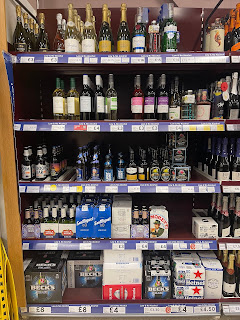
Sometimes, you only notice a trend when it has already fully established itself, leaving you to trail back to where it might have begun. My latest such realisation came in, well, the alcoholic drinks section of a local supermarket, one which still separates out the non-alcoholic versions of well-known brands into their own, comparatively tiny section.
I had been looking for Guinness 0.0, which is basically the standard draught Guinness with the alcohol filtrated out at the end of the production process, which has recently been reintroduced after a contamination issue led to its withdrawal in October 2020 after only its first two weeks on sale. I remember it tasted pretty much exactly like normal Guinness, if a little lighter, with notes of coffee – here’s hoping that wasn’t what was wrong with it.
The design of Guinness 0.0 cans is pretty close to those of the standard brand, except for stating “0.0” in large blue lettering, and blue bands on the top and bottom of the cans. The supermarket did not have it, but with the other non-alcoholic brands grouped together, I realised that similar design choices had been made on the packaging of other beer brands like Heineken, Beck’s (named "Beck's Blue"), Moretti and San Miguel, but also on Kopparberg cider, Freixenet sparkling wine, and Gordon’s and Tanqueray gin.
The shelves that inspired this article
While not a hard and fast rule – Budweiser Zero removes the red from the standard design to leave it in monochrome, and Carlsberg 0.0% outright replaces its green colour with blue – the use of blue highlights on existing branding, to emphasise the taste identified with the brand over the removal of a major element and selling point of that brand, is something that must have slowly sprouted over the last year, as brands latch on to a growing taste and trend.
I rarely drink alcohol as both a preference and a rule, so the opportunity to avoid it altogether will make having a Guinness even more enjoyable, while I wait for Pimm’s to follow suit. Therefore, another interpretation of this use of blue is to indicate safety, that this drink you would only have in certain acceptable circumstances is safe to drink anywhere, at any time, without having to think about it. My reason for thinking this is intentional is having seen Heineken 0.0 on sale in a shop that otherwise did not sell alcohol, which was a high street branch of the newsagent-stationers-bookshop WH Smith – thinking about it further, the blue accents on the Heineken can made it fit in with the soft drinks stocked next to it.
Having said all this, I live in a country where the colour blue on food and drink packaging is more associated with a conspiracy theory that Walkers Crisps changed the bags for their cheese and onion flavour from green to blue, never acknowledging they changed it, when in fact they have always used blue, despite the majority of other brands use green.
It is a fact of 1990s family life that some VHS cassettes were repeatedly watched until the tape wore out. My family had many: “Who Framed Roger Rabbit?”, “Back to the Future”, and “Fantasia”. All would be replaced as time and home video formats progressed, but one tape, which became lost within the family home, could not be replaced until the film’s eventual DVD release in 2006.
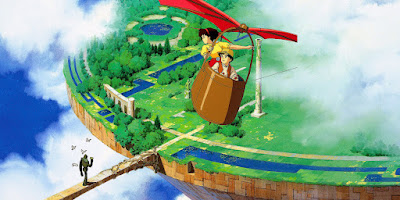
It turned out our lost copy of what was being called “Laputa the Flying Castle,” recorded from a TV airing on 31st December 1988, was from the first occasion that a Japanese animated feature film had been shown on British television. That this was shown at 9.25am on the populist ITV network, more known for cramming their Christmas schedules with Star Wars, Harry Potter and James Bond, is even more remarkable. If they ever did it again, I am not aware of it.
A story of mystical cities, escaping kidnap and airborne pirates, “Castle in the Sky” was directed by Hayao Miyazaki and released, in 1986, as the official first film from Studio Ghibli, founded on the success of “Nausicaä of the Valley of the Wind” two years earlier. Like much of Miyazaki’s work involving planes, airships and other flying devices, “Castle in the Sky” has become widely influential as a classic of the steampunk genre.
The flying island itself is lifted in name and concept from Jonathan Swift's novel "Gulliver's Travels," while also influencing the plot of wanting to harness the castle for political, nefarious ends, before ultimately crashing to the ground. Unlike Swift's satire, Miyazaki's Laputa was old technology and reason, overgrown and reclaimed by nature, to be left alone - it is allowed to escape at the end, but irreversibly marked by human hands.
The setting of a small mining town was familiar to British audiences. Miyazaki visited Wales in 1984 as part of the film’s research, and his witnessing of the aftermath of the Miner's Strike influenced characters as well as architecture. A later noted steampunk work, 2004’s “Steamboy”, Katushiro Otomo's eventual follow-up to "Akira," was explicitly set in Victorian industrial Manchester. “Castle in the Sky” would later be shown in Aberystwyth in 2011, a charity screening to support relief efforts following the Tōhoku earthquake and tsunami, using its original Japanese soundtrack.
Despite The Walt Disney Company’s release of Studio Ghibli’s films on DVD, our lost copy of the ITV airing of “Castle in the Sky” would not truly be replaced until around 2018, my sister having sourced a copy of the Japanese DVD version originally released in 2002 – I immediately asked her to order another one for me. This was the only place we could find the English dubbed soundtrack prepared by Magnum Video Tape and Dubbing, for use in Japan Airways trans-Pacific flights, and later in American art-house screenings – it is a straight translation of the original Japanese, with music and sound effects left intact. Pazu, the boy who rescues central figure Sheeta from kidnap, is voiced by Barbara Goodson, now best known as Rita Repulsa from “Power Rangers”, while Sheeta, who possesses a magical crystal of the sort that allowed the city of Laputa to fly, is voiced by Lara Cody, who later dubbed voices for English-language versions of “My Neighbour Totoro” and “Kiki’s Delivery Service”. This was the version I remembered from my childhood, even if it is not the film’s own original soundtrack, but I knew I had the correct version the moment I heard Pazu deliver a lunch at work: “meatballs for the boss.” As Proustian as a madeleine biscuit, I’m sure you will agree.
It was important for me to have the version of “Castle in the Sky” that I remember, because that version was the reason one of my formative experiences of watching a film – I was five years old when ITV broadcast it – has led me to be spoiled when it comes to the expectation of what an animated feature film can accomplish in scope of story, technical detail and emotion. Arguably, only Studio Ghibli have matched it since, and only Pixar have come close.
It is already noted that the English-language dub of “Castle in the Sky” now most widely available, recorded by Disney in 1998, took liberties with the soundtrack that were later revised and scaled back on further home video releases. The original sixty minutes of synthesised musical score, reworked by the original composer Joe Hisaishi into a lavish, and overwhelming, ninety-minute orchestral performance, was restored, as were periods of silence that were filled in with background noise. However, the increase in Pazu and Sheeta’s ages, from pre-teen to mid-teen, and lines that made Sheeta a potential romantic interest to the airborne pirates instead of a mother figure, were retained, perhaps because James Van Der Beek and Anna Paquin would have had to be recast. The original changes were authorised by Studio Ghibli, but with this now also being the English-language track on Japanese DVDs, following a re-release in 2014, it leaves only the original Japanese soundtrack as being the “correct” version available. Perhaps this is how it always should have been, but accessibility doesn’t usually require a rewrite.