17 December 2016

AND WE’RE SENDING OUR LOVE DOWN THE WELL [33]


Allow yourself to feel incredibly old and terrified for a moment – TWENTY-SEVEN years ago today, the first episode of “The Simpsons” was broadcast on American television. This means there are people who born since the show began, that now have their own children.
In Britain, for those not willing to pay for Sky TV, the BBC began showing “The Simpsons” in November 1996, at just the right time for the teenage me. For years, I dutifully taped every episode I came across, laughing at its subversive humour, marvelling at its feature film-scale storylines, and identifying with its fully rounded characters.
For the record, my favourite episodes of the series came early in its run, like Lisa winning an essay contest and uncovering political corruption in “Mr Lisa Goes to Washington,” the awful musical “Streetcar!” in “A Streetcar Named Marge,” and the disaster movie plot of “Marge versus the Monorail.” There was once a time where no show could do the two things the “The Simpsons” could – anything, and everything.
I also learned about the references “The Simpsons” made to films, books, philiosophy, and American idioms, both in libraries and online, having just got dial-up internet at home. We eventually did get a satellite dish, and the taping, later joined by DVD buying, continued. The show confirmed I should, without exception, always look under the surface of whatever is put in front of me.

And yet, I found myself falling out with “The Simpsons”, feeling I got all I could from it. I had joined it in its ninth season, and left at its seventeenth – it is now on number twenty-eight. I still watch it occasionally, but usually just my favourite episodes. For all the references they gave to other works of creativity, “The Simpsons” also sent me in pursuit of those works – all the homages to “Citizen Kane” cannot be beaten by just watching “Citizen Kane.”
The sitcoms and dramas that are lucky enough to end on their own terms will usually do so once they have finished exploring the world they created. That may be after twelve episodes, in the case of “Fawlty Towers,” or ten years, if you are “Friends.” Recent “Simpsons” storylines, if you look them up, are still good to watch, and exactly the sorts of episodes you expect from the show. However, for me, this is because they are the sorts of plots I had thought they had already done – they are of “The Simpsons,” but they do not add to my idea of what “The Simpsons” is.

“The Simpsons” may only end when it stops making money for 20th Century Fox, but I hope its makers see the end coming. The only sitcom that comes close in both its longevity and cast of characters, “Last of the Summer Wine,” could also have run forever, until the BBC decided it would not. Thankfully, Roy Clarke, who wrote all 295 episodes, from 1972 to 2010, was aware of the show being ended, allowing him to write the low-key ending that he wanted, but everyone else still complained about. If “The Simpsons” does end, its demise should match the cultural impact it has had on the world – they could try blowing it up.

10 December 2016

OTHER LISTINGS MAGAZINES ARE AVAILABLE [32]


Saying you have done something week in, week out, for twenty years, is usually restricted to essential tasks, such as breathing, eating and sleeping - and yet, when I bought the latest Christmas issue last Monday, I have now bought the “Radio Times” every week, without fail, for twenty years.
In an online age, you would have thought that having to go somewhere to buy a magazine, to tell you what programmes are on the television and radio, would be something that died out a while ago, but there was not much of an internet back in 1996, and broadcasters were only starting to open their own websites. As recently as 1991, programme listings were actually regulated in the UK: BBC TV and radio was covered by the self-styled “RT,” owned and published by the BBC, while ITV, Channel 4 and the rest were in the “TV Times” - if you wanted the full picture, you had to buy both magazines. For this reason, the “RT” sold its advertising for more than any other magazine, and continues to do in three quarters of a million copies every week.
(I should now say I wrote an essay about this for my A-Level Business Studies course – for the record, English Literature covered the Arthur Miller plays “Death of a Salesman” and “The Crucible.”)

These days, you can get all the details you need just by a search on your phone, provided you know what you want to search for. Sometimes, you do just need something to cut through the swathes of information, giving you all the important stuff, and provide pointers for where to go if you do want more – ten pages of TV listings each day, another two for radio, and reams of further features might just about do that job, and it certainly does for me.
However, what I have recognised more recently is how the interviews and features from the “RT” can often become news themselves. This appears to be a combination of newspapers and websites picking nuggets of information from them, and the influence of Ben Preston, the magazine’s editor since 2009, two years before the BBC sold its magazine division – “he is a cyclist,” claims Wikipedia.
Therefore, the past week’s news stories about how the Prime Minister’s Christian faith is important at Christmas time comes not from a big interview in a broadsheet newspaper, or from having talked with Andrew Marr or Robert Peston, but from Theresa May having answered the “View From My Sofa” questionnaire on the back page. Meanwhile, Eric Idle’s remarks on his fellow Python Terry Jones’s health came from a “RT” interview the previous week. However, which magazine caused Robert De Niro to walk out of an interview in September 2015, amid “negative inferences” about commercialism in his film festival, and about acting on auto-pilot?
It is necessary to keep your product fresh – in the United States, “TV Guide” cut down on the listings, and increased the features. Thankfully, the “RT” has kept both, and has continued to make it a success, maintaining the reputation it inherited from when it was part of the BBC. Making the news keeps it in your mind, and it sticks around to help you pick your night’s viewing.

09 December 2016

GLORY DAYS, WELL THEY’LL PASS YOU BY [31]


Everything I am about to tell you happened before nine o’clock this morning.
I had arrived at work a good hour before my day was due to start, so I could go through my usual warm-up process – reading through e-mails, stretching, continuing to wake up. Meanwhile, two of my managers were talking about the latest of their Christmas dinner out from the previous night. One manager then told the other about a faux pas they had apparently perpetrated, where they had referred to putting something away as stuffing it in their “glory hole.”
This admission had already started waves of laughter, of both recognition and embarrassment. Sitting across from the conversation, I had missed the cause of the laughter. One manager looked to me, and said I didn’t want to know what they were talking about, like I had stumbled across an awkward situation, while the other, who had made the faux pas, walked to my desk to explain, clearly still wanting to get the issue off their chest. They started by apologising if what they were about to say sounded offensive – that is always a good way to start a conversation.

The origin of the term “glory hole” is unknown, having appeared in the early nineteenth century. There is the word “gloriole,” derived from Latin, which is another word for a halo, but this appeared at around the same time, so there appears to be no link. At the same time, there is no clear indication how “glory hole” came to mean an untidy room or cupboard used for storage, or a small furnace used by glassblowers, or a term used in North American mining to describe an open quarry.
The meaning most used nowadays, referring to enabling anonymous sexual activity between two rooms, came from Polari, the secret gay language that employed a combination of English and French and Italian to help save lives, at a time when being gay in the UK was illegal. While sounding appropriate in its own way, it sounds quaint and whimsical in a very British manner, just as the Polari term for public toilets were “cottages,” because they were often built to resemble small houses.

Just like it was at last night’s Christmas dinner, the meaning of “glory hole” changed with the people you were with, and what you are doing, just like the words “thing” or “jigger” might do – evidently, the other people there understood it to mean something entirely different, but it had not meant that one meaning had supplanted the other.
This was where the conversation interested me the most. The definition of “glory hole,” like “gay,” “tranny,” and numerous other words, was being defined as a generational thing, and by one other person at work, who offered to take a picture of the glory hole they had at home, as being “political correctness.” The non-sexual uses of “glory hole” are used less, but are not invalid, and are examples of how the English language continues to develop. In fact, the whole story does speak to the human condition – when someone sees a hole, they must fill it.

03 December 2016

TAKE THAT LOOK OFF YOUR FACE [30]


When I last created a CV, I knew I had to use the correct font. I chose Futura, a precursor to Gill Sans, which is clear and easy to read, especially when any human resources person may scan it for only a few seconds before making a decision. If I chose the wrong font, any split second of confusion in the reader could have threatened my future career prospects.
So, when I come across forms at work that use COMIC SANS, that a company has asked us to fill in, and which could be used in a court of law, you do question the decisions made by both the designer, and by those that said, “yes, that looks OK.” The company concerned does not use these anymore, so they must have realised what the forms look like.
Comic Sans exists to look child-like, but its misuse has made it look childish. Designed for Microsoft Bob, a 1994 program to make navigating screens easier for novice computer users, it was intended to solve the problem of having a cartoon dog having speech bubbles that used Times New Roman, a font designed for use in "The Times" newspaper from 1932 to 1972. However, the font’s designer, Microsoft’s Vincent Connare, did not have the font completed in time for Bob, but it was included with Windows 95.


To me, the main problem with Comic Sans is its deliberate aping of someone’s handwriting, in particular the kind of handwriting you expect your child to grow out of when they are taught how to join the letters up. Therefore, when an adult uses it, you doubt any serious intent in the words you are given, and you are less likely to take in their meaning. Its position as a default font on Microsoft Word makes it too easy a choice, especially when few people are likely to look for a font that fits what they want to say. When the inevitable consequences of this appear, you will eventually read the message, but not after you have rolled your eyes first.
The irksome nature of the font’s name doesn’t help either. Few comic books are made for children these days, and the most popular graphic novels of the last thirty years carry the phrase “Suggested for Mature Readers” on the back cover. “Watchmen” and “Batman: The Dark Knight Returns” are the two books that, when collected into square-bound books, gained the medium the respect that has grown into blockbuster film franchises.

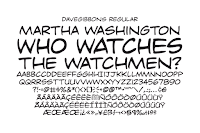
However, “Watchmen” and “Dark Knight” inspired Comic Sans, through the work of Dave Gibbons and John Costanza respectively, and by being found on Vincent Connare’s bookshelf. Gibbons, who drew and lettered every page of “Watchmen,” described Comic Sans as, “…a real mess. I think it's a particularly ugly letter form.” I don’t think the fact you can buy a Dave Gibbons font has anything to do with his opinion, but having your name even mentioned alongside Comic Sans can’t be desirable.
For the record, Vincent Connare went on to design Trebuchet MS in 1996, which is a much easier font to look at.

26 November 2016

LIKE ENDLESS RAIN INTO A PAPER CUP [29]


Earlier this week, I tried to find a computer programme that allowed me to turn speech into text, while I spoke. Thankfully, entering notes on my phone allows me to do this, but this all came from an idle thought about writing in a stream of consciousness style, hoping the mere act of continuing to talk might yield something that could be useful in one of these screeds, rather than go through a week-long bout of perspiration, trying to think of a subject that could be both informative and entertaining.

However, once I started to do it, I started feeling like this may not work. What you are reading here is, in fact, a VERY, VERY heavily edited version of my talking, to myself, about trying to talk about streams of consciousness, as if layers of reality, like layers of rocks over millions of years, were bearing down on my brain. You may feel that you are free when you can say anything you like, but when you have set yourself a task to be as free as possible, before giving yourself a completely clear ground, with no reference points, and nothing on the horizon, your journey is going to be hellish.

Thankfully, with the way the English language is structured, with all its nouns, prepositions, and subordinate conjunctions, one thing can very easily follow the other, so off I went. What also helped is knowing that, if the mangled results can be presented in a nice way, all contained within paragraphs, it will, at least, be readable.

Having introduced the idea of streams of consciousness to myself, Beat Generation writers like Jack Kerouac and William Burroughs did come to mind, with Kerouac’s original draft of his novel “On the Road” being one continuous roll of paper, fed through a typewriter over the course of three weeks. There was also an academic paper, accepted last month for a US conference on atomic and nuclear physics, that was produced by Christoph Bartneck, an associate professor at a New Zealand university, by using the same auto-completion software I was using, to prove the conference was only looking to make money – the paper was accepted, but asked for an expensive attendance fee.

However, I knew I would be slowing myself down by referring to things I would have to check were correct later – thankfully, they were, and I could still use them.

I think my experiment was successful, but it may not extend beyond this first stage – I was left with far too much rubbish to sort through, with my phone, at one point, thinking I had launched “an investigation into sex,” which has already been successfully completed by other people. Building a good structure means you need to have a plan first, and that is where I feel happier. Perhaps my words work better when you can see the sweat and effort still dripping off them, I don’t know…


21 November 2016

WHO SAYS A MISS WAS MADE TO KISS? [28]


I refrained from writing about Donald John Trump two weeks ago, when the US Presidential election race finally ended, because the prevailing mood in the United States was too raw, and too polarising, to make light of the situation, and no-one from the land of Brexit can realistically make light of political problems elsewhere.
However, comedy is described as tragedy plus time, and Trump is described alternately as Charles Foster Kane and Biff Tannen, despite winning a Golden Raspberry Award for Best Supporting Actor in the 1990 Bo Derek film “Ghosts Can’t Do It,” where he played himself.
The comparisons with “Citizen Kane” endure, especially when Trump was asked about it, in 2002, by the documentary maker Errol Morris, for an unfinished film. Trump recognised the theme of wealth not being everything, and how it isolates you from people. However, the subsequent focus on his comments is regarding the montage of scenes between Kane and his first wife, over a breakfast table that progressively puts more distance between them. “Perhaps I can understand that—the relationship that he had was not a good one for him,” Trump says.
From behind the camera, Morris asks, "If you could give Charles Foster Kane advice, what would you say to him?"
“Get a different woman.”

Trump also thought that people did not understand the meaning of the “Rosebud” sledge because that was the name used: “Perhaps if they came up with another word that meant the same thing, it wouldn't have worked… But Rosebud works."
Trump also spoke, in an interview with Mark Singer for “The New Yorker” magazine in 1997, about his favourite film being “Bloodsport,” a 1988 martial arts film starring Jean Claude Van Damme. However, he charged his son Eric with fast forwarding past the exposition and dialogue, to see just the action. “You want to write that Donald Trump was loving this ridiculous… movie, but are you willing to put in there that you were loving it, too?” Would his opinion have changed if he saw all of it?
Regardless of whether his words helped him become President-elect, so many of Donald Trump’s words, said over months, years, could have gone unsaid, and more people could have thought more of his words. However, the bleak museum of Twitter means we no longer have that option. “Publish and be damned,” the Duke of Wellington said in 1825, but online, posting your own words may bite you in the behind, sometimes immediately.

For Trump, his impulsive use of Twitter makes him a very easy figure to satirise, when what he says defy you to take them seriously. Calling “Saturday Night Live” a “totally one-sided, biased show,” he wanted equal time to respond. For Trump-mirror Alec Baldwin to point out the election is over, “there is no more equal time,” and that we must now respond to his actions as President, reveals a disconnect between the thoughts of a private man, that have to be replaced by the considered pronouncements of a public figure, for there must be no risk of conflating the two of them.
The farrago over “Hamilton,” a hip-musical about a Founding Father, turned very quickly from the booing of the Vice President-elect, Mike Pence, who was in the audience, over to Trump’s condemnation of the “overrated” musical’s cast for “harassing” Pence, in the same manner he berated protestors, “incited by the media,” before acknowledging they “have passion for our great country” – one wrong tweet, one moment too late. That Pence was the diplomat, stopping to listen to the cast’s impassioned speech, insisting later that he took on their message, while telling his son that the boos are “what freedom sounds like,” shows that his job as Vice President is to act as a “superego” for a man that never previously needed one.
(I love that Trump thinks the theatre “must always be a safe and special place,” a point not lost on Arthur Miller, writer of “Death of a Salesman,” or Abraham Lincoln, for that matter.)
Six months ago, I began “Dancing with the Gatekeepers” by talking about how Yoko Ono overrode the original reason for The Beatles being given their name, in favour of John Lennon’s joke remark about a dream, involving a man on a flaming pie. An underlying theme of life, to me at least, is to be careful when people impose their thoughts upon you, make sure to question their motives, and look for evidence.
Donald Trump will be President of the United States from 20thJanuary 2017, and the weight of that office demands respect. However, the holder of that office cannot afford to be given the benefit of the doubt, especially when Trump has never appeared to need it before. He will be given the opportunity to govern in the way he sees fit, but he will be under constant scrutiny, for every single decision, for every public utterance, for the rest of his life...
Good luck to us all, whoever we are, wherever we are, whatever he does, whatever we do.

18 November 2016

AND WE’LL KEEP ON FIGHTING ‘TIL THE END [27]


Well, my original intention to write about newspapers was to excoriate how they assume their way of reflecting the United Kingdom fits the national character, how they second-guess the thoughts and reactions of their audience, before prescribing what they should think, and how they berate those who do not have the same ways they do, calling them “champagne socialists,” “the establishment,” or “Bremoaners” (the last one is particularly annoying, as if only a few people voted to stay in the European Union).
However, that is what most people think about newspapers, including many who still buy them – thankfully, they have other features and pull-out sections about less contentious stuff, particularly at the weekend, when we have more time to read them. The bigger question that came out of my preparation for this display of putting one word in front of the other, having not bought my usual Saturday copy of “The Times” recently, is: “does anyone still buy newspapers?”
It is a bit of an obvious question, as the answer, for now, is still “yes.” “The Sun” still sells nearly 1.7 million copies a day, and the “Daily Mail” is just behind that. However, only ten years ago, they each sold nearly a million more than that. The “Daily Express” once claimed the biggest circulation in the world, at over five million copies, except that was in the 1930s – now, they can’t even scrape 400,000 but, unlike “The Sun,” “Mail” and most other papers, they don’t give copies away, competing the million-plus copies of the “Metro” sent out every morning.
Sales of newspapers essentially started to decline with the start of radio, its potential seen immediately as a threat. The General Strike of 1926 hobbled the print industry, even reducing “The Times” down to two sides of an A4 sheet, but radio, with a number of bulletins per day, still got the news out to people, and in a much more efficient way. Once the strike was over, the British Broadcasting Company received a Royal Charter to become a corporation, but newspaper companies managed to have bulletins restricted to evenings only, using only news supplied by them – the outbreak of the Second World War to put an end to that.


So, what of newspapers now? Shorn of the ability to break stories first, they can only rely on influence, either through investigations being reported on by wider media, such as the “Guardian” series on phone hacking, or through its journalists being called upon to speak on TV and radio news. Meanwhile, the preponderance of opinionated columnists, like Katie Hopkins, and the inevitable Twitter backlashes they inspire, is the nearest we get to experiencing that particularly American type of talk radio that never arose in the UK, because we still had newspapers for that point of view.
As much as the “Guardian” website implores me to help pay for its content, it has given it away for seventeen years now, and when advertising on a website that attracts nine million regular visitors can’t pay for the level of quality it has to maintain its brand, and the only other option is paying TWO QUID for the paper version, there may come a point where the concept of a “newspaper” may end. It all depends if you can convince people to pay for it online, which “The Times” had, although “The Sun” scrapped its paywall after lack of interest. Thankfully, I don’t need to work out the answer but, if enough people are reading online, they could save the money spent printing ink onto woodpulp.