28 January 2024

LIKE A SHOCK TO THE SYSTEM [433]

AI image generated via Dall-E 3: "cybernetics, but without using human form"

I have built a long enough list of words I have needed to look up to clarify their meaning, I could start my own dictionary – “proscribe”, “sententious”, “speechify”, “extant” and “disdain” have been my most recent additions. I like to be sure, and I want to be clear, so I need to use the right word if I can.

“Cybernetics” is one of those words for which I felt I should know the meaning, but the breadth of the subject made it hard to grasp in one go, when what I would like is a working definition that may form the basis of further discussion. Therefore, the grasping has become the discussion.

When I previously defined cybernetics here as “the science of control systems, communications and technology”, I was still under the impression that the term was mostly to do with technology, the prefix “cyber-” having been popularised in the 1980s by the cyberpunk movement of culture and literature. The use of “cyberspace” to describe online space also dates from then, but the word dates from the 1960s, “Atelier Cyberspace” having been the name of a husband-and-wife artistic group from Denmark producing installations about the management of physical space.

“Cybernetics”, both the word and the discipline, dates to 1948 and the publication of the book “Cybernetics: Or Control and Communication in the Animal and the Machine” by Norbert Weiner, following a Greek word meaning “steersman”, but more usually translated as “governor”. This title is similar to definitions I found for “cybernetics” used by the Oxford English Dictionary at OED.com, and via the macOS Dictionary app, which used the Oxford Dictionary of English. Merriam-Webster is more detailed: “the science of communication and control theory that is concerned especially with the comparative study of automatic control systems (such as the nervous system and brain and mechanical-electrical communication systems).” This definition reads like it was written before technology captured the meaning of the first two syllables, examinations into artificial intelligence as part of cybernetics having begun further into the 1950s.

The most straightforward and useful definition of cybernetics I have found is in the book “Anti-Oculus: A Philosophy of Escape” by the artistic and philosophical collective Acid Horizon, published in 2023 by Repeater Books: “Cybernetics is the interdisciplinary science of control and communication. One can use cybernetics as a science to build social machines of control, and one can use cybernetics to analyse the machinations of production that attempt to direct and govern social reality.”

After positing that we have arrived at the “vision of ecstasy and anxiety all at once” promised by cyberpunk, the book explores how we can escape the management and control inherent in this “Cybercene”, by way of a manual produced by a fictional institute concerned with studying how systems organise, recognise and compartmentalise ourselves. The idea of this book is exciting, and it is my reason for making cybernetics that will come up here in future: it is “having a moment”. Deciding what kind of world you want to have starts with how the world acts with you, or on you.

21 January 2024

DO YOU WANNA KNOW HOW IT FEELS? [432]


My musical listening journey has created a list of artists and bands for whom I don’t have a physical copy of any of their music, an omission to remedy someday: Pink Floyd, Led Zeppelin, Nina Simone, Joni Mitchell, the Spice Girls and so on. Some works demand better than the lossy compressions of MP3 or streaming.

Kate Bush is a different matter. Upon realising I had none of her albums, I felt embarrassed by this admission - how can I have all of David Bowie’s studio albums, but nothing by Kate Bush? I practically ran to the nearest HMV to stock up: “Hounds of Love”, “The Red Shoes”, “Never For Ever”, “The Kick Inside” and “The Sensual World”, one each of what the store had in stock. 

My CD collection felt complete in that moment, and seemingly remains so until I decide I really need something by Pink Floyd, for Kate Bush always feels like a special occasion, whenever I hear a song by her, and no matter how often I hear those songs. 

From the ethereal nature of early hits like “Wuthering Heights”, “Them Heavy People” and “Wow”, to the spiky characters of “The Dreaming” album, and the triumph of both sides of “Hounds of Love”, Kate Bush’s output became better as more creative freedom was afforded to her, and her increasingly experimental albums, made in her own time, at home through technological advances and portability, like the Fairlight CMI album first used on “Babushka”, have allowed this experimentation and freedom to become mainstream.

My favourite Kate Bush album is 1985’s “Hounds of Love”, and my favourite song of her songs is “Running Up that Hill (A Deal with God)”, from the commercial-led side A of that album – the perceived failure of 1982’s “The Dreaming”, which still reached number 3 in the charts despite singles not charting, led to a compromise that put more avant-garde material onto side B, while also becoming Bush’s first album recorded entirely at home, in her own time, at her own pace.

“Running Up That Hill” reached number 1 in the UK singles chart for three weeks in June 2022, having been used as a plot device in the Netflix TV drama “Stranger Things”. Having a song that talks about exchanging sexes to achieve a greater understanding to have come back from 1985 to become more relevant and celebrated than ever intended, is perhaps one of the best things that could have happened in pop music, and it was entirely deserved – it was like us, as the audience, had caught up with the song at last.

Kate Bush’s last album of new material was 2011’s “50 Words for Snow”, a chamber-pop-jazz-ambient album based around a single theme, with no track shorter than seven minutes in length. There is a natural expectation for any future release, but I currently like to think that she thought long enough to make music her way, having achieved a position where she can make music entirely for herself, any clash this makes with the image of a publicly accessible rock star is her audience’s problem alone.  

14 January 2024

STUMBLE YOU MIGHT FALL [431]

The BT Tower, seen from St Paul's Cathedral

Leaving home for work as usual, I opened the BBC Sounds app on my phone to play BBC Radio 6 Music. Chris Hawkins has a brilliant weekly feature about people’s names heard unintentionally during songs, and as the time for it approached, the app would not load. Sometimes it takes a while, but realising this was taking longer than usual, I opened my web browser to stream the station via the BBC’s website. This also failed to load, along with any other website I tried.

Arriving at my bus stop, unable to check why my phone had no internet signal, I hoped the bus company’s app will let me catch the bus. Restarting my phone did not re-establish any connection. Fortunately, I was able to carry on my journey, as whatever codes needed for the app to work today must have downloaded previously.

Unaccustomed to travelling in silence, and with my MP3 player at home, I was resigned to listening to music saved to my phone before the near-unlimited choice of a music streaming app made purchases rare. I compromised with the Muzak Corporation’s “Stimulus Progression 5” background music album, various songs by the Bonzo Dog Doo-Dah Band, and the reworked version of David Bowie’s 1987 “Never Let Me Down” album released in 2018, an interesting exercise that could still have been left alone. Listening to the sublime original “Rawlinson End” piece by Vivian Stanshall, I thought of looking up more information about it, then had to sit there realising I could not – I couldn’t leave my bus to work to stop at a library.

Finally logging into my work computer confirmed that Vodafone, my mobile network, had an outage of their 4G and 5G internet networks, but not phone calls and text messages – Vodafone introduced text messages to the world, so maintaining its use must be a point of pride. I thought the internet came back just before starting work at 9am, but this was after going to an area of the building with poor reception (the staff toilets) caused my phone to search out the still operating 3G network instead. This network will be phased out by Vodafone during 2024 to bolster 4G and 5G reception, a good idea in the circumstances, but GPRS (General Packet Radio Services), introduced in 2001 and still used for calls and messages, will remain.

Cybernetics is a subject I plan to discuss in greater detail in coming weeks, but nothing serves to focus your mind on the science of control systems, communications and technology than being temporarily kicked out of such a control system. As much as I would like to think I could live without the internet, I have surely arrived at the point where any period of disconnection will cause frustration. Its initial usefulness became a welcome extension of myself, and it may be time to properly make sense of that.

Everything was back to my new normal by 11am, and I listened to Chris Hawkins’ radio feature during lunchtime.

06 January 2024

I KNOW THIS MUCH IS TRUE [430]

The famous "South Park" disclaimer

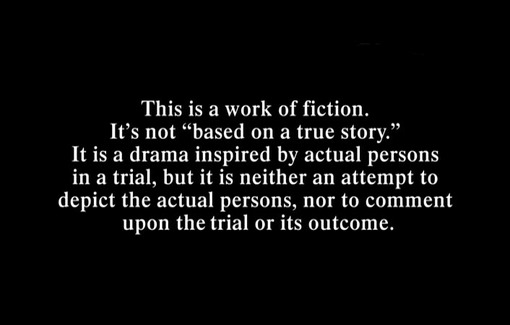
Would saying “this article is based on a true story” make you more likely to read it?

Is this because you are assured of reading something true to life, inspired by real events, or because it will shed light on a wider truth? Or did I use it as a marketing tool, knowing it would work?

The truth is that I wrote “this article is based on a true story” on a Post-It note with no idea of what I meant by writing it, or of what I would do with it. This sums up my feelings about this phrase: by itself, it means nothing, but it is used to ascribe worth to other things.

Two examples of stories “based on a true story”, when they are not, are Joel & Ethan Coen’s 1996 film “Fargo”, which infamously begins with a message saying it is a true story, but in reality is a fictional story based around a real murder; and “Saturday Night Fever”, a film based on a “New York” magazine article of which its writer, Nik Cohn, revealed twenty years later was a fictional story, but inspired by people he met. “Based on a true story” perhaps sounds more “official” than “inspired by true events”, because that could feasibly be used to describe the inspiration for any and all stories.

An article on MTV’s website from 2005 quotes Joel Cohen from a “Time Out” magazine interview, which I have been unable to find online, saying “if an audience believes that something's based on a real event, it gives you permission to do things they might otherwise not accept.” The MTV article, by Karl Heitmueller, talks about the veracity of “The Amityville Horror” series of films, real-life atrocities being the reliable sponge base for many horror film cakes.

Disclaimer for the HBO film "Phil Spector" (2013)

For me, verisimilitude has more importance. The average Batman comic book story could be completely fantastical, from the villains to the technology deployed and the way Gotham City is portrayed, but there are elements of truth or realism that make the more outlandish elements plausible. I think this is why, in terms of the fictional stories I read or watch, I can get along with “Blade Runner” more than “Lord of the Rings” – the former, especially through its city setting, has a more immediately familiar verisimilitude to me from real life, while the rich world-building of the latter, well, builds its own plausibility, rewarding the audience’s attention.

I don’t find myself watching a straight drama very often – that is, one not tinged by a genre, like science fiction. One was “Howzat! Kerry Packer’s War”, a 2012 Australian two-part mini-series about the commercial professional cricket tournament set up for a media mogul’s television network. The two characters that drew me the most into the story were TV executive Gavin Warner, who bore the pressure of making this outlandish idea work, and Packer’s personal assistant Rose, both reflecting and deflecting her employer’s monstrous personality. 

At the end of the second episode, I saw the cast explicitly listed them as “fictional character[s]”. At the time, I felt a little like I had wasted my time in watching scenes that did not happen, but I recognised this artistic license was needed for the story to work as a drama – a talking heads-style documentary, or even a docudrama, could give you the facts efficiently, but making an emotional connection requires a different approach. I did like the fact that the credits were honest - the creation of a fictional assassin in the 1932 MGM film "Rasputin and the Empress", and the defamation trial that followed, prompted the adoption of the famous disclaimer “The events and characters depicted in this photoplay are fictitious. Any similarity to actual persons, living or dead, is purely coincidental.”

In 2023, “Based on a True Story” was used to name a TV comedy series about an estate agent with a “true crime”-themed podcast, also named “Based on a True Story”. The success of this series may determine future (over-)usage of the phrase.

31 December 2023

WE WANT FUN AND YOU BETTER BELIEVE IT [429]


I may be restating this for myself, but I use the phrase “dancing with the gatekeepers” because I dreamed that I recorded an album titled “Leigh Spence is Dancing with the Gatekeepers”, singing “all they have are words” over and over again. My first article in 2016 defined “dancing with the gatekeepers” as “taking delight in the challenges life gives you, and having fun with those that think they have all the answers.”

I love that I wrote “have fun with”, rather than “make fun of”. Understanding Donald Trump’s assault on language, and on the general concept of “understanding”, in previous articles here was a more fun use of my time than simply insulting the man, despite having also called him “a man that makes gold look cheap, while looking and sounding like a drag queen version of his younger self”. All I have are words, and all he has are words, but Trump’s words are becoming more incendiary, and with his current run for President being described as an “openly authoritarian campaign”, those words can no longer be ignored, as much as I wish I could.

That has been the lesson of 2023 for me. I have ignored talking about anything remotely related to politics because it is not fun. Government infighting, culture wars, literal wars, ideological struggles, squabbles over the words used to identify ourselves, describing everything as “woke” – a word I haven’t discussed because it sounds more like a dog bark than a dog whistle, an easier word to throw than “political correctness” – and whether artificial intelligence could make everything meaningless anyway. Nothing works, nothing lasts, and nothing matters.

But all we have are words. That is the first lesson of 2024.

If words are incendiary, words can defuse them.

If words are cheap, then there’s enough to go around.

If words are meaningless, give them meaning, and avoid boiling the nature of meaning down to “because I said so”.

Ongoing wars, impending elections and competing agendas mean there is a lot at stake in 2024, and I can only be resilient amidst this precarity by remembering this world is also mine. If I ever record that album, I will sing “all they have are words” only then to say “all we have are words”. We are all in this together, so try to make fun with one another.

For me, the meaning of “dancing with the gatekeepers” remains the same – I think I just needed the reminder to have fun.

24 December 2023

I’LL BE THERE, FOLLOWING YOU AROUND [428]


We open on Eric Morecambe & Ernie Wise asleep in bed like Laurel & Hardy as Father Christmas comes down the chimney with a sack to steal the silverware. After the opening titles feature Morecambe’s trademark slaps of Wise’s cheeks between appearances of the show’s guests, their personal popularity is measured in sizes of commemorative tankards. Later, they will appear as bell-ringing monks, using candlesticks to pull pints of beer, and as turkeys ready for the yuletide chop, before dancing with actress Glenda Jackson like they were Fred Astaire & Ginger Rogers – the increasing size of Morecambe’s cane is done so deftly that the audience doesn’t notice the first time it’s done, but they do the others. They then spar with a very real-life authority, a conductor of a symphony orchestra who turns out to be as funny as they are.

I have always liked Morecambe & Wise – for my generation, they are the link between Laurel & Hardy and Reeves & Mortimer, all comedy double acts that were perfectly surreal, perfectly timed, and perfectly tuned. There is a line in the above episode, which was their Christmas special of 1971, where upon seeing the first tankard, Wise says “Great Scott”, to which Morecambe replies “He’s not in there is he? He’s everywhere else!” I don’t care that makes no sense, but the energy of the delivery made me laugh. 

I personally think this special may be the greatest hour of television ever made in the UK, but saying that is very subjective indeed, having also said it in May 2022. I used this Carlsbergian statement then to justify the extreme lengths made to save a 1968 episode of the show by using laser cutting and X-rays on a fused film reel. With the BBC run of “The Morecambe & Wise Show” from 1968 to 1977 being a milestone in both the comedy history of the UK, and of its cultural history, its Christmas specials often bringing literally half the population together, the effort to save one lost episode was rewarded.

With compilations of Morecambe & Wise sketches being prevalent on British television through the decades, along with memories of individual sketches, the power of the 1971 Christmas special lies in seeing how many of the duo’s classic sketches are from this one show, just as when you realise the episodes of “Fawlty Towers” about the fire alarm and the Germans are the same episode. This special has the “Grieg’s Piano Concerto by Grieg” with André Previn/Preview/Privet, Glenda Jackson's dance routine, and Shirley Bassey singing “Smoke Gets In Your Eyes” as her stuck shoe is replaced by a hobnail boot. The final sketch, Wise’s “play what I wrote” was “Robin Hood” featuring Francis Matthews, known to audiences as the radio voice of Paul Temple, and the TV voice of Captain Scarlet.

The 1971 Christmas special also saw the coalescing of the various changes made to “The Morecambe & Wise Show”. The first BBC series was much like the previous 1960s for ITV, staged sketches written by Sid Green & Dick Hills, with Ernie Wise very much the straight man to Eric Morecambe’s unpredictable and zany persona, successful in a few appearances in the United States on “The Ed Sullivan Show” but did not travel further. Eddie Braben was brought in by the BBC to write subsequent series, changing Wise’s persona to be a self-important writer and Morecambe’s close friend, as sketches and routines brought classical Hollywood spectacle and production values. Dance routines were choreographed by Ernest Maxin, producer of later episodes, and music was arranged for orchestra and conducted by Peter Knight, who later did the same for The Carpenters’ version of the song “Calling Occupants of Interplanetary Craft”.


“The Morecambe & Wise Show” would become the show to appear on if you were famous. BBC faces like Michael Parkinson, Frank Bough, Patrick Moore of “The Sky at Night” and newsreader Robert Dougall appear in the 1971 special were making other programmes elsewhere in BBC Television Centre, but Glenda Jackson’s appearance followed that of actors Peter Cushing and Edward Woodward. The 1973 Christmas special boasted Vanessa Redgrave and The New Seekers in the studio, and Yehudi Menuhin, Rudolf Nureyev and Laurence Olivier appearing in filmed insert jokes about why they couldn’t appear in person.

“The Morecambe & Wise Show” became the Rolls-Royce, or Lincoln Continental, of UK TV shows: parodies of “Opportunity Knocks” and “Mastermind” had their real hosts Hughie Green and Magnus Magnusson respectively appear, instead of Morecambe or Wise impersonating them, and their spin on routines from “South Pacific”, “Singin’ in the Rain” and other classical Hollywood musicals were eagerly awaited. 

But the epitome of these was Eddie Braben’s own favourite sketch from those he wrote for Eric & Ernie, from the 1971 Christmas special and featuring André Previn, then the principal conductor of the London Symphony Orchestra, being much more naturally funny than expected: “Thank you for that tremendous introduction, that doesn’t come out of my fee, doesn’t it?” Having been “tricked” into thinking he would conduct Yehudi Menuhin instead of Eric Morecambe, it shouldn’t have been surprising that an accomplished musician and conductor would have had good timing, saying “I’ll get my baton, it’s in Chicago” - Morecambe then seemingly breaks character, saying “Pow! He’s in. I like him.” With a full orchestra and Steinway piano, the piece reworks an earlier 1963 sketch with Previn taking the place of Ernie Wise as the exasperated conductor of a smaller band, Wise now acting as Morecambe’s support and mediator against a very real authority, making the grabbing of Previn’s lapels, and Morecambe’s line “I’m playing all the right notes, but not necessarily in the right order, I’ll give you that”, followed by the slap on Previn’s cheek, all the funnier. Seeing Morecambe’s own applause at the end of the sketch, you can see he is genuinely happy that the sketch has gone so well.

I didn’t need an excuse to write about Morecambe & Wise, or one of their Christmas specials, but people will keep returning to it, or discovering it anew, so we will continue to talk about it.

17 December 2023

HIGHWAY TO THE DANGER ZONE [427]

Cover of "The Art of Archer" book (2016)

September 2016 was the month my viewing habits changed: I bought a streaming device for my TV, and I began subscribing to Netflix. Initially an easier way to get YouTube onto a bigger screen, streaming made taking up Netflix inevitable, but for me, it was not for their own shows like “House of Cards” and “Orange is the New Black”, or for their Blockbuster Video-replacing back catalogue of recent films - it was because it was the only place in the UK to see the animated comedy series “Archer”. With the show now ending on its American home of FXX on 17
th December 2023, a date also marking the thirty-fourth anniversary of “The Simpsons”, a show that will outlast us all, I have reason to reconsider continuing my Netflix subscription.

First appearing in 2009, “Archer” is a retro-styled secret agent adventure series crossed with workplace comedy. Sterling Archer, an agent whose intuition is enhanced by womanising and alcohol, is an agent at ISIS, an agency owned and run by his similarly hard-nosed mother Malory. The ensemble originally had rigidly defined roles: Lana Kane, the by-the-book lead agent; Ray Gillette, the gay bomb expert with a transplanted hand; Cyril Figgis, the downtrodden head of accounts; Cheryl (or is Carol this episode?) Tunt, the secretary too rich and neurotic for this reality; Pam Poovey, the boisterous head of HR; and Algernop Krieger, the skilled engineer who built his holographic girlfriend. All have become agents over the show’s fourteen seasons, embroiled in plots and heists that have stretched and fleshed out these characters across different realities and time periods, particularly during three seasons that took place while Sterling was in a coma. It may wear the skin of a James Bond film, but it has the heart of “The A-Team.” 

What attracted me to “Archer” is what animation has afforded it. The retro aesthetic deliberately fudges the time period in which it is set, living in the world of both Sean Connery’s Bond and “Get Smart”, while not being restrained by technology of the time – something exists to help get out of any scrape. That said, there is the satisfaction of recognising the Apple Lisa computers on ISIS agents’ desks, or their building’s establishing shot having a Renault 12 driving past. The humour is very quick and often about language: characters warning each other over “phrasing”, exclamations like “yup”, “boop” and “sploosh”, and even outright saying “I swear to God I had something for this”. But every viewer of “Archer” knows the phrase most often repeated: “You want ants? Because this is how you get ants.” For stories where is victory is often achieved just in time, the pacing and comedic timing of each twenty-minute episode could not be achieved in live-action.

I originally saw “Archer” on Channel 5 in the UK, or one of their extra channels, but after the first four seasons, the show became available on Netflix only, feeling like when “The X-Files” or “Friends” previously disappeared to satellite television about fifteen years earlier. This move to streaming also stopped UK DVDs of the show in their tracks – this is another case of me wanting a copy of a show that is uninhibited by digital rights management. Maintaining access to the show requires maintaining a subscription to a service I rarely watched for anything else. Can The Criterion Collection start releasing TV shows as well please?