24 November 2019

EVERYONE SEEMS TO KNOW THE SCORE [208]


Please see below for the script I used:


Hello there. It shouldn’t need this much effort, but even a gigantic piece of technology can still tell me that two plus two is four.

So, this is the Sports Direct giant calculator. For those outside the UK, Sports Direct is a sporting goods and fashion retailer, towards the cheaper end of the market, but they are also the owners of sporting labels like Slazenger, Everlast and Lonsdale. They are also in the business of selling giant novelty items with their logo plastered on them, like mugs, bowls, and calculators. It cost me all of four pounds to buy, and the cashier smiled when I asked for one – they were on a peg behind her, so I couldn’t just reach over and take one. You can buy similar calculators without the logo, but it’s one more thing with “Sports Direct” on it, and that’s why it exists. Nothing else about this says “sport,” does it?

Despite the size this is still a calculator, working like any other... to a point. You’ll notice that there are no memory functions, but that isn’t unusual. I have an old Sharp calculator, made in 1974, that doesn’t have them either. If you really needed it, you could always just write the number down. However, one thing isn’t quite right. You can usually enter more numbers than the screen can handle, but still add, subtract, multiply or divide the number on screen. On the Sports Direct giant calculator, if you enter too many numbers, an error message happens, and you can’t do anything more. You have to reset, and start again. Remember, no more than twelve digits, and you’ll be fine.

The packaging says the calculator is designed for people with a visual impairment. Nice try. More seriously-minded solutions use braille, or an electronic voice to read the display, while most smartphones can use voice activation without using a single button. Larger machines include teaching aids made for overhead projectors, to display a calculator on a wall, and while you can buy giant scientific calculators that can display graphs, the price may give you pause.

What surprised me most about this is its build quality. How does something that only cost four pounds need twenty screws? An A4-sized calculator can’t need the circuit board the size of a PC motherboard? Trust me for owning a screwdriver.

(While I do that, I should mention that, if you are selling an old calculator on eBay, it’s all fine saying it comes from a smoke-free home, but please also say if you are a smoke-filled home. I opened up this old Canon calculator to clean it, and the circuit board stank! Was someone smoking through it or something?)

(Just to say, I’ve nearly finished.)

(Oh, sorry.)

I was not expecting a piece of cardboard but, taking it out, you can see how it shields the contacts, which are printed onto a piece of paper. These connect up to a tiny central circuit board, to which the screen, battery and solar panel are attached. There are more elegant versions of this – this Casio fx-100d, for example, attaches its single chip to a piece of plastic, and that’s pretty much it. On the other hand, it also does a few more things.

Thank you for watching. As ever, the nostalgia culture crisis continues at [www.leighspence.net], and I shall now screw this back together.

17 November 2019

WE’RE THE MASTERS OF SPACE [207]


As I write, the latest “Star Wars” trilogy is due to end, with “The Rise of Skywalker.” I was not stirred when watching the trailer at the cinema – it was the same tropes, characters and references, in a different order, with all the finality of a “Friday the 13th” film’s ending. Mind you, the unsettling experience of watching the feature, “Joker,” perked me back up, using its own bag of intellectual property to create a powerful psychological portrait. 


No wonder a “Star Wars” parody appeals to me – forcing yourself to be original by approaching your source material from a different direction. Even better, "Spaceballs" is not just a good parody of "Star Wars," but a credible science fiction film in its own right, after I forgot I was watching a parody.

In 1987, the original "Star Wars" trilogy had been complete for four years, giving the pre-internet general public, not just hardcore fans, enough time to soak in the references that Mel Brooks would work against. However, the home rental video market helped out, as shown when Rick Moranis' Darth Vader clone, Dark Helmet, finds out where Princess Vespa is by renting a copy of the film he is in, and fast forwarding to a later scene. "Spaceballs" itself lived on in home video form, becoming as much of a cult as "Star Wars" appears to most people.


"Spaceballs" is a welcome contrast from the cynical, tired retread of the source material that the "Laugh It Up, Fuzzball" trilogy from "Family Guy" was, with jokes inserted in a way that does not distinguish itself from any other "Family Guy" episode. Like "Blazing Saddles," "Young Frankenstein," and "High Anxiety," "Spaceballs" is a very Brooks-ian cross between a compendium of jokes, like "Airplane" and the then upcoming "Naked Gun" films, and a visually accurate parody. The production employed Apogee Inc., a visual effects company formed by ex-Industrial Light and Magic employees, lending credibility to all the pissing about going on around those effects, like Dark Helmet being surrounded by Assholes, the surname of the majority of the crew on his ship, and when a radar is jammed by launching a gigantic jar of jam at it.

The year 1987 also meant that "Spaceballs" was in a prime position to pick timely references from what turned out to be a golden period for Hollywood. Rick Moranis had already starred in "Ghostbusters," while Bull Pullman's Han Solo analogue, Lone Starr, is also suitably close to Indiana Jones. Like "Ghostbusters," "Spaceballs" also has its own cheesy tie-in song, when the ship Spaceball One, a very long ship first introduced in a very long shot, is about to self-destruct.

The most daring parody of "Star Wars" is how Mel Brooks, as Yogurt - no need for explanation there - and his "Ewoks" make their money from merchandising, an idea that rose from George Lucas requesting that, in allowing "Spaceballs" to be made, there would be no merchandising, as it would look too similar to the "real thing." "Spaceballs" merchandise, from bedspreads to toilet roll, is randomly seen throughout the rest of the film, including a scene where Dark Helmet plays action figures of himself and Princess Vespa. The turning of Spaceball One into a "mega-maid," to suck up the air that the Spaceballs need from Princess Vespa's home planet - a suitably mad sci-fi plot - prompts the timely line, "it's not just a spaceship, it's a Transformer."


Parody is very carefully detailed for maximum effect. The majestic theme by John Morris, minus the zapping sounds, could have been by John Williams, while the explanatory scrolling introduction is ended by a line that appears in the distance: "If you can read this, you don't need glasses." After a long exposition of the plot, Dark Helmet looks at the audience to ask, "everybody got that?" Instead of the main characters being captured by the "stormtroopers," their stunt doubles are caught by accident, and when one is zapped in the behind by a gun, his leap is accompanied by the "Wilhelm scream" that "Star Wars" sound editor Ben Burtt has shoehorned into every film he made. Even when it is not "Star Wars," the chest-bursting scene from "Alien" can only be properly parodied if you get someone that looks like John Hurt, so what you do is get the actual John Hurt, exclaiming, "Oh no, not again!"

The success of "Spaceballs" as a good a work of comedy and science-fiction can even be expressed in numbers. "Superman IV: The Quest for Peace," the final film with Christopher Reeve in the starring role, was released in Christmas 1987, with "Spaceballs" released earlier in the summer. However, what was intentionally a serious piece of work was let down by the woolly anti-nuclear plot, and the poor special effects caused by Cannon Films' financial troubles producing a reduced budget. "Superman IV" cost $17 million to make, while "Spaceballs" was Mel Brooks' most expensive film at $22.7 million, but with all the money on screen. The final box office results were $15.6 million for "Superman IV," and $38.1 million for "Spaceballs" - this is when taking comedy seriously has results.

10 November 2019

I SEE IT ALL, IT HAS NO GLORY [206]


“Deliberately scarifying and highly commercial shocker with little but its art direction to commend it to connoisseurs.”


With Halloween over, we are approaching that time to be thankful again and, for lovers of films, Christmas roots you to your sofa, with the biggest TV premières saved for the festive period. You may also be given a book or two as a present, a popular choice being books with curated, “definitive” lists, with titles like “1001 Movies You Must See Before You Die” – ironically, updated versions of that book come out each year, so anyone who saw a film displaced by new entries for the 2019 edition, like “Sorry to Bother You” and “The Favourite,” may have to reassess their options.

The above quote, for Ridley Scott’s original “Alien” (1979), came from “Halliwell’s Film Guide,” an originator of the annual film guides that forced their ways into homes each Christmas, from magazine publishers like “Radio Times, “Empire” and “Time Out,” and from critics like Leonard Maltin and Roger Ebert. Originally published in 1964, the last “Halliwell’s” edition came in 2008, long after Leslie Halliwell death in 1989, and after other authors took over to rewrite his original opinions – my copy of the 2008 edition kept the first half of Halliwell’s original “Alien” review but, diplomatically, stated the art direction was “on its own terms,” before deeming it a “classic,” which had already been decided elsewhere by then.

Leslie Halliwell was not a film critic, but more people depended on his verdicts than those from critics, because they often determined what films you could watch. Originally the manager of a cinema in Cambridge, and later a publicist for the Rank Organisation, his encyclopaedic knowledge of film made him indispensable in the growing television industry. In 1959, Halliwell joined Granada, a part of the ITV network that grew from a chain of cinemas. By 1964, his initial personal assistant job had been swapped for buying foreign programmes (read: United States) for Granada, and in 1968, Halliwell became the “Head Buyer” for the whole ITV network. For UK audiences, Halliwell is the reason you have really only seen the James Bond and Star Wars films on ITV, along with classic TV series like “Murder, She Wrote,” “The A-Team,” “The Incredible Hulk,” and “The Six Million Dollar Man,” cementing the good reputation of US TV by keeping the crap away.


When Channel 4 began in 1982, Halliwell also started buying up films and TV shows for them, helping to establish the channel as the place to go for more off-beat stuff, like “Raging Bull,” “Last Tango in Paris,” and “Hill Street Blues,” too offbeat to be shown on the mainstream ITV – in fact, the growth of TV movies and mini-series in the 1970s, like “Columbo,” was the new Hollywood’s answer to needing product that people like Halliwell could actually show to families in the early evening.

Read this way, Leslie Halliwell appears to be the Father Christmas of British television, influencing choices still made today, but some reviews in his guides, like his summary of “Alien,” are indicative of a snobbery that don’t work as helpful criticism – “abysmal apologia for loutish teenage behaviour” does not help you to decide whether “The Breakfast Club” or not, as it does not tell you enough what the film itself is like, while “a feast of hardware and noisy music; not much story,” does not tell you why people still watch “Top Gun.” In fact, my copy of the 2008 guide was solely to check cast and crew details, and awards won – the reviews were the least of it. Perhaps, the rewriting was to help make it more, well, helpful.

Since the last Halliwell’s guide was published, the reference books do appear to have been replaced by “definitive list” books, and by cloud-sourced websites like the Internet Movie Database (IMDB), Rotten Tomatoes and Wikipedia. No new guides from “Time Out,” “Empire” or “Total Film,” and while “Radio Times” published a guide for 2019, no 2020 edition has so far materialised. It seems the criticism of the films themselves has been replaced with making lists.

03 November 2019

AND SCREW YOUR WIG ON TIGHT [205]


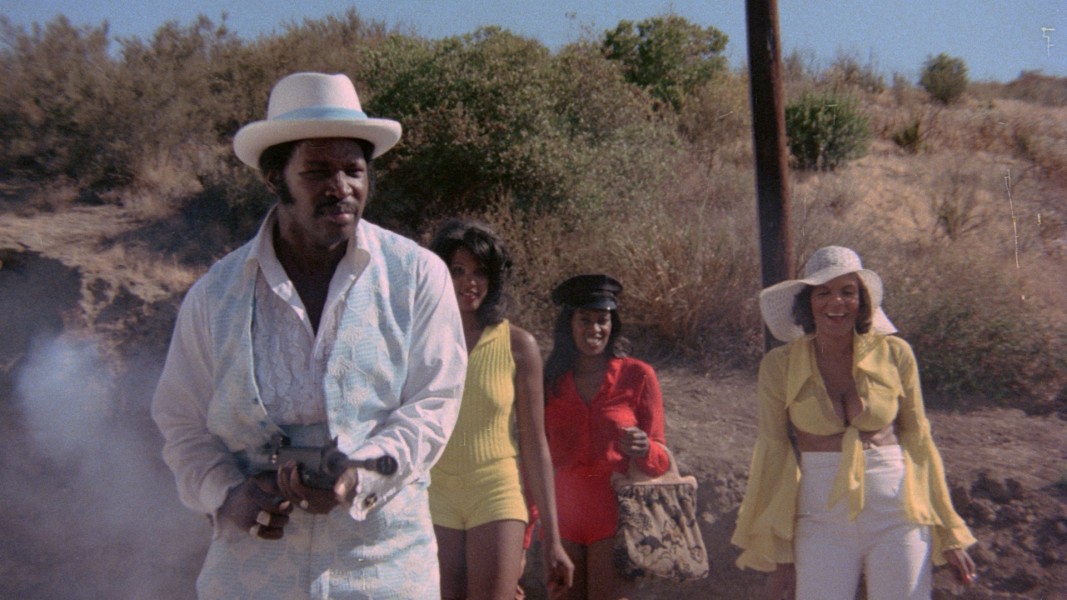
The story of enterprising and ribald comedian Rudy Ray Moore, and how he made the outrageous blaxploitation comedy “Dolemite,” is worth retelling for how Moore inhabited a character far larger than life and tastes could allow, recording explicit stand-up albums, leading to films, all forced into life by sheer force of Dolemite’s will, and Moore’s determination. “Dolemite” could never have been a studio project, but popular culture pierced itself on it very quickly once Moore made it himself. The Netflix comedy “Dolemite Is My Name,” stars Eddie Murphy as one of his heroes, with a script by the writers of Tim Burton’s film “Ed Wood,” in a passion project that took fifteen years to complete.

(How is this for six degrees of separation: Rudy Ray Moore starred in “Dolemite,” whose cinematographer, then U.C.L.A. film student Nicholas von Sternberg, was the son of director Josef von Sternberg, who directed Marlene Dietrich in “The Blue Angel” - Dietrich appeared in “Touch of Evil” with Orson Welles, who voiced Unicron in “Transformers: The Movie” alongside Roger Carmel, who appeared in “Myra Breckinridge,” a film less dignified than “Dolemite.”)

I saw “Dolemite Is My Name” and loved it, but the “Ed Wood” story made me wary of one thing. “Dolemite” is as scrappy and rough as its hero, but is also as charming. However, it is also known for a very notorious technical issue, namely the boom microphone wandering into shot from either the top or bottom of the frame. “Dolemite” is known almost as much for its boom mic as for Moore himself, but this is a very unfair slight on Nicholas von Sternberg’s skills as a cinematographer, because if you can see the boom mic at all (or, in a couple of shots, the operator holding the boom), you are not seeing the film as intended.


Much like the “Back to the Future” and “Jurassic Park” trilogies, “Titanic,” “Top Gun,” and many other Hollywood films, “Dolemite” was shot using the “open matte” process, by which you will shoot your film first, using the standard Academy ratio of 1.33:1, and make it widescreen later by blocking out the top and bottom of the frame. While “Dolemite” will have done this in 1974 to save the expense of anamorphic lenses, to squeeze a widescreen picture into the square film frame, open matte would be used in the 1980s and 1990s for when films were shown at home on old-style, non-widescreen televisions – instead of having a “letterboxed” picture, and instead of choosing what parts of the widescreen picture you could see (known as “pan and scan”), you could just show the original film without masking any of it. 

The advent of widescreen televisions did away with all of these problems, but open matte was also used to re-present films for different cinema experiences, like IMAX, but it explains TV shows shot on film, like “Friends,” “Seinfeld” and “Cheers,” are now available in widescreen after twenty to thirty years – this time, the picture is just being masked vertically, instead of horizontally. Meanwhile, I do remember grumbles some years ago about not being able to see all the picture on the “Back to the Future” Blu-Ray, in comparison with VHS, but as far as I can see, the version available is the correct one.

So, when “Dolemite” was first released for home video in the 1980s, it should really have been in a “pan and scan” version, and not full screen. There should not have been the opportunity to create drinking games from how often the boom mic could be seen, and while the film isn’t the best ever made, its reputation suffered from not being viewed on its own terms. “Dolemite” is now available on Blu-Ray, in a restored widescreen version – a full-screen “Boom Mic Edition” is an optional extra on the disc. 


27 October 2019

MAMA I’M SURE HARD TO HANDLE [204]


This is Part 3 of an apparent series about the 1970 film “Myra Breckinridge” – find part 1 here [link], and part 2 here [link]. In short, I think “Myra Breckinridge” is the worst film ever made because I needed it to be the best ever made, and it wasn’t – a statement I made so snappily in my notes, I didn’t realise I hadn’t used it in my first two thousand words on the subject. 

Having given myself time to recover, I can return to my study of “Myra Breckinridge” to discuss what happened next. To further understand my enemy, I have invested in my own copies of the sources of information that have most influenced the opinions made about the film, and one that even Gore Vidal’s original novel couldn’t do without. My intention is ultimately to refer to them when I eventually write the definitive book on “Myra Breckinridge” – I have already pointed out the rarity of a transgender film buff writing about a film whose protagonist is also a transgender film buff – but, in the meantime, I will share with you what they are, and what they say.

The best narrative account of the making of “Myra Breckinridge” is contained in the essay “Swinging Into Disaster,” by Steven Daly, published in the April 2001 issue of “Vanity Fair” magazine, and collected into the book “Vanity Fair’s Tales of Hollywood,” published by Penguin in 2008. There are interviews with the film’s writer and director, Michael Sarne, producers Richard Zanuck and David Brown, and with the film’s star, Raquel Welch – Gore Vidal responded in writing, Farah Fawcett declined to be involved, and others are reflected through narrative and anecdotes. The essay does a great job of centring its story on Sarne, his becoming director, and his influence in creating a notoriously chaotic production, people being fired left and right, and scripts rewritten every day. The decision to use archive pieces of Laurel & Hardy and Shirley Temple came during the editing process after the film was completed, not when it was being written. The ultimate outcome is that no-one came away from the film unscathed, either by it becoming a blot in John Huston’s filmography, or Raquel Welch not being properly recognised as a comic actress until four years later, in Richard Lester’s “The Three Musketeers.” Sarne clearly had scores to settle, as later proved in his DVD commentary in 2004, in contrast to Welch’s bemusement on her own.

The film critic Rex Reed, playing the pre-transition Myron Breckinridge in a white suit, like an episode of “Randall and Hopkirk (Deceased)” is often quoted in saying that, of “Myra Breckinridge,” “on this movie, everybody’s asking, ‘Who do you have to screw to get out of it?’” This comes from “Myra Goes Hollywood,” an essay for the August 1970 issue of “Playboy” magazine. Yes, I really did buy a copy of “Playboy” for the articles and, for the time, it reads like “The New Yorker” with soft-core pornography leavened into the mix. The advertisements are for alcohol, tobacco, and British Leyland – their page 3 pin-up is the MGB GT. The purpose of the article is for Reed to provide a more authoritative contemporary account of the chaotic production than the leaks could have suggested, played out as mostly juicy gossip, but the most telling part is how Reed details his agreeing to play  Myron, based on having script approval for his role – his not interested in playing a gay man who has a sex change, his eventual role as “a sort of carnal Jiminy Cricket to Raquel’s erotic Pinocchio” ultimately resulted from working around his demands. Reed does not state why he even agreed to be in the film, apart from making some reference to how critics should take the opportunity to learn the technical side of making a film.

The writing of the film critic Parker Tyler looms large in Myra Breckinridge’s mind, as she waxes lyrical about Hollywood dealing in myths, and in exclaiming that, “during the decade between 1935 and 1945, no unimportant film was made in the United States.” Parker’s 1947 book “Magic and Myth of the Movies,” a seminal work that applies psychoanalysis to then-recent films like “Mildred Pierce,” “Double Indemnity” and “The Seventh Veil,” at a time when films were only just doing that themselves, for example in Alfred Hitchcock’s “Spellbound” (1945). However, the glow of the screen does better for Parker than the real life it reflects upon, and Myra also basks in that glow, as the new Hollywood of the 60s produces less effectual role models. 


Tyler initially complained that “Myra Breckinridge,” both the novel and film, defamed him and his work, but the attention led “Magic and Myth of the Movies” to be republished in 1971. My copy of the British reissue, with Rita Hayworth on the front cover, also features a new foreword by Tyler, where he deals with the ambiguous nature of the tribute the story gives him, as his ideas are even dropped by Myra upon the novel’s end.

Finally, the February 1971 issue of the British journal “Films and Filming” has an article by Michael Sarne, returning to the magazine for which he used to write reviews, titled “For Love of Myra.” Sarne plays the production as an affair between himself and the character of Myra. Photographic evidence was provided, also on the cover of the magazine, to prove Sarne did try to find a male actor to play both Myra and Myron, before opting for the baggage of Rex Reed. Sarne labelling his affair as “the ultimate love-hate relationship, the Lord Byron and Caroline Lamb of the ‘sixties, perhaps all that remains of our affair will be the things they say about us.” For certain, that is all Sarne has, as Myra returned in Gore Vidal’s sequel novel “Myron.”  

20 October 2019

WHEN YOU TELL ME WHAT WILL BE [203]


I don’t like being given opportunities to feel old, especially as I am still in my thirties, but the inevitability of progress in technology, working against my human stubbornness to adapt to a new way of working, will provide more situations to reflect on where that progress leaves you.


What am I talking about? It’s more that I don’t expect my devices to talk back at me, mainly because I turned off their ability to talk. Even more, I have turned off their ability to evaluate my commands.

Before I make myself sound even more paranoid, this is based on the principle of knowing that, if I want something, I will ask for it. I will not say “Alexa...” or “Hey Siri,” “Hey Google,” “Hey Cortana” – I’m not really a “hey” kind of person – and expect the artificial intelligence based on previous interactions to throw up what it thinks is the right answer, or what is the first answer, or the answer most accessed by others. 

The only virtual assistant I do use is Siri, on my Apple TV box, purely to speak the name or title I want to search on YouTube, Vimeo or the BBC iPlayer, an expediency over just typing it, which is the final resort when it doesn’t accept how I’ve pronounced a vowel.


While the debate over the application of virtual assistants is currently focussed on the microphone – your voice being recorded and analysed, even when you are not using it – my concern is on its ability to act as a bridge in human thought, making evaluations over the answer it thinks I will need, without informing me on how it came to that decision. There is an implication of trust on my part, which turns into a lack of trust in practice.

If so, why am I happy using a search engine like Google? Is it the trust gained over twenty years of usage, that virtual assistants need to demonstrate? (Siri, the oldest of them, began in 2011.) Is it having a screen to view the answers of the search engine providing the illusion of choice? Is it that the algorithms that influence the search results are more well-known? (For Google, PageRank evaluates the links to pages, and between pages, Panda promotes higher-quality sites, while Hummingbird emphasises natural writing over forced keywords – how am I doing so far?)

Perhaps, I am still looking at virtual assistants as being in their infancy, as having pretensions over previous voice-activated units that acted as glorified hands-free switches. It comes back to trust over the answers I would expect them to give, if I tried to use them. I just need something to explain how they came to their decisions, like a screen, and something to choose and edit the answer, like a keyboard.


13 October 2019

I’M GIVING UP ON TRYING TO SELL YOU THINGS THAT YOU AIN’T BUYING [202]


A direct link to the video is here:

Below is the script for the video: 

Hello there, this is Leigh Spence is Dancing with the Gatekeepers, I’m Leigh Spence, and this is Fratton Road, one of the main shopping streets in Portsmouth, on a rainy, windy morning in October 2019 - my umbrella had already broken by this point. It was quite early, and most shops hadn’t opened yet. This video will look around a shopping mall I made a video about two years ago, mostly because I kept getting requests to film an update, and because people like watching videos about dead malls over videos about calculators. 

Incidentally, my video about the INTERESTING HP-12C calculator is available on this channel.

Fratton Road is receiving money from a Government fund to revitalise high streets, provide better transport links, and find new uses for vacant buildings. However, I don’t see much of a future for the former Troxy cinema, a building so derelict that the porthole windows have been filled in with deckchairs.

Anyway, in July 2017, I made a video about The Bridge Shopping Centre, a mall I knew was pretty empty, left acting as a, well, bridge, between Fratton Road and the giant Asda supermarket. And when I say giant, I do mean giant. A Co-Op department store used to stand on this site, before the Co-Op replaced it with a more modern supermarket and shopping mall, opening in 1989. Asda took over both in 2001. I really do like this travelling shot, so I’ll just keep it going a bit longer.

Asda continue to own The Bridge, but apart from it acting as another entrance for themselves, the feeling I got two years ago was that the mall was done, the bigger brands having moved on, or gone out of business themselves. Sure, some stores were left, but even they couldn’t last much longer. I wish they would put back the neon sign they used to have outside.

Here is some of the original video I shot two years ago. According to the foundation stone, this mall was built back when people still made time capsules.

I believe the pet shop closed about a year later. Fashion stores that used to be on the left-hand side were Select, New Look and Ethel Austin. The jewellery store has seemingly always been here. You will find I like the red tiling and glass roof in this place, very Eighties indeed. The Savers chain of budget health stores is owned by Superdrug, and that store used to be a Superdrug. The flickering light suggests some level of decline, but the place was still kept clean. This central platform was used as seating for the café, last known as Rebecca’s Pantry. When the Co-Op was here they also had a travel agent and a shoe shop, Shoefayre, in the mall. You do get the feeling that, if the café had remained open, this place wouldn’t feel half as dead. I don’t know why I didn’t go through these barriers, only myself was there to stop me. And there is the entrance to Asda.

Back to October 2019, and not much has changed outside, apart from the weather. There is a new tenant on the right, Cubano Beach Club, which hosts children’s birthday parties and other events.

Making my way across the road, I see a new games arcade, including virtual reality and escape rooms, both growing areas at the moment. The pet shop has a replacement too. Like I said, I wish they would put the neon back.

The automatic doors have obviously seen me coming today. I’m still coming in... and in we go. There isn’t much difference to begin, except for more signs. The time capsule is obviously still there. If you want to rent this space, ring the number on your screen. They were playing music in here two years ago, but I’ve never heard it this loud – perhaps they’ve bought new speakers. The jewellers, will always be there. Ethel Austin closed down in 2006, by the way.

Now this is something I wish happened more often – using vacant store space for showing art works, like this former New Look store. This one here is provided by the Aspex gallery in Portsmouth, and was made by an established artist along with local residents. Here is display on the store front, and you can visit the gallery’s website for more information.

Savers and Iceland will always be here, by the looks of things. This former charity shop is now being used to sell home brewing kits. They’ve also fixed the light. The travel agent is now a beauty store – “People will stare, make it worth their while.” And, crucially, the café is back open, which gave the mall its atmosphere back, and is enticing more businesses to set up here again. The former Asda photo store is now operated by Max Spielmann, with a Timpsons sharing the space. An Olan Mills studio once operated in the mall, if anyone remembers them. Asda have also opened an opticians next to the post office.

Yes, there is still space to fill, but there is more hope now than there was two years ago. It’s a good place to come in, not least to keep you out of the rain. Give it another two years, and The Bridge may have left its dead mall past far behind.

Thank you for watching. As ever, the nostalgia culture crisis continues at [www.leighspence.net].